As Samsung Electronics' labor union has announced a strike for next month, academic warnings have emerged that the resulting damage could extend beyond tens of trillions of won to irreversible damage to trust and supply chains.
The argument is that a strike amidst a semiconductor supercycle could not only lead to unprecedented large-scale damage but also escalate into more critical and structural blows such as customer attrition, supply chain realignment, and loss of market leadership.
 Song Heon-jae, Professor of Economics at the University of Seoul, giving a presentation [Provided by Anmin Policy Forum]
According to industry sources on the 26th, Professor Song Heon-jae of the Economics Department at the University of Seoul presented these projections at a recent seminar hosted by the Anmin Policy Forum, under the theme 'The Ripple Effects of the Samsung Electronics Union Strike.'
The Anmin Policy Forum is a private policy research forum chaired by former Deputy Prime Minister and Minister of Economy and Finance, Yoo Il-ho.
Professor Song estimated that if the Samsung Electronics union strike materializes, the losses from factory operations would amount to several billion won per minute and around one trillion won per day.
He projected that if the strike were to be prolonged, operating profit from the semiconductor division alone could decrease by up to 10 trillion won.
More importantly, analyses suggest that the real risks lie not in the direct losses from the strike, but in customer anxiety, departure of business partners, and pressure for supply chain realignment.
Professor Song pointed out, "Global big tech clients may start considering alternative suppliers like TSMC to diversify risks," and added, "Given the semiconductor industry's nature where verifying processes requires immense cost and time, customers who leave once are difficult to win back."
Indeed, AMD is incorporating supply chain resilience into its ESG (Environmental, Social, and Governance) evaluation criteria, and Nvidia directly links supplier evaluation results from quarterly and semi-annual periods to volume allocation.
With major clients strictly scrutinizing supply stability in this manner, concerns are rising that production disruptions due to a strike could immediately lead to a loss of global leading position.
Professor Song categorized strike costs into 'visible costs' such as production stoppages and decreased sales, and 'invisible costs' like weakened trust, delayed investments, and shocks to the industrial ecosystem, emphasizing that the latter could be more long-term and detrimental.
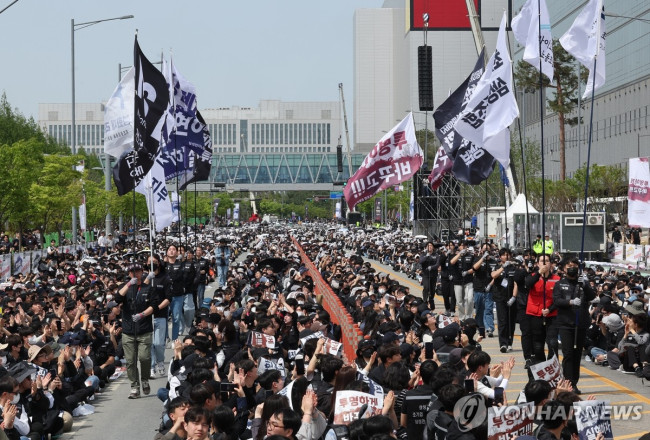 Samsung Electronics Union Struggle Rally, flags entering [Yonhap News]
Specifically, he identified five key 'invisible costs': the erosion of trust assets, permanent market loss due to switching costs, loss of opportunity cost during the artificial intelligence (AI) semiconductor hegemony race, the departure of key talent, and the deepening of the Korea discount.
Professor Song stated, "Semiconductor technology loses competitiveness after just one to two years of falling behind," and noted, "While Nvidia, TSMC, and Intel are in a life-or-death competition for AI semiconductor hegemony, consuming resources to resolve internal conflicts is itself a massive opportunity cost."
Recently, Taiwanese media also reported that if Samsung Electronics' production disruptions materialize, Taiwanese semiconductor companies would benefit and gain leverage in price negotiations.
A strike at Samsung Electronics could also negatively impact the entire industrial ecosystem, which consists of 1,764 material, component, and equipment (SMC) suppliers.
The Pyeongtaek campus, for instance, is known to create approximately 30,000 jobs, including those from suppliers, per production line. Therefore, a shutdown could lead to direct blows to this large employment base and the local economy.
Professor Song analyzed the opacity of performance bonus calculation standards and information asymmetry as the background of the current conflict.
He further explained the current situation using the 'Hicks Paradox,' where labor and management, despite knowing that a strike is detrimental to all, reach an inefficient equilibrium through the process of hiding or exaggerating each other's information.
Consequently, he proposed six solutions: public disclosure of performance compensation standards; reform of the compensation system based on objective management indicators such as ROIC (Return on Invested Capital), TSR (Total Shareholder Return), and EVA (Economic Value Added); differential distribution based on profit segments; introduction of cap (upper limit), floor (lower limit), and clawback (repayment) mechanisms; introduction of external verification and arbitration mechanisms; and institutionalization of pre-strike adjustment procedures (cooling-off periods).

 Iranian Foreign Ministry: "Continuing Message Exchanges with the U.S. and Activities of Mediating Countries"
Esmaeil Baghaei, Spokesperson for the Iranian Ministry of Foreign Affairs [Xinhua, Yonhap News file photo]Esmaeil Baghaei, spokesperson for the Iranian Ministry of Foreign Affairs, stated on the 26th
Iranian Foreign Ministry: "Continuing Message Exchanges with the U.S. and Activities of Mediating Countries"
Esmaeil Baghaei, Spokesperson for the Iranian Ministry of Foreign Affairs [Xinhua, Yonhap News file photo]Esmaeil Baghaei, spokesperson for the Iranian Ministry of Foreign Affairs, stated on the 26th
 President Yoon: "Do You Think You Are Safe from the Special Counsel?"... Final Statement Video Released
President Yoon Suk Yeol rebuking the special prosecutor on the 24th. [Court video / @birds_justice X account subtitle GIF] A video of President Yoon Suk Yeol's closing statement at his trial rega
President Yoon: "Do You Think You Are Safe from the Special Counsel?"... Final Statement Video Released
President Yoon Suk Yeol rebuking the special prosecutor on the 24th. [Court video / @birds_justice X account subtitle GIF] A video of President Yoon Suk Yeol's closing statement at his trial rega
 President Yoon, regarding the first-instance ruling on the Public Official Election Act: “An excessive political verdict that distorts the facts… We will appeal immediately.”
The first-instance sentencing hearing for President Yoon Suk Yeol regarding violations of the Public Official Election Act is being broadcast live at Seoul Station on the 27th. [Photo=Yonhap News]Pres
President Yoon, regarding the first-instance ruling on the Public Official Election Act: “An excessive political verdict that distorts the facts… We will appeal immediately.”
The first-instance sentencing hearing for President Yoon Suk Yeol regarding violations of the Public Official Election Act is being broadcast live at Seoul Station on the 27th. [Photo=Yonhap News]Pres
 WSJ: "SK Hynix ADR Premium Is a Sign of AI Trading Overheat"
Advertisement for SK Hynix ADR listing in New York's Times Square [Reuters=Yonhap News file photo]The Wall Street Journal (WSJ) has pointed out that the price of SK Hynix’s American Depositary Recei
WSJ: "SK Hynix ADR Premium Is a Sign of AI Trading Overheat"
Advertisement for SK Hynix ADR listing in New York's Times Square [Reuters=Yonhap News file photo]The Wall Street Journal (WSJ) has pointed out that the price of SK Hynix’s American Depositary Recei
 'Godfather of Japanese Mystery Novels' Keigo Higashino Passes Away After Battle with Cancer at 68
Famous Japanese mystery novelist Keigo Higashino [AFP=Yonhap News]It has been belatedly reported that Keigo Higashino, the "godfather of Japanese mystery novels" and author of bestsellers such as "The
'Godfather of Japanese Mystery Novels' Keigo Higashino Passes Away After Battle with Cancer at 68
Famous Japanese mystery novelist Keigo Higashino [AFP=Yonhap News]It has been belatedly reported that Keigo Higashino, the "godfather of Japanese mystery novels" and author of bestsellers such as "The
 [Park Pil-kyu Security Column] To the Ignorant Trying to Clothe a Beast in Sheep's Clothing
Rep. Kim Byung-joo of the Democratic Party of Korea [Photo=Yonhap News]“The Air Force Academy doesn't teach you how to fly a plane!” “The Army, Navy, and Air Force academies are exactly the
[Park Pil-kyu Security Column] To the Ignorant Trying to Clothe a Beast in Sheep's Clothing
Rep. Kim Byung-joo of the Democratic Party of Korea [Photo=Yonhap News]“The Air Force Academy doesn't teach you how to fly a plane!” “The Army, Navy, and Air Force academies are exactly the
 [Issue Diagnosis] Two Effects of the Election Petition Review
 [Photo] Evidence of Election Fraud Flooding U.S. Media… Trump Had 2.7 Million Votes Stolen
 [Video] U.S. Semiquincentennial Air Show... 'Art in the Sky' streaks across New York
 [Editorial Cartoon] A Draconian Law That Undermines Freedom of Expression

 List
List









