 ROK-US joint exercise [Yonhap News]
The government is attempting to quell controversy by stating its intention to actively communicate with the United States to resolve issues such as the limitations on sharing North Korea-related intelligence and the Coupang problem, which have sparked speculation about strains in ROK-US relations.
However, there are views that the government may face limitations in persuading the U.S. due to significant differences in positions between the two countries on key issues, and the entanglement of various pending matters in diplomacy, security, and trade.
At a briefing on the 28th, Ministry of Foreign Affairs spokesperson Park Il stated regarding the various pending issues between South Korea and the U.S. that "We are coordinating what needs to be coordinated, and we are faithfully explaining our position on areas where there are differences of opinion," adding, "There are no issues with our cooperation on North Korea policy with the U.S."
A government official, speaking anonymously to the press on the same day, said, "Although the intelligence that the U.S. has been providing to us is partially restricted, we are carrying out reconnaissance and surveillance tasks without disruption by actively utilizing our own satellite assets."
These remarks are interpreted as an attempt to pacify the speculation about ROK-US relations and concerns about weakened deterrence against North Korea, which arose after it became known that the U.S. had restricted the sharing of intelligence, citing the issue of Unification Minister Jeong Dong-young's remarks about a "uranium enrichment facility in North Korea."
Currently, ROK-US relations appear to be characterized by more friction than cooperation, as key agenda items agreed upon by President Lee Jae-myung and U.S. President Donald Trump during their summit in October last year are not being properly pursued or are being questioned by the U.S.
The government is continuing dialogues with the U.S. to resolve the issue of restricted intelligence sharing, with Blue House National Security Strategy Secretary Cho Hyun-woo visiting Washington D.C. last week, but there has been no news of the sharing being restored yet.
Most importantly, the implementation of diplomatic and security agreements, such as the construction of nuclear-powered submarines, uranium enrichment, and reprocessing of spent nuclear fuel, which the government secured in return for a $350 billion investment in the U.S., is not proceeding smoothly.
While the government wishes to swiftly implement these agreements before the political uncertainties escalate in the latter half of President Trump's term, it is understood that a U.S. delegation to discuss these pending issues has not yet scheduled a visit to South Korea.
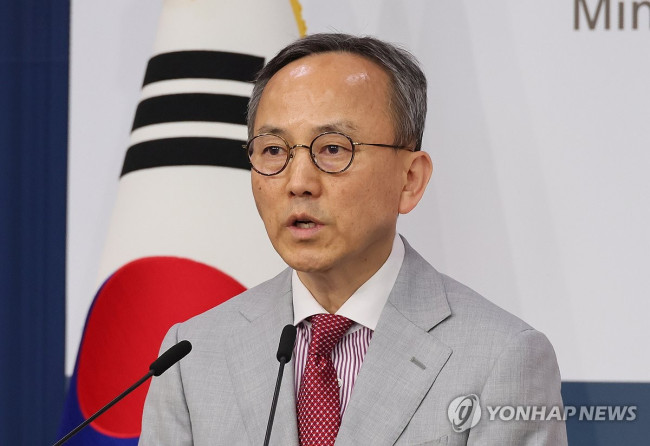 Ministry of Foreign Affairs Spokesperson Park Il giving a regular briefing [Yonhap News]
While the current Trump administration is preoccupied with the war in Iran and lacks the capacity to focus on consultations with South Korea, foreign affairs authorities reportedly believe that the primary reason for the delay in diplomatic and security consultations is the slow pace of South Korea's investment implementation, which falls short of U.S. expectations.
The U.S. has consistently urged the selection and prompt execution of investment projects in the U.S., and the fact that Japan has already announced its first project in February and its second project in March is also putting pressure on the South Korean government.
After being surprised by President Trump's threat of a "tariff hike" in January, South Korea has been working to quickly pass a special law on investment in the U.S. in the National Assembly and has been consulting with the U.S. on project selection. However, the first project has not yet been announced.
The South Korean government is approaching the matter more cautiously than the U.S. due to the enormous amount of investment and the need to ensure commercial rationality.
South Korea wants the implementation of diplomatic and security agreements, while the U.S. wants the implementation of trade agreements, making it difficult for the two countries to align their steps.
Furthermore, although the issue of intelligence sharing regarding North Korea has recently emerged, there are analyses suggesting that the U.S. has come to view South Korea's sincerity as an ally more negatively due to accumulated disagreements concerning aerial training exercises by U.S. Forces Korea over the Yellow Sea and ROK-U.S.-Japan aerial drills.
It is suggested that the U.S. desires South Korea to clearly position itself and provide support in containing China, its primary competitor in the Indo-Pacific region, and may be dissatisfied with South Korea's ambiguous stance.
Professor Park Won-gon of Ewha Womans University stated, "The government needs to clarify its position on what the U.S. wants. We are intentionally being ambiguous now, and while cooperation is possible up to this point, we need to communicate more transparently or state that we cannot do the rest."
 Coupang headquarters [Yonhap News]
Amidst this, the Coupang issue is also negatively impacting diplomatic and security consultations, as the U.S. administration and Congress continue to raise concerns about the South Korean government's response to Coupang's large-scale data leak.
The South Korean government maintains that its actions regarding Coupang are in accordance with domestic law and due process, and are not discriminatory against U.S. companies as the U.S. claims.
The problem is that despite the government explaining this position to the U.S. for several months, not only has it failed to persuade them, but on the 21st, as many as 54 Republican House members sent a letter to Ambassador Kang Kyung-wha in Washington D.C. demanding an end to discrimination against U.S. companies like Coupang.
In response, some are evaluating whether the government's diplomatic capabilities are being overshadowed by Coupang's lobbying power.
The government reportedly recognizes the need to strengthen communication, understanding that there is a perception within the administration, beyond what the government anticipated, that the Coupang issue is being viewed very seriously, in addition to the congressional criticism that has been publicly raised.
A foreign ministry official stated to reporters on the same day, "We are consulting with the U.S. with the basic principle that the Coupang issue should not negatively impact security negotiations."
The U.S. Trade Representative's (USTR) expression of dissatisfaction on the 27th regarding South Korea's network usage fee policy also highlights the difference in perception between South Korea and the U.S.
In a joint press release announcing the summit results in November last year, both South Korea and the U.S. promised to "ensure that U.S. companies are not discriminated against or face unnecessary barriers" regarding digital regulations such as network usage fees. However, there are significant differences in the interpretation of this promise.
The South Korean government's position is that there is no discrimination as digital regulations are applied equally to companies from all countries, not just the U.S. However, the U.S. has opposed the pursuit of digital regulations that would affect U.S. companies.
In this situation, the government is promoting a stance of resolving issues such as the restriction on sharing intelligence on North Korea through negotiations with the U.S. on equal footing as much as possible.
President Lee Jae-myung stated at a Cabinet meeting today regarding cooperative relations with traditional allies, "We need the wisdom to build a healthy and future-oriented relationship by resolving pending issues based on mutual respect, common sense, and principles," adding, "I will focus on diplomacy that builds genuine friendship with our allies with the confident posture of a sovereign nation."

 Trump pressures for rate cut again ahead of FOMC... "Should be the lowest in the world"
U.S. President Donald Trump. [Photo = The White House] U.S. President Donald Trump once again pressured the Federal Reserve, the U.S. central bank, to lower interest rates on the 27th (local time
Trump pressures for rate cut again ahead of FOMC... "Should be the lowest in the world"
U.S. President Donald Trump. [Photo = The White House] U.S. President Donald Trump once again pressured the Federal Reserve, the U.S. central bank, to lower interest rates on the 27th (local time
 “Ignoring crisp ballots and damaged seals”… Tongyeong mayoral recount concludes with ‘no change in outcome,’ leaving suspicions and public outrage behind
Suspected counterfeit ballots discovered in Tongyeong [GIF from social media of Representative Hwang Kyo-ahn / Attorney Park Joo-hyun]During a recount of the Tongyeong mayoral election in South Gyeong
“Ignoring crisp ballots and damaged seals”… Tongyeong mayoral recount concludes with ‘no change in outcome,’ leaving suspicions and public outrage behind
Suspected counterfeit ballots discovered in Tongyeong [GIF from social media of Representative Hwang Kyo-ahn / Attorney Park Joo-hyun]During a recount of the Tongyeong mayoral election in South Gyeong
 President Yoon, regarding the first-instance ruling on the Public Official Election Act: “An excessive political verdict that distorts the facts… We will appeal immediately.”
The first-instance sentencing hearing for President Yoon Suk Yeol regarding violations of the Public Official Election Act is being broadcast live at Seoul Station on the 27th. [Photo=Yonhap News]Pres
President Yoon, regarding the first-instance ruling on the Public Official Election Act: “An excessive political verdict that distorts the facts… We will appeal immediately.”
The first-instance sentencing hearing for President Yoon Suk Yeol regarding violations of the Public Official Election Act is being broadcast live at Seoul Station on the 27th. [Photo=Yonhap News]Pres
 WSJ: "SK Hynix ADR Premium Is a Sign of AI Trading Overheat"
Advertisement for SK Hynix ADR listing in New York's Times Square [Reuters=Yonhap News file photo]The Wall Street Journal (WSJ) has pointed out that the price of SK Hynix’s American Depositary Recei
WSJ: "SK Hynix ADR Premium Is a Sign of AI Trading Overheat"
Advertisement for SK Hynix ADR listing in New York's Times Square [Reuters=Yonhap News file photo]The Wall Street Journal (WSJ) has pointed out that the price of SK Hynix’s American Depositary Recei
 'Godfather of Japanese Mystery Novels' Keigo Higashino Passes Away After Battle with Cancer at 68
Famous Japanese mystery novelist Keigo Higashino [AFP=Yonhap News]It has been belatedly reported that Keigo Higashino, the "godfather of Japanese mystery novels" and author of bestsellers such as "The
'Godfather of Japanese Mystery Novels' Keigo Higashino Passes Away After Battle with Cancer at 68
Famous Japanese mystery novelist Keigo Higashino [AFP=Yonhap News]It has been belatedly reported that Keigo Higashino, the "godfather of Japanese mystery novels" and author of bestsellers such as "The
 [Park Pil-kyu Security Column] To the Ignorant Trying to Clothe a Beast in Sheep's Clothing
Rep. Kim Byung-joo of the Democratic Party of Korea [Photo=Yonhap News]“The Air Force Academy doesn't teach you how to fly a plane!” “The Army, Navy, and Air Force academies are exactly the
[Park Pil-kyu Security Column] To the Ignorant Trying to Clothe a Beast in Sheep's Clothing
Rep. Kim Byung-joo of the Democratic Party of Korea [Photo=Yonhap News]“The Air Force Academy doesn't teach you how to fly a plane!” “The Army, Navy, and Air Force academies are exactly the
 [Issue Diagnosis] Two Effects of the Election Petition Review
 [Photo] Evidence of Election Fraud Flooding U.S. Media… Trump Had 2.7 Million Votes Stolen
 [Video] U.S. Semiquincentennial Air Show... 'Art in the Sky' streaks across New York
 [Editorial Cartoon] A Draconian Law That Undermines Freedom of Expression

 List
List










