 Iranians shopping in a market in Tehran, Iran [EPA=Yonhap News]
Diagnosis suggests the Iranian economy is falling into a deep pit due to prolonged economic sanctions and an unending war.
According to the Wall Street Journal (WSJ) on the 28th (local time), approximately 1 million people in Iran have lost their jobs due to the war, with an additional 1 million unemployed due to the indirect impact of the conflict. Considering Iran's working population of 25 million, this is an enormous scale.
Prices have skyrocketed, with the annual inflation rate reaching 67% as of mid-April, compared to the same period last year.
Iran had been importing numerous food items, pharmaceuticals, and raw materials through the Strait of Hormuz, but the war has blocked the import of various goods. Furthermore, with numerous manufacturers and retailers halting operations, it has become difficult for Iranians to easily obtain essential supplies.
The consumer price of red meat, a representative imported food item, has now surged to $3.6 per pound (approximately 5,300 won). This is an unaffordable level for Iranians whose monthly minimum wage is $130.
The cost of war damage recovery is also expected to be a drag on the Iranian economy in the future.
The scale of damage to roads, ports, and residential facilities destroyed by airstrikes from the United States and Israel is still difficult to accurately estimate. Iranian state media reports that the cost of post-war reconstruction could reach approximately $270 billion. Considering Iran's gross domestic product (GDP) of $341 billion last year, this is a massive amount that cannot be easily managed independently.
The Iranian regime claims that the suffering will end soon once the US lifts sanctions and the global market stabilizes, and is mobilizing all available measures, including raising minimum wages, increasing public sector salaries, subsidizing essential goods, and providing cash payments.
They are also desperately working to secure alternative trade routes to break through the blocked import channels. Iranian parliamentarian Ebrahim Najafi recently stated in the Iranian parliament that they are importing goods through rail networks connected to Turkey, Armenia, and Azerbaijan along their northern border, and via the Caspian Sea to the north.
According to data from ship-tracking firm Kpler, at least 11 vessels departing from Russia, Kazakhstan, and Turkmenistan have arrived at northern Iranian Caspian Sea ports since the US imposed maritime sanctions on Iran. These ships were laden with grain, corn, and sunflower oil.
Experts predict that Iran's economic collapse, which began before the war and has become uncontrollably severe due to the conflict, could potentially become a factor of regime instability once again.
Javad Salehi-Isfahani, a professor of economics at Virginia Tech, stated, "The Iranian government sees the end of the war as the beginning of a new set of challenges in dealing with a population plunged into disappointment and poverty."
Conversely, there are also arguments that Iranians, accustomed to prolonged economic downturns, will endure the current situation.
Mohamed Arsi, a member of the Global Advisory Board at the Wilson Center, a US think tank, commented, "The Iranian people will suffer," but added, "However, they also have a high threshold for enduring pain."
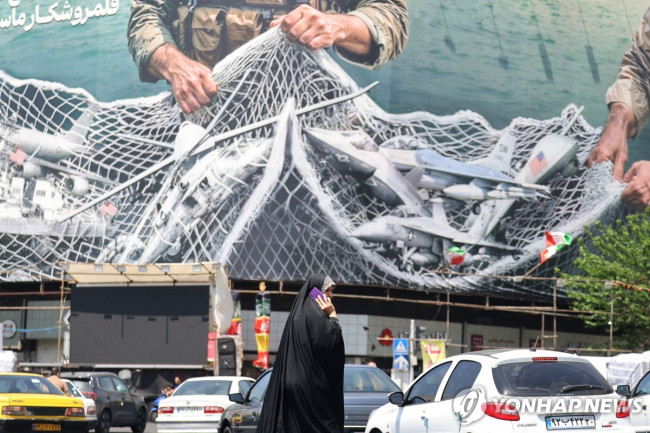 A woman walks past propaganda posters on a street in Tehran, Iran [AFP=Yonhap News]

 Iranian Foreign Ministry: "Continuing Message Exchanges with the U.S. and Activities of Mediating Countries"
Esmaeil Baghaei, Spokesperson for the Iranian Ministry of Foreign Affairs [Xinhua, Yonhap News file photo]Esmaeil Baghaei, spokesperson for the Iranian Ministry of Foreign Affairs, stated on the 26th
Iranian Foreign Ministry: "Continuing Message Exchanges with the U.S. and Activities of Mediating Countries"
Esmaeil Baghaei, Spokesperson for the Iranian Ministry of Foreign Affairs [Xinhua, Yonhap News file photo]Esmaeil Baghaei, spokesperson for the Iranian Ministry of Foreign Affairs, stated on the 26th
 President Yoon: "Do You Think You Are Safe from the Special Counsel?"... Final Statement Video Released
President Yoon Suk Yeol rebuking the special prosecutor on the 24th. [Court video / @birds_justice X account subtitle GIF] A video of President Yoon Suk Yeol's closing statement at his trial rega
President Yoon: "Do You Think You Are Safe from the Special Counsel?"... Final Statement Video Released
President Yoon Suk Yeol rebuking the special prosecutor on the 24th. [Court video / @birds_justice X account subtitle GIF] A video of President Yoon Suk Yeol's closing statement at his trial rega
 President Yoon, regarding the first-instance ruling on the Public Official Election Act: “An excessive political verdict that distorts the facts… We will appeal immediately.”
The first-instance sentencing hearing for President Yoon Suk Yeol regarding violations of the Public Official Election Act is being broadcast live at Seoul Station on the 27th. [Photo=Yonhap News]Pres
President Yoon, regarding the first-instance ruling on the Public Official Election Act: “An excessive political verdict that distorts the facts… We will appeal immediately.”
The first-instance sentencing hearing for President Yoon Suk Yeol regarding violations of the Public Official Election Act is being broadcast live at Seoul Station on the 27th. [Photo=Yonhap News]Pres
 WSJ: "SK Hynix ADR Premium Is a Sign of AI Trading Overheat"
Advertisement for SK Hynix ADR listing in New York's Times Square [Reuters=Yonhap News file photo]The Wall Street Journal (WSJ) has pointed out that the price of SK Hynix’s American Depositary Recei
WSJ: "SK Hynix ADR Premium Is a Sign of AI Trading Overheat"
Advertisement for SK Hynix ADR listing in New York's Times Square [Reuters=Yonhap News file photo]The Wall Street Journal (WSJ) has pointed out that the price of SK Hynix’s American Depositary Recei
 'Godfather of Japanese Mystery Novels' Keigo Higashino Passes Away After Battle with Cancer at 68
Famous Japanese mystery novelist Keigo Higashino [AFP=Yonhap News]It has been belatedly reported that Keigo Higashino, the "godfather of Japanese mystery novels" and author of bestsellers such as "The
'Godfather of Japanese Mystery Novels' Keigo Higashino Passes Away After Battle with Cancer at 68
Famous Japanese mystery novelist Keigo Higashino [AFP=Yonhap News]It has been belatedly reported that Keigo Higashino, the "godfather of Japanese mystery novels" and author of bestsellers such as "The
 [Park Pil-kyu Security Column] To the Ignorant Trying to Clothe a Beast in Sheep's Clothing
Rep. Kim Byung-joo of the Democratic Party of Korea [Photo=Yonhap News]“The Air Force Academy doesn't teach you how to fly a plane!” “The Army, Navy, and Air Force academies are exactly the
[Park Pil-kyu Security Column] To the Ignorant Trying to Clothe a Beast in Sheep's Clothing
Rep. Kim Byung-joo of the Democratic Party of Korea [Photo=Yonhap News]“The Air Force Academy doesn't teach you how to fly a plane!” “The Army, Navy, and Air Force academies are exactly the
 [Issue Diagnosis] Two Effects of the Election Petition Review
 [Photo] Evidence of Election Fraud Flooding U.S. Media… Trump Had 2.7 Million Votes Stolen
 [Video] U.S. Semiquincentennial Air Show... 'Art in the Sky' streaks across New York
 [Editorial Cartoon] A Draconian Law That Undermines Freedom of Expression

 List
List










