 Oil tanker in the Strait of Hormuz (not directly related to the article) [AP Yonhap News]
An oil tanker owned by Japan passed through the Strait of Hormuz with permission from Iranian authorities, Iran's state-run Press TV reported on the 28th (local time).
According to the report, the very large crude carrier (VLCC) Idemitsu Maruho, flying the flag of Panama and owned by a Japanese company, departed from the Gulf region (Persian Gulf) this morning carrying 2 million barrels of crude oil and exited the Strait of Hormuz.
The oil tanker, operated by a subsidiary of Japanese oil refiner Idemitsu Kosan, loaded crude oil at the Juaymah terminal in Saudi Arabia early last month, anchored in the Gulf region, and then began its voyage late in the afternoon of the 27th local time.
According to a ship tracking website, the vessel navigated a route close to Qeshm Island and Larak Island, designated as a 'safe passage' by Iranian authorities, and as of 11:40 PM Korean time on the 28th, it was sailing in the international waters of the Gulf of Oman.
Nikkei, citing information from the Automatic Identification System (AIS) on the 29th, stated that the oil tanker's destination appeared to be Nagoya Port in Japan, and it is expected to arrive in Japan around mid-next month, as the journey from the Persian Gulf to Japan takes approximately 20 days.
An official from Idemitsu Kosan told Japanese media that they could not comment on the transportation situation for the safety of the vessel.
Press TV reported that the oil tanker had received permission from Iranian authorities but did not mention whether any so-called 'tolls' were paid.
Nikkei and Asahi Shimbun reported, citing a high-ranking Japanese government official, that no tolls were paid for passage through the strait.
The official told Nikkei that the Idemitsu Maruho's passage through the Strait of Hormuz after 62 days was "the result of negotiations by the Japanese government."
In this regard, Sanae Takaichi, a Japanese minister, posted on her X (formerly Twitter) account on the afternoon of the 29th, stating, "I have confirmed that one Japanese-related vessel has safely passed through the Strait of Hormuz and is sailing towards Japan," and added, "Three Japanese crew members are aboard."
She continued, "We have consistently taken a stance that it is important to promptly secure free and safe navigation in the Strait of Hormuz for vessels of all countries, including Japan, and have communicated this position to Iran. I have also conveyed this to President Masoud Pezeshkian," and "The Japanese government views this vessel's passage as a positive development."
She added, "We will continue to request Iran to ensure that vessels of all countries, including other Japanese-related ships, can pass through the Strait of Hormuz freely and safely."
The Iranian Embassy in Japan suggested on X early this morning that the historical friendly relations between Iran and Japan had influenced the passage of the Idemitsu Maruho through the Strait of Hormuz.
The Iranian Embassy in Japan mentioned the Nissho Maru incident in 1953.
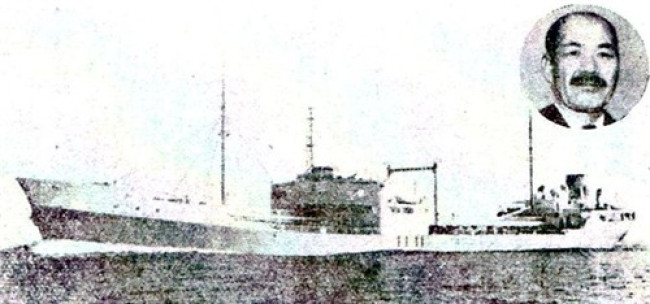 Photo of the Nissho Maru posted on X by the Iranian Embassy in Japan [X capture]
The Nissho Maru was an oil tanker that Japan used to secretly import Iranian oil at a time when Iran was isolated internationally due to measures such as the nationalization of oil facilities. Japan's dispatch of the Nissho Maru proved that Iran could break through international blockades.
The Nissho Maru, like the Idemitsu Maru, was owned by Idemitsu Kosan.
The Iranian Embassy in Japan wrote about the Nissho Maru incident, "This is a testament to the long friendship between our two countries, and this legacy holds great significance even today."
While three Japanese-related vessels passed through the Strait of Hormuz earlier this month, they were all liquefied natural gas (LNG) carriers, and this is the first oil tanker.
Japanese media have speculated that it is currently unclear whether approximately 40 other Japanese-related ships stranded in the Strait of Hormuz will be able to exit the strait.

 Iranian Foreign Ministry: "Continuing Message Exchanges with the U.S. and Activities of Mediating Countries"
Esmaeil Baghaei, Spokesperson for the Iranian Ministry of Foreign Affairs [Xinhua, Yonhap News file photo]Esmaeil Baghaei, spokesperson for the Iranian Ministry of Foreign Affairs, stated on the 26th
Iranian Foreign Ministry: "Continuing Message Exchanges with the U.S. and Activities of Mediating Countries"
Esmaeil Baghaei, Spokesperson for the Iranian Ministry of Foreign Affairs [Xinhua, Yonhap News file photo]Esmaeil Baghaei, spokesperson for the Iranian Ministry of Foreign Affairs, stated on the 26th
 President Yoon: "Do You Think You Are Safe from the Special Counsel?"... Final Statement Video Released
President Yoon Suk Yeol rebuking the special prosecutor on the 24th. [Court video / @birds_justice X account subtitle GIF] A video of President Yoon Suk Yeol's closing statement at his trial rega
President Yoon: "Do You Think You Are Safe from the Special Counsel?"... Final Statement Video Released
President Yoon Suk Yeol rebuking the special prosecutor on the 24th. [Court video / @birds_justice X account subtitle GIF] A video of President Yoon Suk Yeol's closing statement at his trial rega
 President Yoon, regarding the first-instance ruling on the Public Official Election Act: “An excessive political verdict that distorts the facts… We will appeal immediately.”
The first-instance sentencing hearing for President Yoon Suk Yeol regarding violations of the Public Official Election Act is being broadcast live at Seoul Station on the 27th. [Photo=Yonhap News]Pres
President Yoon, regarding the first-instance ruling on the Public Official Election Act: “An excessive political verdict that distorts the facts… We will appeal immediately.”
The first-instance sentencing hearing for President Yoon Suk Yeol regarding violations of the Public Official Election Act is being broadcast live at Seoul Station on the 27th. [Photo=Yonhap News]Pres
 WSJ: "SK Hynix ADR Premium Is a Sign of AI Trading Overheat"
Advertisement for SK Hynix ADR listing in New York's Times Square [Reuters=Yonhap News file photo]The Wall Street Journal (WSJ) has pointed out that the price of SK Hynix’s American Depositary Recei
WSJ: "SK Hynix ADR Premium Is a Sign of AI Trading Overheat"
Advertisement for SK Hynix ADR listing in New York's Times Square [Reuters=Yonhap News file photo]The Wall Street Journal (WSJ) has pointed out that the price of SK Hynix’s American Depositary Recei
 'Godfather of Japanese Mystery Novels' Keigo Higashino Passes Away After Battle with Cancer at 68
Famous Japanese mystery novelist Keigo Higashino [AFP=Yonhap News]It has been belatedly reported that Keigo Higashino, the "godfather of Japanese mystery novels" and author of bestsellers such as "The
'Godfather of Japanese Mystery Novels' Keigo Higashino Passes Away After Battle with Cancer at 68
Famous Japanese mystery novelist Keigo Higashino [AFP=Yonhap News]It has been belatedly reported that Keigo Higashino, the "godfather of Japanese mystery novels" and author of bestsellers such as "The
 [Park Pil-kyu Security Column] To the Ignorant Trying to Clothe a Beast in Sheep's Clothing
Rep. Kim Byung-joo of the Democratic Party of Korea [Photo=Yonhap News]“The Air Force Academy doesn't teach you how to fly a plane!” “The Army, Navy, and Air Force academies are exactly the
[Park Pil-kyu Security Column] To the Ignorant Trying to Clothe a Beast in Sheep's Clothing
Rep. Kim Byung-joo of the Democratic Party of Korea [Photo=Yonhap News]“The Air Force Academy doesn't teach you how to fly a plane!” “The Army, Navy, and Air Force academies are exactly the
 [Issue Diagnosis] Two Effects of the Election Petition Review
 [Photo] Evidence of Election Fraud Flooding U.S. Media… Trump Had 2.7 Million Votes Stolen
 [Video] U.S. Semiquincentennial Air Show... 'Art in the Sky' streaks across New York
 [Editorial Cartoon] A Draconian Law That Undermines Freedom of Expression

 List
List









