Amidst the ongoing tug-of-war between the United States and China ahead of U.S. President Donald Trump's visit to China scheduled for the 14th-15th of next month (local time), assessments suggest that the U.S. is attempting to pressure China with semiconductor and crude oil as leverage.
In response, China is strengthening its control over rare earths, its "counter-attack weapon," and how the Taiwan issue will be handled at the summit is also a point of interest.
Hong Kong media South China Morning Post (SCMP) reported on the 30th that while the U.S. is intensifying pressure on China in various sectors, China is unlikely to be swayed as it has already reduced its dependence on the U.S.
 Chinese Semiconductors (PG) [Yonhap News]
◇ U.S. Restricts Equipment Exports to China's HUA HONG SEMICONDUCTOR... 'Hindering AI Chip Development'
It is reported that the U.S. has recently targeted HUA HONG SEMICONDUCTOR, China's second-largest foundry (contract chip manufacturer), by restricting equipment exports to slow down HUA HONG's artificial intelligence (AI) chip development.
Reuters reported on the 28th, citing multiple sources, that the U.S. Department of Commerce has ordered its semiconductor equipment companies, such as Lam Research, not to send specific equipment to two of HUA HONG SEMICONDUCTOR's advanced manufacturing facilities.
SCMP also reported that the U.S. House Foreign Affairs Committee has advanced 20 new export control measures this month to prevent China's access to advanced technology and advanced semiconductor manufacturing equipment.
These include restrictions on the sale of advanced semiconductor equipment to China and calls for allies such as the Netherlands and Japan to align more closely with the U.S.
Chinese experts criticized these moves as political maneuvers in interviews with state media outlet Global Times.
Zhou Mi, a researcher at the Chinese Academy of International Trade and Economic Cooperation, called it trade protectionism, but questioned whether the U.S. could achieve its regulatory goals given the rapid growth of China's semiconductor industry.
Indeed, DeepSee, a Chinese startup that shocked the U.S. AI industry backed by massive capital by releasing a "cost-effective" AI model early last year, is now touting its collaboration with Huawei's AI chips instead of U.S. Nvidia for its recently released new model V4.
The issue of Iranian crude oil flowing into China could also become a U.S. pressure card following the outbreak of war between the U.S., Israel, and Iran.
The U.S. Department of the Treasury's Office of Foreign Assets Control (OFAC) issued an "advisory" on its website on the 28th, prohibiting transactions with small private refiners (teapots) in Shandong Province, China, which purchase most of Iran's crude oil, and stating that foreign entities engaging in such activities could be subject to sanctions.
China purchases about 90% of Iran's crude oil exports, and most of these are traded through these small private refiners, according to OFAC.
Chinese-speaking region experts believe that China or Iran will not stop crude oil trade due to sanctions concerns, and view the U.S. Treasury's announcement as an attempt to solicit support for the war by directly involving China.
There are also observations that China has sufficient strategic reserves, and Dai Houliang, chairman of China National Petroleum Corporation (CNPC), China's largest oil and gas company, emphasized on the same day that all efforts would be made to prevent domestic supply shortages.
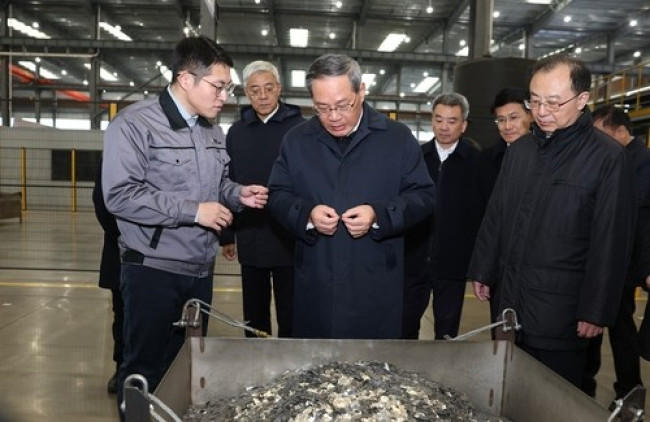 Chinese Premier Li Qiang visits a company in Jiangxi Province, China [Xinhua News Agency Capture]
◇ China Strengthens Control from Rare Earth Mining to Distribution
On the other hand, China is also raising the level of control over its "counter-attack card," the rare earth industry.
China's Ministry of Industry and Information Technology released the "Draft List of Administrative Penalties According to Rare Earth Management Regulations" on its website on the 28th.
This establishes penalty standards for violations in all processes of rare earth mining, smelting, and distribution, indicating a clear intention to manage rare earths as a national strategic asset.
Bloomberg News reported that "rare earth dominance provides China with strong bargaining power ahead of the U.S.-China summit," and that the U.S. economy, valued at $1.4 trillion (approximately 2 quadrillion won), is related to industries that use rare earths.
Meanwhile, Reuters reported that China will make Taiwan the top agenda item at the upcoming U.S.-China summit. This is because Chinese President Xi Jinping has made it clear that Taiwan will be the top agenda item.
This contrasts with the U.S.-China summit held at the end of October last year, the first since President Trump's re-election, where the Taiwan issue was not discussed.
There are concerns in Taiwan that the Trump administration, unlike the previous Biden administration, may approach the Taiwan issue from a "give-and-take" negotiation perspective. This is because President Trump may make concessions regarding Taiwan during trade negotiations with China.
There have also been reports that China has pressured the U.S. to go beyond stating that it "does not support" Taiwan's independence and instead "oppose" it.
Wu Xinbo, director of the Center for International Studies at Fudan University, stated, "The logic regarding the Taiwan issue is simple. If the U.S. does not want to go to major war with China over the Taiwan issue, it should not support Taiwan's independence," and added, "President Trump is not interested in a war with China."

 Iranian Foreign Ministry: "Continuing Message Exchanges with the U.S. and Activities of Mediating Countries"
Esmaeil Baghaei, Spokesperson for the Iranian Ministry of Foreign Affairs [Xinhua, Yonhap News file photo]Esmaeil Baghaei, spokesperson for the Iranian Ministry of Foreign Affairs, stated on the 26th
Iranian Foreign Ministry: "Continuing Message Exchanges with the U.S. and Activities of Mediating Countries"
Esmaeil Baghaei, Spokesperson for the Iranian Ministry of Foreign Affairs [Xinhua, Yonhap News file photo]Esmaeil Baghaei, spokesperson for the Iranian Ministry of Foreign Affairs, stated on the 26th
 President Yoon: "Do You Think You Are Safe from the Special Counsel?"... Final Statement Video Released
President Yoon Suk Yeol rebuking the special prosecutor on the 24th. [Court video / @birds_justice X account subtitle GIF] A video of President Yoon Suk Yeol's closing statement at his trial rega
President Yoon: "Do You Think You Are Safe from the Special Counsel?"... Final Statement Video Released
President Yoon Suk Yeol rebuking the special prosecutor on the 24th. [Court video / @birds_justice X account subtitle GIF] A video of President Yoon Suk Yeol's closing statement at his trial rega
 President Yoon, regarding the first-instance ruling on the Public Official Election Act: “An excessive political verdict that distorts the facts… We will appeal immediately.”
The first-instance sentencing hearing for President Yoon Suk Yeol regarding violations of the Public Official Election Act is being broadcast live at Seoul Station on the 27th. [Photo=Yonhap News]Pres
President Yoon, regarding the first-instance ruling on the Public Official Election Act: “An excessive political verdict that distorts the facts… We will appeal immediately.”
The first-instance sentencing hearing for President Yoon Suk Yeol regarding violations of the Public Official Election Act is being broadcast live at Seoul Station on the 27th. [Photo=Yonhap News]Pres
 WSJ: "SK Hynix ADR Premium Is a Sign of AI Trading Overheat"
Advertisement for SK Hynix ADR listing in New York's Times Square [Reuters=Yonhap News file photo]The Wall Street Journal (WSJ) has pointed out that the price of SK Hynix’s American Depositary Recei
WSJ: "SK Hynix ADR Premium Is a Sign of AI Trading Overheat"
Advertisement for SK Hynix ADR listing in New York's Times Square [Reuters=Yonhap News file photo]The Wall Street Journal (WSJ) has pointed out that the price of SK Hynix’s American Depositary Recei
 'Godfather of Japanese Mystery Novels' Keigo Higashino Passes Away After Battle with Cancer at 68
Famous Japanese mystery novelist Keigo Higashino [AFP=Yonhap News]It has been belatedly reported that Keigo Higashino, the "godfather of Japanese mystery novels" and author of bestsellers such as "The
'Godfather of Japanese Mystery Novels' Keigo Higashino Passes Away After Battle with Cancer at 68
Famous Japanese mystery novelist Keigo Higashino [AFP=Yonhap News]It has been belatedly reported that Keigo Higashino, the "godfather of Japanese mystery novels" and author of bestsellers such as "The
 [Park Pil-kyu Security Column] To the Ignorant Trying to Clothe a Beast in Sheep's Clothing
Rep. Kim Byung-joo of the Democratic Party of Korea [Photo=Yonhap News]“The Air Force Academy doesn't teach you how to fly a plane!” “The Army, Navy, and Air Force academies are exactly the
[Park Pil-kyu Security Column] To the Ignorant Trying to Clothe a Beast in Sheep's Clothing
Rep. Kim Byung-joo of the Democratic Party of Korea [Photo=Yonhap News]“The Air Force Academy doesn't teach you how to fly a plane!” “The Army, Navy, and Air Force academies are exactly the
 [Issue Diagnosis] Two Effects of the Election Petition Review
 [Photo] Evidence of Election Fraud Flooding U.S. Media… Trump Had 2.7 Million Votes Stolen
 [Video] U.S. Semiquincentennial Air Show... 'Art in the Sky' streaks across New York
 [Editorial Cartoon] A Draconian Law That Undermines Freedom of Expression

 List
List









