 The Constitutional Court of Korea. [Yonhap News Photo]
A conflict has reignited between the Constitutional Court and the Supreme Court over the selection of the first case for the court's review, which involves a Supreme Court decision to dismiss an appeal without further deliberation.
Previously, the Supreme Court opposed the introduction of the Constitutional Court's review system, arguing that it would create a "fourth instance" of trial, leading to prolonged and repeated litigation that would weaken national competitiveness. This opposition stems from the Constitutional Court's decision to examine cases dismissed by the Supreme Court without deliberation, a process often criticized as a "10-second trial."
While some predict that the full court will focus on the legality of the operation of the deliberation-without-proceeding system rather than the system itself, legal circles view it as a deliberate choice of a case that is bound to create tension with the Supreme Court from the outset.
According to legal circles on the 2nd, the Constitutional Court referred to its full court a case filed by GC Biopharma seeking the cancellation of a fine imposed for alleged bid-rigging in vaccine procurement.
This case was the first to pass preliminary review and proceed to full deliberation among the 525 cases received since the implementation of the review system on March 12th until the 27th of last month.
GC Biopharma filed an administrative lawsuit to cancel a fine of approximately 2 billion won imposed by the Fair Trade Commission for bid-rigging in vaccine procurement, but lost the case at the Seoul High Court in October last year.
Although GC Biopharma appealed, the Supreme Court finalized the ruling in February of this year by dismissing the appeal without deliberation.
GC Biopharma argued that its right to seek a trial was infringed because the Supreme Court dismissed its appeal without deliberation, despite its acquittal in the related criminal case, creating a discrepancy between the administrative lawsuit ruling and the criminal case outcome.
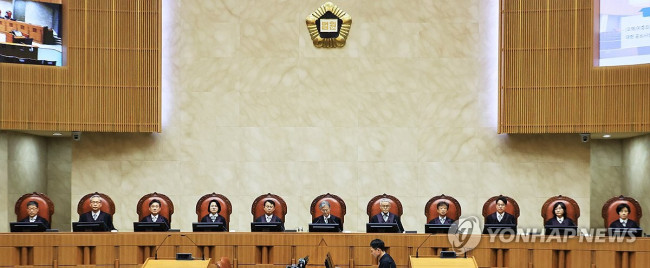 Supreme Court en banc ruling [Yonhap News]
The deliberation-without-proceeding system, introduced in 1994, allows the Supreme Court to dismiss an appeal without further deliberation in cases other than criminal matters, if there is no significant violation of laws or regulations in the appellate court's ruling.
Its purpose is to filter out the abuse of appeals in a system where appeals are virtually unlimited, and to enable the Supreme Court to efficiently perform its function of reviewing legal matters.
Currently, about 70% of civil, family, and administrative cases are finalized through dismissal of appeals without deliberation.
However, litigants have expressed dissatisfaction, as their cases are concluded without a full hearing up to the appellate stage, and the reasons for the dismissal are not stated in the ruling.
The Constitutional Court, however, has consistently upheld the constitutionality of the deliberation-without-proceeding system in constitutional complaints arguing that it infringes upon the right to seek a trial.
The reasoning is that the right to seek a trial does not guarantee the right to receive an appellate trial in all cases, and the deliberation-without-proceeding system prioritizes the "uniformity of legal interpretation" over "relief for individual cases" (as per decision 2006HunMa551, etc.).
The court also ruled that requiring more than a statement that "it does not constitute grounds for proceeding with deliberation" in the ruling would impose an unnecessary burden on the appellate court, thereby contradicting the legislative intent.
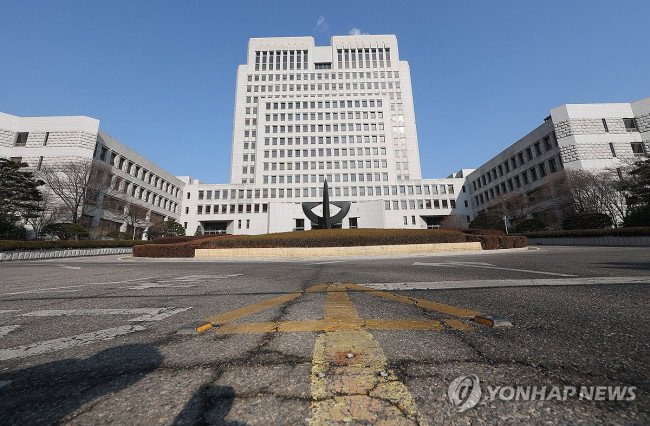 Review Court Bill Passes Legal Subcommittee... What's the Supreme Court's Situation? [Yonhap News]
In the current case, the key issue is whether the Constitutional Court will rule on the specific operational methods of the deliberation-without-proceeding system, rather than the system itself, and to what extent it will set the boundaries if it does.
Kim Jin-han, a lawyer who previously served as a Constitutional Research Officer (Law Firm Kelas Hankyul), stated, "Even if a system is constitutional, it should not be abused, so the Constitutional Court may draw a line by saying, 'There are these limitations.'"
He added, "The Supreme Court itself is aware of the problems with deliberation without proceeding, but it's difficult to change the reality, so it feels like an 'Achilles' heel.' The fact that the Constitutional Court selected a case that the courts would find most sensitive as its first case can be seen as quite courageous."
Noh Hee-beom, a lawyer also a former Constitutional Research Officer, predicted, "It seems likely that guidelines will be established for when deliberation without proceeding is possible and when it is not. There is a possibility that the number of dismissals without deliberation will significantly decrease in the future."
It is predicted that the tension between the Constitutional Court and the Supreme Court could escalate if the Constitutional Court appears to be encroaching on the Supreme Court's authority.
Jang Young-soo, Emeritus Professor at Korea University School of Law, commented, "It is difficult for the Constitutional Court to say that the system itself is wrong, and it will examine the issues of individual rulings, but we need to carefully observe where that boundary lies. If the Constitutional Court goes too far, the conflict with the Supreme Court could intensify."
A former Supreme Court Justice stated, "Given that deliberation without proceeding is unavoidable in the current structure, it will be difficult for the Constitutional Court to touch the system itself. They will rule on this specific case, but the Constitutional Court also bears a risk."
 What's the Situation at the Supreme Court? [Yonhap News]
Reactions are divided regarding the ruling in GC Biopharma's administrative lawsuit itself.
Lee Woo-yeol, a lawyer representing GC Biopharma (Law Firm Yulchon), argued, "Under the Supreme Court Act, if the original ruling contradicts the Supreme Court's precedent, an appeal cannot be dismissed without deliberation. In this case, the Supreme Court acquitted the defendant in the criminal trial, stating that 'restraint of competition is not recognized,' which is contrary to the appellate ruling in the administrative lawsuit. Therefore, there are grounds for the Supreme Court to hear the case."
Conversely, a presiding judge at a metropolitan court emphasized, "In administrative and civil cases, the party with slightly more evidence wins, but in criminal cases, the decision is made in favor of the defendant if there is doubt. Therefore, the conclusions in administrative and criminal cases can be significantly different."
This implies that it is difficult to argue that the dismissal of an appeal without deliberation is not permissible simply because the conclusion in a civil or administrative case differs from the conclusion in a criminal case.
Within the judiciary, there are concerns that the designation of the first case by the Constitutional Court might be a realization of existing fears that the review system could devolve into a "fourth instance" of trial or be used as a "tool for the powerful."
This is because, among hundreds of cases rejected during preliminary review by the Constitutional Court over the past month and a half, the case represented by Yulchon, a large law firm, was selected for full court deliberation.
A legal professional commented, "Ultimately, the first case selected, which even challenges the deliberation-without-proceeding system, involves a multi-billion won bid-rigging case handled by a large law firm. Isn't this far from the protection of fundamental rights for the powerless?"
There is also a view that to determine whether an issue constitutes grounds for appeal, one must examine the legal interpretation of the original ruling, thus essentially conducting a legal review.
Meanwhile, conflicts between the Constitutional Court and the Supreme Court have repeatedly occurred over the ultimate authority to interpret the law.
Constitutional adjudication was alternately handled by the Constitutional Committee and the Supreme Court from 1948 until the current Constitution was established in 1987, leading to the creation of the Constitutional Court.
Article 15 of the Constitutional Court Act stipulates, "The treatment and remuneration of the President of the Constitutional Court shall follow the example of the Chief Justice of the Supreme Court, and the Justices shall be appointed as political appointees with their treatment and remuneration following the example of the Justices of the Supreme Court."
The fact that the Chief Justice of the Supreme Court and the President of the Constitutional Court, as well as Supreme Court Justices and Constitutional Court Justices, receive equivalent treatment is based on this provision.
The problem lies in the fact that this provision treats the two institutions as equal, leading to repeated conflicts due to overlapping roles and incomplete division of labor.
In this context, the ongoing tension between the two institutions surrounding the introduction of the review system has surfaced, triggered by the selection of the first case.

 Iranian Foreign Ministry: "Continuing Message Exchanges with the U.S. and Activities of Mediating Countries"
Esmaeil Baghaei, Spokesperson for the Iranian Ministry of Foreign Affairs [Xinhua, Yonhap News file photo]Esmaeil Baghaei, spokesperson for the Iranian Ministry of Foreign Affairs, stated on the 26th
Iranian Foreign Ministry: "Continuing Message Exchanges with the U.S. and Activities of Mediating Countries"
Esmaeil Baghaei, Spokesperson for the Iranian Ministry of Foreign Affairs [Xinhua, Yonhap News file photo]Esmaeil Baghaei, spokesperson for the Iranian Ministry of Foreign Affairs, stated on the 26th
 President Yoon: "Do You Think You Are Safe from the Special Counsel?"... Final Statement Video Released
President Yoon Suk Yeol rebuking the special prosecutor on the 24th. [Court video / @birds_justice X account subtitle GIF] A video of President Yoon Suk Yeol's closing statement at his trial rega
President Yoon: "Do You Think You Are Safe from the Special Counsel?"... Final Statement Video Released
President Yoon Suk Yeol rebuking the special prosecutor on the 24th. [Court video / @birds_justice X account subtitle GIF] A video of President Yoon Suk Yeol's closing statement at his trial rega
 President Yoon, regarding the first-instance ruling on the Public Official Election Act: “An excessive political verdict that distorts the facts… We will appeal immediately.”
The first-instance sentencing hearing for President Yoon Suk Yeol regarding violations of the Public Official Election Act is being broadcast live at Seoul Station on the 27th. [Photo=Yonhap News]Pres
President Yoon, regarding the first-instance ruling on the Public Official Election Act: “An excessive political verdict that distorts the facts… We will appeal immediately.”
The first-instance sentencing hearing for President Yoon Suk Yeol regarding violations of the Public Official Election Act is being broadcast live at Seoul Station on the 27th. [Photo=Yonhap News]Pres
 WSJ: "SK Hynix ADR Premium Is a Sign of AI Trading Overheat"
Advertisement for SK Hynix ADR listing in New York's Times Square [Reuters=Yonhap News file photo]The Wall Street Journal (WSJ) has pointed out that the price of SK Hynix’s American Depositary Recei
WSJ: "SK Hynix ADR Premium Is a Sign of AI Trading Overheat"
Advertisement for SK Hynix ADR listing in New York's Times Square [Reuters=Yonhap News file photo]The Wall Street Journal (WSJ) has pointed out that the price of SK Hynix’s American Depositary Recei
 'Godfather of Japanese Mystery Novels' Keigo Higashino Passes Away After Battle with Cancer at 68
Famous Japanese mystery novelist Keigo Higashino [AFP=Yonhap News]It has been belatedly reported that Keigo Higashino, the "godfather of Japanese mystery novels" and author of bestsellers such as "The
'Godfather of Japanese Mystery Novels' Keigo Higashino Passes Away After Battle with Cancer at 68
Famous Japanese mystery novelist Keigo Higashino [AFP=Yonhap News]It has been belatedly reported that Keigo Higashino, the "godfather of Japanese mystery novels" and author of bestsellers such as "The
 [Park Pil-kyu Security Column] To the Ignorant Trying to Clothe a Beast in Sheep's Clothing
Rep. Kim Byung-joo of the Democratic Party of Korea [Photo=Yonhap News]“The Air Force Academy doesn't teach you how to fly a plane!” “The Army, Navy, and Air Force academies are exactly the
[Park Pil-kyu Security Column] To the Ignorant Trying to Clothe a Beast in Sheep's Clothing
Rep. Kim Byung-joo of the Democratic Party of Korea [Photo=Yonhap News]“The Air Force Academy doesn't teach you how to fly a plane!” “The Army, Navy, and Air Force academies are exactly the
 [Issue Diagnosis] Two Effects of the Election Petition Review
 [Photo] Evidence of Election Fraud Flooding U.S. Media… Trump Had 2.7 Million Votes Stolen
 [Video] U.S. Semiquincentennial Air Show... 'Art in the Sky' streaks across New York
 [Editorial Cartoon] A Draconian Law That Undermines Freedom of Expression

 List
List









