 Ships anchored and stopped in the Strait of Hormuz [AP=Yonhap News Agency Photo]
While the government is contemplating how to participate in a multinational force initiative led by Britain and France to ensure safe passage through the Strait of Hormuz, a new variable has emerged with the United States proposing its own coalition, presenting an even more complex equation.
Given that the government has already stated its commitment to making a "substantial contribution" as a responsible member of the international community, it is highly likely that it will participate in multinational operations in some form. However, there are many practical constraints to deploying military assets, necessitating a cautious review.
Military authorities have consistently participated in multinational discussions led by Britain and France concerning the reopening of the Strait of Hormuz after the war.
Following an online meeting of chiefs of staff from various countries, presided over by France, in March, which was attended by General Jin Young-seung of the Joint Chiefs of Staff, several working-level and high-level meetings have taken place. On April 23 (local time), a defense attaché (Naval Captain) stationed in London attended a multinational military planning meeting in person at the Permanent Joint Headquarters of the British Armed Forces in Northwood, north of London.
On April 30 (local time), a video conference for general-level officers, jointly hosted by Britain and France, was held, with the Director of the Joint Chiefs of Staff's Strategic Planning Department (Air Force Major General) reportedly participating.
At this meeting, attended by about 40 countries, Britain and France explained their envisioned post-war operations. The South Korean side reportedly stated that it is continuing to review potential contributions.
A representative from the Joint Chiefs of Staff stated on the 2nd regarding the meeting, "The Ministry of National Defense and the Joint Chiefs of Staff are actively participating in discussions on international cooperation to ensure safe passage through the Strait of Hormuz, monitoring the situation and trends, and maintaining close communication with relevant countries."
 On April 23, British Defence Secretary Ben Wallace (second from left) greets defence officials from Gulf countries at the Northwood Joint Headquarters of the British Armed Forces. [Reuters Yonhap News Agency Photo]
South Korea's continued participation in the discussions led by Britain and France signifies its support for and strengthening of international efforts to ensure freedom of navigation.
The issue is that deploying military assets for civilian vessel protection or mine clearance operations in the Strait of Hormuz after the war requires "ensured safety" as a prerequisite, which is currently difficult to guarantee.
Some suggest the possibility of deploying the Cheonghae Unit's destroyer Daejoyong, currently deployed in the Gulf of Aden, or the destroyer Wang Geon (4,400 tons class), which will soon replace it, or a logistical support ship.
While the military is reportedly planning to enhance the Wang Geon with anti-drone weaponry, considering the situation in the Middle East, it is realistically difficult to rule out the risk of exposure to various attacks, including drones.
Furthermore, military authorities assess that a new parliamentary approval will be required to dispatch the Cheonghae Unit to the Strait of Hormuz.
A military official stated, "The Ministry of National Defense and the Joint Chiefs of Staff will carefully review realistic contribution methods with relevant ministries, comprehensively considering various factors such as international law and the safety of international maritime routes, the ROK-US alliance and the security situation on the Korean Peninsula, and domestic legal procedures." The reference to "domestic legal procedures" is understood to be in consideration of parliamentary approval.
For this reason, among military and civilian circles, options for contribution that can be implemented relatively earlier, such as dispatching personnel like liaison officers to the future multinational force headquarters or engaging in information exchange, are being discussed.
On April 14, Defense Minister Ahn Kyu-baek mentioned at the National Assembly's National Defense Committee that a "1-4 stage" plan is being developed in preparation for a prolonged blockade of the Strait of Hormuz.
Minister Ahn's remarks are understood to convey that expressing support for international efforts, information exchange, and personnel dispatch are being considered as earlier stages, while the actual deployment of military assets will be reviewed in the final stage.
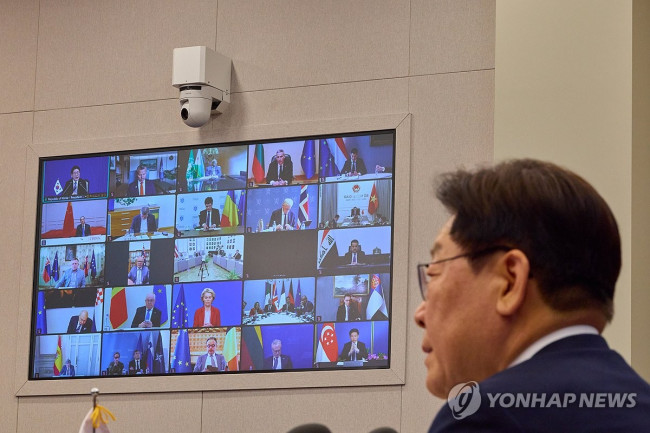 Video conference on freedom of navigation in the Strait of Hormuz [Yonhap News]
In this context, the new coalition proposal put forth by the United States could become another variable.
The US daily Wall Street Journal (WSJ) reported on April 29 (local time) that the State Department headquarters had sent a cable to its embassies in various countries outlining the "Maritime Freedom Construct" (MFC) initiative to resume commercial navigation in the Strait of Hormuz.
Following this, Australia, New Zealand, and others have announced that they have received the MFC proposal from the United States, indicating that the process of proposing it through diplomatic channels is underway.
The South Korean government has stated its standard position of "maintaining close communication with the United States" without specifically confirming whether it has received the proposal.
The government may need to consider various factors, including the impact on ROK-US relations and the relationship with the initiative led by Britain and France. Given that the US proposal is still in its early stages, understanding the US's specific intentions is seen as a priority task.

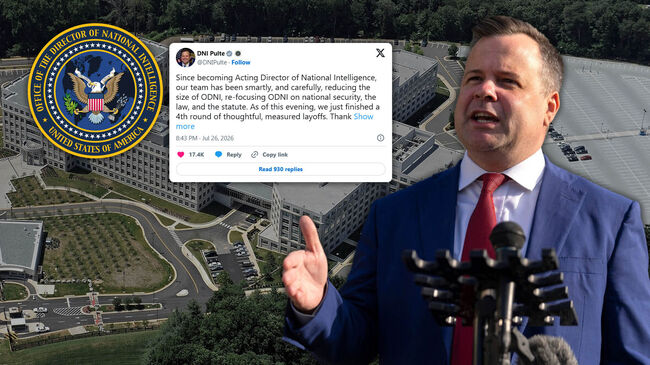 Bill Pulte to Restructure ‘Deep State’… Announces 4th Round of Layoffs at the Office of the Director of National Intelligence
Acting Director of National Intelligence Bill Pulte announced Sunday that he has carried out a fourth "deliberate and measured" reduction in personnel since taking office on June 19, as part of the Tr
Bill Pulte to Restructure ‘Deep State’… Announces 4th Round of Layoffs at the Office of the Director of National Intelligence
Acting Director of National Intelligence Bill Pulte announced Sunday that he has carried out a fourth "deliberate and measured" reduction in personnel since taking office on June 19, as part of the Tr
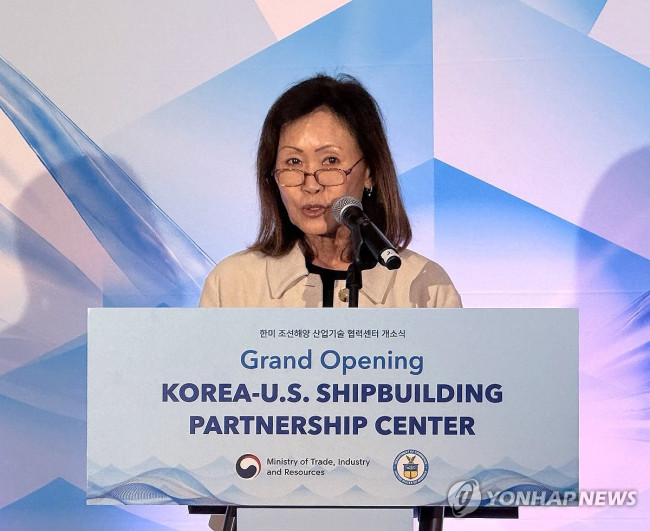 First U.S. Ambassador of Trump's Second Term to Arrive This Week… Will It Provide Momentum to Resolve Pending Issues?
U.S. Ambassador to South Korea Michelle Steel speaks at the opening ceremony of the Korea-U.S. Shipbuilding Cooperation Center held at the Mayflower Hotel in Washington, D.C., on the 23rd (local time)
First U.S. Ambassador of Trump's Second Term to Arrive This Week… Will It Provide Momentum to Resolve Pending Issues?
U.S. Ambassador to South Korea Michelle Steel speaks at the opening ceremony of the Korea-U.S. Shipbuilding Cooperation Center held at the Mayflower Hotel in Washington, D.C., on the 23rd (local time)
 President Yoon, regarding the first-instance ruling on the Public Official Election Act: “An excessive political verdict that distorts the facts… We will appeal immediately.”
The first-instance sentencing hearing for President Yoon Suk Yeol regarding violations of the Public Official Election Act is being broadcast live at Seoul Station on the 27th. [Photo=Yonhap News]Pres
President Yoon, regarding the first-instance ruling on the Public Official Election Act: “An excessive political verdict that distorts the facts… We will appeal immediately.”
The first-instance sentencing hearing for President Yoon Suk Yeol regarding violations of the Public Official Election Act is being broadcast live at Seoul Station on the 27th. [Photo=Yonhap News]Pres
 91% of Net Influx of MZ Generation Goes to Seoul Metropolitan Area… Population Migration Also Shows 'K-shaped Polarization' by Industry
[Provided by Leaders Index]Over the past four years, the MZ generation population has become increasingly concentrated in the Seoul metropolitan area and the Chungcheong region. While cities cen
91% of Net Influx of MZ Generation Goes to Seoul Metropolitan Area… Population Migration Also Shows 'K-shaped Polarization' by Industry
[Provided by Leaders Index]Over the past four years, the MZ generation population has become increasingly concentrated in the Seoul metropolitan area and the Chungcheong region. While cities cen
 'Godfather of Japanese Mystery Novels' Keigo Higashino Passes Away After Battle with Cancer at 68
Famous Japanese mystery novelist Keigo Higashino [AFP=Yonhap News]It has been belatedly reported that Keigo Higashino, the "godfather of Japanese mystery novels" and author of bestsellers such as "The
'Godfather of Japanese Mystery Novels' Keigo Higashino Passes Away After Battle with Cancer at 68
Famous Japanese mystery novelist Keigo Higashino [AFP=Yonhap News]It has been belatedly reported that Keigo Higashino, the "godfather of Japanese mystery novels" and author of bestsellers such as "The
 [Park Pil-kyu Security Column] To the Ignorant Trying to Clothe a Beast in Sheep's Clothing
Rep. Kim Byung-joo of the Democratic Party of Korea [Photo=Yonhap News]“The Air Force Academy doesn't teach you how to fly a plane!” “The Army, Navy, and Air Force academies are exactly the
[Park Pil-kyu Security Column] To the Ignorant Trying to Clothe a Beast in Sheep's Clothing
Rep. Kim Byung-joo of the Democratic Party of Korea [Photo=Yonhap News]“The Air Force Academy doesn't teach you how to fly a plane!” “The Army, Navy, and Air Force academies are exactly the
 [Issue Diagnosis] Two Effects of the Election Petition Review
 [Photo] Evidence of Election Fraud Flooding U.S. Media… Trump Had 2.7 Million Votes Stolen
 [Video] U.S. Semiquincentennial Air Show... 'Art in the Sky' streaks across New York
 [Editorial Cartoon] A Draconian Law That Undermines Freedom of Expression

 List
List









