 US President Donald Trump [Photo courtesy of UPI/Yonhap]
As the Donald Trump administration decided to reduce the number of U.S. troops in Germany by 5,000, it has been pointed out that the fundamental problem facing Europe is the widening rift in the transatlantic alliance and the accompanying security and economic risks.
Foreign media outlets such as the Wall Street Journal (WSJ) and The Telegraph reported on the 2nd (local time) that President Trump's increased tariffs on European automobiles, the withdrawal of plans to deploy long-range missiles, and the repercussions of the Iran war would have a much greater impact on Europe than the withdrawal of U.S. troops from Germany itself.
In particular, foreign media pointed out that what is more serious for Europe than the reduction of 5,000 troops is the rapid depletion of America's arsenal due to the Iran war.
The U.S. forces stationed in Germany are approximately 36,000, and can reach close to 40,000 depending on rotational deployments and training. A reduction of 5,000 from this number is not expected to have an immediate, direct negative impact on Germany's security, according to general views.
As President Trump announced that the scale of the reduction in U.S. troops in Germany would be larger than the 5,000 initially proposed by the Department of Defense, NATO (North Atlantic Treaty Organization) is reportedly cooperating with the U.S. to understand the specific plans of the Trump administration.
German security experts cite the U.S. decision to withdraw the planned deployment of Tomahawk cruise missiles and Dark Eagle hypersonic missile units to Germany, which was promised during the Joe Biden administration in 2024, as the biggest security concern.
"It is a significant problem that the gap in conventional deterrence remains unresolved at a time when Europe faces serious security threats," said Nico Lange, former political director at the German Ministry of Defense. "Europe does not yet possess these capabilities on its own."
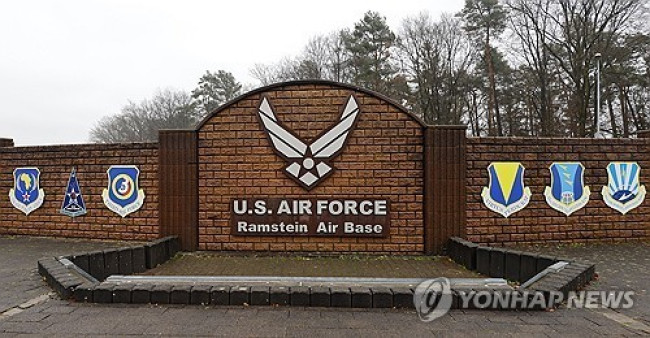 Ramstein Air Base, Germany [EPA=Yonhap News]
Furthermore, it has been pointed out that President Trump's efforts to create a reconciliation atmosphere with Russian President Vladimir Putin, such as suspending oil sanctions against Russia after Iran's blockade of the Strait of Hormuz, are a significant burden for Europe.
Concerns have also been raised that President Trump's stance could derail attempts to achieve a ceasefire between Ukraine and Russia.
The WSJ noted that the economic situation is deteriorating, particularly for Germany.
With President Trump's recent announcement to increase tariffs on European automobiles from the current 15% to 25%, Germany's core automotive industry has been hit hard.
German exports to the U.S. have already plummeted due to the trade war that began last year.
Although the German government attempted to drive growth through increased defense spending and public infrastructure investment, these plans have been thwarted by the surge in energy prices caused by the Iran war.
The economic growth forecast for this year has been downgraded, and corporate confidence has hit a six-year low.
Domestically, Chancellor Friedrich Merz's position is also weakening. Merz, whose approval ratings have steadily declined since taking office, is considered one of the least popular chancellors in post-war German history and is analyzed to be losing political influence.
Polish Prime Minister Donald Tusk recently emphasized on social media, "The biggest threat to the transatlantic community is not external enemies, but the ongoing dissolution of our alliance. We must take every measure to reverse this catastrophic trend."

 Iranian Foreign Ministry: "Continuing Message Exchanges with the U.S. and Activities of Mediating Countries"
Esmaeil Baghaei, Spokesperson for the Iranian Ministry of Foreign Affairs [Xinhua, Yonhap News file photo]Esmaeil Baghaei, spokesperson for the Iranian Ministry of Foreign Affairs, stated on the 26th
Iranian Foreign Ministry: "Continuing Message Exchanges with the U.S. and Activities of Mediating Countries"
Esmaeil Baghaei, Spokesperson for the Iranian Ministry of Foreign Affairs [Xinhua, Yonhap News file photo]Esmaeil Baghaei, spokesperson for the Iranian Ministry of Foreign Affairs, stated on the 26th
 President Yoon: "Do You Think You Are Safe from the Special Counsel?"... Final Statement Video Released
President Yoon Suk Yeol rebuking the special prosecutor on the 24th. [Court video / @birds_justice X account subtitle GIF] A video of President Yoon Suk Yeol's closing statement at his trial rega
President Yoon: "Do You Think You Are Safe from the Special Counsel?"... Final Statement Video Released
President Yoon Suk Yeol rebuking the special prosecutor on the 24th. [Court video / @birds_justice X account subtitle GIF] A video of President Yoon Suk Yeol's closing statement at his trial rega
 President Yoon, regarding the first-instance ruling on the Public Official Election Act: “An excessive political verdict that distorts the facts… We will appeal immediately.”
The first-instance sentencing hearing for President Yoon Suk Yeol regarding violations of the Public Official Election Act is being broadcast live at Seoul Station on the 27th. [Photo=Yonhap News]Pres
President Yoon, regarding the first-instance ruling on the Public Official Election Act: “An excessive political verdict that distorts the facts… We will appeal immediately.”
The first-instance sentencing hearing for President Yoon Suk Yeol regarding violations of the Public Official Election Act is being broadcast live at Seoul Station on the 27th. [Photo=Yonhap News]Pres
 WSJ: "SK Hynix ADR Premium Is a Sign of AI Trading Overheat"
Advertisement for SK Hynix ADR listing in New York's Times Square [Reuters=Yonhap News file photo]The Wall Street Journal (WSJ) has pointed out that the price of SK Hynix’s American Depositary Recei
WSJ: "SK Hynix ADR Premium Is a Sign of AI Trading Overheat"
Advertisement for SK Hynix ADR listing in New York's Times Square [Reuters=Yonhap News file photo]The Wall Street Journal (WSJ) has pointed out that the price of SK Hynix’s American Depositary Recei
 'Godfather of Japanese Mystery Novels' Keigo Higashino Passes Away After Battle with Cancer at 68
Famous Japanese mystery novelist Keigo Higashino [AFP=Yonhap News]It has been belatedly reported that Keigo Higashino, the "godfather of Japanese mystery novels" and author of bestsellers such as "The
'Godfather of Japanese Mystery Novels' Keigo Higashino Passes Away After Battle with Cancer at 68
Famous Japanese mystery novelist Keigo Higashino [AFP=Yonhap News]It has been belatedly reported that Keigo Higashino, the "godfather of Japanese mystery novels" and author of bestsellers such as "The
 [Park Pil-kyu Security Column] To the Ignorant Trying to Clothe a Beast in Sheep's Clothing
Rep. Kim Byung-joo of the Democratic Party of Korea [Photo=Yonhap News]“The Air Force Academy doesn't teach you how to fly a plane!” “The Army, Navy, and Air Force academies are exactly the
[Park Pil-kyu Security Column] To the Ignorant Trying to Clothe a Beast in Sheep's Clothing
Rep. Kim Byung-joo of the Democratic Party of Korea [Photo=Yonhap News]“The Air Force Academy doesn't teach you how to fly a plane!” “The Army, Navy, and Air Force academies are exactly the
 [Issue Diagnosis] Two Effects of the Election Petition Review
 [Photo] Evidence of Election Fraud Flooding U.S. Media… Trump Had 2.7 Million Votes Stolen
 [Video] U.S. Semiquincentennial Air Show... 'Art in the Sky' streaks across New York
 [Editorial Cartoon] A Draconian Law That Undermines Freedom of Expression

 List
List









