 U.S. Secretary of State Marco Rubio briefs at the White House on the 5th (local time) [Reuters=Yonhap News]
The United States and its Gulf allies are pushing again for a UN Security Council resolution demanding Iran reopen the Strait of Hormuz, warning of sanctions if it does not comply.
The new resolution is a revised version of one that was blocked last month by vetoes from China and Russia. It adjusts wording related to the use of force and supplements provisions on humanitarian aid.
U.S. Secretary of State Marco Rubio officially proposed the Security Council resolution to ensure the safety of the Strait of Hormuz in a statement on the 5th (local time).
This resolution, jointly drafted by the United States, Bahrain, Saudi Arabia, the United Arab Emirates (UAE), Kuwait, and Qatar, calls on Iran to: ▲ cease attacks on vessels and mine-laying ▲ stop collecting passage fees ▲ disclose the location of laid mines and cooperate in their removal ▲ support the establishment of humanitarian corridors.
Compared to the resolution rejected last month, this new draft takes a more cautious approach.
According to Reuters and AP, the new draft excludes language explicitly authorizing military action, mindful of Russia and China.
However, it retains the framework of Chapter VII of the UN Charter, which provides for enforcement measures including sanctions and military action, thus preserving practical leverage.
The resolution condemns Iran's recent violations of agreements and defines attempts to obstruct freedom of navigation or impose passage fees as threats to international peace and security.
In particular, it highlights the disruption of essential supplies such as fertilizers and relief goods due to the blockade of the strait and urges Iran to cooperate in establishing humanitarian corridors.
According to the resolution, the UN Secretary-General must report to the Security Council within 30 days on Iran's compliance. If Iran fails to meet the demands, the Security Council will convene to consider further enforcement measures, including sanctions.
The U.S. plans to circulate the draft by the 8th and aims for a vote next week.
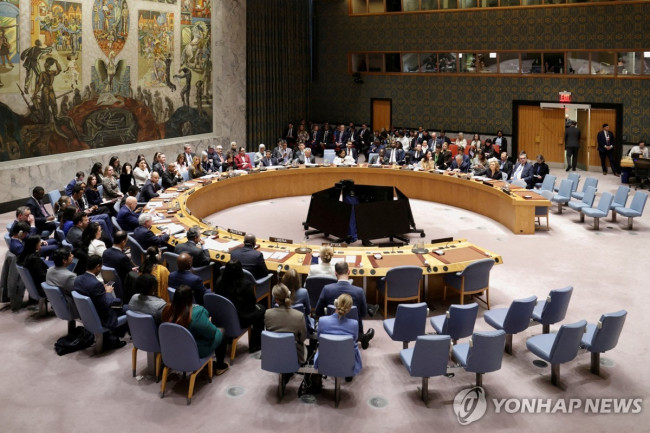 UN Security Council meeting [Reuters=Yonhap News file photo]
The U.S.'s pursuit of a solution through the UN represents a strategic shift compared to its recent actions.
Recently, the U.S. has responded outside the UN framework, striking Iran without Security Council approval and requesting participation from allies like South Korea in operations under the guise of freedom of navigation.
However, by opting for the Security Council resolution process this time, the U.S. appears to be aiming to diplomatically isolate Iran and secure legitimacy for its actions.
During a briefing on the 5th, Secretary Rubio stated that while some wording was adjusted to avoid another veto, he could not be certain if it would successfully circumvent a veto.
He described the resolution as a "true test" of the UN's role and urged China and Russia to refrain from exercising their veto power.
In parallel, the U.S. has proposed the establishment of a multinational maritime coalition called the 'Maritime Freedom Construct' (MFC) to its partners, according to Reuters.
The MFC, in cooperation with a separate coalition led by the UK and France, involving approximately 30 countries including South Korea, aims to fully resume navigation through the Strait of Hormuz once the situation stabilizes.

 Iranian Foreign Ministry: "Continuing Message Exchanges with the U.S. and Activities of Mediating Countries"
Esmaeil Baghaei, Spokesperson for the Iranian Ministry of Foreign Affairs [Xinhua, Yonhap News file photo]Esmaeil Baghaei, spokesperson for the Iranian Ministry of Foreign Affairs, stated on the 26th
Iranian Foreign Ministry: "Continuing Message Exchanges with the U.S. and Activities of Mediating Countries"
Esmaeil Baghaei, Spokesperson for the Iranian Ministry of Foreign Affairs [Xinhua, Yonhap News file photo]Esmaeil Baghaei, spokesperson for the Iranian Ministry of Foreign Affairs, stated on the 26th
 President Yoon: "Do You Think You Are Safe from the Special Counsel?"... Final Statement Video Released
President Yoon Suk Yeol rebuking the special prosecutor on the 24th. [Court video / @birds_justice X account subtitle GIF] A video of President Yoon Suk Yeol's closing statement at his trial rega
President Yoon: "Do You Think You Are Safe from the Special Counsel?"... Final Statement Video Released
President Yoon Suk Yeol rebuking the special prosecutor on the 24th. [Court video / @birds_justice X account subtitle GIF] A video of President Yoon Suk Yeol's closing statement at his trial rega
 President Yoon, regarding the first-instance ruling on the Public Official Election Act: “An excessive political verdict that distorts the facts… We will appeal immediately.”
The first-instance sentencing hearing for President Yoon Suk Yeol regarding violations of the Public Official Election Act is being broadcast live at Seoul Station on the 27th. [Photo=Yonhap News]Pres
President Yoon, regarding the first-instance ruling on the Public Official Election Act: “An excessive political verdict that distorts the facts… We will appeal immediately.”
The first-instance sentencing hearing for President Yoon Suk Yeol regarding violations of the Public Official Election Act is being broadcast live at Seoul Station on the 27th. [Photo=Yonhap News]Pres
 WSJ: "SK Hynix ADR Premium Is a Sign of AI Trading Overheat"
Advertisement for SK Hynix ADR listing in New York's Times Square [Reuters=Yonhap News file photo]The Wall Street Journal (WSJ) has pointed out that the price of SK Hynix’s American Depositary Recei
WSJ: "SK Hynix ADR Premium Is a Sign of AI Trading Overheat"
Advertisement for SK Hynix ADR listing in New York's Times Square [Reuters=Yonhap News file photo]The Wall Street Journal (WSJ) has pointed out that the price of SK Hynix’s American Depositary Recei
 'Godfather of Japanese Mystery Novels' Keigo Higashino Passes Away After Battle with Cancer at 68
Famous Japanese mystery novelist Keigo Higashino [AFP=Yonhap News]It has been belatedly reported that Keigo Higashino, the "godfather of Japanese mystery novels" and author of bestsellers such as "The
'Godfather of Japanese Mystery Novels' Keigo Higashino Passes Away After Battle with Cancer at 68
Famous Japanese mystery novelist Keigo Higashino [AFP=Yonhap News]It has been belatedly reported that Keigo Higashino, the "godfather of Japanese mystery novels" and author of bestsellers such as "The
 [Park Pil-kyu Security Column] To the Ignorant Trying to Clothe a Beast in Sheep's Clothing
Rep. Kim Byung-joo of the Democratic Party of Korea [Photo=Yonhap News]“The Air Force Academy doesn't teach you how to fly a plane!” “The Army, Navy, and Air Force academies are exactly the
[Park Pil-kyu Security Column] To the Ignorant Trying to Clothe a Beast in Sheep's Clothing
Rep. Kim Byung-joo of the Democratic Party of Korea [Photo=Yonhap News]“The Air Force Academy doesn't teach you how to fly a plane!” “The Army, Navy, and Air Force academies are exactly the
 [Issue Diagnosis] Two Effects of the Election Petition Review
 [Photo] Evidence of Election Fraud Flooding U.S. Media… Trump Had 2.7 Million Votes Stolen
 [Video] U.S. Semiquincentennial Air Show... 'Art in the Sky' streaks across New York
 [Editorial Cartoon] A Draconian Law That Undermines Freedom of Expression

 List
List









