5월6일 발행한 <주간 한미일보> 8호 커버스토리입니다. 시의성을 고려해 금일 업로드합니다. [편집자 주]
 Professor Lee Hee-cheon being interviewed by Hanmi Ilbo. ⒸHanmi Ilbo
Professor Lee Hee-cheon, an expert in anti-communism who served 27 years at the National Intelligence Service and taught national and historical perspectives to elite agents for 17 years. He is also the person who popularized terms such as "pro-North Korea forces," "anti-South Korea forces," and "regime war," which we are familiar with.
We recently met Professor Lee Hee-cheon, who is currently a hot topic of conversation for his article published in Hanmi Ilbo, titled "If the Constitutional Amendment Passes, South Korea Will Cease to Exist." Why is constitutional amendment such a grave issue, and how could South Korea disappear?
Professor Lee Hee-cheon stated, "The core of this constitutional amendment is changing three articles, and these are not simple articles but contents that will change the identity of South Korea, the national identity itself." He added, "Given the situation, I am concerned that the People Power Party and the right-wing camp do not feel the seriousness of constitutional amendment, as no significant resistance movement has emerged. I resolved to inform the public and subsequently decided to write a book and appear on YouTube."
Inclusion of May 18th Will Accuse the Entire Right-Wing Regime as 'Deep-Rooted Evils'
First, Professor Lee provided an answer as to why including the May 18th Democratic Uprising and the Busan-Masan Uprising in the constitution is so dangerous. According to him, if "May 18th" and "Busan-Masan Uprising" are enshrined in the constitution, they, along with the already existing "April 19th Revolution," will form a single thread of "democratization movement."
"When any clause is being introduced, it is important to understand the purpose of those introducing it. In other words, we must know what kind of political forces Lee Jae-myung's administration and the Democratic Party are and what their ideological orientation is."
According to Professor Lee, they are not only well-known to have core members from anti-establishment forces like Hanchongnyeon (National Federation of University Student Councils) and Gyeonggi Dongbu Yeonhap, but they are also led by those called Juche ideologues (Juche faction). He stated that the Juche faction has harbored intentions to overthrow the system of South Korea for 40 years, from the 1980s to the present.
He emphasized, "It is important to discern the purpose of those who have an ideological orientation to dismantle South Korea's liberal democratic system when they attempt to change three articles of the constitution."
Professor Lee continued, "If, at this moment, the preamble of the constitution includes content stating that the May 18th Uprising was a democratization movement, and the Chun Doo-hwan regime suppressed and persecuted it, resulting in numerous casualties, then the Chun Doo-hwan regime itself becomes a deep-rooted evil, a dictatorial regime that suppressed democratic forces and an unjust regime," he asserted.
"Not only that, but it will extend to the Roh Tae-woo regime, the Lee Myung-bak regime, the Park Geun-hye regime, and even the Yoon Suk-yeol regime, all becoming unjust regimes and deep-rooted evil regimes."
Furthermore, Professor Lee stated, "Including the Busan-Masan incident in the spirit of the constitution means that because the Busan-Masan incident was an act of resistance against President Park Chung-hee, the entire 18-year Park Chung-hee regime will be condemned by the constitution as an unjust regime and a deep-rooted evil regime."
"It is similar to how the April 19th Revolution, which erupted as a resistance against the Liberal Party, became established as a democratization movement through the constitution, leading to the Ipseungman regime being labeled an unjust regime that suppressed the democratization movement."
Professor Lee Hee-cheon explained that by including the May 18th Uprising and the Busan-Masan Uprising in the constitution, the entire 80-year history of South Korea, from President Syngman Rhee to the current Yoon Suk-yeol government, would be characterized as unjust, deep-rooted evil regimes that suppressed and eliminated democratization movements.
Is the Current South Korea Fake? Are They Returning to Right After Liberation?
Professor Lee then stated that all of this is not his own interpretation. He referred to the book "Lee Jae-myung, Revolutionize South Korea," written by Seongnam Mayor Lee Jae-myung in January 2017 with the presidential election in mind.
 Professor Lee Hee-cheon ⒸHanmi Ilbo
"The most frequently used word in that book is 'cleansing of deep-rooted evils.' Deep-rooted evils refer to accumulated problems. However, these deep-rooted evils are not about corruption. The book states, 'cleansing the deep-rooted evils that have accumulated over the 70 years since the founding of the nation after liberation.'"
According to Professor Lee, the book, published in 2017, considers South Korea's founding to be 70 years ago. This implies that the entire history of South Korea is viewed as a deep-rooted evil and needs to be re-established. Borrowing Lee Jae-myung's words, he stated that their true meaning of founding is to "create a nation where the values of a democratic republic that we agreed upon after liberation are alive and breathing."
"What was the 'democratic republic' we agreed upon after liberation? Immediately after August 15, 1945, the leader of the South Korean Workers' Party, Park Heon-young, created people's committees nationwide under the name 'Korean People's Republic.' When the US military entered Korea at the time, they found something resembling a state already established and exercising control. Therefore, the US military government began reclaiming administrative power. While most areas were reclaimed, there was only one place that did not yield until February 1946."
That place was Jeju Island. Jeju Island was a place where the influence of the People's Committee was so strong that after the police chief gave a greeting at village events, the chairman of the People's Committee would come forward to give a greeting. According to Professor Lee, the Jeju April 3rd Incident was a rebellion by subversive elements aimed at hindering the founding of South Korea and the May 10th elections, and it occurred in Jeju Island, where the People's Committee organization was still alive and active.
"However, Lee Jae-myung is now saying, 'Let's create a nation where the values of a democratic republic that we agreed upon after liberation are alive and breathing,' while simultaneously stating that South Korea's 70-year history is a history of deep-rooted evils and that we should create a new South Korea."
The official slogan for Lee Jae-myung's presidential campaign in the 21st presidential election was "The Real South Korea, From Now On." Professor Lee explained, "This means that the current South Korea is not South Korea, and therefore they intend to change the constitution to make it a real South Korea, a South Korea again."
"To do this, all of the history of the past 80 years since the founding of South Korea must be erased. They intend to cleanse South Korea based on a new constitution. Ordinary citizens might think, 'What's the big deal? President Yoon Suk-yeol also promised to include the spirit of May 18th in the preamble of the constitution when he took office. So, if the Democratic Party is advocating for it now, is there any reason for us to oppose it? It's just a word or two...'"
Professor Lee warned that such thinking is dangerous, emphasizing that every word in the constitution is extremely important. He stated that the spirit of the constitution can be entirely changed by simply omitting or including the word "freedom." From this perspective, enshrining the May 18th Uprising and the Busan-Masan Uprising in the preamble of the constitution is an act of reversing South Korea's 80-year history of liberal democracy and an act of undermining its legitimacy.
Stricter Conditions for Martial Law Declaration… Cannot Respond to Rebellion Without National Assembly Approval?
Secondly, regarding the stricter conditions for martial law declaration included in the constitutional amendment proposal, Professor Lee stated, "Previously, when the president declared martial law, it was sufficient to simply notify the National Assembly. However, with the constitutional amendment, the president will now need parliamentary approval to declare martial law, and if approval is not obtained, martial law will become invalid after 48 hours."
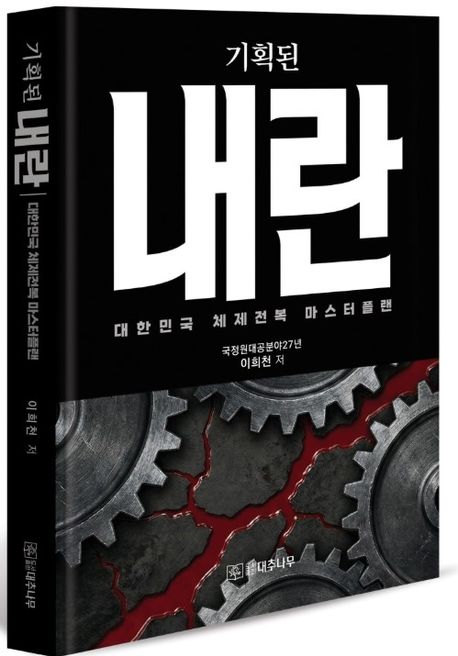 Professor Lee Hee-cheon's new book, 'Planned Treason.' In the book, the professor analyzes, "In the continuation of the Lee Jae-myung faction inciting President Yoon Suk-yeol for treason, this constitutional amendment aims to lay the legal groundwork for prosecuting the president for treason and dissolving the People Power Party as an unconstitutional party."
For example, if the National Assembly is seized by rebellious forces, the president must have emergency powers to counter them. However, they intend to let the National Assembly seize those emergency powers. If the president's final authority to protect the nation is taken away in a presidential system, the president becomes a mere figurehead.
Professor Lee analyzed, "In the continuation of the Lee Jae-myung faction inciting President Yoon Suk-yeol for treason, this constitutional amendment aims to lay the legal groundwork for prosecuting the president for treason and dissolving the People Power Party as an unconstitutional party."
Ultimately, if it is fully stipulated in the constitution that President Yoon Suk-yeol is the leader of a rebellion and that martial law was an act of rebellion, then President Yoon Suk-yeol can now be punished according to the constitution.
Furthermore, there were forces that supported President Yoon Suk-yeol's declaration of martial law, which were the People Power Party. This could be used as grounds for prosecuting the People Power Party as a rebellious force alongside President Yoon, leading to its dissolution through an application to the Constitutional Court.
Professor Lee views the purpose of this constitutional amendment as being more focused on dissolving the People Power Party than on punishing President Yoon Suk-yeol. Currently, the People Power Party holds 107 seats. If they are dissolved, the Democratic Party can complete its one-party dictatorship. This would be the completion of a proletarian dictatorship, a left-wing dictatorship.
Professor Lee stated, "What happens when a one-party dictatorship is established? They will finally attempt the second constitutional amendment they desire."
So, what will be included in the second constitutional amendment? Professor Lee brought up the constitutional amendment bill that the Democratic Party attempted from January to March 2018 during the Moon Jae-in administration.
"At that time, 'freedom of conscience' was changed to 'freedom of thought and conscience.' The moment the constitution guarantees freedom of thought, such as communism, socialism, and Juche ideology, South Korea's liberal democracy is simply dismantled. Ultimately, they will attempt a second constitutional amendment to carry out such actions."
The paradox of destroying freedom through freedom is not only chilling but also terrifying. According to Professor Lee, next, market order will be destroyed through "equal pay for equal work," and then laws will be changed so that legislative proposals can be initiated with just 500,000 citizens through the "citizen's right to speak." The end result is the "neutralization of the National Assembly." Ultimately, even the power concentrated in the National Assembly will be reduced to a mere stepping stone.
"A world where anything can be initiated with just 500,000 citizens, this is a world of people's democracy. These contents are included in the constitution that the Democratic Party demanded at the time. However, the Juche ideologues of the Moon Jae-in administration and the current Lee Jae-myung administration are on a different level. The constitutional bill from back then would probably be child's play compared to now."
Professor Lee stated that when we observe the legislative, executive, judicial, and local government branches currently transforming into a totalitarian system suited for their one-party dictatorship, the second constitutional amendment will lead to an experience of a completely new nation that our citizens cannot even imagine, a nation they have never experienced before.
Through the Excuse of Balanced Regional Development, They May Establish 'Left-Wing Power at the Village Level'
Third, he stated that the clause on balanced regional development will serve as a stepping stone for establishing "left-wing power at the village level." Professor Lee explained that the resident autonomy committee model promoted since the Moon Jae-in administration was benchmarked from the village organizations of Hugo Chávez's regime in Venezuela. He predicted, "If this clause is enshrined in the constitution, it will complete a one-party dictatorship system where left-wing forces seize control of governance, economy, and education in towns, townships, and districts, thereby permanently controlling voters."
"The balanced regional development clause included in the constitutional amendment states that the state has an obligation to resolve regional disparities and promote balanced development so that all citizens can enjoy equal quality of life and opportunities regardless of their place of residence. On the surface, it seems like there is no problem."
He again cited the constitutional amendment proposal from the Moon Jae-in administration in 2018 as an example. It included provisions allowing local governments to create ordinances without legal basis. He explained that this means autonomous bodies can act arbitrarily, rather than operating in a unified manner under the state's governing system.
In short, it is content that destroys the nation. He pointed out that left-wing activists have been relentlessly promoting rural return and farming return movements for the past 20 years to gain control of the lower strata of South Korea, and that during Mayor Park Won-soon's tenure, things like "village communities" became widespread.
"During the Moon Jae-in administration, they established the Committee for Autonomous Decentralization and attempted to seize power, money, and educational rights through village communities, educational communities, cooperatives, and social enterprises. In particular, when they tried to enact the Basic Law on Resident Autonomy in 2021, I wrote a book titled 'The Gateway to the Communization of Resident Autonomy' and traveled nationwide, working to awaken the residents."
His efforts were not in vain, as the law was ultimately not enacted, and the Moon Jae-in administration ended. However, he stated that on March 31st of the current Lee Jae-myung administration, a bill to implement resident autonomy committees nationwide was passed.
Professor Lee predicted that once resident autonomy committees are established, all community centers, police substations, educational communities, cooperatives, and social enterprises in every town, township, and district will be subordinate to them, controlling all aspects of politics, economy, society, and culture, and even collecting and redistributing residents' money.
He added, "The state will provide support so that residents can enjoy an equal quality of life, whether they are in Seoul, Uljin in Gyeongsang Province, Mokpo in Jeollanam-do, or in a rural valley. The left-wing village activists, i.e., the resident autonomy committees, will act as agents to implement this by using the money and power, and this will be enshrined in the constitution to create the legal basis."
What Comes After the Disappearance of 80 Years of South Korea
In conclusion, if the constitutional amendment passes, the national spirit that South Korea has upheld for 80 years will be completely dismantled. The grounds for executing President Yoon and dissolving the opposition party will be created, leading to a complete transition to a one-party dictatorship, and a dictatorial system will be established to fully control villages and its residents.
Professor Lee stated that the reason we fail to understand the essence of the situation, despite all this, is that we do not understand the true nature of the Democratic Party and the Lee Jae-myung faction's ideology and how they intend to lead South Korea.
Professor Lee Hee-cheon believes it is not too late. During the Korean War, Park Heon-young boasted, "If the North Korean army crosses the 38th parallel and advances south, 600,000 members of the South Korean Workers' Party will respond, and we can win in three days." However, in reality, a nationwide rebellion or a large-scale response from the South Korean Workers' Party did not occur in the South.
While it is true that some segments of the population harbored illusions about communism, our people had no intention of abandoning freedom whatsoever. Consequently, North Korea's "3-day communization" plan failed.
Professor Lee suggested that even if some people agree with the constitutional amendment, if the entire nation strongly rises up and clearly communicates the essence of the issue, they can reverse the situation, just as they did during the Korean War.
He emphasized, "If more than 80% of the citizens who wish to protect liberal democracy unite, we can turn this crisis into an opportunity for reversal."
Finally, Professor Lee defined the current situation as a "regime war that will determine the fate of South Korea" and urged, "Free and patriotic citizens must temporarily put aside all their livelihoods and devote all their efforts to the anti-constitutional amendment movement, and inform friendly nations like the United States of this conspiracy." He also called for unity among the fragmented political circles.
"The People Power Party must absolutely not fall for their strategy of division. Even among the right-wing conservatives, they should not fight among themselves, arguing about 'Yoon-eogein' or 'Je-yoon.' This is what they want, and it means falling into their frame. We must unconditionally unite as one and attack only their wrongdoings."
Professor Lee Hee-cheon stressed that by breaking free from the "treason frame" plotted by the leftists and uniting the people over the issue of "defending the liberal democratic constitution versus transitioning to socialism," we can win the regime war.
Reporter Lim Yo-hee

 Iranian Foreign Ministry: "Continuing Message Exchanges with the U.S. and Activities of Mediating Countries"
Esmaeil Baghaei, Spokesperson for the Iranian Ministry of Foreign Affairs [Xinhua, Yonhap News file photo]Esmaeil Baghaei, spokesperson for the Iranian Ministry of Foreign Affairs, stated on the 26th
Iranian Foreign Ministry: "Continuing Message Exchanges with the U.S. and Activities of Mediating Countries"
Esmaeil Baghaei, Spokesperson for the Iranian Ministry of Foreign Affairs [Xinhua, Yonhap News file photo]Esmaeil Baghaei, spokesperson for the Iranian Ministry of Foreign Affairs, stated on the 26th
 President Yoon: "Do You Think You Are Safe from the Special Counsel?"... Final Statement Video Released
President Yoon Suk Yeol rebuking the special prosecutor on the 24th. [Court video / @birds_justice X account subtitle GIF] A video of President Yoon Suk Yeol's closing statement at his trial rega
President Yoon: "Do You Think You Are Safe from the Special Counsel?"... Final Statement Video Released
President Yoon Suk Yeol rebuking the special prosecutor on the 24th. [Court video / @birds_justice X account subtitle GIF] A video of President Yoon Suk Yeol's closing statement at his trial rega
 President Yoon, regarding the first-instance ruling on the Public Official Election Act: “An excessive political verdict that distorts the facts… We will appeal immediately.”
The first-instance sentencing hearing for President Yoon Suk Yeol regarding violations of the Public Official Election Act is being broadcast live at Seoul Station on the 27th. [Photo=Yonhap News]Pres
President Yoon, regarding the first-instance ruling on the Public Official Election Act: “An excessive political verdict that distorts the facts… We will appeal immediately.”
The first-instance sentencing hearing for President Yoon Suk Yeol regarding violations of the Public Official Election Act is being broadcast live at Seoul Station on the 27th. [Photo=Yonhap News]Pres
 WSJ: "SK Hynix ADR Premium Is a Sign of AI Trading Overheat"
Advertisement for SK Hynix ADR listing in New York's Times Square [Reuters=Yonhap News file photo]The Wall Street Journal (WSJ) has pointed out that the price of SK Hynix’s American Depositary Recei
WSJ: "SK Hynix ADR Premium Is a Sign of AI Trading Overheat"
Advertisement for SK Hynix ADR listing in New York's Times Square [Reuters=Yonhap News file photo]The Wall Street Journal (WSJ) has pointed out that the price of SK Hynix’s American Depositary Recei
 'Godfather of Japanese Mystery Novels' Keigo Higashino Passes Away After Battle with Cancer at 68
Famous Japanese mystery novelist Keigo Higashino [AFP=Yonhap News]It has been belatedly reported that Keigo Higashino, the "godfather of Japanese mystery novels" and author of bestsellers such as "The
'Godfather of Japanese Mystery Novels' Keigo Higashino Passes Away After Battle with Cancer at 68
Famous Japanese mystery novelist Keigo Higashino [AFP=Yonhap News]It has been belatedly reported that Keigo Higashino, the "godfather of Japanese mystery novels" and author of bestsellers such as "The
 [Park Pil-kyu Security Column] To the Ignorant Trying to Clothe a Beast in Sheep's Clothing
Rep. Kim Byung-joo of the Democratic Party of Korea [Photo=Yonhap News]“The Air Force Academy doesn't teach you how to fly a plane!” “The Army, Navy, and Air Force academies are exactly the
[Park Pil-kyu Security Column] To the Ignorant Trying to Clothe a Beast in Sheep's Clothing
Rep. Kim Byung-joo of the Democratic Party of Korea [Photo=Yonhap News]“The Air Force Academy doesn't teach you how to fly a plane!” “The Army, Navy, and Air Force academies are exactly the
 [Issue Diagnosis] Two Effects of the Election Petition Review
 [Photo] Evidence of Election Fraud Flooding U.S. Media… Trump Had 2.7 Million Votes Stolen
 [Video] U.S. Semiquincentennial Air Show... 'Art in the Sky' streaks across New York
 [Editorial Cartoon] A Draconian Law That Undermines Freedom of Expression

 List
List










