 Trump and Xi Jinping met in Busan last October [Yonhap News file photo]
The US-China summit, which was postponed once due to instability in the Middle East, is expected to materialize during President Donald Trump's visit to China from the 14th to the 15th, capturing global attention.
This will be the first visit by a US president to China since November 2017, during Trump's first term, and it will be approximately six months since the Busan summit on October 30th last year.
Unlike last year, when trade disputes were the primary focus, this year's summit is expected to prioritize geopolitical issues such as the Middle East and Taiwan, given the US-Iran conflict and the potential blockade of the Strait of Hormuz have emerged as the most pressing global concerns.
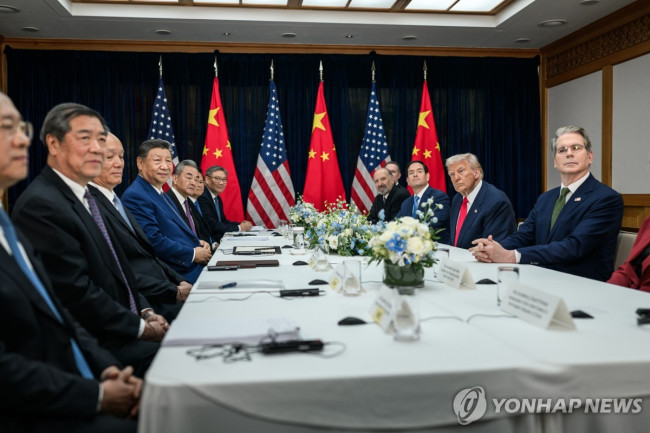 US and Chinese leaders at the summit venue [UPI/Yonhap News file photo]
◇ 'Temporary Truce' in Tariff War in Busan Last Year… Trump's China Visit Postponed Due to Iran Conflict
During the approximately 100-minute summit in Busan last October, President Trump and Chinese President Xi Jinping reached a provisional agreement to de-escalate the trade dispute that had been ongoing for over half a year since the start of Trump's second term. They agreed to a one-year 'truce' on key issues such as retaliatory tariffs, rare earths, and fentanyl.
However, subsequent discussions between the two countries slowed down after the Busan summit.
Following the full-scale escalation of the trade war in April last year, high-level trade talks were held almost monthly in various locations such as Geneva, Switzerland (May), London, UK (June), Stockholm, Sweden (July), and Madrid, Spain (September). This year, apart from the Paris meeting in March, no similar high-level trade talks have been held.
After the outbreak of the US-Iran conflict in late February, President Trump's focus shifted to the Middle East. His visit to China, initially discussed for late March or early April, was postponed for over a month to the 14th-15th of this month.
There were also observations that President Trump, who had been aggressively criticizing China with trade sanctions and strong rhetoric last year, had put China 'on the back burner' this year.
Concerns were raised that Trump's visit to China and the US-China summit could be postponed again if the Iran conflict, which had been in a ceasefire, intensified. However, as negotiations between the US and Iran show progress, the realization of the US-China summit is coming into view.
The US has recently engaged in a pre-summit show of force by imposing controls on semiconductor equipment exports to Chinese companies and sanctioning Chinese firms suspected of trading oil with Iran. China responded to the psychological warfare by announcing regulations last month that increased controls on rare earth exports.
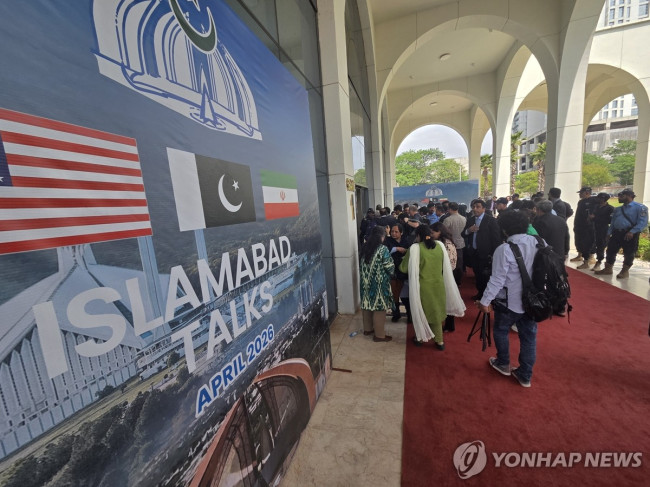 Reporters gather at the press center set up in Islamabad, Pakistan, ahead of the first peace talks between the US and Iran on the 11th (local time) last month. [Yonhap News]
◇ US Demands 'Iran Mediation'… China Advocates 'Non-Interference in Taiwan'
The most pressing issue for the two leaders, who will finally meet after overcoming various obstacles, is the 'Iran issue'.
From the outset of the conflict, President Trump has gestured to link China to the current war. Subsequently, he pressured President Xi by highlighting the importance of the Strait of Hormuz to China and mentioning China's alleged support for Iran. This month, his administration even sanctioned Chinese companies identified as conduits for Iran's oil product imports.
One interpretation is that the US is seeking to involve China because it needs a 'guarantor' to ensure the stability of any agreement between the US and Iran, especially given that Iran's supreme leadership is not firmly established.
Ahead of the summit, the US is explicitly demanding that China exert its influence on Iran.
In an interview with Fox News on the 4th (local time), US Treasury Secretary Scott Bessant urged China to play a role in resolving the blockade of the Strait of Hormuz. The following day, US Secretary of State Marco Rubio stated at a press conference that he hopes China will directly tell Iran, 'You are villains, and do not hold the global economy hostage.'
Iran also dispatched its Foreign Minister Abbas Araghchi to Beijing on the 6th, seemingly bolstering efforts to create a negotiation framework with the US that involves China.
China also needs to prevent the erosion of its strategic interests that could arise if instability in Iran continues or if a new Middle Eastern order more favorable to the US is established post-conflict.
During his meeting with Minister Araghchi on the 6th, Chinese Foreign Minister Wang Yi expressed China's intention to expand its influence in the future Middle East order by stating, "We support a regional peace and security framework built on the joint participation of regional countries, safeguarding common interests, and realizing common development."
Some experts on China believe that President Xi might offer a solution where China increases its imports of US crude oil and agricultural products and guarantees rare earth supply to save President Trump's 'face,' while President Trump agrees to end the war without overthrowing the current Iranian regime.
For this reason, it is analyzed that the 'Iran issue' will be intertwined with the 'Taiwan issue' at this summit.
In a call with Secretary Rubio on the 30th of last month, which served as a prelude to the summit, Minister Wang foreshadowed that the Taiwan issue would be a top agenda item, stating, "The Taiwan issue is China's core interest and the biggest risk to US-China relations. The US must keep its promises and make the right decisions to open new spaces for US-China cooperation and do what is right for world peace."
The Taiwan issue, one of the major fronts in US-China relations, was not discussed at the Busan summit last October.
China, which has vowed to unify Taiwan, has reacted sensitively to US intervention in the Taiwan Strait issue. However, at the previous summit, where a truce in the trade war was the primary concern, the Taiwan issue was sidelined.
In diplomatic circles, it is anticipated that President Xi will leverage his role in mediating the Iran conflict to enhance his negotiating power at the summit, leading to stronger demands on the US, such as an end to arms sales to Taiwan.
In a press conference on the 5th, Secretary Rubio stated, "We do not want to see any destabilizing events occur in Taiwan or any part of the Indo-Pacific region, and we believe this is mutually beneficial for both the US and China," drawing a line.
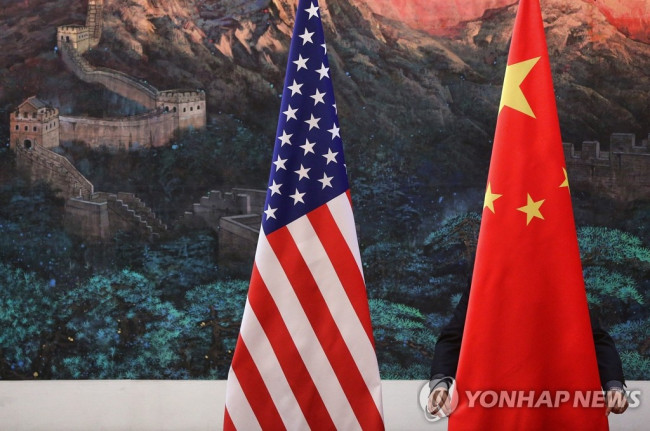 [EPA/Yonhap News file photo]
◇ US AI and Semiconductors vs. China's Rare Earths… Predictions of a 'Temporary Resumption of Trade Disputes'
Areas of global competition between the US and China, including high-tech controls, are also key points to watch at the upcoming US-China summit.
The US is expected to focus on securing a competitive advantage over China and fostering cooperation in advanced fields such as artificial intelligence (AI) and semiconductors.
At a White House event on the 4th, President Trump stated, "We are ahead of China in AI," adding, "(The US and China are) very friendly competitors. But actually, (this visit to China) will be a very important trip."
Ahead of the summit, the US revealed that it had obtained evidence of Chinese companies stealing US AI technology, leaving open the possibility of further contentious issues, including controls on semiconductor exports.
The US daily Wall Street Journal (WSJ) recently reported, citing Treasury Department officials, that a 'historic moment' is expected at this summit, where the leaders of the two global powers will discuss AI as a formal agenda item for the first time.
China, having confirmed the power of rare earths as a potent bargaining chip against the US during last year's tariff war, is expected to use this as leverage to extract maximum concessions from the US.
China's national focus on securing its own advanced technologies and its increased technological confidence, as seen in the denial of the acquisition of Chinese AI startup 'Manus' by US tech giant Meta, are also identified as variables.
However, some observers believe it is uncertain whether the summit next week will bring about fundamental changes to the current 'truce' in the tariff war between the two countries.
The reason cited is the lack of time this year due to the Iran conflict, unlike last year when summit agendas were prepared over a long period through continuous high-level meetings.
There is also an analysis that the urgency differs between last year, when US-China trade was effectively halted due to over 100% punitive tariffs, and the current situation, where a significant obstacle has been temporarily removed by the truce.
Consequently, some predict that the Beijing summit may conclude with the two countries agreeing to a suspension of trade investigations and sanctions initiated this year or confirming a consensus to extend the tariff war truce. They also anticipate that President Xi Jinping may signal his stance on President Trump's invitation to visit the US within the year, promising future engagement.

 Iranian Foreign Ministry: "Continuing Message Exchanges with the U.S. and Activities of Mediating Countries"
Esmaeil Baghaei, Spokesperson for the Iranian Ministry of Foreign Affairs [Xinhua, Yonhap News file photo]Esmaeil Baghaei, spokesperson for the Iranian Ministry of Foreign Affairs, stated on the 26th
Iranian Foreign Ministry: "Continuing Message Exchanges with the U.S. and Activities of Mediating Countries"
Esmaeil Baghaei, Spokesperson for the Iranian Ministry of Foreign Affairs [Xinhua, Yonhap News file photo]Esmaeil Baghaei, spokesperson for the Iranian Ministry of Foreign Affairs, stated on the 26th
 President Yoon: "Do You Think You Are Safe from the Special Counsel?"... Final Statement Video Released
President Yoon Suk Yeol rebuking the special prosecutor on the 24th. [Court video / @birds_justice X account subtitle GIF] A video of President Yoon Suk Yeol's closing statement at his trial rega
President Yoon: "Do You Think You Are Safe from the Special Counsel?"... Final Statement Video Released
President Yoon Suk Yeol rebuking the special prosecutor on the 24th. [Court video / @birds_justice X account subtitle GIF] A video of President Yoon Suk Yeol's closing statement at his trial rega
 President Yoon, regarding the first-instance ruling on the Public Official Election Act: “An excessive political verdict that distorts the facts… We will appeal immediately.”
The first-instance sentencing hearing for President Yoon Suk Yeol regarding violations of the Public Official Election Act is being broadcast live at Seoul Station on the 27th. [Photo=Yonhap News]Pres
President Yoon, regarding the first-instance ruling on the Public Official Election Act: “An excessive political verdict that distorts the facts… We will appeal immediately.”
The first-instance sentencing hearing for President Yoon Suk Yeol regarding violations of the Public Official Election Act is being broadcast live at Seoul Station on the 27th. [Photo=Yonhap News]Pres
 WSJ: "SK Hynix ADR Premium Is a Sign of AI Trading Overheat"
Advertisement for SK Hynix ADR listing in New York's Times Square [Reuters=Yonhap News file photo]The Wall Street Journal (WSJ) has pointed out that the price of SK Hynix’s American Depositary Recei
WSJ: "SK Hynix ADR Premium Is a Sign of AI Trading Overheat"
Advertisement for SK Hynix ADR listing in New York's Times Square [Reuters=Yonhap News file photo]The Wall Street Journal (WSJ) has pointed out that the price of SK Hynix’s American Depositary Recei
 'Godfather of Japanese Mystery Novels' Keigo Higashino Passes Away After Battle with Cancer at 68
Famous Japanese mystery novelist Keigo Higashino [AFP=Yonhap News]It has been belatedly reported that Keigo Higashino, the "godfather of Japanese mystery novels" and author of bestsellers such as "The
'Godfather of Japanese Mystery Novels' Keigo Higashino Passes Away After Battle with Cancer at 68
Famous Japanese mystery novelist Keigo Higashino [AFP=Yonhap News]It has been belatedly reported that Keigo Higashino, the "godfather of Japanese mystery novels" and author of bestsellers such as "The
 [Park Pil-kyu Security Column] To the Ignorant Trying to Clothe a Beast in Sheep's Clothing
Rep. Kim Byung-joo of the Democratic Party of Korea [Photo=Yonhap News]“The Air Force Academy doesn't teach you how to fly a plane!” “The Army, Navy, and Air Force academies are exactly the
[Park Pil-kyu Security Column] To the Ignorant Trying to Clothe a Beast in Sheep's Clothing
Rep. Kim Byung-joo of the Democratic Party of Korea [Photo=Yonhap News]“The Air Force Academy doesn't teach you how to fly a plane!” “The Army, Navy, and Air Force academies are exactly the
 [Issue Diagnosis] Two Effects of the Election Petition Review
 [Photo] Evidence of Election Fraud Flooding U.S. Media… Trump Had 2.7 Million Votes Stolen
 [Video] U.S. Semiquincentennial Air Show... 'Art in the Sky' streaks across New York
 [Editorial Cartoon] A Draconian Law That Undermines Freedom of Expression

 List
List









