 Heo Cheol-hoon, Secretary General of the National Election Commission, answers questions from lawmakers at a plenary session of the Special Committee on Political Reform held at the National Assembly on April 28. [Photo=Yonhap News]
The constitutional amendment referendum has been effectively postponed until after the June 3 local elections. However, the National Election Commission (NEC) accepted applications for overseas voter registration to ensure voting rights for South Korean nationals residing abroad without local registration, in accordance with the fully revised Referendum Act.
According to the status of overseas voter registration applications confirmed by the NEC on May 8, only 496 new applicants registered, excluding the existing 27,450 permanent overseas voters.
Although the NEC and overseas diplomatic missions provided guidance on the application process to enable overseas Koreans to participate in the referendum, the application results were negligible.
The NEC's overseas election internet reporting and application system announced the period for overseas absentee reporting and overseas voter registration for the constitutional amendment referendum from April 8 to April 27, 2026.
The NEC system encouraged overseas Koreans to apply with a message encouraging them to apply today if they had not yet registered, and explained that overseas referendum participants are South Korean nationals residing or staying abroad.
Overseas missions also provided information on multiple application channels.
The announcement from the Consulate General in Sydney indicated the period for overseas absentee reporting and overseas voter registration applications as April 8 to April 27, 2026, and suggested the NEC website, mail, and email as submission methods.
It was also announced that overseas voter registration applications could be submitted via the website, mail, and email. On the surface, the application channels seemed widely accessible. Applications could be made through the website, by mail, and via email submission.
However, the situation changes when examining the actual application structure.
The key is not the number of application channels, but that the required reporting and application forms were predicated on providing a passport number.
Results: 496 Applicants
The disclosed forms for overseas absentee reporting and overseas voter registration included fields for passport numbers and instructions for entering passport numbers.
The announcement from the Embassy of the Republic of Korea in Qatar also included the application forms for overseas absentee reporting and overseas voter registration, along with the announcement of the email address for receiving applications for overseas referendums.
While there were multiple application methods, the situation changes if all these methods operated within the same application form structure.
It appears that not only website applications required passport numbers, but mail and email applications were also processed using forms that required passport numbers.
The issue is not the use of passport numbers as a verification document itself. Passports are important identification documents for verifying the identity and nationality of overseas Koreans.
However, using a passport number as one of the verification methods is different from making the passport number the de facto gateway for the entire application process.
The former may be an issue of administrative convenience, but the latter becomes a matter of the conditions for exercising the right to vote.
The starting point of the overseas Korean referendum system is not whether one holds a passport. The subjects of a referendum are the citizens of the Republic of Korea (nationality).
The NEC system also explains overseas absentees as citizens with resident registration numbers who wish to vote abroad, and overseas voter registration subjects as citizens who do not have or have had their resident registration numbers canceled and are only listed in the family relations register.
The criterion is being a citizen of the Republic of Korea, not the passport itself.
Therefore, the question is clear.
Since methods other than passports exist for verifying nationality, why was the referendum application process designed around passport numbers? How could overseas Koreans without passport numbers apply? Were applications without passport numbers accepted, requested for supplementation, or rejected? The NEC must explain this.
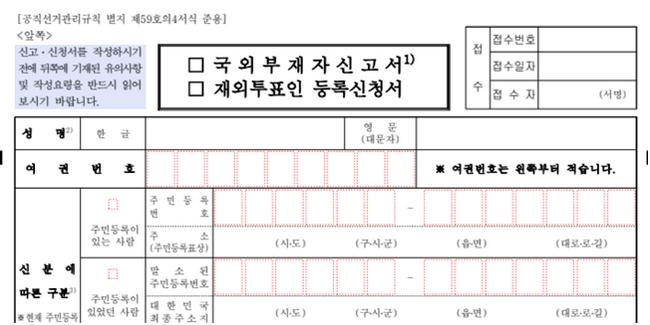
Forms Over Channels
The NEC and overseas missions can state that they opened application channels. In fact, formal channels like the website, mail, and email existed.
However, if all these channels were tied to an application form that required a passport number, the statement that "application channels were open" is not sufficient.
The announcements from overseas missions guided individuals wishing to vote abroad to report or apply within the designated period. They suggested the NEC website, mail, and email as submission methods for overseas absentee reporting, and the same methods for overseas voter registration applications.
The announcement from the Consulate General in Sydney also explained that overseas voters must present their identification document and original documents for nationality verification at the polling station to be able to vote.
This explanation further clarifies the issue.
If identification documents and nationality verification documents can be requested at the voting stage, what is the legal basis for making a passport number virtually mandatory at the application stage?
How were the verification procedures distinguished between the application and voting stages? What alternative verification procedures were guaranteed for citizens without passport numbers?
The NEC needs to explain three points.
First, what is the legal basis for designating the passport number as a key entry for overseas absentee reporting and overseas voter registration applications?
Second, what alternative application procedures were guaranteed for overseas Koreans who do not have passport numbers?
Third, who instructed the design of the application forms and online system around passport numbers, and through what internal procedures was this decision made?
The right to vote in a referendum falls under the scope of constitutional participatory rights.
When administrative agencies design procedures for exercising participatory rights, they cannot rely solely on administrative convenience.
Especially if the intention of amending the Referendum Act was to institutionalize the process for overseas Koreans to participate in referendums, the NEC should have designed the system and application forms in a way that expands the possibility of exercising these rights.
Who Made the Decision?
The figure of 496 applicants prevents this issue from being seen as a mere debate over forms. If the number of new applicants, excluding the 27,450 permanent overseas voters, was only 496, the NEC must examine the reasons for this.
It needs to be determined whether the problem lies in a lack of publicity, the application period, the application method, or if the passport number-centric design actually hindered applications.
Of course, the fact that there were few new applicants does not immediately mean that the requirement for a passport number was the sole cause of the low application rate. Various factors such as a lack of interest from overseas Koreans, uncertainty about the possibility of holding a referendum, a short application period, and differences in guidance by consulates may have contributed.
However, if the application form itself was predicated on providing a passport number, the correlation between the low application rate and the application structure must be verified.
There is a significant gap between the NEC's statement that it opened application channels and the result of only 496 new applicants.
If this gap cannot be explained, the NEC's guidance will remain a formal statement of "application possible." It is necessary to determine whether the system was open to all overseas Koreans or only to those who could provide their passport number.
More importantly, there is the issue of accountability.
Application forms are not documents created by chance. The same applies to online systems.
Decisions about which information to make mandatory, which to make optional, whether to accept applications with missing information or request supplements, and whether to accept alternative documents are all within the realm of administrative design.
Therefore, there must be a decision-making entity and process behind the creation of a "passport number-centric application structure."
The NEC must clarify whether this decision was made in accordance with laws and regulations, internal guidelines, or for practical convenience.
If there is a legal basis, the relevant provisions and interpretation standards should be disclosed. If there are internal guidelines, the entity that drafted them and the implementation date should be explained. If it was for practical convenience, the NEC must explain why alternative means were not sufficiently provided for the exercise of participatory rights.
The Issue is Rights
The essence of this controversy is not just about passport numbers. It is about how the state designs the procedures for citizens' direct exercise of participatory rights.
The core issues are why passport numbers functioned as a de facto gateway when other methods exist for verifying nationality, who made that judgment, and whether that instruction was based on laws and regulations.
Confidence in election management stems from procedures, not just results.
The right to vote in a referendum is the right of citizens, as members of the state, to directly express their will on significant matters of the constitutional order.
If that right can be blocked by a single passport number field on an application form, the NEC must explain "under what conditions it is possible and what alternative procedures exist" rather than simply stating "it is possible."
The NEC promoted the overseas Korean referendum application system. Overseas missions also announced the application period and submission methods. However, the results were limited to 496 new applicants.
That number could indicate simple indifference or a failure in system design. Therefore, an explanation is all the more necessary.
Ultimately, the question is this:
Was the application channel opened by the NEC for all overseas Koreans, or was it a channel that was practically open only to overseas Koreans who could provide their passport number?
Given that new applications, excluding the existing 27,450 permanent voters, were only 496, the NEC must disclose to the public the legal basis for the passport number-centric application structure, alternative procedures, and the responsibility for the decision.

 Iranian Foreign Ministry: "Continuing Message Exchanges with the U.S. and Activities of Mediating Countries"
Esmaeil Baghaei, Spokesperson for the Iranian Ministry of Foreign Affairs [Xinhua, Yonhap News file photo]Esmaeil Baghaei, spokesperson for the Iranian Ministry of Foreign Affairs, stated on the 26th
Iranian Foreign Ministry: "Continuing Message Exchanges with the U.S. and Activities of Mediating Countries"
Esmaeil Baghaei, Spokesperson for the Iranian Ministry of Foreign Affairs [Xinhua, Yonhap News file photo]Esmaeil Baghaei, spokesperson for the Iranian Ministry of Foreign Affairs, stated on the 26th
 President Yoon: "Do You Think You Are Safe from the Special Counsel?"... Final Statement Video Released
President Yoon Suk Yeol rebuking the special prosecutor on the 24th. [Court video / @birds_justice X account subtitle GIF] A video of President Yoon Suk Yeol's closing statement at his trial rega
President Yoon: "Do You Think You Are Safe from the Special Counsel?"... Final Statement Video Released
President Yoon Suk Yeol rebuking the special prosecutor on the 24th. [Court video / @birds_justice X account subtitle GIF] A video of President Yoon Suk Yeol's closing statement at his trial rega
 President Yoon, regarding the first-instance ruling on the Public Official Election Act: “An excessive political verdict that distorts the facts… We will appeal immediately.”
The first-instance sentencing hearing for President Yoon Suk Yeol regarding violations of the Public Official Election Act is being broadcast live at Seoul Station on the 27th. [Photo=Yonhap News]Pres
President Yoon, regarding the first-instance ruling on the Public Official Election Act: “An excessive political verdict that distorts the facts… We will appeal immediately.”
The first-instance sentencing hearing for President Yoon Suk Yeol regarding violations of the Public Official Election Act is being broadcast live at Seoul Station on the 27th. [Photo=Yonhap News]Pres
 WSJ: "SK Hynix ADR Premium Is a Sign of AI Trading Overheat"
Advertisement for SK Hynix ADR listing in New York's Times Square [Reuters=Yonhap News file photo]The Wall Street Journal (WSJ) has pointed out that the price of SK Hynix’s American Depositary Recei
WSJ: "SK Hynix ADR Premium Is a Sign of AI Trading Overheat"
Advertisement for SK Hynix ADR listing in New York's Times Square [Reuters=Yonhap News file photo]The Wall Street Journal (WSJ) has pointed out that the price of SK Hynix’s American Depositary Recei
 'Godfather of Japanese Mystery Novels' Keigo Higashino Passes Away After Battle with Cancer at 68
Famous Japanese mystery novelist Keigo Higashino [AFP=Yonhap News]It has been belatedly reported that Keigo Higashino, the "godfather of Japanese mystery novels" and author of bestsellers such as "The
'Godfather of Japanese Mystery Novels' Keigo Higashino Passes Away After Battle with Cancer at 68
Famous Japanese mystery novelist Keigo Higashino [AFP=Yonhap News]It has been belatedly reported that Keigo Higashino, the "godfather of Japanese mystery novels" and author of bestsellers such as "The
 [Park Pil-kyu Security Column] To the Ignorant Trying to Clothe a Beast in Sheep's Clothing
Rep. Kim Byung-joo of the Democratic Party of Korea [Photo=Yonhap News]“The Air Force Academy doesn't teach you how to fly a plane!” “The Army, Navy, and Air Force academies are exactly the
[Park Pil-kyu Security Column] To the Ignorant Trying to Clothe a Beast in Sheep's Clothing
Rep. Kim Byung-joo of the Democratic Party of Korea [Photo=Yonhap News]“The Air Force Academy doesn't teach you how to fly a plane!” “The Army, Navy, and Air Force academies are exactly the
 [Issue Diagnosis] Two Effects of the Election Petition Review
 [Photo] Evidence of Election Fraud Flooding U.S. Media… Trump Had 2.7 Million Votes Stolen
 [Video] U.S. Semiquincentennial Air Show... 'Art in the Sky' streaks across New York
 [Editorial Cartoon] A Draconian Law That Undermines Freedom of Expression

 List
List










