 A five-meter wide and seven-meter deep breach was discovered on the lower hull. Provided by the Ministry of Foreign Affairs.
The government announced on May 10 that the fire on the Korean vessel (Namho) in the Strait of Hormuz was caused by an unidentified aerial vehicle, but the perpetrator and the means of attack remain unclear.
Unless it was a case of mistaken fire, the perpetrator who intentionally caused damage to a civilian vessel would logically be narrowed down to Iran. However, the government maintains its stance of continuing its investigation into the vessel attack without prejudging the outcome and deciding on future response measures.
According to the government's joint investigation team's findings announced by the Ministry of Foreign Affairs on this day, the government confirmed from the CCTV footage of HMM's Namho that two unidentified aerial vehicles struck the Namho at approximately one-minute intervals.
The impact of the strike caused flames and smoke accompanied by vibrations, and the outer plating of the port stern was damaged, with a width of approximately 5 meters and a depth of approximately 7 meters.
However, it is difficult to confirm the exact model and physical size of the aerial vehicle based on the footage alone, so the government plans to further analyze the engine debris recovered from the site.
If confirmed as an attack by Iran, it is possible that a suicide drone or an anti-ship missile, which Iran has primarily used to threaten vessels in the strait, was used.
In response to a question at the press briefing on the investigation results asking if the unidentified aerial vehicle could be considered a drone, Park Il, spokesperson for the Ministry of Foreign Affairs, stated, "Information regarding the exact projectile requires further investigation. It is a matter that requires additional investigation to determine whether it was a drone or a missile."
Experts who lean towards the drone theory note that although the Namho became incapable of self-navigation due to an engine room fire, it did not sustain severe damage to the point of being halved or sinking.
A military source said, "If it were a cruise missile, the breach would be larger, and the damage would not have ended at this point. If two drones were sent, one detonated, and then the same spot was hit again, the hull could be penetrated up to 7 meters deep."
Conversely, there is also an analysis suggesting a higher possibility of it being a missile, considering the flight characteristics of drones and missiles.
Shin Jong-woo, Secretary-General of the Korea Defense Security Forum (KODEF), pointed out that the damaged area was about 1 to 1.5 meters above sea level and stated, "Drones cannot perform sea-skimming (flying at a low altitude close to the sea surface), so it is highly likely that it was an anti-ship missile flying at sea level."
He added, "Anti-ship missiles can perform sea-skimming and fly horizontally at low altitudes, allowing for repeated strikes on the same spot. Also, drones are slow and explode upon contact with the target, so if it penetrated the steel plate, it is likely an anti-ship missile," mentioning the possibility of Iran's Nasr-1 anti-ship cruise missile.
Experts also note that there are inherent differences in size and specifications between engines used to power relatively small drones and those used in missiles.
It is anticipated that if the debris secured by the government is not excessively damaged, the model of the aerial vehicle can be identified based on these technical differences.
An anonymous military expert said, "If the recovered engine is a jet engine, it's a missile; if it's a reciprocating engine, it's a drone."
The government is also expected to analyze the origin of the parts.
The United States has strictly enforced sanctions and export controls to prevent Iran from acquiring the technology and components necessary for missile and drone production. It is known that Iran has primarily procured the technology and components for weapon development from China and Russia, rather than from Western countries.
Given that the government confirmed the aerial vehicle through CCTV footage, it considers the possibility of mines or torpedoes being used in the attack, as suggested by some in the past, to be low.
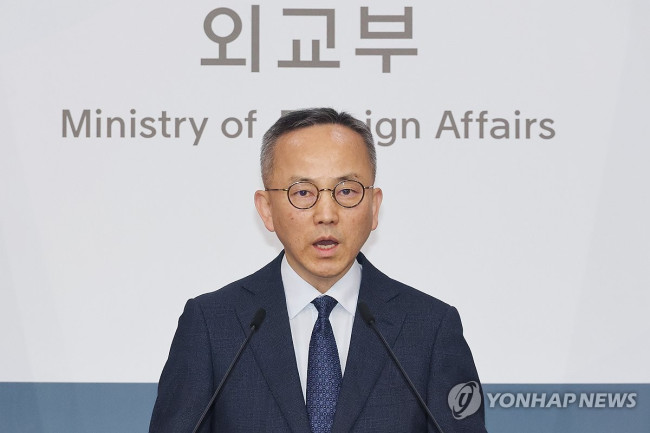 Park Il, spokesperson for the Ministry of Foreign Affairs, announces the results of the Hormuz Namho incident at the Government Complex Seoul on May 10. Yonhap News.
Even after confirming that an aerial vehicle struck the Namho, the government is still approaching the issue of the perpetrator and future responses with extreme caution.
The government has consistently maintained that the confirmation of accurate facts, including whether an attack occurred, is a priority.
At the press briefing on the investigation results, spokesperson Park Il reiterated, "We are not intending to prejudge the perpetrator of this attack at this time," stating that further investigation is still needed.
May 4, the day the explosion and fire occurred on the Korean cargo ship HMM Namho, was also the day the United States initiated military operations to guide ships trapped in the Strait of Hormuz to safe areas.
At the time, Iran claimed that these US operations violated the ceasefire and warned that it would forcibly stop vessels attempting to pass through the Strait of Hormuz without consultation with Iran.
There were indeed minor clashes between the US and Iran on that day, and Iran resumed attacks on neighboring Arab countries, leading to the possibility that the Namho might have also been attacked.
Immediately after the announcement of the investigation results on this day, the government explained the findings to Iranian Ambassador to Korea Said Kozechi at the Ministry of Foreign Affairs building.
To date, the Iranian government has claimed that the Iranian military was not involved in this incident.
However, Iran had warned that "unintended incidents" could occur if passage conditions in the Strait of Hormuz were not met, leading to speculation that it might have been an impulsive attack by groups like the Revolutionary Guard, operating outside the Iranian government's command structure.
As Ambassador Kozechi left the Ministry of Foreign Affairs building, he referred to the vessel attack as an "accident" when speaking to reporters and did not provide further comment when asked if the Iranian government's position that the Iranian military was not involved remained unchanged.
In contrast, the United States, with President Donald Trump having definitively stated from the outset that it was an Iranian attack, has been pressuring South Korea to participate in the US-led operation to 'liberate' ships in the Strait of Hormuz.
Later, as progress appeared to be made in the ceasefire negotiations between the US and Iran, and the US military operations in the Strait of Hormuz entered a lull, the pressure on South Korea seemed to somewhat decrease.
However, if the perpetrator of the vessel attack is confirmed to be Iran, the government may face the necessity and pressure to consider more active responses, including more active participation in US-led efforts to stabilize the strait to protect Korean vessels and citizens.
Park Il, spokesperson for the Ministry of Foreign Affairs, stated, "The government is committed to ensuring the safety of our citizens by thoroughly investigating the cause of the accident and pursuing all possible measures, including cooperation with the international community, to prevent recurrence. We are also closely reviewing participation in US initiatives, including the Maritime Freedom Initiative (MFC)."
The government plans to explain the investigation results to the US and continue related communications.
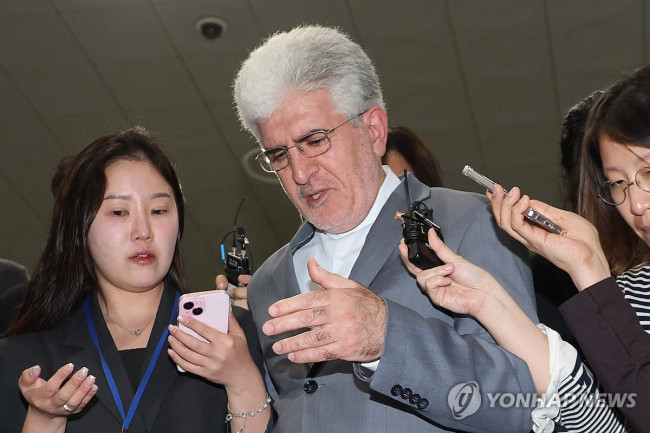 Iranian Ambassador to Korea Said Kozechi leaves the Ministry of Foreign Affairs building at the Government Complex Seoul on May 10, after receiving an explanation from the ministry regarding the HMM Namho incident in the Strait of Hormuz. Yonhap News.

 Iranian Foreign Ministry: "Continuing Message Exchanges with the U.S. and Activities of Mediating Countries"
Esmaeil Baghaei, Spokesperson for the Iranian Ministry of Foreign Affairs [Xinhua, Yonhap News file photo]Esmaeil Baghaei, spokesperson for the Iranian Ministry of Foreign Affairs, stated on the 26th
Iranian Foreign Ministry: "Continuing Message Exchanges with the U.S. and Activities of Mediating Countries"
Esmaeil Baghaei, Spokesperson for the Iranian Ministry of Foreign Affairs [Xinhua, Yonhap News file photo]Esmaeil Baghaei, spokesperson for the Iranian Ministry of Foreign Affairs, stated on the 26th
 President Yoon: "Do You Think You Are Safe from the Special Counsel?"... Final Statement Video Released
President Yoon Suk Yeol rebuking the special prosecutor on the 24th. [Court video / @birds_justice X account subtitle GIF] A video of President Yoon Suk Yeol's closing statement at his trial rega
President Yoon: "Do You Think You Are Safe from the Special Counsel?"... Final Statement Video Released
President Yoon Suk Yeol rebuking the special prosecutor on the 24th. [Court video / @birds_justice X account subtitle GIF] A video of President Yoon Suk Yeol's closing statement at his trial rega
 President Yoon, regarding the first-instance ruling on the Public Official Election Act: “An excessive political verdict that distorts the facts… We will appeal immediately.”
The first-instance sentencing hearing for President Yoon Suk Yeol regarding violations of the Public Official Election Act is being broadcast live at Seoul Station on the 27th. [Photo=Yonhap News]Pres
President Yoon, regarding the first-instance ruling on the Public Official Election Act: “An excessive political verdict that distorts the facts… We will appeal immediately.”
The first-instance sentencing hearing for President Yoon Suk Yeol regarding violations of the Public Official Election Act is being broadcast live at Seoul Station on the 27th. [Photo=Yonhap News]Pres
 WSJ: "SK Hynix ADR Premium Is a Sign of AI Trading Overheat"
Advertisement for SK Hynix ADR listing in New York's Times Square [Reuters=Yonhap News file photo]The Wall Street Journal (WSJ) has pointed out that the price of SK Hynix’s American Depositary Recei
WSJ: "SK Hynix ADR Premium Is a Sign of AI Trading Overheat"
Advertisement for SK Hynix ADR listing in New York's Times Square [Reuters=Yonhap News file photo]The Wall Street Journal (WSJ) has pointed out that the price of SK Hynix’s American Depositary Recei
 'Godfather of Japanese Mystery Novels' Keigo Higashino Passes Away After Battle with Cancer at 68
Famous Japanese mystery novelist Keigo Higashino [AFP=Yonhap News]It has been belatedly reported that Keigo Higashino, the "godfather of Japanese mystery novels" and author of bestsellers such as "The
'Godfather of Japanese Mystery Novels' Keigo Higashino Passes Away After Battle with Cancer at 68
Famous Japanese mystery novelist Keigo Higashino [AFP=Yonhap News]It has been belatedly reported that Keigo Higashino, the "godfather of Japanese mystery novels" and author of bestsellers such as "The
 [Park Pil-kyu Security Column] To the Ignorant Trying to Clothe a Beast in Sheep's Clothing
Rep. Kim Byung-joo of the Democratic Party of Korea [Photo=Yonhap News]“The Air Force Academy doesn't teach you how to fly a plane!” “The Army, Navy, and Air Force academies are exactly the
[Park Pil-kyu Security Column] To the Ignorant Trying to Clothe a Beast in Sheep's Clothing
Rep. Kim Byung-joo of the Democratic Party of Korea [Photo=Yonhap News]“The Air Force Academy doesn't teach you how to fly a plane!” “The Army, Navy, and Air Force academies are exactly the
 [Issue Diagnosis] Two Effects of the Election Petition Review
 [Photo] Evidence of Election Fraud Flooding U.S. Media… Trump Had 2.7 Million Votes Stolen
 [Video] U.S. Semiquincentennial Air Show... 'Art in the Sky' streaks across New York
 [Editorial Cartoon] A Draconian Law That Undermines Freedom of Expression

 List
List









