 The South Korean government announced that a fire incident involving a Korean vessel, the HMM Namuho, in the Strait of Hormuz on the 4th was caused by an unidentified aerial object. The Ministry of Foreign Affairs revealed the joint government investigation results on the 10th and released photos recorded by the on-site investigation team. The photo shows the scene of the HMM Namuho fire. [Provided by the Ministry of Foreign Affairs]
With the cause of the HMM Namuho fire in the Strait of Hormuz confirmed on the 10th as an 'external attack' by an unidentified aerial vehicle, attention is being paid to whether the government will more actively consider ways to contribute to international efforts for navigational safety.
In particular, there is keen interest in whether there will be a slight shift in the government's previously cautious stance regarding the deployment of military assets in the Strait of Hormuz.
The government has cautiously reviewed its participation and methods in initiatives such as the U.S.-proposed multinational coalition 'Maritime Freedom Construct' (MFC) and multinational force concepts led by the UK and France, predicated on a post-conflict scenario.
This caution stemmed from the fact that the cause of the HMM Namuho fire was not yet definitively established, and there were significant practical constraints such as ensuring safety and the need for parliamentary approval for immediate deployment of military assets like warships to the Strait of Hormuz.
However, the fact that a civilian vessel operated by a Korean shipping company has become a direct target of an external attack in the Strait of Hormuz could become a new variable in the government's consideration of its response.
In response to a question at a briefing about how the investigation would affect the government's participation in U.S.-led efforts to stabilize the Strait of Hormuz, Foreign Ministry Spokesperson Park Il stated, "We intend to ensure the utmost safety of our citizens by pursuing all possible measures, including cooperation with the international community, to prevent recurrence."
He added, "We are also closely reviewing the issue of participating in U.S. initiatives, including the Maritime Freedom Construct (MFC)."
There is also a possibility that pressure from countries like the United States, urging South Korea to participate more actively in stabilization efforts in the Strait of Hormuz, could intensify following the conclusion of an 'external attack'.
U.S. President Donald Trump had claimed on the 4th that the Namuho was attacked by Iran while acting alone, not participating in a 'liberation project' where the U.S. would use military force to rescue third-country ships stranded in the strait, and had pressed for South Korea's contribution to resolving the strait's blockage.
Attention is therefore focused on how this issue will be discussed during the meeting between U.S. Secretary of Defense Mark Esper and South Korean Minister of National Defense Jeong Kyeong-doo in the United States on the 11th (local time). It remains to be seen if the U.S. side will reiterate the possibility of Iranian involvement and request more active participation from South Korea.
Measures that the government could implement before a full-scale conflict to stabilize the Strait of Hormuz, even before the Korean War ended, include non-combat contributions such as information sharing and the dispatch of liaison officers.
Regarding the actual deployment of military assets, the military maintains a cautious stance, stating that it will "comprehensively consider international law and the safety of international sea lanes, the ROK-U.S. alliance and the security situation on the Korean Peninsula, and domestic legal procedures."
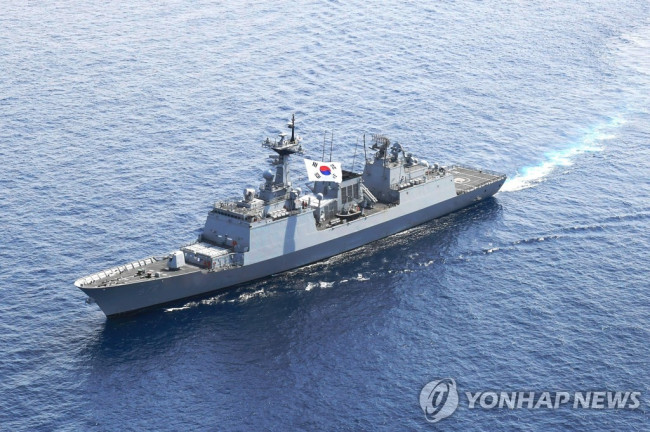 The destroyer ROKS Daejoyeong, part of the Cheonghae Unit, carrying out its mission [Provided by the JCS=Yonhap News]
The Ministry of National Defense's judgment is that parliamentary approval is required to deploy the Cheonghae Unit's forces, which are currently engaged in missions such as protecting our merchant vessels and combating piracy in the Gulf of Aden, to the Strait of Hormuz, where a de facto wartime situation exists.
However, there is a possibility that the Cheonghae Unit's forces could provide safety support to merchant vessels in the outer areas of the Strait of Hormuz.
The destroyer ROKS Wang Geon (4,400-ton class), the 48th contingent of the Cheonghae Unit, is scheduled to depart on the 15th to replace the 47th contingent, the ROKS Daejoyeong, which is currently on mission.
The ROKS Wang Geon will depart with enhanced anti-drone capabilities compared to the ROKS Daejoyeong, and it is reported that it takes approximately 3 to 4 weeks to reach the Gulf of Aden.
Some speculate that expanding the operational scope of the Cheonghae Unit is a realistically effective contribution, and depending on future developments, the government may proactively consider undergoing the parliamentary ratification process.
The very act of pursuing such procedures could send a message to the international community that it is preparing for a substantial contribution.

 Iranian Foreign Ministry: "Continuing Message Exchanges with the U.S. and Activities of Mediating Countries"
Esmaeil Baghaei, Spokesperson for the Iranian Ministry of Foreign Affairs [Xinhua, Yonhap News file photo]Esmaeil Baghaei, spokesperson for the Iranian Ministry of Foreign Affairs, stated on the 26th
Iranian Foreign Ministry: "Continuing Message Exchanges with the U.S. and Activities of Mediating Countries"
Esmaeil Baghaei, Spokesperson for the Iranian Ministry of Foreign Affairs [Xinhua, Yonhap News file photo]Esmaeil Baghaei, spokesperson for the Iranian Ministry of Foreign Affairs, stated on the 26th
 President Yoon: "Do You Think You Are Safe from the Special Counsel?"... Final Statement Video Released
President Yoon Suk Yeol rebuking the special prosecutor on the 24th. [Court video / @birds_justice X account subtitle GIF] A video of President Yoon Suk Yeol's closing statement at his trial rega
President Yoon: "Do You Think You Are Safe from the Special Counsel?"... Final Statement Video Released
President Yoon Suk Yeol rebuking the special prosecutor on the 24th. [Court video / @birds_justice X account subtitle GIF] A video of President Yoon Suk Yeol's closing statement at his trial rega
 President Yoon, regarding the first-instance ruling on the Public Official Election Act: “An excessive political verdict that distorts the facts… We will appeal immediately.”
The first-instance sentencing hearing for President Yoon Suk Yeol regarding violations of the Public Official Election Act is being broadcast live at Seoul Station on the 27th. [Photo=Yonhap News]Pres
President Yoon, regarding the first-instance ruling on the Public Official Election Act: “An excessive political verdict that distorts the facts… We will appeal immediately.”
The first-instance sentencing hearing for President Yoon Suk Yeol regarding violations of the Public Official Election Act is being broadcast live at Seoul Station on the 27th. [Photo=Yonhap News]Pres
 WSJ: "SK Hynix ADR Premium Is a Sign of AI Trading Overheat"
Advertisement for SK Hynix ADR listing in New York's Times Square [Reuters=Yonhap News file photo]The Wall Street Journal (WSJ) has pointed out that the price of SK Hynix’s American Depositary Recei
WSJ: "SK Hynix ADR Premium Is a Sign of AI Trading Overheat"
Advertisement for SK Hynix ADR listing in New York's Times Square [Reuters=Yonhap News file photo]The Wall Street Journal (WSJ) has pointed out that the price of SK Hynix’s American Depositary Recei
 'Godfather of Japanese Mystery Novels' Keigo Higashino Passes Away After Battle with Cancer at 68
Famous Japanese mystery novelist Keigo Higashino [AFP=Yonhap News]It has been belatedly reported that Keigo Higashino, the "godfather of Japanese mystery novels" and author of bestsellers such as "The
'Godfather of Japanese Mystery Novels' Keigo Higashino Passes Away After Battle with Cancer at 68
Famous Japanese mystery novelist Keigo Higashino [AFP=Yonhap News]It has been belatedly reported that Keigo Higashino, the "godfather of Japanese mystery novels" and author of bestsellers such as "The
 [Park Pil-kyu Security Column] To the Ignorant Trying to Clothe a Beast in Sheep's Clothing
Rep. Kim Byung-joo of the Democratic Party of Korea [Photo=Yonhap News]“The Air Force Academy doesn't teach you how to fly a plane!” “The Army, Navy, and Air Force academies are exactly the
[Park Pil-kyu Security Column] To the Ignorant Trying to Clothe a Beast in Sheep's Clothing
Rep. Kim Byung-joo of the Democratic Party of Korea [Photo=Yonhap News]“The Air Force Academy doesn't teach you how to fly a plane!” “The Army, Navy, and Air Force academies are exactly the
 [Issue Diagnosis] Two Effects of the Election Petition Review
 [Photo] Evidence of Election Fraud Flooding U.S. Media… Trump Had 2.7 Million Votes Stolen
 [Video] U.S. Semiquincentennial Air Show... 'Art in the Sky' streaks across New York
 [Editorial Cartoon] A Draconian Law That Undermines Freedom of Expression

 List
List









