- "Solid growth potential and governance, with stock price relatively undervalued."
 TSMC Logo [Reuters=Yonhap News]
Amid an unprecedented surge in performance for memory semiconductor companies like Samsung Electronics due to the artificial intelligence (AI) boom, Taiwan's TSMC, the world's No. 1 foundry (semiconductor contract manufacturing), is garnering attention as a key driver of future growth, the Wall Street Journal (WSJ) reported on the 11th (local time).
The WSJ emphasized, "While TSMC does not produce memory chips, it is an indispensable manufacturer in virtually all other sectors, including Nvidia's AI chips and Apple's smartphone chips."
According to the WSJ, TSMC's greatest strength is its well-managed growth potential. As the speed of revenue growth outpaces the speed of cost increases, its gross profit margin is rising.
This creates a virtuous cycle where the burden of fixed costs is offset as the factories operate close to "full capacity." The company's gross profit margin rose from 59% a year ago to 66% in the first quarter of this year.
Compared to other big tech companies grappling with the AI bubble issue, TSMC's situation is much more favorable.
Although TSMC announced that its capital expenditures (CAPEX) this year will be at the higher end of the initially projected range of $52 billion to $56 billion, the market sees little of this as overexpansion.
Wei Zhejia (C.C. Wei), chairman of TSMC, expressed confidence that revenue growth this year will exceed 30%, sufficiently outstripping the increase in investment.
The WSJ noted that the revenue growth emphasized by the company is solidifying as a given trend. This is because, amidst the competition for AI equipment, customers are actively securing semiconductor volumes, even paying billions of dollars in advance payments.
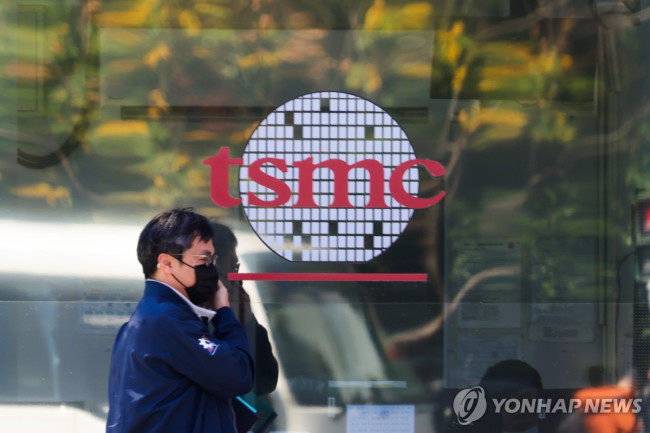 Pedestrian walks past TSMC logo [EPA=Yonhap News]
For example, Nvidia had purchase commitments exceeding $95 billion (141 trillion won) in its fiscal fourth quarter (November to January), a significant portion of which reflects payments to TSMC. Nvidia's purchase commitment has grown nearly sixfold compared to $16 billion two years ago.
Another of TSMC's attractions is its market dominance, where it virtually has no competitors. While Samsung Electronics is the second-largest foundry in the world, the revenue gap with TSMC is substantial, and Intel and Japan's Rapidus are struggling to establish themselves in the market.
Recently, Tesla CEO Elon Musk launched the 'Terafab' project in collaboration with Intel to counter TSMC, but it is expected to take a long time for actual results to emerge.
Despite these advantages, the WSJ reported that TSMC's stock price is undervalued. The company's 12-month forward price-to-earnings ratio is around 21 times, well below the Philadelphia Semiconductor Index's average of 26 times.
TSMC's stock price has risen 44% since the beginning of the year. This is significantly lower compared to the 112.5% and 174.2% increases in the stock prices of Samsung Electronics and SK Hynix, respectively, during the same period.
According to the Korea Securities Depository, as of the 8th, Korean investors held $1.61 billion (approximately 2.4 trillion won) worth of TSMC ADRs listed on U.S. stock exchanges, ranking 26th among U.S. stocks.
What do you think of this article?

 Iranian Foreign Ministry: "Continuing Message Exchanges with the U.S. and Activities of Mediating Countries"
Esmaeil Baghaei, Spokesperson for the Iranian Ministry of Foreign Affairs [Xinhua, Yonhap News file photo]Esmaeil Baghaei, spokesperson for the Iranian Ministry of Foreign Affairs, stated on the 26th
Iranian Foreign Ministry: "Continuing Message Exchanges with the U.S. and Activities of Mediating Countries"
Esmaeil Baghaei, Spokesperson for the Iranian Ministry of Foreign Affairs [Xinhua, Yonhap News file photo]Esmaeil Baghaei, spokesperson for the Iranian Ministry of Foreign Affairs, stated on the 26th
 President Yoon: "Do You Think You Are Safe from the Special Counsel?"... Final Statement Video Released
President Yoon Suk Yeol rebuking the special prosecutor on the 24th. [Court video / @birds_justice X account subtitle GIF] A video of President Yoon Suk Yeol's closing statement at his trial rega
President Yoon: "Do You Think You Are Safe from the Special Counsel?"... Final Statement Video Released
President Yoon Suk Yeol rebuking the special prosecutor on the 24th. [Court video / @birds_justice X account subtitle GIF] A video of President Yoon Suk Yeol's closing statement at his trial rega
 President Yoon, regarding the first-instance ruling on the Public Official Election Act: “An excessive political verdict that distorts the facts… We will appeal immediately.”
The first-instance sentencing hearing for President Yoon Suk Yeol regarding violations of the Public Official Election Act is being broadcast live at Seoul Station on the 27th. [Photo=Yonhap News]Pres
President Yoon, regarding the first-instance ruling on the Public Official Election Act: “An excessive political verdict that distorts the facts… We will appeal immediately.”
The first-instance sentencing hearing for President Yoon Suk Yeol regarding violations of the Public Official Election Act is being broadcast live at Seoul Station on the 27th. [Photo=Yonhap News]Pres
 WSJ: "SK Hynix ADR Premium Is a Sign of AI Trading Overheat"
Advertisement for SK Hynix ADR listing in New York's Times Square [Reuters=Yonhap News file photo]The Wall Street Journal (WSJ) has pointed out that the price of SK Hynix’s American Depositary Recei
WSJ: "SK Hynix ADR Premium Is a Sign of AI Trading Overheat"
Advertisement for SK Hynix ADR listing in New York's Times Square [Reuters=Yonhap News file photo]The Wall Street Journal (WSJ) has pointed out that the price of SK Hynix’s American Depositary Recei
 'Godfather of Japanese Mystery Novels' Keigo Higashino Passes Away After Battle with Cancer at 68
Famous Japanese mystery novelist Keigo Higashino [AFP=Yonhap News]It has been belatedly reported that Keigo Higashino, the "godfather of Japanese mystery novels" and author of bestsellers such as "The
'Godfather of Japanese Mystery Novels' Keigo Higashino Passes Away After Battle with Cancer at 68
Famous Japanese mystery novelist Keigo Higashino [AFP=Yonhap News]It has been belatedly reported that Keigo Higashino, the "godfather of Japanese mystery novels" and author of bestsellers such as "The
 [Park Pil-kyu Security Column] To the Ignorant Trying to Clothe a Beast in Sheep's Clothing
Rep. Kim Byung-joo of the Democratic Party of Korea [Photo=Yonhap News]“The Air Force Academy doesn't teach you how to fly a plane!” “The Army, Navy, and Air Force academies are exactly the
[Park Pil-kyu Security Column] To the Ignorant Trying to Clothe a Beast in Sheep's Clothing
Rep. Kim Byung-joo of the Democratic Party of Korea [Photo=Yonhap News]“The Air Force Academy doesn't teach you how to fly a plane!” “The Army, Navy, and Air Force academies are exactly the
 [Issue Diagnosis] Two Effects of the Election Petition Review
 [Photo] Evidence of Election Fraud Flooding U.S. Media… Trump Had 2.7 Million Votes Stolen
 [Video] U.S. Semiquincentennial Air Show... 'Art in the Sky' streaks across New York
 [Editorial Cartoon] A Draconian Law That Undermines Freedom of Expression

 List
List









