Samsung Electronics' labor and management are in a critical phase of wage negotiations, failing to reach an agreement even on the second day of the post-mediation period.
With a general strike just nine days away, there are predictions that the government will extend the post-mediation period for further arbitration, and the possibility of invoking emergency arbitration as a last resort to prevent national damage from the strike is also being discussed.
 Samsung Electronics' labor and management are engaged in the final negotiations regarding performance-based bonus disputes under government mediation during the second post-mediation meeting held at the Central Labor Relations Commission in Sejong Government Complex on the 12th. In the photo are Vice President Kim Hyung-ro (left), Samsung Electronics' chief negotiator, and Choi Seung-ho (right), chairperson of the United Samsung Electronics Branch of the Pan-Company Labor Union, who are attending the second post-mediation meeting. In the center photo is Hwang Ki-don, a standing mediation commissioner of the Central Labor Relations Commission, responding to reporters' questions outside the first post-mediation meeting venue the previous day. [Yonhap News]
Samsung Electronics' labor and management held their second post-mediation meeting on May 12th at the Central Labor Relations Commission in the Sejong Government Complex for the 2026 wage agreement, but negotiations are facing difficulties.
Having failed to reach an agreement during the mediation held in February-March, leading to the suspension of mediation, Samsung Electronics' labor and management resumed negotiations through the post-mediation process for two days starting yesterday.
Post-mediation is a procedure that is re-implemented with the consent of both labor and management to resolve labor disputes after mediation has ended.
The Central Labor Relations Commission acts as a mediator, facilitating negotiations, and if a mediation proposal is reached, it has the same legal effect as a collective agreement.
Following the first meeting yesterday, which lasted approximately 11 hours and 30 minutes from 10 AM, there are predictions that it may be difficult to reach a conclusion even by late tonight for the second meeting.
The union has clearly stated its firm stance of being prepared for negotiation breakdown even before the meeting began.
Choi Seung-ho, chairperson of the United Samsung Electronics Branch of the Pan-Company Labor Union (hereafter Pan-Company Labor Union), Samsung Electronics' largest union, told reporters before attending the meeting, "We are working with the sole aim of delivering results that our members can be satisfied with," and added, "I want to say that we will do our best, whether it leads to an agreement or a breakdown."
Kim Hyung-ro, the company's chief negotiator, entered the meeting room without responding to reporters' questions.
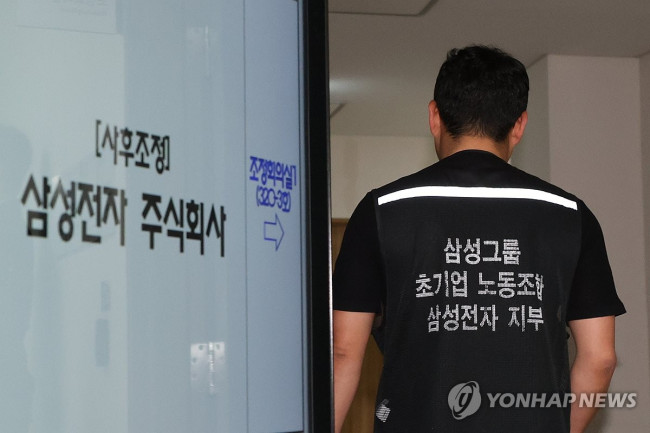 Union negotiators attending the second post-mediation meeting [Yonhap News]
The core issue where labor and management are at an impasse is the basis for performance-based bonus funds and whether to formalize them.
The labor side demands the abolition of the performance-based bonus cap and the institutionalization of a payment plan where 15% of operating profit is set aside as funds for performance-based bonuses.
While the management promises the highest treatment through special rewards if top domestic performance is achieved, they maintain that the institutionalization of performance-based bonuses, as demanded by the union, should be discussed over time.
It is known that the Central Labor Relations Commission will propose a mediation plan that allows for compromise to both labor and management today, following the listening to both sides' opinions yesterday.
If labor and management fail to reach an agreement today or do not accept the Central Labor Relations Commission's mediation proposal, the post-mediation process may be extended.
There is no legal time limit for post-mediation, so it can be operated flexibly according to the agreement of labor and management.
The Central Labor Relations Commission plans to persuade labor and management to extend the period and attempt further mediation if they believe there are still points of contact, even if labor and management request the suspension of mediation.
Despite this, if an agreement is ultimately not reached and a general strike occurs on the 21st, it is predicted that the damage could exceed 40 trillion won, with more critical long-term damage such as customer departure during the semiconductor super-boom and disruption of the supply chain.
Some speculate that the government may invoke emergency arbitration to prevent such a situation.
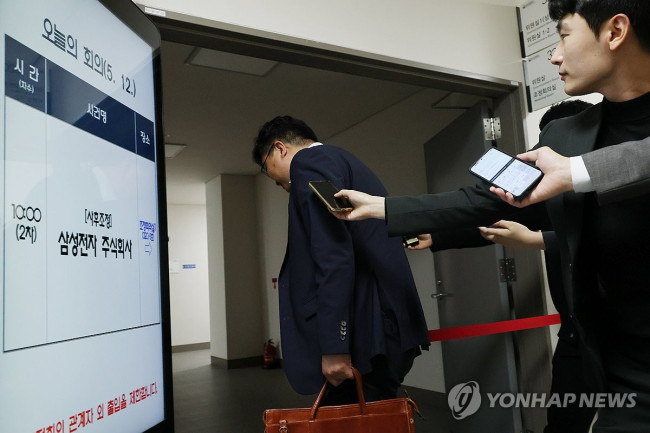 Samsung Electronics' management representatives attending the second post-mediation meeting [Yonhap News]
Emergency arbitration is a system based on Article 76 of the Labor Union and Labor Relations Adjustment Act (Labor Union Act), and it is an exceptional mediation procedure that the Minister of Employment and Labor can invoke when a labor dispute is likely to endanger the daily lives of citizens or significantly harm the national economy.
Upon invocation of emergency arbitration, labor disputes are prohibited for 30 days, and mediation and arbitration procedures by the Central Labor Relations Commission are conducted.
There have been only four instances of emergency arbitration being invoked in the past: the strike at Korea Shipbuilding & Engineering Corporation in 1969, the Hyundai Motor Company strike in 1993, and the pilots' strikes at Asiana Airlines and Korean Air in July and December 2005.

 Iranian Foreign Ministry: "Continuing Message Exchanges with the U.S. and Activities of Mediating Countries"
Esmaeil Baghaei, Spokesperson for the Iranian Ministry of Foreign Affairs [Xinhua, Yonhap News file photo]Esmaeil Baghaei, spokesperson for the Iranian Ministry of Foreign Affairs, stated on the 26th
Iranian Foreign Ministry: "Continuing Message Exchanges with the U.S. and Activities of Mediating Countries"
Esmaeil Baghaei, Spokesperson for the Iranian Ministry of Foreign Affairs [Xinhua, Yonhap News file photo]Esmaeil Baghaei, spokesperson for the Iranian Ministry of Foreign Affairs, stated on the 26th
 President Yoon: "Do You Think You Are Safe from the Special Counsel?"... Final Statement Video Released
President Yoon Suk Yeol rebuking the special prosecutor on the 24th. [Court video / @birds_justice X account subtitle GIF] A video of President Yoon Suk Yeol's closing statement at his trial rega
President Yoon: "Do You Think You Are Safe from the Special Counsel?"... Final Statement Video Released
President Yoon Suk Yeol rebuking the special prosecutor on the 24th. [Court video / @birds_justice X account subtitle GIF] A video of President Yoon Suk Yeol's closing statement at his trial rega
 President Yoon, regarding the first-instance ruling on the Public Official Election Act: “An excessive political verdict that distorts the facts… We will appeal immediately.”
The first-instance sentencing hearing for President Yoon Suk Yeol regarding violations of the Public Official Election Act is being broadcast live at Seoul Station on the 27th. [Photo=Yonhap News]Pres
President Yoon, regarding the first-instance ruling on the Public Official Election Act: “An excessive political verdict that distorts the facts… We will appeal immediately.”
The first-instance sentencing hearing for President Yoon Suk Yeol regarding violations of the Public Official Election Act is being broadcast live at Seoul Station on the 27th. [Photo=Yonhap News]Pres
 WSJ: "SK Hynix ADR Premium Is a Sign of AI Trading Overheat"
Advertisement for SK Hynix ADR listing in New York's Times Square [Reuters=Yonhap News file photo]The Wall Street Journal (WSJ) has pointed out that the price of SK Hynix’s American Depositary Recei
WSJ: "SK Hynix ADR Premium Is a Sign of AI Trading Overheat"
Advertisement for SK Hynix ADR listing in New York's Times Square [Reuters=Yonhap News file photo]The Wall Street Journal (WSJ) has pointed out that the price of SK Hynix’s American Depositary Recei
 'Godfather of Japanese Mystery Novels' Keigo Higashino Passes Away After Battle with Cancer at 68
Famous Japanese mystery novelist Keigo Higashino [AFP=Yonhap News]It has been belatedly reported that Keigo Higashino, the "godfather of Japanese mystery novels" and author of bestsellers such as "The
'Godfather of Japanese Mystery Novels' Keigo Higashino Passes Away After Battle with Cancer at 68
Famous Japanese mystery novelist Keigo Higashino [AFP=Yonhap News]It has been belatedly reported that Keigo Higashino, the "godfather of Japanese mystery novels" and author of bestsellers such as "The
 [Park Pil-kyu Security Column] To the Ignorant Trying to Clothe a Beast in Sheep's Clothing
Rep. Kim Byung-joo of the Democratic Party of Korea [Photo=Yonhap News]“The Air Force Academy doesn't teach you how to fly a plane!” “The Army, Navy, and Air Force academies are exactly the
[Park Pil-kyu Security Column] To the Ignorant Trying to Clothe a Beast in Sheep's Clothing
Rep. Kim Byung-joo of the Democratic Party of Korea [Photo=Yonhap News]“The Air Force Academy doesn't teach you how to fly a plane!” “The Army, Navy, and Air Force academies are exactly the
 [Issue Diagnosis] Two Effects of the Election Petition Review
 [Photo] Evidence of Election Fraud Flooding U.S. Media… Trump Had 2.7 Million Votes Stolen
 [Video] U.S. Semiquincentennial Air Show... 'Art in the Sky' streaks across New York
 [Editorial Cartoon] A Draconian Law That Undermines Freedom of Expression

 List
List









