 U.S. President Donald Trump (left) visits China.
As a record-sized delegation of industry leaders from the technology, finance, and aviation sectors prepare to accompany President Trump on his visit to China for the U.S.-China summit in Beijing on the 14th, it is noteworthy that President Trump precisely one year ago today mentioned China's "full opening of its capital markets."
On May 12th last year (U.S. local time, May 13th Korean time), President Trump held a press conference at the White House in Washington D.C. and announced, "China has agreed to fully open its capital markets to the United States."
At the time, the global trade war was at its peak, and the U.S. President's official statement followed high-level talks between the U.S. and China held in Geneva the previous weekend. Domestic media downplayed the term "full opening" to "market opening," and coupled with the preceding announcement that the U.S. would suspend tariffs on China for 90 days, rampant speculation arose that the U.S. had capitulated to China.
However, the reality was different. Markets anticipated that the behind-the-scenes agreement that effectively led to the tariff suspension would be revealed, and it soon became clear that the "verbal agreement for the full opening of China's capital markets" was behind it. For Xi Jinping, who was effectively cornered, it was a humiliation where he ceded control of his territory without being able to put up a fight, and public attention turned to what "plus alpha" card had neutralized China at the time.
President Trump hinted at "full opening" within the bounds of common sense. He focused on the unfairness where Chinese companies could freely operate in the U.S. while U.S. companies could not freely pursue profit-generating activities in China. Specifically, he stated, "It never made sense to me that China didn't open its markets to us. It wasn't fair. But now they agreed to open it up, and it's going to be a wonderful thing for both countries."
He added, "China has also agreed to defer and eliminate non-monetary barriers," and noted China's proactive measures by saying, "They've agreed to remove a lot, a lot of barriers." President Trump did suggest, however, that the commitments made by the Chinese side were not yet solidified, stating, "We have to get it papered, but the agreement itself will be of great benefit to everybody."
Consequently, pro-Trump think tanks, focusing on Trump's rhetoric that seized the agenda, predicted, "He will eventually achieve his goals." However, left-leaning mainstream U.S. media did not pay attention to this, and domestic media, which have followed the tone of U.S. media regarding international news, also largely ignored it.
Conversely, U.S. analysts primarily pointed out that when a communist country opens its markets to companies from capitalist countries, the implications extend beyond economics. They offered a reasoned analysis that if the North Korean market were fully opened and U.S. telecommunications companies provided unlimited Wi-Fi to North Korean citizens, socialist government control would be effectively neutralized, jeopardizing the regime's existence.
President Trump also projected an air of confidence during the press conference. He said, "The Geneva meeting with China was very friendly, and relations between the two countries are very good," showcasing his familiarity with his characteristic "Kyoto-style" rhetoric, and quipped, "We're not looking to hurt China. The Communist Party of China is happy just having the ability to do things with us."
The Chinese Ministry of Foreign Affairs and the Chinese Embassy in the United States remained silent, offering no comments on President Trump's unprecedented remarks. This was a significant departure from China's usual immediate rebuttals citing "interference in internal affairs," leading to widespread speculation. In essence, the question was: why was China backing down? This was before the U.S. had engaged with Venezuela and Iran, and China's leverage tools, such as rare earth minerals, were still intact.
Exactly one year later, on the 13th (Korean time), assessments are spreading among the U.S. conservative circles that China's capital markets are indeed falling in line with the path predicted by the U.S. Analyses suggest that from the moment the U.S. dealt with Venezuela and Iran, it had already begun to tighten the economic noose around China.
In addition, leading entrepreneurs from capitalist America are knocking on China's doors. According to foreign media reports from outlets like Bloomberg, the group of billionaires includes Elon Musk, CEO of Tesla and SpaceX; Tim Cook, CEO of Apple; Jensen Huang, CEO of Nvidia; and Kelly Ottberg, CEO of Boeing.
In addition, executives from major U.S. companies are heading to China, including David Solomon, CEO of Goldman Sachs; Stephen Schwarzman, CEO of Blackstone; Larry Fink, CEO of BlackRock; Jane Fraser, CEO of Citigroup; Dina Powell McCormick, President of the Middle East and North Africa at LinkedIn (part of Meta); Sanjay Mehrotra, CEO of Micron; Cristiano Amon, CEO of Qualcomm; Jacob Thaysen, CEO of Illumina; Michael Miebach, CEO of Mastercard; Ryan McInerney, President of Visa; Brian Sikes, Chairman and CEO of Cargill; Chuck Robbins, CEO of Cisco; Jim Anderson, CEO of Coherent; and H. Lawrence Culp Jr., CEO of GE Aerospace. It's akin to a feast with plenty of food drawing in many guests. President Trump is poised to secure significant business deals and purchase agreements with China on this visit. The prevailing analysis is that this scenario is possible because he holds China's lifeline.
President Trump is scheduled to make a state visit to China from the 13th to the 15th.
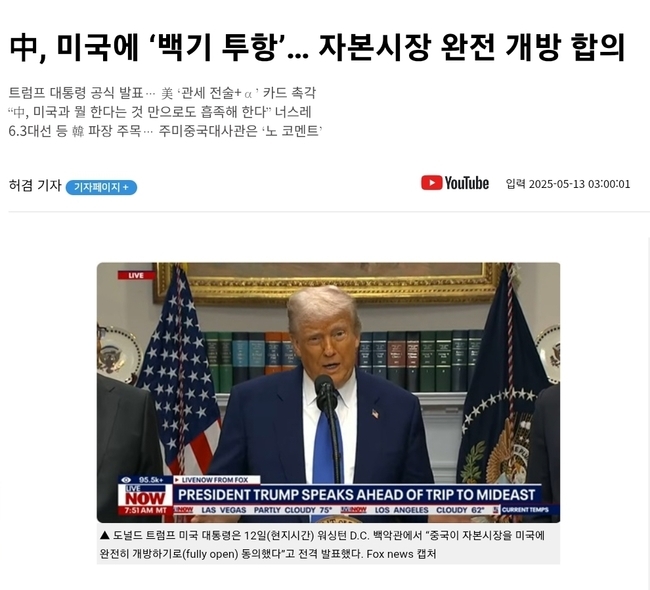 Capture from a Sky Daily report dated May 13, 2025.

 Iranian Foreign Ministry: "Continuing Message Exchanges with the U.S. and Activities of Mediating Countries"
Esmaeil Baghaei, Spokesperson for the Iranian Ministry of Foreign Affairs [Xinhua, Yonhap News file photo]Esmaeil Baghaei, spokesperson for the Iranian Ministry of Foreign Affairs, stated on the 26th
Iranian Foreign Ministry: "Continuing Message Exchanges with the U.S. and Activities of Mediating Countries"
Esmaeil Baghaei, Spokesperson for the Iranian Ministry of Foreign Affairs [Xinhua, Yonhap News file photo]Esmaeil Baghaei, spokesperson for the Iranian Ministry of Foreign Affairs, stated on the 26th
 President Yoon: "Do You Think You Are Safe from the Special Counsel?"... Final Statement Video Released
President Yoon Suk Yeol rebuking the special prosecutor on the 24th. [Court video / @birds_justice X account subtitle GIF] A video of President Yoon Suk Yeol's closing statement at his trial rega
President Yoon: "Do You Think You Are Safe from the Special Counsel?"... Final Statement Video Released
President Yoon Suk Yeol rebuking the special prosecutor on the 24th. [Court video / @birds_justice X account subtitle GIF] A video of President Yoon Suk Yeol's closing statement at his trial rega
 President Yoon, regarding the first-instance ruling on the Public Official Election Act: “An excessive political verdict that distorts the facts… We will appeal immediately.”
The first-instance sentencing hearing for President Yoon Suk Yeol regarding violations of the Public Official Election Act is being broadcast live at Seoul Station on the 27th. [Photo=Yonhap News]Pres
President Yoon, regarding the first-instance ruling on the Public Official Election Act: “An excessive political verdict that distorts the facts… We will appeal immediately.”
The first-instance sentencing hearing for President Yoon Suk Yeol regarding violations of the Public Official Election Act is being broadcast live at Seoul Station on the 27th. [Photo=Yonhap News]Pres
 WSJ: "SK Hynix ADR Premium Is a Sign of AI Trading Overheat"
Advertisement for SK Hynix ADR listing in New York's Times Square [Reuters=Yonhap News file photo]The Wall Street Journal (WSJ) has pointed out that the price of SK Hynix’s American Depositary Recei
WSJ: "SK Hynix ADR Premium Is a Sign of AI Trading Overheat"
Advertisement for SK Hynix ADR listing in New York's Times Square [Reuters=Yonhap News file photo]The Wall Street Journal (WSJ) has pointed out that the price of SK Hynix’s American Depositary Recei
 'Godfather of Japanese Mystery Novels' Keigo Higashino Passes Away After Battle with Cancer at 68
Famous Japanese mystery novelist Keigo Higashino [AFP=Yonhap News]It has been belatedly reported that Keigo Higashino, the "godfather of Japanese mystery novels" and author of bestsellers such as "The
'Godfather of Japanese Mystery Novels' Keigo Higashino Passes Away After Battle with Cancer at 68
Famous Japanese mystery novelist Keigo Higashino [AFP=Yonhap News]It has been belatedly reported that Keigo Higashino, the "godfather of Japanese mystery novels" and author of bestsellers such as "The
 [Park Pil-kyu Security Column] To the Ignorant Trying to Clothe a Beast in Sheep's Clothing
Rep. Kim Byung-joo of the Democratic Party of Korea [Photo=Yonhap News]“The Air Force Academy doesn't teach you how to fly a plane!” “The Army, Navy, and Air Force academies are exactly the
[Park Pil-kyu Security Column] To the Ignorant Trying to Clothe a Beast in Sheep's Clothing
Rep. Kim Byung-joo of the Democratic Party of Korea [Photo=Yonhap News]“The Air Force Academy doesn't teach you how to fly a plane!” “The Army, Navy, and Air Force academies are exactly the
 [Issue Diagnosis] Two Effects of the Election Petition Review
 [Photo] Evidence of Election Fraud Flooding U.S. Media… Trump Had 2.7 Million Votes Stolen
 [Video] U.S. Semiquincentennial Air Show... 'Art in the Sky' streaks across New York
 [Editorial Cartoon] A Draconian Law That Undermines Freedom of Expression

 List
List









