 A new report highlights the cooperative relationship between Kim Jong-un (left) and Vladimir Putin in relation to the sinking of the Russian cargo ship Ursa Major. [Photo: Getty Images]
A new report has emerged concerning the sinking of the Russian cargo ship Ursa Major in the Mediterranean Sea in December 2024.
The new report allegedly states that "the Ursa Major is believed to have suffered multiple explosions while carrying two nuclear reactors towards North Korea."
According to a CNN report on the 12th (local time), there were reports from Spanish investigators stating that "the vessel, also known as Sparta III, appears to have been hit by a rare type of torpedo."
This weapon, known as the Black Bodkin torpedo, is said to be equipped with a unique device designed to sink a ship by puncturing its hull. Only the United States, some NATO member states, Russia, and Iran are known to possess this torpedo.
According to the report, after the incident, the Russian captain of the vessel, Igor Anisimov, told Spanish investigators that the Ursa Major was carrying "two nuclear reactor components similar to those used in submarines." However, he stated that it was unclear whether the reactors were loaded with nuclear fuel.
The captain is reported to have told investigators, "I thought the cargo was being diverted to the North Korean port of Rason (Rajin) to transport the reactors."
The vessel, which had permits to transport nuclear materials, departed from Russia on December 11, 2024. The publicly available shipping manifest did not mention any reactors or related materials, only listing empty containers, two large cranes, and two large 'manhole covers'.
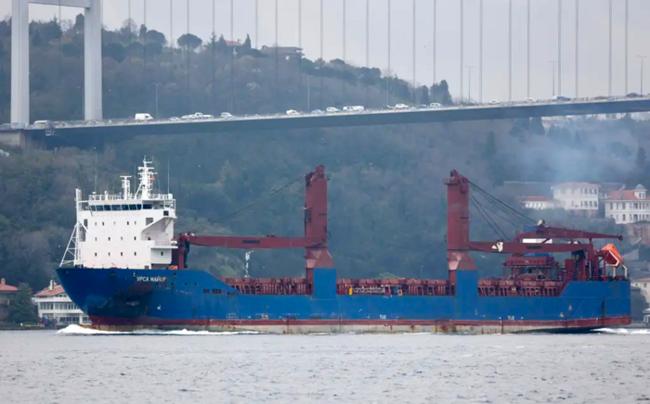
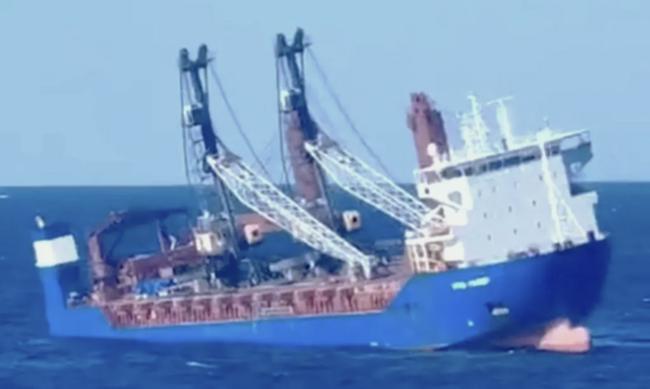 The Russian cargo ship Ursa Major before its sinking (top) and during its sinking after a torpedo attack. [Photo: Reuters]
The report described the incident as "an utter humiliation for Vladimir Putin" and noted that it occurred just two months after North Korean leader Kim Jong-un pledged to send thousands of troops to help Russia reclaim the Kursk region following a surprise counteroffensive by Ukraine.
Furthermore, the report stated that "it is an open secret in the Western world that Russia is providing technical expertise to North Korea as part of a military exchange," adding that "Kim Jong-un, in particular, desperately wanted Pyongyang to have its own nuclear-powered submarines."
Consequently, Europe had been tracking the movements of the Ursa Major. The Portuguese Navy also deployed aircraft to locate the vessel and its escorts in the Mediterranean.
The Portuguese Navy began tracking the vessel on the morning of December 22nd, and it was subsequently spotted slowing down near the Spanish coastline, according to the Portuguese side.
Due to the vessel's unusual behavior, Spanish rescue teams contacted the Russian ship via radio, but the Russian vessel responded that there were no problems, according to Madrid.
However, approximately 24 hours later, the Ursa Major issued an emergency distress call after experiencing three explosions near its engine room. Two crew members are reported to have died in these explosions.
As the ship sank, the Russian naval destroyer Ivan Gren arrived shortly thereafter and ordered nearby vessels to stay at least 2 nautical miles (approximately 3.2 km) away from the damaged ship, while demanding the immediate repatriation of the rescued crew members to the Spanish authorities.
Meanwhile, the report stated that Spanish rescue personnel were unable to access the sealed engine room of the vessel.
Although the ship appeared stable on the surface immediately after the explosions, it sank to the seabed after four more explosions, similar to underwater mines, occurred when the Ivan Gren fired several flares at the scene.
In related news, the report states that "the US military deployed a WC135-R 'nuclear sniffer' over the incident site twice, with flight data showing one instance on August 28, 2025, and another on February 6 of this year."
The US government is reportedly remaining tight-lipped about the reason for the aircraft's deployment off the coast of Spain or whether anything was detected during the two flights.
With governments remaining silent on the incident, it remains a mystery what exactly the Ursa Major was carrying and how it ended up at the bottom of the sea.
By Reporter Im Yo-hee

 Iranian Foreign Ministry: "Continuing Message Exchanges with the U.S. and Activities of Mediating Countries"
Esmaeil Baghaei, Spokesperson for the Iranian Ministry of Foreign Affairs [Xinhua, Yonhap News file photo]Esmaeil Baghaei, spokesperson for the Iranian Ministry of Foreign Affairs, stated on the 26th
Iranian Foreign Ministry: "Continuing Message Exchanges with the U.S. and Activities of Mediating Countries"
Esmaeil Baghaei, Spokesperson for the Iranian Ministry of Foreign Affairs [Xinhua, Yonhap News file photo]Esmaeil Baghaei, spokesperson for the Iranian Ministry of Foreign Affairs, stated on the 26th
 President Yoon: "Do You Think You Are Safe from the Special Counsel?"... Final Statement Video Released
President Yoon Suk Yeol rebuking the special prosecutor on the 24th. [Court video / @birds_justice X account subtitle GIF] A video of President Yoon Suk Yeol's closing statement at his trial rega
President Yoon: "Do You Think You Are Safe from the Special Counsel?"... Final Statement Video Released
President Yoon Suk Yeol rebuking the special prosecutor on the 24th. [Court video / @birds_justice X account subtitle GIF] A video of President Yoon Suk Yeol's closing statement at his trial rega
 President Yoon, regarding the first-instance ruling on the Public Official Election Act: “An excessive political verdict that distorts the facts… We will appeal immediately.”
The first-instance sentencing hearing for President Yoon Suk Yeol regarding violations of the Public Official Election Act is being broadcast live at Seoul Station on the 27th. [Photo=Yonhap News]Pres
President Yoon, regarding the first-instance ruling on the Public Official Election Act: “An excessive political verdict that distorts the facts… We will appeal immediately.”
The first-instance sentencing hearing for President Yoon Suk Yeol regarding violations of the Public Official Election Act is being broadcast live at Seoul Station on the 27th. [Photo=Yonhap News]Pres
 WSJ: "SK Hynix ADR Premium Is a Sign of AI Trading Overheat"
Advertisement for SK Hynix ADR listing in New York's Times Square [Reuters=Yonhap News file photo]The Wall Street Journal (WSJ) has pointed out that the price of SK Hynix’s American Depositary Recei
WSJ: "SK Hynix ADR Premium Is a Sign of AI Trading Overheat"
Advertisement for SK Hynix ADR listing in New York's Times Square [Reuters=Yonhap News file photo]The Wall Street Journal (WSJ) has pointed out that the price of SK Hynix’s American Depositary Recei
 'Godfather of Japanese Mystery Novels' Keigo Higashino Passes Away After Battle with Cancer at 68
Famous Japanese mystery novelist Keigo Higashino [AFP=Yonhap News]It has been belatedly reported that Keigo Higashino, the "godfather of Japanese mystery novels" and author of bestsellers such as "The
'Godfather of Japanese Mystery Novels' Keigo Higashino Passes Away After Battle with Cancer at 68
Famous Japanese mystery novelist Keigo Higashino [AFP=Yonhap News]It has been belatedly reported that Keigo Higashino, the "godfather of Japanese mystery novels" and author of bestsellers such as "The
 [Park Pil-kyu Security Column] To the Ignorant Trying to Clothe a Beast in Sheep's Clothing
Rep. Kim Byung-joo of the Democratic Party of Korea [Photo=Yonhap News]“The Air Force Academy doesn't teach you how to fly a plane!” “The Army, Navy, and Air Force academies are exactly the
[Park Pil-kyu Security Column] To the Ignorant Trying to Clothe a Beast in Sheep's Clothing
Rep. Kim Byung-joo of the Democratic Party of Korea [Photo=Yonhap News]“The Air Force Academy doesn't teach you how to fly a plane!” “The Army, Navy, and Air Force academies are exactly the
 [Issue Diagnosis] Two Effects of the Election Petition Review
 [Photo] Evidence of Election Fraud Flooding U.S. Media… Trump Had 2.7 Million Votes Stolen
 [Video] U.S. Semiquincentennial Air Show... 'Art in the Sky' streaks across New York
 [Editorial Cartoon] A Draconian Law That Undermines Freedom of Expression

 List
List









