 Constitutional Court [Yonhap News file photo]
The two cases, numbers 2 and 3 for the Court of Appeals, which will determine whether to overturn finalized court rulings, share the core issue of "whether the court excessively narrowed its interpretation of the law, infringing upon fundamental rights."
Some analyses suggest this effectively creates a "fourth instance" system, as it examines whether the courts have properly interpreted the law.
According to legal circles on the 14th, the Constitutional Court referred to a full panel hearing the two cases for annulment of judgment filed by the A Housing Redevelopment and Maintenance Project Association in Yeongdeungpo-gu, Seoul, and lawyer Kim Young-soo (Law Firm Daeryun) against the courts on the 12th.
The issue in the redevelopment association's case is whether the Supreme Court's excessively restrictive interpretation of a former Urban Development Act provision regarding the "free transfer of maintenance and infrastructure facilities" infringed upon the association's fundamental rights, including the right to equality and property rights.
In 2012, Yeongdeungpo-gu approved the association's project implementation plan, imposing a condition that it purchase roads within the maintenance district.
Although the land in question was not officially a road under the Road Act, it was a "de facto road" used for general traffic.
The association entered into a sales contract with the Seoul Metropolitan Government and Yeongdeungpo-gu in 2017 and paid billions of won to purchase the road. However, it later filed a lawsuit claiming the sales contract was invalid, citing provisions of the Urban Development Act.
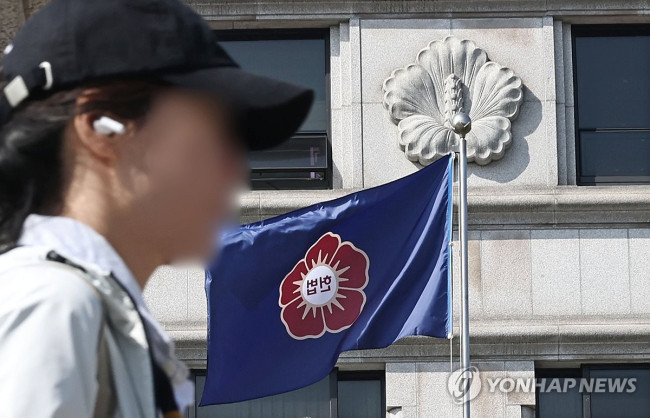 Constitutional Court [Yonhap News file photo]
Initially, "de facto roads" were excluded from maintenance and infrastructure facilities to be transferred free of charge to the project implementer under the Urban Development Act. In 2015, an amendment to the law newly included provisions for public project implementers to receive these free of charge, and a comprehensive revision in 2017 expanded this scope to include private project implementers.
The association argued that although it received project approval before 2017 when private implementers became applicable, considering the intent of the 2015 law amendment, free transfer should be recognized for private entities as well, and the appellate court accepted this.
This was because no discussion was held at the time of the 2015 law amendment to differentiate between private and public entities.
However, the Supreme Court ruled that the appellate court's interpretation excessively expanded the law.
It was concluded that the provision applied in this case, prior to the 2017 amendment, was "clear in its wording and not open to multiple interpretations," making it difficult to interpret it as extending to private implementers.
Ultimately, the key issue before the Constitutional Court is expected to be whether the Supreme Court's interpretation, which adhered strictly to the literal wording of the law and recognized free transfer of "de facto roads" only for public entities and not for private ones, infringed upon the right to equality.
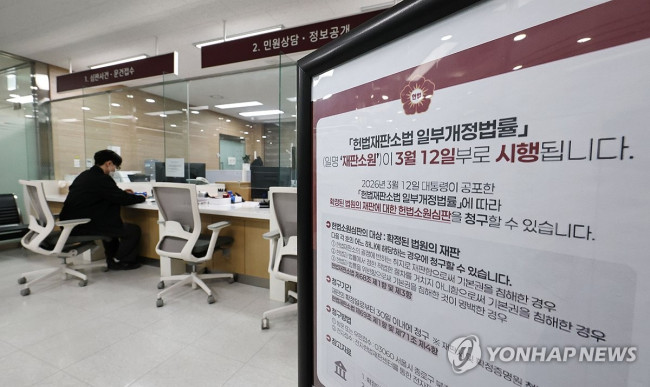 Constitutional Court, Information on Court of Appeals Cases [Yonhap News file photo]
The Court of Appeals filed by lawyer Kim Young-soo concerns whether the court's interpretation of a provision in the Criminal Procedure Act, which defines the scope of those eligible to receive a copy of a search warrant, infringed upon fundamental rights.
Lawyer Kim was searched and seized by the special prosecutor's team under prosecutor Ahn Mi-young in July 2022 in connection with allegations of preferential treatment for Jeon Ik-soo, former head of the Air Force's legal affairs office.
He argued that the special prosecutor's failure to provide a copy of the search warrant during its execution was illegal, but the court ruled that there was no issue with not providing it to a "witness."
Article 118 of the current Criminal Procedure Act stipulates that "a copy of the search warrant must be delivered to the accused when they are the recipient of the warrant order," and Article 219 states that Article 118 shall apply mutatis mutandis to search warrants issued during the investigation stage.
The courts interpreted Article 118 of the Criminal Procedure Act to mean that the recipients of the warrant copy are limited to the "accused," excluding third parties, and therefore, when applying the provisions at the investigation stage, it is limited to "suspects," excluding witnesses.
Consequently, lawyer Kim filed a Court of Appeals, arguing that the failure to recognize the right to receive a copy of a warrant for "witnesses" under the Criminal Procedure Act, which is granted to the accused and suspects, constitutes an infringement of fundamental rights.
Lawyer Kim stated, "When the provision was first drafted, it was discussed as 'the recipient of the order,' but the Ministry of Justice included a clause limiting it to 'the accused' for the sake of investigation secrecy." He added, "Even if it is defined as 'the accused' at the trial stage, narrowly interpreting it as 'suspects' at the investigation stage, where the scope of investigative agencies' activities is broad, infringes upon constitutional equality."
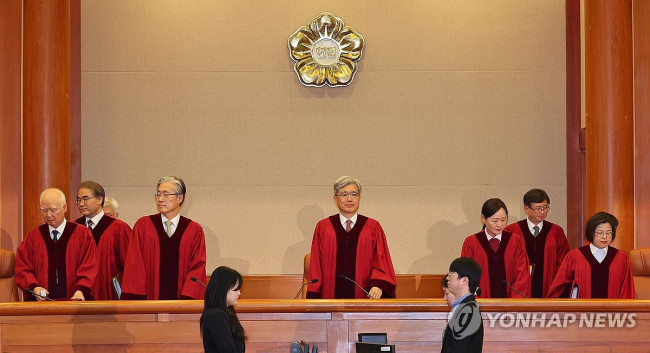 Constitutional Court Ruling on Constitutional Complaint Cases [Yonhap News]
Both cases can essentially be considered as a "fourth instance" system in that they dispute the correctness of the court's final interpretation of the law.
A chief judge at a court in the Seoul metropolitan area commented, "Ultimately, it means that a judgment can be overturned on the grounds that the court misinterpreted the law." He added, "If we scrutinize the correctness of the interpretation, doesn't it become a fourth instance?"
Jang Young-soo, Professor Emeritus at Korea University Law School, stated, "It is now inevitable to acknowledge that there is a fourth instance and that the Constitutional Court is a higher authority than the Supreme Court." He continued, "However, the question remains whether the Constitutional Court possesses superior certainty in expertise or public trust to that extent."
The case that passed preliminary review as "Case No. 1" on the 29th of last month was an administrative lawsuit filed by Green Cross seeking to nullify a 2 billion won fine imposed by the Fair Trade Commission for bid rigging in vaccine tenders, in which they ultimately lost.
Green Cross had received a not-guilty verdict in the related criminal case, but the initial ruling in the administrative lawsuit was a loss, creating a discrepancy in judgments. They then filed a Court of Appeals, arguing that their right to judicial remedy was infringed because the Supreme Court dismissed their appeal without further review.

 Iranian Foreign Ministry: "Continuing Message Exchanges with the U.S. and Activities of Mediating Countries"
Esmaeil Baghaei, Spokesperson for the Iranian Ministry of Foreign Affairs [Xinhua, Yonhap News file photo]Esmaeil Baghaei, spokesperson for the Iranian Ministry of Foreign Affairs, stated on the 26th
Iranian Foreign Ministry: "Continuing Message Exchanges with the U.S. and Activities of Mediating Countries"
Esmaeil Baghaei, Spokesperson for the Iranian Ministry of Foreign Affairs [Xinhua, Yonhap News file photo]Esmaeil Baghaei, spokesperson for the Iranian Ministry of Foreign Affairs, stated on the 26th
 President Yoon: "Do You Think You Are Safe from the Special Counsel?"... Final Statement Video Released
President Yoon Suk Yeol rebuking the special prosecutor on the 24th. [Court video / @birds_justice X account subtitle GIF] A video of President Yoon Suk Yeol's closing statement at his trial rega
President Yoon: "Do You Think You Are Safe from the Special Counsel?"... Final Statement Video Released
President Yoon Suk Yeol rebuking the special prosecutor on the 24th. [Court video / @birds_justice X account subtitle GIF] A video of President Yoon Suk Yeol's closing statement at his trial rega
 President Yoon, regarding the first-instance ruling on the Public Official Election Act: “An excessive political verdict that distorts the facts… We will appeal immediately.”
The first-instance sentencing hearing for President Yoon Suk Yeol regarding violations of the Public Official Election Act is being broadcast live at Seoul Station on the 27th. [Photo=Yonhap News]Pres
President Yoon, regarding the first-instance ruling on the Public Official Election Act: “An excessive political verdict that distorts the facts… We will appeal immediately.”
The first-instance sentencing hearing for President Yoon Suk Yeol regarding violations of the Public Official Election Act is being broadcast live at Seoul Station on the 27th. [Photo=Yonhap News]Pres
 WSJ: "SK Hynix ADR Premium Is a Sign of AI Trading Overheat"
Advertisement for SK Hynix ADR listing in New York's Times Square [Reuters=Yonhap News file photo]The Wall Street Journal (WSJ) has pointed out that the price of SK Hynix’s American Depositary Recei
WSJ: "SK Hynix ADR Premium Is a Sign of AI Trading Overheat"
Advertisement for SK Hynix ADR listing in New York's Times Square [Reuters=Yonhap News file photo]The Wall Street Journal (WSJ) has pointed out that the price of SK Hynix’s American Depositary Recei
 'Godfather of Japanese Mystery Novels' Keigo Higashino Passes Away After Battle with Cancer at 68
Famous Japanese mystery novelist Keigo Higashino [AFP=Yonhap News]It has been belatedly reported that Keigo Higashino, the "godfather of Japanese mystery novels" and author of bestsellers such as "The
'Godfather of Japanese Mystery Novels' Keigo Higashino Passes Away After Battle with Cancer at 68
Famous Japanese mystery novelist Keigo Higashino [AFP=Yonhap News]It has been belatedly reported that Keigo Higashino, the "godfather of Japanese mystery novels" and author of bestsellers such as "The
 [Park Pil-kyu Security Column] To the Ignorant Trying to Clothe a Beast in Sheep's Clothing
Rep. Kim Byung-joo of the Democratic Party of Korea [Photo=Yonhap News]“The Air Force Academy doesn't teach you how to fly a plane!” “The Army, Navy, and Air Force academies are exactly the
[Park Pil-kyu Security Column] To the Ignorant Trying to Clothe a Beast in Sheep's Clothing
Rep. Kim Byung-joo of the Democratic Party of Korea [Photo=Yonhap News]“The Air Force Academy doesn't teach you how to fly a plane!” “The Army, Navy, and Air Force academies are exactly the
 [Issue Diagnosis] Two Effects of the Election Petition Review
 [Photo] Evidence of Election Fraud Flooding U.S. Media… Trump Had 2.7 Million Votes Stolen
 [Video] U.S. Semiquincentennial Air Show... 'Art in the Sky' streaks across New York
 [Editorial Cartoon] A Draconian Law That Undermines Freedom of Expression

 List
List









