 Samsung Electronics' Post-Dispute Adjustment Fails [Yonhap News Photo]
Samsung Electronics is reportedly entering an emergency management phase, involving a partial reduction in production, to minimize production disruptions and quality decline ahead of a general strike scheduled to begin in one week.
There are also analyses suggesting that a full-scale strike, if realized, could cause astronomical direct and indirect losses amounting to 100 trillion won.
According to industry sources on the 14th, if the Federation of Korean Trade Unions Samsung Electronics Branch (FKSU) goes on a 18-day general strike starting on the 21st, and the semiconductor manufacturing process is completely halted, direct and indirect losses are projected to reach approximately 100 trillion won.
Direct damages from the suspension of semiconductor production lines are expected to reach tens of trillions of won alone. This is because the highly precise process facilities, designed for 24-hour operation, incur massive losses even from brief interruptions.
For instance, in March 2018, a power outage at Samsung Electronics' Pyeongtaek semiconductor plant, which caused a 28-minute line shutdown, resulted in an estimated 50 billion won in damages. This occurred because dust entered some products and numerous in-process products had to be discarded when power was cut to the clean vacuum environment of the lines.
At that time, the losses from the line stoppage exceeded 1 billion won per minute. This translates to approximately 107.1 billion won in losses per hour and about 2.6 trillion won per day.
Assuming semiconductor production lines are halted during the announced 18-day strike period, projections indicate losses exceeding 40 trillion won.
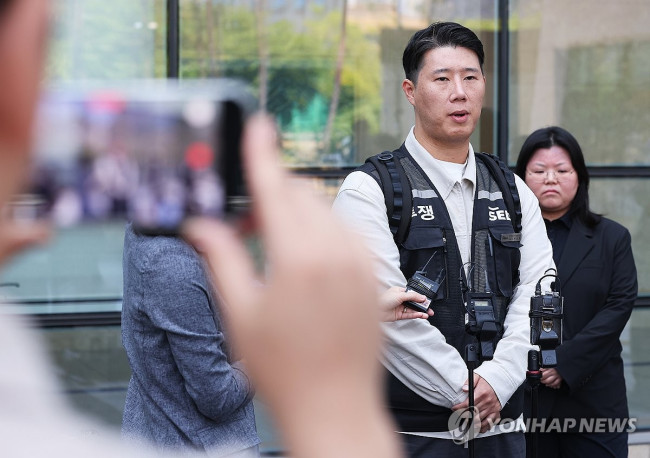 Choi Seung-ho, Chairman, After Hearing for Provisional Attachment Application to Prohibit Illegal Labor Disputes [Yonhap News Photo]
As of today, 43,286 individuals have applied to participate in the strike. If they actually go on strike, it is predicted that the entire Samsung Electronics semiconductor plant will effectively face a shutdown.
The industry expects losses of 10 to 20 trillion won to be unavoidable, even if the provisional attachment application filed by the management to prohibit illegal labor disputes is granted by the court, preventing 5-10% of personnel in essential roles such as safety from participating in the strike.
The problem is that the actual impact of this strike is likely to extend beyond the 18-day period announced by the union.
Considering the inability to produce normally not only during the strike but also during the preliminary preparation period to mitigate damages, a disruption in production for at least one month is structurally unavoidable.
In fact, Samsung Electronics has reportedly begun preliminary measures (warm-down) to minimize strike-related damages through quality control and other means, adjusting its production process and reducing output starting today. This includes limiting the quantity of new wafers fed into the initial stages of the lines and reconfiguring the product mix to prioritize high-priced, latest processes such as High Bandwidth Memory (HBM).
Even if the strike concludes in 18 days, there will be a significant time lag before supply normalizes after post-strike stabilization efforts.
Kim Dong-won, head of KB Securities' research division, analyzed in a recent report that it is highly likely that an additional two to three weeks will be required for the re-operation and normalization of automated lines even after the 18-day strike ends.
Concerns are also being raised that this strike could inflict more fatal "invisible damages" worth tens of trillions of won on Samsung Electronics, beyond the losses from semiconductor production suspension.
When these factors are considered, direct and indirect losses could reach 100 trillion won.
Song Heon-jae, a professor in the Department of Economics at the University of Seoul, identified five key risks of the strike: ▲ erosion of trust assets ▲ permanent market loss due to switching costs ▲ loss of opportunity cost during the AI semiconductor hegemony competition ▲ exodus of key talent ▲ deepening Korea Discount.
In particular, concerns are being raised that this could provide an opportunity for Chinese companies to seize the lead that Samsung Electronics has maintained in the global memory supply chain.
As the global memory shortage intensifies, analyses suggest that if major tech customers such as Nvidia, AMD, Google, and Meta seek stable alternative supply chains, Chinese companies like Changxin Integrated Circuits (CXMT) and Yangtze Memory Technologies (YMTC) are highly likely to quickly fill the void.
 Rally for Struggle Resolution Held in Front of Samsung Electronics Pyeongtaek Campus on the 23rd of Last Month [Yonhap News Photo]
Furthermore, with semiconductors accounting for approximately 35% of South Korea's exports, concerns are growing that the strike risk will not only impact a single company but also inevitably deal a direct blow to national finances and tax revenue.
The business community is increasingly calling for the government to intervene with emergency mediation to prevent the worst-case scenario, given the estimated massive damages of 100 trillion won.
The right to emergency mediation is a system based on Article 76 of the Trade Union and Labor Relations Adjustment Act (Labor Union Act). It is an exceptional mediation procedure that the Minister of Employment and Labor can invoke when labor disputes threaten the daily lives of the public or are likely to cause significant harm to the national economy.
Upon the invocation of emergency mediation, labor disputes must cease immediately, and labor disputes cannot be resumed for 30 days. The National Labor Relations Commission will then proceed with mediation and arbitration procedures.
An industry official stated, "Given that the union has announced a hardline stance and self-resolution is difficult to expect, it is a responsible stance for the government to actively utilize legal measures such as emergency mediation to protect the national economy. While emergency orders have historically been issued after strikes begin, given the nature of semiconductors, it is necessary to do so as soon as possible before a strike occurs."

 Iranian Foreign Ministry: "Continuing Message Exchanges with the U.S. and Activities of Mediating Countries"
Esmaeil Baghaei, Spokesperson for the Iranian Ministry of Foreign Affairs [Xinhua, Yonhap News file photo]Esmaeil Baghaei, spokesperson for the Iranian Ministry of Foreign Affairs, stated on the 26th
Iranian Foreign Ministry: "Continuing Message Exchanges with the U.S. and Activities of Mediating Countries"
Esmaeil Baghaei, Spokesperson for the Iranian Ministry of Foreign Affairs [Xinhua, Yonhap News file photo]Esmaeil Baghaei, spokesperson for the Iranian Ministry of Foreign Affairs, stated on the 26th
 President Yoon: "Do You Think You Are Safe from the Special Counsel?"... Final Statement Video Released
President Yoon Suk Yeol rebuking the special prosecutor on the 24th. [Court video / @birds_justice X account subtitle GIF] A video of President Yoon Suk Yeol's closing statement at his trial rega
President Yoon: "Do You Think You Are Safe from the Special Counsel?"... Final Statement Video Released
President Yoon Suk Yeol rebuking the special prosecutor on the 24th. [Court video / @birds_justice X account subtitle GIF] A video of President Yoon Suk Yeol's closing statement at his trial rega
 President Yoon, regarding the first-instance ruling on the Public Official Election Act: “An excessive political verdict that distorts the facts… We will appeal immediately.”
The first-instance sentencing hearing for President Yoon Suk Yeol regarding violations of the Public Official Election Act is being broadcast live at Seoul Station on the 27th. [Photo=Yonhap News]Pres
President Yoon, regarding the first-instance ruling on the Public Official Election Act: “An excessive political verdict that distorts the facts… We will appeal immediately.”
The first-instance sentencing hearing for President Yoon Suk Yeol regarding violations of the Public Official Election Act is being broadcast live at Seoul Station on the 27th. [Photo=Yonhap News]Pres
 WSJ: "SK Hynix ADR Premium Is a Sign of AI Trading Overheat"
Advertisement for SK Hynix ADR listing in New York's Times Square [Reuters=Yonhap News file photo]The Wall Street Journal (WSJ) has pointed out that the price of SK Hynix’s American Depositary Recei
WSJ: "SK Hynix ADR Premium Is a Sign of AI Trading Overheat"
Advertisement for SK Hynix ADR listing in New York's Times Square [Reuters=Yonhap News file photo]The Wall Street Journal (WSJ) has pointed out that the price of SK Hynix’s American Depositary Recei
 'Godfather of Japanese Mystery Novels' Keigo Higashino Passes Away After Battle with Cancer at 68
Famous Japanese mystery novelist Keigo Higashino [AFP=Yonhap News]It has been belatedly reported that Keigo Higashino, the "godfather of Japanese mystery novels" and author of bestsellers such as "The
'Godfather of Japanese Mystery Novels' Keigo Higashino Passes Away After Battle with Cancer at 68
Famous Japanese mystery novelist Keigo Higashino [AFP=Yonhap News]It has been belatedly reported that Keigo Higashino, the "godfather of Japanese mystery novels" and author of bestsellers such as "The
 [Park Pil-kyu Security Column] To the Ignorant Trying to Clothe a Beast in Sheep's Clothing
Rep. Kim Byung-joo of the Democratic Party of Korea [Photo=Yonhap News]“The Air Force Academy doesn't teach you how to fly a plane!” “The Army, Navy, and Air Force academies are exactly the
[Park Pil-kyu Security Column] To the Ignorant Trying to Clothe a Beast in Sheep's Clothing
Rep. Kim Byung-joo of the Democratic Party of Korea [Photo=Yonhap News]“The Air Force Academy doesn't teach you how to fly a plane!” “The Army, Navy, and Air Force academies are exactly the
 [Issue Diagnosis] Two Effects of the Election Petition Review
 [Photo] Evidence of Election Fraud Flooding U.S. Media… Trump Had 2.7 Million Votes Stolen
 [Video] U.S. Semiquincentennial Air Show... 'Art in the Sky' streaks across New York
 [Editorial Cartoon] A Draconian Law That Undermines Freedom of Expression

 List
List









