The summit between U.S. President Donald Trump and Chinese President Xi Jinping, which garnered global attention, is being evaluated as an occasion where both leaders shared the recognition of managing bilateral relations with stable reciprocity amid strategic competition.
President Trump highlighted economic achievements, stating he reached a "fantastic trade agreement" during his three-day visit to China, accompanied by prominent business leaders. President Xi, on the other hand, focused on solidifying China's status as one of the world's two major powers (G2) by forming an equal relationship with the United States through this summit.
However, by the time President Trump departed for home after concluding his visit to China, the first in nearly nine years, neither side had produced concrete outcomes. This has led to observations that significant differences in their positions on sensitive key issues such as Iran and Taiwan may not have been narrowed.
Although further meetings between the two leaders within the year have been announced, there are also points being made that the underlying structural conflict between the two countries over core interests remains.
 U.S. President Trump (left) and Chinese President Xi Jinping [Reuters=Yonhap News Agency File Photo]
◇ Trump Emphasizes "Fantastic Trade Agreement"… Xi Jinping Signals "Equal Competition" with the U.S.
Since the launch of Trump's second term last year, the U.S. and China have clashed fiercely over trade issues. However, the two countries shifted towards managing the conflict by refraining from further escalation following the summit in Busan in October of last year. A year-long "truce" began regarding tariffs and rare earth export controls.
During President Trump's visit to Beijing from the 13th to the 15th (local time), it appears the two leaders maintained this approach, making a realistic judgment that building a cooperative relationship through stable reciprocity aligns with their mutual interests.
President Trump, facing pressure from declining approval ratings after the Iran War, is grappling with the challenge of managing inflation ahead of the November midterm elections. President Xi also needs economic stability amid a prolonged property market slump and weak domestic demand.
This context explains President Trump's emphasis on having reached a "fantastic trade agreement with China" during his tea talk with President Xi at Zhongnanhai on the 15th. This can be seen as a domestic message to demonstrate achievements on economic issues, a key theme for the elections.
In a prior interview with Fox News, he mentioned the export of U.S. aircraft, soybeans, and energy, as well as the opening of China's market in the service and electric vehicle sectors, claiming he had secured "hundreds of billions of dollars in investment" from China. The unusual presence of American CEOs at the summit clearly indicated that the focus of the visit was on trade and economic achievements.
However, unlike nine years ago when China offered a plethora of "gifts," the absence of specific investment and purchase commitments announced was not unrelated to China's changed standing.
A prime example is President Xi's statement during the tea talk that day: "Together, we have established a new status of 'constructive strategic cooperative relationship between the U.S. and China'," declaring his intention to engage in equal competition with the United States.
At the summit the previous day, President Xi reiterated the "Thucydides Trap," hinting at the need for established hegemonic powers to acknowledge rising new powers. These remarks reveal China's confidence in solidifying its status as a true G2, leading the international order on an equal footing with the U.S.
Both leaders, while showcasing the summit's outcomes as domestic and foreign achievements through political and diplomatic rhetoric, also emphasized a reciprocal trade relationship and displayed personal camaraderie.
President Xi sent a message of "coexistence" by stating that "the great rejuvenation of the Chinese nation" and "Make America Great Again" (MAGA) are fully compatible, and that their respective achievements will benefit the world.
President Trump responded by saying, "The relationship between China and the United States will be better than ever," and "We will create a fantastic future together." He also referred to President Xi as "a person I deeply respect" and a "friend," adding, "We have known each other for now 11 years, almost 12 years."
Daniel Kritenbrink, former Assistant Secretary of State for East Asian and Pacific Affairs and now a partner at the U.S. think tank Asia Group, commented, "The key word for this summit is 'stability.' It seems both leaders want to maintain this stability, at least until next year if not for the next three years, which will generally be good news for businesses in both countries."
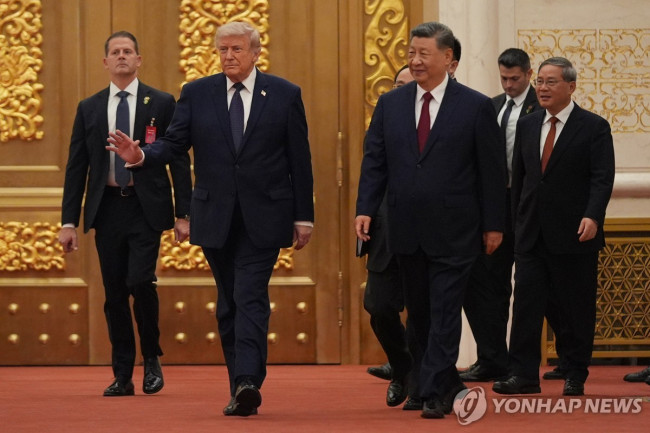 Two leaders entering the state banquet hall [AP=Yonhap News Agency File Photo]
◇ Tangible Results on Iran and Taiwan Issues Uncertain… Differences in Perceptions of Core Interests
It is widely assessed that the tangible results achieved by both countries in the discussions on Iran and Taiwan, which were considered major agenda items for this summit, fell somewhat short of expectations. This is because the two sides only engaged in unilateral announcements or statements on these matters and did not reach documented agreements.
President Trump stated on the 15th, "We think very similarly on Iran. We want to see that situation end. We don't want them to have nuclear weapons. We want to see the strait open." This indicates they found common ground in their perceptions but did not move forward to concrete joint actions.
Although President Trump claimed in his earlier Fox News interview that President Xi had expressed willingness not to provide military equipment to Iran and to help open the Strait of Hormuz during the summit the previous day, President Xi's specific comments were not disclosed.
The White House also issued a press release stating that the two leaders agreed on prohibiting Iran from possessing nuclear weapons and opposing tolls on the Strait of Hormuz, but there was a clear difference in tone compared to China's announcement.
In a statement, the Chinese Ministry of Foreign Affairs reiterated its principled stance that "China's position on the Iranian situation is very clear" and that the conflict should end quickly. Regarding the Iranian nuclear issue, it only stated that "through dialogue and negotiation," a solution should be reached that "takes into account the concerns of all parties (including Iran)."
The divergence in views on Taiwan appears to be even wider. This is evident from President Xi's unusually strong warning message at the summit the previous day, stating, "If this is handled well, bilateral relations can maintain overall stability, but if it is handled poorly, the two countries could clash or even lead to conflict, pushing the entire U.S.-China relationship into a very dangerous situation."
Even though he mentioned the possibility of "clash" directly to his face, President Trump consistently avoided mentioning the issue of Taiwan in public during his visit to China.
Instead, the only response came in an interview with NBC News after the summit, where Secretary of State Mike Pompeo stated, "Our policy toward Taiwan has not changed," and warned, "In our view, any forceful change in the status quo would be detrimental to both countries."
Patricia Kim, a research associate at the Brookings Institution's Center for East Asia Policy Studies, commented in a statement sent to Yonhap News Agency, "China is focusing on Taiwan, and the U.S. is focusing on Iran. For now, judging from the official announcements, it seems that the U.S. and China are emphasizing their respective interests."
Beyond the issues of Iran and Taiwan, it appears that matters concerning the strategic core interests of both countries, such as the U.S.'s control over advanced AI and semiconductor technology and China's control over rare earth exports, were not agreed upon or a common ground was not found.
If President Trump's reciprocal visit invitation is accepted, the two leaders are expected to meet again in Washington D.C. on September 24th, potentially meeting up to four times this year. However, there are many observations that the structural conflict between the G2, who are bound to compete or confront for dominance in the international order under a "nation first" approach, will not be easily resolved.
Patrick Cronin, Director of the Center for Asia-Pacific Security at the Hudson Institute, pointed out in a statement sent to Yonhap News Agency, "This summit did not resolve the fundamental structural tensions and strategic competition that define the relationship between the two countries."
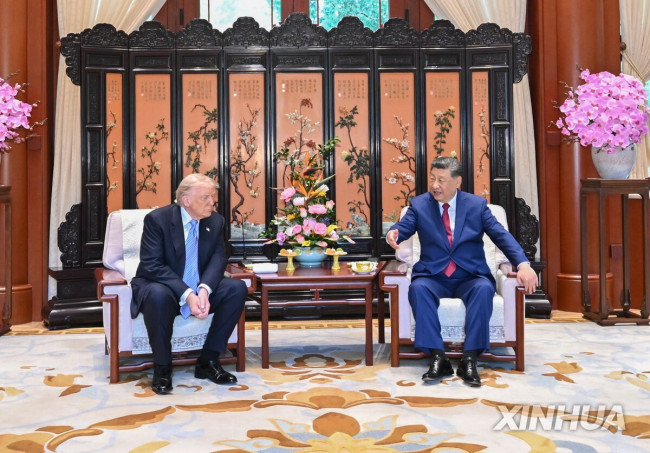 U.S. and Chinese leaders having tea at Zhongnanhai [Xinhua-Yonhap News]

 Iranian Foreign Ministry: "Continuing Message Exchanges with the U.S. and Activities of Mediating Countries"
Esmaeil Baghaei, Spokesperson for the Iranian Ministry of Foreign Affairs [Xinhua, Yonhap News file photo]Esmaeil Baghaei, spokesperson for the Iranian Ministry of Foreign Affairs, stated on the 26th
Iranian Foreign Ministry: "Continuing Message Exchanges with the U.S. and Activities of Mediating Countries"
Esmaeil Baghaei, Spokesperson for the Iranian Ministry of Foreign Affairs [Xinhua, Yonhap News file photo]Esmaeil Baghaei, spokesperson for the Iranian Ministry of Foreign Affairs, stated on the 26th
 President Yoon: "Do You Think You Are Safe from the Special Counsel?"... Final Statement Video Released
President Yoon Suk Yeol rebuking the special prosecutor on the 24th. [Court video / @birds_justice X account subtitle GIF] A video of President Yoon Suk Yeol's closing statement at his trial rega
President Yoon: "Do You Think You Are Safe from the Special Counsel?"... Final Statement Video Released
President Yoon Suk Yeol rebuking the special prosecutor on the 24th. [Court video / @birds_justice X account subtitle GIF] A video of President Yoon Suk Yeol's closing statement at his trial rega
 President Yoon, regarding the first-instance ruling on the Public Official Election Act: “An excessive political verdict that distorts the facts… We will appeal immediately.”
The first-instance sentencing hearing for President Yoon Suk Yeol regarding violations of the Public Official Election Act is being broadcast live at Seoul Station on the 27th. [Photo=Yonhap News]Pres
President Yoon, regarding the first-instance ruling on the Public Official Election Act: “An excessive political verdict that distorts the facts… We will appeal immediately.”
The first-instance sentencing hearing for President Yoon Suk Yeol regarding violations of the Public Official Election Act is being broadcast live at Seoul Station on the 27th. [Photo=Yonhap News]Pres
 WSJ: "SK Hynix ADR Premium Is a Sign of AI Trading Overheat"
Advertisement for SK Hynix ADR listing in New York's Times Square [Reuters=Yonhap News file photo]The Wall Street Journal (WSJ) has pointed out that the price of SK Hynix’s American Depositary Recei
WSJ: "SK Hynix ADR Premium Is a Sign of AI Trading Overheat"
Advertisement for SK Hynix ADR listing in New York's Times Square [Reuters=Yonhap News file photo]The Wall Street Journal (WSJ) has pointed out that the price of SK Hynix’s American Depositary Recei
 'Godfather of Japanese Mystery Novels' Keigo Higashino Passes Away After Battle with Cancer at 68
Famous Japanese mystery novelist Keigo Higashino [AFP=Yonhap News]It has been belatedly reported that Keigo Higashino, the "godfather of Japanese mystery novels" and author of bestsellers such as "The
'Godfather of Japanese Mystery Novels' Keigo Higashino Passes Away After Battle with Cancer at 68
Famous Japanese mystery novelist Keigo Higashino [AFP=Yonhap News]It has been belatedly reported that Keigo Higashino, the "godfather of Japanese mystery novels" and author of bestsellers such as "The
 [Park Pil-kyu Security Column] To the Ignorant Trying to Clothe a Beast in Sheep's Clothing
Rep. Kim Byung-joo of the Democratic Party of Korea [Photo=Yonhap News]“The Air Force Academy doesn't teach you how to fly a plane!” “The Army, Navy, and Air Force academies are exactly the
[Park Pil-kyu Security Column] To the Ignorant Trying to Clothe a Beast in Sheep's Clothing
Rep. Kim Byung-joo of the Democratic Party of Korea [Photo=Yonhap News]“The Air Force Academy doesn't teach you how to fly a plane!” “The Army, Navy, and Air Force academies are exactly the
 [Issue Diagnosis] Two Effects of the Election Petition Review
 [Photo] Evidence of Election Fraud Flooding U.S. Media… Trump Had 2.7 Million Votes Stolen
 [Video] U.S. Semiquincentennial Air Show... 'Art in the Sky' streaks across New York
 [Editorial Cartoon] A Draconian Law That Undermines Freedom of Expression

 List
List









