이 리포트는 2026년 5월 20일 오후 4시 현재 확인 가능한 자료를 기준으로 작성했다. 시장 데이터는 숫자보다 시점이 중요하다. 장중 수치와 장마감 수치, 거래일과 집계일, 보도 기준과 공식 기준은 서로 다른 의미를 갖는다. 따라서 이 리포트는 5월 19일 국내 증시 마감 이후 확인된 자료를 중심으로 하며, 이후 환율·외국인 수급·신용융자·대차잔고·공매도 잔고가 변동될 경우 분석의 강도와 결론은 달라질 수 있다.<편집자 주>
 As of 9:30 AM on May 20th, the KOSPI is trading at 7,197.58, down 74.08 points (1.02%) from the previous trading day. [Photo = Yonhap News
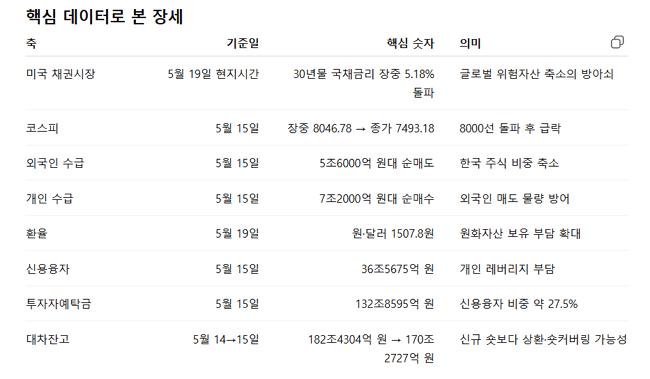
As of May 19th (local time), the U.S. 30-year Treasury yield surpassed 5.18% during intraday trading, reaching a level not seen since 2007. The 10-year yield also stood around 4.66%.
Inflationary pressures from high oil prices and concerns over fiscal deterioration in major developed countries are pushing up long-term yields, leading to a global bond sell-off.
In Korea, the KOSPI reached a high of 8046.78 during intraday trading on May 15th, before closing at 7493.18.
Individual investors net purchased 7.2291 trillion won, while foreign and institutional investors net sold 5.6610 trillion won and 1.7336 trillion won, respectively. On May 19th, the KOSPI fell to 7271.66, and the won-dollar exchange rate closed at 1507.8 won.
The U.S. Bond Market Wobbled First
The instability in the Korean stock market did not originate solely from domestic supply and demand. At the higher level, there is the U.S. bond market. As long-term U.S. Treasury yields surged, global funds reduced their exposure to risk assets and increased their preference for dollar assets.
This pressure manifested in the Korean market as the won-dollar exchange rate crossing the 1500 won mark, net selling by foreign investors, and a sharp decline in the KOSPI.
The rise in long-term yields is not just a problem for the U.S. bond market.
In regions where the U.S. 30-year yield exceeds 5%, dollar-denominated safe-haven assets become more attractive. Consequently, Korean stocks, which are won-denominated risk assets, face both a decline in stock prices and the burden of exchange rate losses.
Therefore, the key sentence for this market trend can be summarized as follows:
"The trigger was pulled by the U.S. bond market, and the detonator within the Korean market is 'debt-fueled investing.'"
Foreign Investors Didn't Just Sell Stocks
Viewing foreign selling solely as profit-taking is only seeing half the picture.
If foreign investors sell stocks and continue to hold won, it represents a reduction in their position. However, when stock sales and won depreciation occur simultaneously, the meaning changes.
If foreign investors sell Korean stocks and then convert their won holdings into dollars, this can be interpreted not just as a reduction in Korean stock holdings but as a broader reduction in exposure to won-denominated assets.
On May 15th, the KOSPI plummeted immediately after breaking the 8000 mark, and foreign investors net sold over 5 trillion won in the KOSPI market. While individual investors net purchased over 7 trillion won, they could not prevent the index from falling.
The problem is that this selling spree did not end as a one-day shock. On May 19th, foreign investors again net sold 6.2853 trillion won, and the won-dollar exchange rate rose to 1507.8 won.
A rising exchange rate means that for foreign investors, not only stock price declines but also the burden of exchange rate losses increases simultaneously.
From this point on, Korean stocks are no longer simply "rising assets" but "assets whose dollar-denominated returns must be recalculated."
When foreign selling and a rising exchange rate move in the same direction, the market shifts from being a place for profit-taking to a market for reducing exposure to won-denominated assets.
The Issue is Not 'Record Highs' But Ratio, Speed, and Position
Terms like "record high" are often applied to margin financing, customer deposits, and stock borrowing balances. However, one should not conclude overheating solely based on these expressions.
The market has grown larger, and the KOSPI level is different from the past. If the total amount of individual funds has increased, the absolute amount of margin financing balance can also increase. What is important is not the absolute scale but the ratio, speed, and position.
As of May 15th, the margin financing balance was recorded at 36.5675 trillion won. On the same day, customer deposits were 132.8595 trillion won. A simple calculation shows that margin financing is approximately 27.5% of customer deposits.
On the same day, while foreign and institutional investors net sold 5.6610 trillion won and 1.7336 trillion won respectively, individual investors net purchased 7.2291 trillion won.
The meaning of these numbers is clear. It does not mean that margin financing being at a record high is inherently dangerous. What is dangerous is the situation where the margin financing ratio has risen to 27% of individual waiting funds, and foreign selling and a rising exchange rate have occurred simultaneously.
30% is neither a legal threshold nor a mechanical collapse point. However, when the margin burden relative to individual waiting funds approaches 30%, individuals may shift from being buyers to becoming protectors of their collateral.
Therefore, what individual investors should focus on in this market trend is not the absolute amount of margin financing. It is the proportion of debt in one's own account, the liquidation price of holdings, and whether foreign selling and a rising exchange rate continue simultaneously. More important than the overall market numbers are the defensive lines of one's own account.
Stock Borrowing and Short Selling are Amplification Variables, Not Causes
Explaining this market trend solely through the lens of short selling could be incorrect.
It is true that short selling transactions have increased. However, looking at the trend of stock borrowing balances together makes it difficult to definitively conclude that new short selling positions have been accumulating unilaterally.
On May 14th, the stock borrowing balance was 182.4304 trillion won. However, on May 15th, the number of stock borrowing repayments significantly exceeded the number of executed borrowing transactions, with 99.16 million shares repaid compared to 39.51 million shares borrowed. The stock borrowing balance decreased by approximately 12 trillion won to 170.2727 trillion won.
This indicates that although short selling transactions were active, the actual accumulated short positions showed a decreasing trend, suggesting the possibility of existing short sellers realizing profits or engaging in short covering.
This point is crucial.
A stock borrowing balance of 180 trillion won represents the overall hedging burden of the market. However, if the stock borrowing balance decreases after a sharp decline, it should not be interpreted solely as an expansion of new bearish bets.
Instead, one must also consider the possibility that existing borrowed stocks were repaid during the sharp decline, or that short sellers covered their positions by buying back stocks.
On May 19th, SK Hynix and Samsung Electronics ranked high in KOSPI short selling transaction values. SK Hynix was first with 206 billion won, and Samsung Electronics was among the top with 165.9 billion won.
However, short selling transaction value reflects the day's trading flow, while stock borrowing balance represents the outstanding borrowed shares that have not yet been repaid. If short selling transactions increased while stock borrowing balances decreased, the possibility of existing position liquidation, profit-taking, or short covering becomes higher than new bearish bets.
The conclusion is clear.
Short selling is an amplification variable rather than a cause of this market trend. The core issue is the confluence of the U.S. bond market shock, won depreciation, foreign investors exiting the spot market, and the struggle of individual investors to defend their debt-fueled positions.
Large Semiconductor Stocks Are Not 'Shorts on Bad Companies'
The logic of short selling and hedging related to Samsung Electronics and SK Hynix is not a separate recommendation to sell these stocks. Both companies have been engines of the Korean stock market's rise.
The issue is not corporate insolvency but whether good news has been priced in too quickly.
If SK Hynix's weakness lies in overbuying driven by expectations for HBM and AI memory, Samsung Electronics' weakness stems from a rapid reassessment of mixed factors including rising memory prices, expectations for HBM recovery, foundry uncertainties, and risks related to unions and labor costs.
If hedge funds view these stocks as short or hedging targets, it is likely not because they are "bad companies," but rather a question about speed and supply/demand dynamics, asking, "Haven't good companies risen too quickly?"
The purpose of this paragraph is not to make buy/sell decisions on specific stocks. Samsung Electronics and SK Hynix are core pillars of the KOSPI, and thus, the trends in stock borrowing, short selling, and repayments surrounding these stocks serve as examples to explain the market structure.
Why Are the 7000 Line and 1550 Won Important?
The 7000 KOSPI level is not just a psychological barrier. It was a benchmark that signaled the return of foreign capital to the Korean market in early May. If this line breaks, it can be interpreted by foreign investors as a failure of the Korean rally.
Conversely, the 1550 won-dollar exchange rate is a line that forces foreign investors to re-evaluate the burden of holding won-denominated assets. If the exchange rate exceeds and stabilizes above 1550 won, the risk of exchange rate losses may appear more significant than the risk of stock price decline.
However, this statement should not be made definitively. The breach of the 7000 line does not automatically lead to an outflow of passive funds. Foreign investors do not all exit just because the exchange rate exceeds 1550 won.
However, if foreign spot selling, ETF redemptions, won depreciation, margin financing burdens, and fears of forced liquidation occur simultaneously, the pressure for passive fund outflows can increase.
Therefore, the collapse of the 7000 line is a warning for the stock market, and breaking the 1550 won level is a warning for the exodus of won-denominated assets. If both lines are shaken simultaneously, a correction market can transform into a leverage liquidation market.
The Message Needed for Individual Investors is 'Defense,' Not 'Selling'
The message to individual investors in this market is neither "Sell unconditionally" nor "Buy more." The precise message is to reduce debt, stop new margin purchases, and first check the forced liquidation price.
Investors holding long-term with cash and those enduring with margin/leveraged trading see the same market but face entirely different risks.
Cash investors can withstand time, but debt-fueled investors are driven by collateral ratios before price. If the market falls further, brokerage firms' forced liquidation rules will act before the investor's judgment.
What individual investors should be looking at now is not which stocks will rise further. The first thing to confirm is up to what point their account will be liquidated forcibly.
Stocks purchased with debt should be reduced, and further purchases with debt should be stopped.
Even for investors with cash, until stabilization of the exchange rate, a halt in foreign selling, a slowdown in margin financing growth, and an stabilization of stock borrowing and short selling balances are confirmed, observation should take precedence over chasing rallies.
The risk in this market trend is not the decline itself.
It is the fact that individuals have taken over the volume sold by foreign investors with borrowed money, and when this debt is converted into forced liquidations, hedging funds for declines can simultaneously join in.
Short selling is an amplifier, not a cause.
The exchange rate is a signal of foreign investors' pressure to exit won-denominated assets, margin financing is the detonator for forced liquidations, and stock borrowing balances are the pressure for decline hedging.
However, the trend of decreasing stock borrowing balances for large semiconductor stocks like Samsung Electronics and SK Hynix indicates that this market trend should be viewed as a leverage clash frame rather than a simple short selling frame.
The Conclusion is Clear.
Now, defense comes before offense.
There is no need to be swayed by terms like "record high" or "record high," nor is there a need to jump into low-priced buying simply because of a sharp decline.
More important than the absolute scale of numbers are the timing, ratio, speed, and position. Currently, all four of these factors are tilting towards defense in the market.
❄ Conditions for Validity of Judgment
The defensive judgment in this report is valid in a period where the won-dollar exchange rate remains in the 1500 won range, the KOSPI is being tested for its ability to defend the 7000 line, and foreign net selling and individual margin buying burdens continue.
❄ Triggers for Invalidity of Judgment
If the won-dollar exchange rate stabilizes below the 1450 won level, foreign net selling turns into net buying, the growth of margin financing slows, and the burdens of stock borrowing balances and net short positions ease together, the defensive judgment in this report should be re-evaluated.
❄ Scope of Judgment
This report is a market report interpreting exchange rates, supply/demand, and leverage structures, not a judgment on buying/selling specific stocks. Mentions of Samsung Electronics and SK Hynix are limited to examples for explaining market structure, not investment opinions.
❄ Investment Caution Notice
This article is for reference analysis to help understand market structure and is not investment advice. Actual index, exchange rates, and stock prices may vary depending on various factors, and investment judgment and responsibility lie with the investor.
Basis for Preparation
Preparation Time: As of 11:00 AM, May 20th, 2026 Market Basis: As of the close of the Korean stock market on May 19th, 2026 Turning Point: Sharp decline after KOSPI intraday break of 8000 on May 15th, 2026 Exchange Rate Basis: As of the closing price of the Seoul foreign exchange market's weekly trading on May 19th, 2026 Margin Financing/Deposit Basis: As confirmed on May 15th, 2026, compiled by the Korea Financial Investment Association Stock Borrowing Balance Basis: Public data from the Korea Financial Investment Association, Save-iro by the Korea Securities Depository, and published reports Short Selling Basis: Public data from the Korea Exchange on short selling transaction values and net outstanding balances
|

 Iranian Foreign Ministry: "Continuing Message Exchanges with the U.S. and Activities of Mediating Countries"
Esmaeil Baghaei, Spokesperson for the Iranian Ministry of Foreign Affairs [Xinhua, Yonhap News file photo]Esmaeil Baghaei, spokesperson for the Iranian Ministry of Foreign Affairs, stated on the 26th
Iranian Foreign Ministry: "Continuing Message Exchanges with the U.S. and Activities of Mediating Countries"
Esmaeil Baghaei, Spokesperson for the Iranian Ministry of Foreign Affairs [Xinhua, Yonhap News file photo]Esmaeil Baghaei, spokesperson for the Iranian Ministry of Foreign Affairs, stated on the 26th
 President Yoon: "Do You Think You Are Safe from the Special Counsel?"... Final Statement Video Released
President Yoon Suk Yeol rebuking the special prosecutor on the 24th. [Court video / @birds_justice X account subtitle GIF] A video of President Yoon Suk Yeol's closing statement at his trial rega
President Yoon: "Do You Think You Are Safe from the Special Counsel?"... Final Statement Video Released
President Yoon Suk Yeol rebuking the special prosecutor on the 24th. [Court video / @birds_justice X account subtitle GIF] A video of President Yoon Suk Yeol's closing statement at his trial rega
 President Yoon, regarding the first-instance ruling on the Public Official Election Act: “An excessive political verdict that distorts the facts… We will appeal immediately.”
The first-instance sentencing hearing for President Yoon Suk Yeol regarding violations of the Public Official Election Act is being broadcast live at Seoul Station on the 27th. [Photo=Yonhap News]Pres
President Yoon, regarding the first-instance ruling on the Public Official Election Act: “An excessive political verdict that distorts the facts… We will appeal immediately.”
The first-instance sentencing hearing for President Yoon Suk Yeol regarding violations of the Public Official Election Act is being broadcast live at Seoul Station on the 27th. [Photo=Yonhap News]Pres
 WSJ: "SK Hynix ADR Premium Is a Sign of AI Trading Overheat"
Advertisement for SK Hynix ADR listing in New York's Times Square [Reuters=Yonhap News file photo]The Wall Street Journal (WSJ) has pointed out that the price of SK Hynix’s American Depositary Recei
WSJ: "SK Hynix ADR Premium Is a Sign of AI Trading Overheat"
Advertisement for SK Hynix ADR listing in New York's Times Square [Reuters=Yonhap News file photo]The Wall Street Journal (WSJ) has pointed out that the price of SK Hynix’s American Depositary Recei
 'Godfather of Japanese Mystery Novels' Keigo Higashino Passes Away After Battle with Cancer at 68
Famous Japanese mystery novelist Keigo Higashino [AFP=Yonhap News]It has been belatedly reported that Keigo Higashino, the "godfather of Japanese mystery novels" and author of bestsellers such as "The
'Godfather of Japanese Mystery Novels' Keigo Higashino Passes Away After Battle with Cancer at 68
Famous Japanese mystery novelist Keigo Higashino [AFP=Yonhap News]It has been belatedly reported that Keigo Higashino, the "godfather of Japanese mystery novels" and author of bestsellers such as "The
 [Park Pil-kyu Security Column] To the Ignorant Trying to Clothe a Beast in Sheep's Clothing
Rep. Kim Byung-joo of the Democratic Party of Korea [Photo=Yonhap News]“The Air Force Academy doesn't teach you how to fly a plane!” “The Army, Navy, and Air Force academies are exactly the
[Park Pil-kyu Security Column] To the Ignorant Trying to Clothe a Beast in Sheep's Clothing
Rep. Kim Byung-joo of the Democratic Party of Korea [Photo=Yonhap News]“The Air Force Academy doesn't teach you how to fly a plane!” “The Army, Navy, and Air Force academies are exactly the
 [Issue Diagnosis] Two Effects of the Election Petition Review
 [Photo] Evidence of Election Fraud Flooding U.S. Media… Trump Had 2.7 Million Votes Stolen
 [Video] U.S. Semiquincentennial Air Show... 'Art in the Sky' streaks across New York
 [Editorial Cartoon] A Draconian Law That Undermines Freedom of Expression

 List
List









