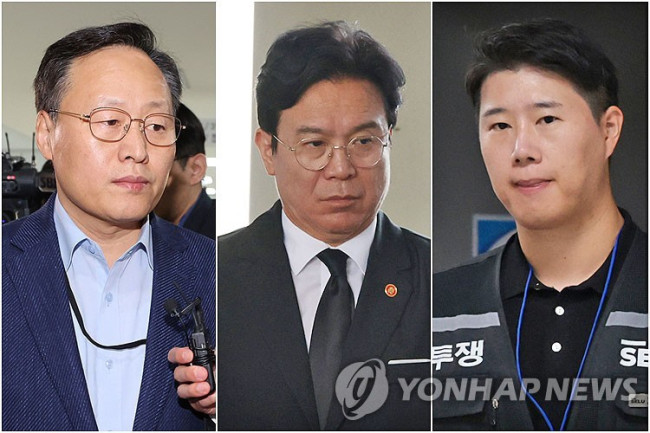
 Yeo Myung-gu, head of Samsung Electronics' DS (Device Solutions - semiconductor business) People Team, and Choi Seung-ho, chairman of the Samsung Group Trans-Enterprise Union's Samsung Electronics Branch, sign a provisional agreement after concluding wage negotiations at the Gyeonggi Employment and Labor Office in Jangan-gu, Suwon-si, Gyeonggi Province on the 20th. [Joint reporting]
"Knowing the negative impact of a Samsung Electronics strike, if our society cannot resolve it, what else can we do in the future? It is a desperate and regretful feeling. Strikes must be prevented." (Statement by Minister of Trade, Industry and Energy Kim Jeong-gwan at the plenary meeting of the National Assembly's Trade, Industry, and Energy Small and Medium-sized Business Committee on the 19th)
The fact that Samsung Electronics' labor and management reached a provisional agreement on the 2026 wage negotiations after a cliff-edge confrontation appears to be due to a shared concern about the immense ripple effects a strike would have on the Korean economy. The majority of the public shared the same sentiment as Minister Kim Jeong-gwan.
With the damage to our economy from a strike estimated to reach 100 trillion won, and the government hinting at the possibility of exercising its emergency adjustment rights, it is analyzed that both sides have avoided the worst through an agreement.
Samsung Electronics' labor and management signed the provisional agreement for the 2026 wage negotiations at the Gyeonggi Employment and Labor Office in Suwon, Gyeonggi Province, on the afternoon of the 20th.
Earlier that morning, the second post-mediation negotiation between labor and management broke down, increasing the likelihood of a general strike becoming a reality. However, with the active mediation of the government, including the Ministry of Employment and Labor and the Central Labor Relations Commission, negotiations for wage talks resumed at 4:25 PM that day.
Approximately six hours after negotiations resumed, at around 10:30 PM, labor and management reached a provisional agreement and signed it.
The union will conduct a vote among its members from the 22nd to the 27th regarding this provisional agreement. The provisional agreement will be finalized only if it receives a majority of votes from the total number of union members participating in the vote and a majority in favor.
 Minister of Employment and Labor Kim Young-hoon (center) and Samsung Electronics labor and management as mediators [Joint reporting/Yonhap News Agency file photo]
Labor-management negotiations, which had seen little breakthrough with the union's declaration to suspend negotiations in March, the general rally in April attended by about 30,000 people, and the breakdown of post-mediation, yielded results through cumulative mediation efforts from the government, business, and academia.
Furthermore, the government continued to pressure for the exercise of emergency adjustment rights, stating that the conflict between Samsung Electronics' labor and management over performance bonuses could escalate beyond the company to national damage.
President Lee Jae-myung strongly urged compromise through concessions at the State Council and Emergency Economic Committee meeting held at the Blue House on the 20th, saying, "It is good that some labor unions are striving to realize their interests through collective bargaining using their rights to organize and act, but there is a reasonable limit, isn't there?"
After the post-mediation for Samsung Electronics' labor and management failed on the morning of the 20th, they were guided back to the negotiation table once again.
In his address to the nation on the 17th, Prime Minister Kim Min-seok urged a resolution through dialogue between labor and management rather than a strike, stating, "If a situation arises where a Samsung Electronics strike is feared to cause immense damage to the national economy, the government will have no choice but to consider all possible response measures, including emergency adjustments, to protect the national economy."
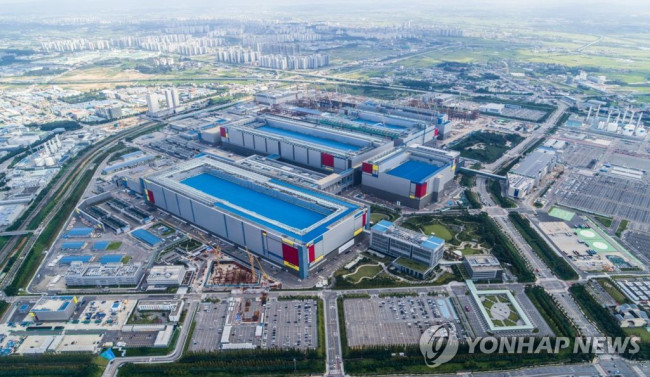 Samsung Electronics Pyeongtaek Campus [Samsung Electronics provided]
The estimated damage if negotiations had failed and a general strike had become a reality was in the tens of trillions of won.
The union claimed that the company would suffer losses of around 30 trillion won due to a strike, and global investment bank JP Morgan also predicted in a recent report that Samsung Electronics' annual operating profit could decrease by more than 40 trillion won. Some in the industry speculated that the damage could exceed 100 trillion won if production facilities or raw materials like wafers were damaged.
The six major economic organizations also pointed out that a strike at Samsung Electronics, which accounts for approximately 25% of the KOSPI's market capitalization, could accelerate a decline in the KOSPI index and an outflow of foreign investors, significantly shrinking the overall domestic capital market. They demanded that the government immediately exercise emergency adjustment rights in the event of a strike.
The American Chamber of Commerce in Korea stated in a press release, "If significant production disruptions or operational uncertainties occur at Samsung Electronics, concerns about supply bottlenecks and increased price volatility in the global memory semiconductor market, procurement stability, and overall supply chain stability could be further amplified."
If a strike had become a reality, there were also concerns about the indirect benefits for Chinese companies, which are closely pursuing Korea in memory semiconductors.
As prospects emerged of disruptions in Samsung Electronics' memory semiconductor production, Chinese companies emerged as alternative suppliers. The analysis suggests that the technology gap could further narrow due to the Chinese government's astronomical support and the drive for semiconductor self-sufficiency.
Shareholders also repeatedly condemned the union's demand to allocate a certain percentage of operating profit as a fixed source of performance bonuses, arguing that it undermines corporate value and infringes upon shareholder interests.
In response, academia also pointed out that the union's demands conflicted with the Commercial Code.
Lee Hong, an honorary professor at Kwangwoon University, stated at the spring regular seminar of the "Stakeholder Management Society," an incorporated association, held on the 6th, "The union receiving a fixed percentage of operating profit as a distribution is akin to receiving a 'prior dividend,' which signifies the union's 'quasi-shareholder' status and is unacceptable."
Minister Kim Young-hoon said of the labor-management agreement, "Above all, it is thanks to the public who have been watching with bated breath under difficult domestic and international circumstances."
He added, "I deeply thank Samsung Electronics' labor and management on behalf of the government for not letting go of the string of dialogue until the end and reaching a provisional agreement through autonomous negotiations," and concluded, "This is why Samsung Electronics seems to be a company of the people."
 Samsung Electronics [Yonhap News Agency file photo]

 Iranian Foreign Ministry: "Continuing Message Exchanges with the U.S. and Activities of Mediating Countries"
Esmaeil Baghaei, Spokesperson for the Iranian Ministry of Foreign Affairs [Xinhua, Yonhap News file photo]Esmaeil Baghaei, spokesperson for the Iranian Ministry of Foreign Affairs, stated on the 26th
Iranian Foreign Ministry: "Continuing Message Exchanges with the U.S. and Activities of Mediating Countries"
Esmaeil Baghaei, Spokesperson for the Iranian Ministry of Foreign Affairs [Xinhua, Yonhap News file photo]Esmaeil Baghaei, spokesperson for the Iranian Ministry of Foreign Affairs, stated on the 26th
 President Yoon: "Do You Think You Are Safe from the Special Counsel?"... Final Statement Video Released
President Yoon Suk Yeol rebuking the special prosecutor on the 24th. [Court video / @birds_justice X account subtitle GIF] A video of President Yoon Suk Yeol's closing statement at his trial rega
President Yoon: "Do You Think You Are Safe from the Special Counsel?"... Final Statement Video Released
President Yoon Suk Yeol rebuking the special prosecutor on the 24th. [Court video / @birds_justice X account subtitle GIF] A video of President Yoon Suk Yeol's closing statement at his trial rega
 President Yoon, regarding the first-instance ruling on the Public Official Election Act: “An excessive political verdict that distorts the facts… We will appeal immediately.”
The first-instance sentencing hearing for President Yoon Suk Yeol regarding violations of the Public Official Election Act is being broadcast live at Seoul Station on the 27th. [Photo=Yonhap News]Pres
President Yoon, regarding the first-instance ruling on the Public Official Election Act: “An excessive political verdict that distorts the facts… We will appeal immediately.”
The first-instance sentencing hearing for President Yoon Suk Yeol regarding violations of the Public Official Election Act is being broadcast live at Seoul Station on the 27th. [Photo=Yonhap News]Pres
 WSJ: "SK Hynix ADR Premium Is a Sign of AI Trading Overheat"
Advertisement for SK Hynix ADR listing in New York's Times Square [Reuters=Yonhap News file photo]The Wall Street Journal (WSJ) has pointed out that the price of SK Hynix’s American Depositary Recei
WSJ: "SK Hynix ADR Premium Is a Sign of AI Trading Overheat"
Advertisement for SK Hynix ADR listing in New York's Times Square [Reuters=Yonhap News file photo]The Wall Street Journal (WSJ) has pointed out that the price of SK Hynix’s American Depositary Recei
 'Godfather of Japanese Mystery Novels' Keigo Higashino Passes Away After Battle with Cancer at 68
Famous Japanese mystery novelist Keigo Higashino [AFP=Yonhap News]It has been belatedly reported that Keigo Higashino, the "godfather of Japanese mystery novels" and author of bestsellers such as "The
'Godfather of Japanese Mystery Novels' Keigo Higashino Passes Away After Battle with Cancer at 68
Famous Japanese mystery novelist Keigo Higashino [AFP=Yonhap News]It has been belatedly reported that Keigo Higashino, the "godfather of Japanese mystery novels" and author of bestsellers such as "The
 [Park Pil-kyu Security Column] To the Ignorant Trying to Clothe a Beast in Sheep's Clothing
Rep. Kim Byung-joo of the Democratic Party of Korea [Photo=Yonhap News]“The Air Force Academy doesn't teach you how to fly a plane!” “The Army, Navy, and Air Force academies are exactly the
[Park Pil-kyu Security Column] To the Ignorant Trying to Clothe a Beast in Sheep's Clothing
Rep. Kim Byung-joo of the Democratic Party of Korea [Photo=Yonhap News]“The Air Force Academy doesn't teach you how to fly a plane!” “The Army, Navy, and Air Force academies are exactly the
 [Issue Diagnosis] Two Effects of the Election Petition Review
 [Photo] Evidence of Election Fraud Flooding U.S. Media… Trump Had 2.7 Million Votes Stolen
 [Video] U.S. Semiquincentennial Air Show... 'Art in the Sky' streaks across New York
 [Editorial Cartoon] A Draconian Law That Undermines Freedom of Expression

 List
List









