 HD Hyundai Heavy Industries [Yonhap News Photo]
The Supreme Court ruled in favor of the prime contractor, HD Hyundai Heavy Industries, stating that it "has no obligation to engage in collective bargaining" in a lawsuit filed by its subcontractor labor union in 2017.
The court maintained the existing precedent that, for matters preceding the enforcement of the "Yellow Envelope Law" (amended Trade Union Act Articles 2 and 3), employers in labor-management relations should, in principle, be considered as those who have an express or implied contract with the workers.
The Supreme Court's en banc decision (Presiding Justice Oh Kyung-mi) on the 21st dismissed the appeal by the in-house subcontracting branch of the Korean Metal Workers' Union Hyundai Heavy Industries Division against HD Hyundai Heavy Industries in a lawsuit demanding collective bargaining.
The key issue was whether the prime contractor could be considered an employer obligated to engage in collective bargaining with the subcontractor union.
The Yellow Envelope Law, which took effect in March of this year, expanded the definition of an employer to include "those who, even if not a party to a labor contract, are in a position to substantially and concretely control and determine the working conditions of workers."
The subcontractor union had been demanding recognition of the prime contractor's employer status even for the period before the law's amendment. The Supreme Court clarified that under the old Trade Union Act, the prime contractor's employer status concerning collective bargaining with subcontractor unions was not recognized.
Eight justices who formed the majority opinion stated, "In matters to which Article 2 of the old Trade Union Act applies (before the enforcement of the Yellow Envelope Law), the existing legal principles regarding 'employers obligated to collective bargaining' are valid and should be maintained."
This upheld the 1986 precedent that established the criterion for the prime contractor's employer status as whether there is an express or implied labor contract relationship aimed at supervising and directing workers, receiving their labor, and paying wages.
While the Supreme Court had previously ruled in 2010 that a prime contractor could be considered an "employer" as a party responsible for unfair labor practices, the majority opinion today held that the employer for "unfair labor practices" and the employer as a "party to collective bargaining" should be viewed differently.
The majority opinion stated, "It is necessary to be cautious in interpreting that the prime contractor bears not only passive obligations, such as not interfering with or intervening in the subcontractor union, but also an active obligation to engage in collective bargaining to conclude a collective agreement."
It further added, "It cannot be considered appropriate to attempt to create and apply legal principles substantially similar to those of the amended Trade Union Act (Yellow Envelope Law) to a collective bargaining case around 2016, to which the old Trade Union Act applies, by changing the previous legal principles."
The explanation is that since no transitional provisions were included in the amendment of the Trade Union Act, it is sufficient to interpret the concept of employer in accordance with the amendment's intent for cases to which the amended law applies in the future.
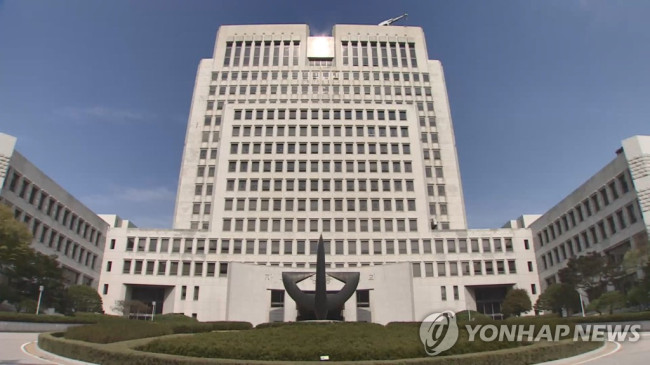 Exterior view of the Supreme Court [Yonhap News TV]
However, Justices Lee Heung-gu, Oh Kyung-mi, Shin Sook-hee, and Ma Yong-ju dissented, arguing that "even without an express or implied labor contract, if the prime contractor is in a position to substantially and concretely control and determine the working conditions of subcontractor workers, it bears the obligation for collective bargaining, absent special circumstances," advocating for a change in the previous precedent.
They argued that when determining the prime contractor's employer status, the spirit of the Constitution directly guaranteeing the three labor rights should be considered, and that subcontractor unions should be able to engage in direct collective bargaining with the prime contractor that determines working conditions to have their three labor rights effectively guaranteed.
Furthermore, they emphasized that consideration should be given to the widespread outsourcing of work and the rapid increase in indirect employment in various industrial sectors since the 1990s, and the development of legal principles by the Supreme Court in a direction that substantially guarantees the three labor rights in new types of labor provision relationships.
The subcontractor union had demanded collective bargaining in 2016, asserting that the prime contractor, HD Hyundai Heavy Industries, was in a position to substantially control and determine the working conditions of its subcontracted workers. When their request was not accepted, they filed a lawsuit against the prime contractor in January 2017.
The first and second trials dismissed the subcontractor union's claims, ruling that HD Hyundai Heavy Industries had no obligation to collective bargaining. The subcontractor union appealed this decision, and the Supreme Court has been hearing the case since December 2018.
Meanwhile, in March of this year, the Yellow Envelope Law (amended Trade Union Act Articles 2 and 3), which expands the scope of employers in labor-management relations, was enforced. This has led to ongoing demands for negotiation with prime contractors from subcontractor unions, resulting in escalating conflicts between prime and subcontractors.
Following the verdict, the Korean Metal Workers' Union issued a statement condemning the ruling, calling it a "judgment that ignores the reality of subcontracted workers."
They criticized the ruling as "a decision that goes against the spirit of the amended Trade Union Act," adding, "Society is already moving in the direction where those who substantially and concretely control and determine working conditions are employers, but the Supreme Court has failed to keep pace with these era-specific demands and the realities of the labor market."
A representative from HD Hyundai Heavy Industries stated, "We respect the court's decision and will faithfully engage in negotiations going forward."

 Iranian Foreign Ministry: "Continuing Message Exchanges with the U.S. and Activities of Mediating Countries"
Esmaeil Baghaei, Spokesperson for the Iranian Ministry of Foreign Affairs [Xinhua, Yonhap News file photo]Esmaeil Baghaei, spokesperson for the Iranian Ministry of Foreign Affairs, stated on the 26th
Iranian Foreign Ministry: "Continuing Message Exchanges with the U.S. and Activities of Mediating Countries"
Esmaeil Baghaei, Spokesperson for the Iranian Ministry of Foreign Affairs [Xinhua, Yonhap News file photo]Esmaeil Baghaei, spokesperson for the Iranian Ministry of Foreign Affairs, stated on the 26th
 President Yoon: "Do You Think You Are Safe from the Special Counsel?"... Final Statement Video Released
President Yoon Suk Yeol rebuking the special prosecutor on the 24th. [Court video / @birds_justice X account subtitle GIF] A video of President Yoon Suk Yeol's closing statement at his trial rega
President Yoon: "Do You Think You Are Safe from the Special Counsel?"... Final Statement Video Released
President Yoon Suk Yeol rebuking the special prosecutor on the 24th. [Court video / @birds_justice X account subtitle GIF] A video of President Yoon Suk Yeol's closing statement at his trial rega
 President Yoon, regarding the first-instance ruling on the Public Official Election Act: “An excessive political verdict that distorts the facts… We will appeal immediately.”
The first-instance sentencing hearing for President Yoon Suk Yeol regarding violations of the Public Official Election Act is being broadcast live at Seoul Station on the 27th. [Photo=Yonhap News]Pres
President Yoon, regarding the first-instance ruling on the Public Official Election Act: “An excessive political verdict that distorts the facts… We will appeal immediately.”
The first-instance sentencing hearing for President Yoon Suk Yeol regarding violations of the Public Official Election Act is being broadcast live at Seoul Station on the 27th. [Photo=Yonhap News]Pres
 WSJ: "SK Hynix ADR Premium Is a Sign of AI Trading Overheat"
Advertisement for SK Hynix ADR listing in New York's Times Square [Reuters=Yonhap News file photo]The Wall Street Journal (WSJ) has pointed out that the price of SK Hynix’s American Depositary Recei
WSJ: "SK Hynix ADR Premium Is a Sign of AI Trading Overheat"
Advertisement for SK Hynix ADR listing in New York's Times Square [Reuters=Yonhap News file photo]The Wall Street Journal (WSJ) has pointed out that the price of SK Hynix’s American Depositary Recei
 'Godfather of Japanese Mystery Novels' Keigo Higashino Passes Away After Battle with Cancer at 68
Famous Japanese mystery novelist Keigo Higashino [AFP=Yonhap News]It has been belatedly reported that Keigo Higashino, the "godfather of Japanese mystery novels" and author of bestsellers such as "The
'Godfather of Japanese Mystery Novels' Keigo Higashino Passes Away After Battle with Cancer at 68
Famous Japanese mystery novelist Keigo Higashino [AFP=Yonhap News]It has been belatedly reported that Keigo Higashino, the "godfather of Japanese mystery novels" and author of bestsellers such as "The
 [Park Pil-kyu Security Column] To the Ignorant Trying to Clothe a Beast in Sheep's Clothing
Rep. Kim Byung-joo of the Democratic Party of Korea [Photo=Yonhap News]“The Air Force Academy doesn't teach you how to fly a plane!” “The Army, Navy, and Air Force academies are exactly the
[Park Pil-kyu Security Column] To the Ignorant Trying to Clothe a Beast in Sheep's Clothing
Rep. Kim Byung-joo of the Democratic Party of Korea [Photo=Yonhap News]“The Air Force Academy doesn't teach you how to fly a plane!” “The Army, Navy, and Air Force academies are exactly the
 [Issue Diagnosis] Two Effects of the Election Petition Review
 [Photo] Evidence of Election Fraud Flooding U.S. Media… Trump Had 2.7 Million Votes Stolen
 [Video] U.S. Semiquincentennial Air Show... 'Art in the Sky' streaks across New York
 [Editorial Cartoon] A Draconian Law That Undermines Freedom of Expression

 List
List









