 U.S. Secretary of State Mike Pompeo holds a press conference after a NATO foreign ministers' meeting in Helsingborg, Sweden, on May 22. [EPA=Yonhap News]
U.S. Secretary of State Mike Pompeo stated that President Donald Trump is disappointed with European allies' lukewarm support for Middle Eastern wars, and that issues surrounding transatlantic division should be addressed at the North Atlantic Treaty Organization (NATO) summit in July.
According to Reuters and other news outlets, Secretary Pompeo said at a NATO foreign ministers' meeting in Helsingborg, southern Sweden, on May 22 (local time), "Frankly, the President is disappointed with the response of some NATO allies to the operations in the Middle East." He suggested that the issue of division within the alliance would be directly addressed at the NATO summit in early July in Ankara, Turkey.
He anticipated that the Ankara summit would be "one of the most important summits in NATO's history" as leaders would need to respond to President Trump's disappointment. He added, "This issue must be addressed, but it will not be resolved today. It is a matter that needs to be discussed at the highest level."
President Trump has repeatedly hinted at the possibility of withdrawing from NATO, expressing strong anger towards Europe for not aiding the U.S. in its conflict with Iran.
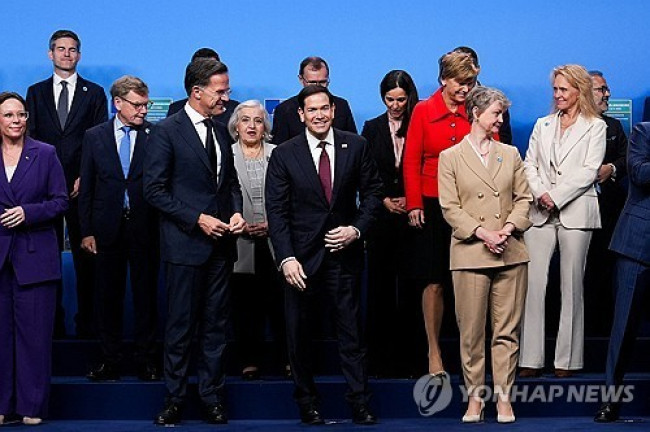 U.S. Secretary of State Mike Pompeo (front row, center) and NATO Secretary General Mark Rutte (to the left of Pompeo) attend a NATO foreign ministers' meeting in Helsingborg, Sweden, on May 22. [Reuters=Yonhap News]
At this foreign ministers' meeting, which served as preparatory work for the July NATO summit agenda, European NATO members focused on highlighting that Europe is increasing defense spending in response to U.S. demands and is prepared to contribute to ensuring freedom of navigation in the Strait of Hormuz after the war, in an effort to placate President Trump.
In this context, Secretary Pompeo's reiteration of President Trump's disappointment regarding the Iran war is interpreted as a clear indication that transatlantic division and its resolution will be a major agenda item at the upcoming NATO summit.
His remarks are also seen as a warning that the future of NATO cannot be guaranteed if the divisions are not effectively mended at the summit.
Secretary Pompeo added, "NATO is important not only for Europe but also for the United States. The goal is to create a stronger NATO."
Pompeo also stated that if the conflict with Iran prolongs, European countries might need to prepare a "Plan B" for the reopening of the Strait of Hormuz. "It doesn't necessarily have to be a NATO mission, but it's certainly something that NATO members could contribute to," he said.
This statement is also interpreted as a suggestion that the U.S. might pressure Europe to play a role in reopening the Strait of Hormuz, even before the war ends, and attention is drawn to how this will unfold.
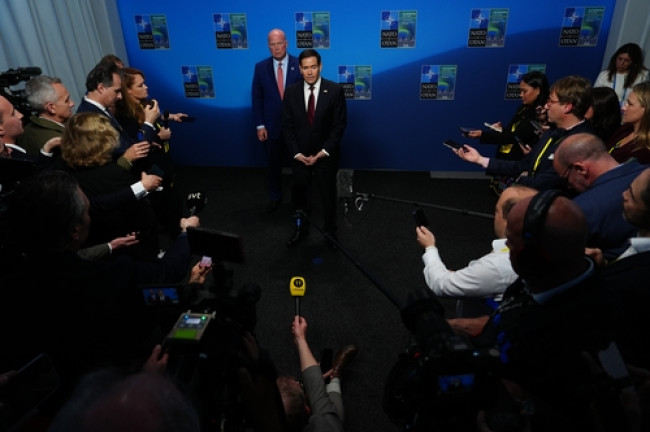 U.S. Secretary of State Mike Pompeo answers reporters' questions after a NATO foreign ministers' meeting in Helsingborg, Sweden, on May 22. [AP=Yonhap News]
At the press conference following the foreign ministers' meeting, reporters' questions were focused on Secretary Pompeo regarding the redeployment of U.S. troops in Europe, including the dispatch of 5,000 additional U.S. troops to Poland, announced by President Trump just before the meeting, and the previously announced reduction of 5,000 U.S. troops stationed in Germany.
In response to Europe's concerned views on the reduction of U.S. troops in Germany, Secretary Pompeo argued that it is "not a punitive measure, but part of an ongoing redeployment of U.S. forces." He explained, "The United States has obligations to fulfill globally, and we must continuously review where to position our forces regarding troop deployment."
He further emphasized, "Our allies have been well aware that U.S. forces in Europe would be adjusted, and this process has been coordinated with our allies, so it should not come as a surprise to anyone. We have missions in the Indo-Pacific region, the Middle East, and the Western Hemisphere."
According to AFP, his remarks are interpreted as a directive to European allies to accept the reduction of U.S. troops stationed in Europe.
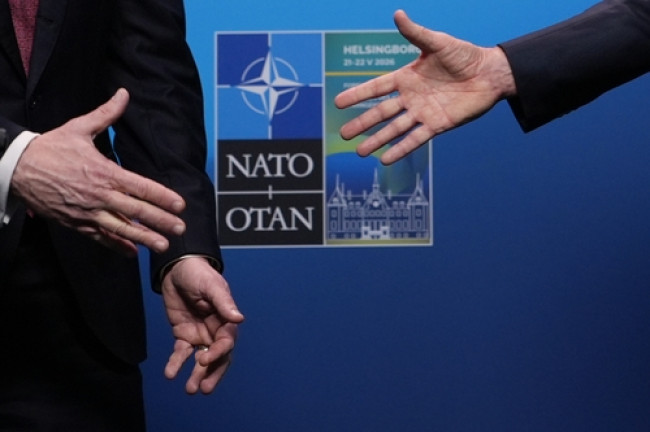 U.S. Secretary of State Mike Pompeo (left) shakes hands with NATO Secretary General Mark Rutte. [AP=Yonhap News]
Regarding the war in Ukraine, Secretary Pompeo assessed that peace negotiations between Russia and Ukraine have "regrettably yielded no results so far," but added that the U.S. is "prepared to continue to play that role" as a mediator in negotiations.
NATO Secretary General Mark Rutte, who held a bilateral meeting with Secretary Pompeo on the same day, acknowledged that developments related to the redeployment of U.S. forces are underway behind the scenes but refused to disclose specific details, citing that it is a "highly classified matter."
Secretary General Rutte also stated that Ukrainian President Volodymyr Zelensky has been invited to the NATO summit in Ankara in July.
Meanwhile, the U.S. Department of State announced that Secretary Rutte and Secretary Pompeo held a bilateral meeting today and discussed NATO's strategic priorities, including allies' defense spending increases, the Ankara NATO summit, expanding defense production by NATO members, and ways to promote freedom of navigation and maritime security in key international waters.

 Iranian Foreign Ministry: "Continuing Message Exchanges with the U.S. and Activities of Mediating Countries"
Esmaeil Baghaei, Spokesperson for the Iranian Ministry of Foreign Affairs [Xinhua, Yonhap News file photo]Esmaeil Baghaei, spokesperson for the Iranian Ministry of Foreign Affairs, stated on the 26th
Iranian Foreign Ministry: "Continuing Message Exchanges with the U.S. and Activities of Mediating Countries"
Esmaeil Baghaei, Spokesperson for the Iranian Ministry of Foreign Affairs [Xinhua, Yonhap News file photo]Esmaeil Baghaei, spokesperson for the Iranian Ministry of Foreign Affairs, stated on the 26th
 President Yoon: "Do You Think You Are Safe from the Special Counsel?"... Final Statement Video Released
President Yoon Suk Yeol rebuking the special prosecutor on the 24th. [Court video / @birds_justice X account subtitle GIF] A video of President Yoon Suk Yeol's closing statement at his trial rega
President Yoon: "Do You Think You Are Safe from the Special Counsel?"... Final Statement Video Released
President Yoon Suk Yeol rebuking the special prosecutor on the 24th. [Court video / @birds_justice X account subtitle GIF] A video of President Yoon Suk Yeol's closing statement at his trial rega
 President Yoon, regarding the first-instance ruling on the Public Official Election Act: “An excessive political verdict that distorts the facts… We will appeal immediately.”
The first-instance sentencing hearing for President Yoon Suk Yeol regarding violations of the Public Official Election Act is being broadcast live at Seoul Station on the 27th. [Photo=Yonhap News]Pres
President Yoon, regarding the first-instance ruling on the Public Official Election Act: “An excessive political verdict that distorts the facts… We will appeal immediately.”
The first-instance sentencing hearing for President Yoon Suk Yeol regarding violations of the Public Official Election Act is being broadcast live at Seoul Station on the 27th. [Photo=Yonhap News]Pres
 WSJ: "SK Hynix ADR Premium Is a Sign of AI Trading Overheat"
Advertisement for SK Hynix ADR listing in New York's Times Square [Reuters=Yonhap News file photo]The Wall Street Journal (WSJ) has pointed out that the price of SK Hynix’s American Depositary Recei
WSJ: "SK Hynix ADR Premium Is a Sign of AI Trading Overheat"
Advertisement for SK Hynix ADR listing in New York's Times Square [Reuters=Yonhap News file photo]The Wall Street Journal (WSJ) has pointed out that the price of SK Hynix’s American Depositary Recei
 'Godfather of Japanese Mystery Novels' Keigo Higashino Passes Away After Battle with Cancer at 68
Famous Japanese mystery novelist Keigo Higashino [AFP=Yonhap News]It has been belatedly reported that Keigo Higashino, the "godfather of Japanese mystery novels" and author of bestsellers such as "The
'Godfather of Japanese Mystery Novels' Keigo Higashino Passes Away After Battle with Cancer at 68
Famous Japanese mystery novelist Keigo Higashino [AFP=Yonhap News]It has been belatedly reported that Keigo Higashino, the "godfather of Japanese mystery novels" and author of bestsellers such as "The
 [Park Pil-kyu Security Column] To the Ignorant Trying to Clothe a Beast in Sheep's Clothing
Rep. Kim Byung-joo of the Democratic Party of Korea [Photo=Yonhap News]“The Air Force Academy doesn't teach you how to fly a plane!” “The Army, Navy, and Air Force academies are exactly the
[Park Pil-kyu Security Column] To the Ignorant Trying to Clothe a Beast in Sheep's Clothing
Rep. Kim Byung-joo of the Democratic Party of Korea [Photo=Yonhap News]“The Air Force Academy doesn't teach you how to fly a plane!” “The Army, Navy, and Air Force academies are exactly the
 [Issue Diagnosis] Two Effects of the Election Petition Review
 [Photo] Evidence of Election Fraud Flooding U.S. Media… Trump Had 2.7 Million Votes Stolen
 [Video] U.S. Semiquincentennial Air Show... 'Art in the Sky' streaks across New York
 [Editorial Cartoon] A Draconian Law That Undermines Freedom of Expression

 List
List









