“The Kim Dae-jung and Roh Moo-hyun administrations secretly provided $1 billion to North Korean leader Kim Jong-il from 1999 to June 2006.”
On the 23rd, President Lee Jae-myung attended the 17th memorial ceremony for former President Roh Moo-hyun at Bongha Village in Gimhae and stated, "I will steadfastly pursue reforms to eliminate unfair practices and privileges without fearing opposition from vested interests."
"A world without unfair practices and privileges" is a phrase frequently used by Roh Moo-hyun and symbolizes the spirit of Roh Moo-hyun. However, Roh Moo-hyun was an individual who took his own life while under investigation for allegedly receiving over 10 billion won in bribes from businessmen.
Creating a Hero Roh Moo-hyun Through Propaganda and Agitation
Roh Moo-hyun's self-inflicted death terminated the investigation, and his family, escaping legal repercussions such as being labeled criminals and the recovery of ill-gotten gains from bribery, now lavishly enjoys their lives with over 10 billion won in bribe money, all while espousing the spirit of Roh Moo-hyun. The Roh Moo-hyun family enjoys privileges obtained through unfair means, namely bribes, and Roh Moo-hyun himself is a symbol of unfair practices and privileges.
The Democratic Party goes a step further, claiming that Roh Moo-hyun was unjustly investigated for bribery and took his own life due to the abuse of power by the prosecution in its investigative and prosecutorial authority. They also claim that the prosecution's fabricated investigation and the media's "rice paddy watch" report drove Roh Moo-hyun to his death.
The investigation at the time by the prosecution concluded that Roh Moo-hyun received two watches, each worth 100 million won, as bribes. Although the crucial point was not whether Roh Moo-hyun had discarded the watches in rice paddies, fields, or ditches after the investigation began, the Democratic Party has continued their propaganda and agitation for decades based on these tangential details. If Roh Moo-hyun did not receive bribes, there would be no reason for him to have taken his own life.
Roh Moo-hyun was not merely passively aware of his wife, Kwon Yang-sook, receiving over 10 billion won in bribes from Park Yeon-cha, chairman of Taekwang Group; he actively participated in the bribery crime by repeatedly calling Park Yeon-cha to demand money.
The book "I Was a Prosecutor in the Republic of Korea: Who Killed Roh Moo-hyun" by Lee In-gyu, the former head of the Supreme Prosecutors' Office's Investigation Bureau who led the investigation into Roh Moo-hyun's bribery case, meticulously details the circumstances of Roh Moo-hyun receiving 11 billion won in bribes.
In media interviews at the time of the book's release, Lee In-gyu stated that he would bravely fight to reveal the truth in court if the Democratic Party and Roh Moo-hyun's family filed lawsuits against him. However, the Democratic Party and Roh Moo-hyun's family, whose specialty is filing numerous lawsuits, did not sue Lee In-gyu.
This is because resolving the truth through litigation would require disclosing the investigation records and summoning relevant witnesses, which would in turn publicly reveal the bribery case involving Roh Moo-hyun and his family, a case Roh Moo-hyun attempted to bury with his death.
The strategy chosen by the Democratic Party and pro-North Korean leftists is not a "hopeless legal battle" but rather "creating a hero Roh Moo-hyun through propaganda and agitation." Historical distortion through propaganda and agitation is the specialty of pro-North Korean leftists.
Through manipulation, propaganda, and agitation, they succeeded in impeaching Presidents Park Geun-hye and Yoon Suk-yeol, and achieved the "communization" of South Korea, which goes beyond its leftward shift.
They distort the history of President Syngman Rhee's arduous nation-building of a liberal democracy and demonize President Park Chung-hee, who ended the history of poverty in South Korea and achieved modernization and industrialization of the nation.
The 12.12 incident, where the Martial Law Command's joint investigation headquarters arrested Jeong Seung-hwa, the Army Chief of Staff who was present at the scene of Park Chung-hee's assassination, for investigation, was a legitimate execution of duty by the joint investigation headquarters. However, pro-North Korean leftists characterize it as a rebellion by Chun Doo-hwan and the military junta.
Furthermore, through propaganda and agitation, they transform the May 18 Gwangju Uprising, which the Supreme Court ruled in 1981 as an "armed riot and rebellion instigated by Kim Dae-jung's instigation," into a pro-democracy movement.
Roh and Lee: A Criminal Regime with a Fantastic Combination
The slogan "A world without unfair practices and privileges" shouted by Roh Moo-hyun was dismantled by Roh Moo-hyun himself. Lee Jae-myung, who champions the spirit of Roh Moo-hyun, is currently enjoying privileges obtained through all sorts of unfair practices that Roh Moo-hyun could not even approach.
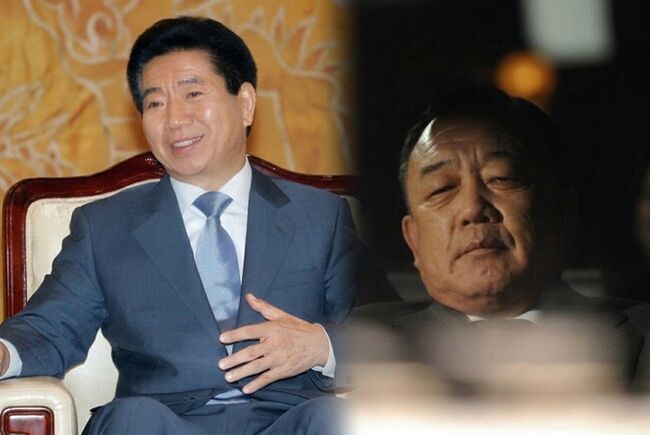 Former Taekwang Industrial Chairman Park Yeon-cha, who allegedly gave a total of 11 billion won in bribes to Roh Moo-hyun (left). [Photo=Roh Moo-hyun Archives & Yonhap News]
Roh Moo-hyun, who allegedly received bribes and shouted for "a world without unfair practices and privileges," is now actively engaging in all sorts of unfair practices and enjoying privileges. Lee Jae-myung is rushing legislation to halt his five ongoing trials and even have them dismissed; they are a criminal regime with a fantastic combination.
Furthermore, Lee Jae-myung, with four previous convictions, is pushing for the enactment of the "Judicial Three Laws," known as "bulletproof laws," and has intimidated the prosecution and the judiciary, thereby dismantling the separation of powers, the rule of law, and the constitutional order.
During the investigations and trials related to Lee Jae-myung, including allegations concerning the Daejang-dong development project, the lawyer's fee payment scandal, the misuse of the Gyeonggi Province corporate credit card, and illegal sponsorships for Seongnam FC, seven associates or individuals close to him have died through suicide, suspicious deaths, or accidents.
Yoo Dong-gyu, former head of the Seongnam Development Corporation, a key witness in the Daejang-dong development favoritism allegations, who was hospitalized after a suspicious traffic accident, stated that he would never commit suicide.
The Suicidal Deaths of Nam Sang-guk and Chung Mong-heon Implied
In a press conference broadcast live on TV in March 2004, Roh Moo-hyun stated that Nam Sang-guk, president of Daewoo Engineering & Construction, had asked his brother, Roh Gun-pyeong, for help with his reappointment as president. Roh Moo-hyun added, "I hope that individuals who attended good schools and achieved great success like the president of Daewoo Engineering & Construction will no longer bow their heads and give money to insignificant people in the countryside."
After the press conference, Nam Sang-guk committed suicide by jumping into the Han River. Nam Sang-guk's family demanded an apology for defamation, but Roh Moo-hyun refused. The family sued Roh Moo-hyun for defamation after his retirement. The prosecution's investigation revealed that, contrary to Roh Moo-hyun's statement, Roh Gun-pyeong had actively solicited the job, even meeting Nam Sang-guk at a hotel in Seoul.
In August 2003, during the Roh Moo-hyun administration, Chung Mong-heon, chairman of the Hyundai Group, who was under investigation by the special prosecutor regarding Hyundai's slush funds in connection with secret North Korea remittances, jumped to his death from the 12th floor of the Hyundai Group headquarters in Gyedong, Jongno-gu, Seoul.
At the time, Chung Mong-heon had been drinking with a friend in Gangnam. After dropping off his friend at the Hyatt Hotel, he headed towards his home in Seongbuk-gu. Upon arriving at the Hyundai building, he told his driver he would be back in 20-30 minutes. He entered his 12th-floor office and was found dead in a flowerbed on the first floor the next morning.
The investigation concluded that it was a suicide. However, suspicions arose that he might have been murdered and then thrown out the window, given the narrowness of the window, which would make it difficult to jump out alone.
The Pro-North Korean Leftist's Unreasonable Bullying, Red Guard Style
Lee Seok-yeon, chairman of the Presidential Committee for National Cohesion, a deputy prime minister-level position, recently revealed that he received a warning email from a presidential secretary regarding his activities. He criticized the secretary's constant interference in his actions and unnecessary obstruction, stating, "This kind of bullying and excessive intervention is never desirable."
The unreasonable bullying, Red Guard style, of the pro-North Korean leftists is not limited to the Lee Jae-myung administration. In the Roh Moo-hyun administration, a minister-level assistant, a former government official, resigned only a few months after taking office. When asked for the reason for his resignation, he replied, "Don't you already know?"
The 386 generation activists who served as secretaries and administrative officers in the Roh Moo-hyun Blue House were like Red Guards wearing armbands. They lacked organizational hierarchy or democratic control, and senior staff, such as chief secretaries and assistants, could not defy the will of the Red Guards. For pro-North Korean leftists, democracy is only necessary when it serves as a means to destroy democracy.
The reason for the brazen behavior of Lee Jae-myung and the Democratic Party regime is their confidence that they will never lose power. Despite widespread allegations and demands for an investigation into electoral fraud, neither Lee Jae-myung and the Democratic Party, the National Election Commission, the Supreme Court, nor even the People Power Party, the direct victim of electoral fraud, are coming forward to address the issue. Allegations of electoral fraud are not only a grave crime that shakes the constitutional order and the nation but also the most severe form of unfair practice.
Kim Dae-jung and Roh Moo-hyun are at the center of the allegations of electoral fraud in South Korea. Upon arriving at Pyongyang Sunan Airport for the June 15 Inter-Korean Summit in 2000, Kim Dae-jung, violating security protocols, got into Kim Jong-il's car without security personnel and had a private conversation with Kim Jong-il for 45 minutes.
According to media reports on the content of this private conversation, obtained by U.S. intelligence agencies, Kim Jong-il instructed Kim Dae-jung to make Roh Moo-hyun the Democratic Party's next presidential candidate. When Kim Dae-jung mentioned Roh Moo-hyun's lower recognition compared to Chung Dong-young or Han Kwang-ok, Kim Jong-il cited Roh Moo-hyun's father's hometown being in Honam and Roh Moo-hyun's father-in-law's background as a partisan, stating that public opinion and recognition can be overcome through propaganda and agitation, and added, "Let's collaborate extensively with us on election matters."
Electronic Vote Counting Machines First Introduced After Kim Dae-jung-Kim Jong-il Summit
As a result of the Kim Dae-jung and Kim Jong-il summit, electronic vote counting machines were first introduced in 2002. Roh Moo-hyun, surpassing his competitors, was elected president in December of that year in the Democratic Party's presidential primary and the general election.
The electronic vote counting system, first introduced during the Kim Dae-jung administration in 2002, was supplied and operated by companies such as Gwanwoo Information & Communications, Hantel Systems, and SK C&C. However, individuals associated with these companies were prosecuted for bribery at the National Election Commission.
During the trial, Ryu Jae-hwa, CEO of Gwanwoo Information & Communications, made a declaration of conscience stating that Kim Dae-jung, Lee Hae-chan, and Park Jie-won had ordered the production of fraudulent electronic vote counting machines. However, the prosecution did not investigate, and Ryu Jae-hwa died under suspicious circumstances.
Subsequently, during the Kim Dae-jung and Roh Moo-hyun administrations, issues arose concerning the inter-Korean communication network project, allegations linking the Dasan Group and Korea Electronic Voting Co., Ltd. to leftist regimes, and suspicions of manipulation of the National Election Commission network through Huawei's backdoor.
The reason for the various forms of unfair practices by Lee Jae-myung and the Democratic Party is the legislative, judicial, and administrative branches, as well as the National Election Commission, all controlled by the Democratic Party, and the media, which is controlled by the media unions under the pro-North Korean leftist group the Korean Confederation of Trade Unions (KCTU).
The media unions, a speaker for the pro-North Korean leftist group KCTU whose core executives have been convicted in espionage cases, are the largest media organization in the country, controlling public broadcasting such as KBS, MBC, YTN, and Yonhap News, as well as unions of hundreds of media outlets. In reality, they are a pro-North Korean leftist political group that destroys free Korea through propaganda, agitation, manipulation, and distorted reporting, and brainwashes the public to aid the North Korean communist group's goal of unification through force.
“We are advancing with great strides on the path of reforming undemocratic legal and social systems, ensuring human dignity, and realizing freedom and equality, under the banner of making workers a political force.” This is a phrase from the media unions' charter, demonstrating that they are not a pure media organization but a political group that uses the media as a tool to realize their pro-North Korean leftist ideology.
The media unions are tools for mass propaganda and agitation, used to justify the "witch hunts" for the impeachment of President Park Geun-hye and the investigation into her bribery charges, and the impeachment of President Yoon Suk-yeol and the investigation into his alleged rebellion, following the Gwanghwamun protests against mad cow disease, the Sewol ferry disaster, and the impeachment of President Park Geun-hye.
The media unions' charter also includes the phrase: "Recognizing that all workers of the world are one, we practice international solidarity and strive for the realization of lasting world peace by opposing war."
In line with the identity of the pro-North Korean leftist group, traces of the final passage of Marx's Communist Manifesto are visible: "The proletarians have nothing to lose but their chains. They have a world to win. Working men of all countries, unite!"
When YTN President Kim Baek ordered a fact-check on allegations of electoral fraud, the YTN union refused. At media outlets controlled by the media unions, management directives for news reporting and writing are refused under the pretext of infringing on press freedom, and only news and reporting that align with the media unions' pro-North Korean leftist ideology enjoy press freedom.
History of Media Suppression by Pro-North Korean Leftist Regimes
There are journalists who do not agree with the ideology of the media unions. However, they cannot voice their opinions in media organizations where the majority are media union members and thus conform to the system. The media unions are not interested in facts; only articles that align with their ideology are considered fair reporting, and articles that do not align with their ideology are subject to manipulation and distortion.
The manipulation, distortion, and propaganda by media outlets controlled by the media unions, as well as by Chosun, JoongAng, and Dong-A, which claim to be conservative media but have degraded into low-quality news peddlers serving the interests of their owners, are the driving force behind the impeachment and criminal trials of Park Geun-hye and Yoon Suk-yeol.
Most media outlets consistently use terms like "rebellion leader" and "rebellion suspect" in their reports on the trial of Yoon Suk-yeol and Kim Yong-hyun for alleged rebellion, engaging in propaganda. "Rebellion leader" is a term used by the Democratic Party, and whether someone is a "rebellion suspect" is a matter for the court to decide. The principle of presumption of innocence applies before the final ruling of the Supreme Court. However, they endlessly repeat propaganda labeling them as "rebellion suspects."
Following the Kim Dae-jung, Roh Moo-hyun, and Moon Jae-in administrations, Lee Jae-myung is even more overtly attempting to control and suppress the media through amendments to the Broadcasting Act and pressure, with the aim of ousting the chairperson of the Korea Communications Commission and the executives of KBS, MBC, EBS, YTN, and Yonhap News TV appointed by the Yoon Suk-yeol government.
Lee Jae-myung's actions go beyond Moon Jae-in's "cleansing of media irregularities" which led to the dismissal and disciplinary action of executives and managers of public broadcasting. Lee Jae-myung and the Democratic Party are initiating media dictatorship with the "Act on Eradicating False and Fabricated Information," which imposes punitive fines of up to 1 billion won on media outlets and YouTubers, thereby discouraging criticism of the government and the exercise of power to ensure that only articles that suit the regime's preferences are published.
The history of media suppression by pro-North Korean leftist regimes began with the Kim Dae-jung administration. Kim Dae-jung launched the largest-ever tax audit of media companies, announcing a claim of 505.6 billion won in back taxes. The back taxes for Chosun, JoongAng, and Dong-A, which were critical of the Kim Dae-jung administration, accounted for more than half of the total claim.
After relatives, family members, and friends were subjected to tax surveillance and summoned by the prosecution, the wife of the owner of Dong-A Ilbo committed suicide by jumping from her apartment. To mend relations with the Kim Dae-jung administration, these conservative media outlets hired a large number of journalists from the Honam region, leading to a rapid leftward shift in their reporting.
Condoleezza Rice: "Roh Moo-hyun was an anti-American President"
The Roh Moo-hyun administration engaged in another act of media control and suppression, known as the "Nail in the Press Room." Under the guise of advancing the press support system, press rooms in government ministries were abolished and consolidated into three joint briefing centers, including one in the Government Complex in Sejong-ro, Seoul.
Through the open briefing system, reporting was effectively blocked beyond the spokesperson's briefings and press releases, and information necessary for propaganda was provided only to media outlets favorable to the regime. At the Blue House's Chunchugwan press room, pro-government media outlets exclusively published exclusive stories daily, while other media outlets found it difficult even to get through to secretaries for verification. In such a situation, reporters, mindful of the secretaries' moods, could not even dare to protest or write critical articles.
During a luncheon between President Roh Moo-hyun and media editors/news directors, the editor of The Korea Herald was told by the senior press secretary that The Korea Herald would not be invited in the future because the editor asked an uncomfortable question to the president. Reporters from The Korea Herald and Herald Business protested and also submitted related articles. As a result of the Blue House's protest, reporters from both The Korea Herald and Herald Business were expelled.
However, no media outlet reported this incident. After a reporter from Gyeonggi Broadcasting asked a critical question about the Moon Jae-in administration's economic policies during a Blue House press conference, the reporter resigned, and Gyeonggi Broadcasting ceased operations.
This is the scene of media suppression by the Roh Moo-hyun and Moon Jae-in administrations, which claim to be creating "a world without unfair practices and privileges." When President Trump questioned a CNN reporter at a White House press conference who continued to ask critical questions, his access was revoked. However, all White House reporters covered this incident. The CNN reporter was eventually allowed back into the White House press corps, and CNN did not cease operations.
Due to the Roh Moo-hyun administration's media suppression, self-censorship became routine among reporters covering the Blue House. Roh Moo-hyun went hiking on the mountain behind the Blue House with these reporters. Upon reaching Sukjeongmun, they all sat down for a briefing. Roh Moo-hyun mentioned his discussion with U.S. Secretary of State Rice about the theory of Northeast Asian balancer, vaguely implying that Rice had agreed.
When a question arose asking if Secretary Rice had truly agreed, a profound silence and tension filled the air. This was a rare critical question during Roh Moo-hyun's press conferences or briefings. Roh Moo-hyun sheepishly smiled and stammered, "Well, that's not quite it," and then vaguely answered again.
In her memoir, Secretary Condoleezza Rice described President Roh Moo-hyun as an incomprehensible president who, during their meeting in Korea, emphasized the need for South Korea to act as a balancer between the U.S. and China, exhibiting anti-American sentiments.
Given the ROK-U.S. Mutual Defense Treaty, would South Korea acting as a balancer between China and the U.S. mean the abrogation of the treaty? The North Korea-China alliance treaty includes a provision for automatic Chinese military intervention in the event of an emergency in North Korea.
"Roh and Others Aided North Korea's Nuclear Development Through Cash Support"
The conciliatory policies toward North Korea, such as Kim Dae-jung's Sunshine Policy and Roh Moo-hyun's Northeast Asian balancer theory, were major contributors to North Korea's nuclear armament. This is according to a report titled "Congressional Issues in ROK-U.S. Relations" dated November 28, 2012, by Larry Niksch, a researcher at the Congressional Research Service of the United States.
“The Kim Dae-jung and Roh Moo-hyun administrations secretly provided $1 billion to North Korean leader Kim Jong-il from 1999 to June 2006. North Korea used this money to purchase materials and equipment for its highly-enriched uranium program, which was being pursued in extreme secrecy at the time. According to CIA assessments at the time and testimony from former Clinton administration officials, North Korea began purchasing enriched uranium technology in 1999 and rapidly increased its purchases between 2000 and 2001. From 1999 to 2008, economic support from South Korea to North Korea amounted to $7 billion, including $2.9 billion in cash. Providing cash to North Korea was extremely risky. Indeed, it was revealed that North Korea purchased approximately $1.5 billion worth of equipment and raw materials from overseas for its nuclear and missile programs between 1998 and 2008. The $1.5 billion spent on this was found to have come from South Korea.” - Lee In-gyu, "I Was a Prosecutor in the Republic of Korea: Who Killed Roh Moo-hyun"
Another anecdote related to Roh Moo-hyun, who championed "a world without unfair practices and privileges." On June 10, 2005, after a summit meeting with President Bush at the White House, a reporter spoke with an airline employee responsible for Roh Moo-hyun's meals on the return flight.
When asked what President Roh Moo-hyun ate for breakfast at the hotel, the employee replied that the president had gone to his son-in-law's home in the U.S. for ramen and had not eaten breakfast at the hotel. At the time, Roh Moo-hyun's daughter was in Seoul finalizing her affairs before going to the U.S., and her husband had already gone ahead.
The reporter wrote an article and submitted it, but the editor, who engaged in self-censorship, did not publish it. At that time, there was reporting on the case of Roh So-young, daughter of former President Roh Tae-woo, smuggling foreign currency.
After his retirement, Roh Moo-hyun was investigated for allegedly receiving $6.4 million in bribes. Media reports emerged that Roh Moo-hyun's daughter, Roh Jeong-yeon, had purchased a luxurious three-bedroom condominium, Unit 400 of the Hudson Club, in West New York, Hudson County, New Jersey, across the Hudson River from the skyscrapers of Manhattan, New York.
Roh Moo-hyun argued that Korean history is a history where opportunism prevailed and justice was defeated, and that the Blue House, a part of Gyeongbokgung Palace from the Joseon Dynasty, a theater of bloody power struggles, was problematic. This was the background behind Roh Moo-hyun's push for the relocation of the administrative capital, with balanced regional development and the alleviation of Seoul's overpopulation serving as the publicly stated justifications. Throughout history, from ancient times to the present, where has there not been court intrigue?...
Leaders ignorant of history plunge their nations into chaos. The Blue House, compared to the White House or the executive offices and residences of leaders in any country worldwide, is an unparalleled symbol of South Korea, and no country carelessly changes its national symbols and history.
Although there were assassinations of Presidents Lincoln and Kennedy, and several U.S. presidents, including Nixon and Trump, faced impeachment issues, the U.S. did not move the White House to another location for such reasons. As the White House main building became cramped and security issues arose, additional buildings were constructed nearby to accommodate White House staff, leaving the main building as a symbol of America.
Acquitting Those Involved in Espionage Cases Through Retrials
Roh Moo-hyun inherited the "work of setting history straight" from Kim Young-sam and Kim Dae-jung. Through various historical committees and court retrials, several individuals involved in espionage cases from decades ago, such as those from the Inhyukdang, Tonghyukdang, Mincheonghakryeon, and Namminjeon incidents, who were apprehended and convicted during the Park Chung-hee and Chun Doo-hwan regimes, were designated as democratization activists, paid large sums of compensation from state funds, and acquitted through retrials.
The reason given was that they merely opposed the dictatorial regime of Park Chung-hee's Yushin system and did not form anti-state organizations to attempt to overthrow the state.
When the issue of illegal campaign funds for the Roh Moo-hyun administration surfaced early in his term, Roh Moo-hyun declared he would step down as president if his slush funds exceeded one-tenth of the Grand National Party's. However, over 10 billion won in illegal funds for Roh Moo-hyun's election camp was revealed by the prosecution.
When this amount exceeded one-tenth of the Grand National Party's 80 billion won, Roh Moo-hyun argued that after deducting various expenses from the 10 billion won, it did not exceed one-tenth. He claimed that the Grand National Party was a "truck-loading party" for receiving 80 billion won, while his campaign, with only 10 billion won, was clean.
It is common sense that the prosecution would be burdened by investigating illegal political funds for the ruling Democratic Party, and thus the investigation into Roh Moo-hyun's campaign funds would be limited, while the investigation into the opposition Grand National Party would be harsh. He argued that the money he received was due to flawed political practices, like mud splashing on him while standing next to a muddy puddle, while what others received was simply dirty business. This is the sophistry of Roh Moo-hyun, who dreamed of "a world without unfair practices and privileges."
This content is from Lee In-gyu's "I Was a Prosecutor in the Republic of Korea: Who Killed Roh Moo-hyun."
“SK's head of restructuring, Kim Chang-geun, began to disclose political funds given to politicians from both ruling and opposition parties during the Kim Dae-jung administration. He stated that during the 16th presidential election process, 10 billion won was given to the Grand National Party, 2.5 billion won to the Democratic Party, and 1.2 billion won to the camp of President-elect Roh Moo-hyun immediately after the presidential election. It was astonishing that 1.2 billion won was given to his associates before Roh Moo-hyun was inaugurated, after his election was confirmed. This matter could be considered bribery, not just political funding. The amounts of illegal campaign funds were 82.3 billion won for the Grand National Party and 11.9 billion won for the Roh Moo-hyun candidate's camp. The crimes of Choi Do-sool, Ahn Hee-jung, and others were either at the direction or conspiracy of President Roh Moo-hyun, or at least made with his knowledge or tacit approval for his benefit. Yet, President Roh spoke as if these crimes had no relation to him whatsoever. This is known as 'body-disembodied speech.' Furthermore, he engaged in sophistry, claiming that the billions of won were not for personal enrichment or accumulation of wealth but merely for the minimal dignity of a president.”
◆ Hwang Doo-hyong
Former Washington Correspondent, Yonhap News
Former Deputy Editor-in-Chief, Yonhap News

 Trump pressures for rate cut again ahead of FOMC... "Should be the lowest in the world"
U.S. President Donald Trump. [Photo = The White House] U.S. President Donald Trump once again pressured the Federal Reserve, the U.S. central bank, to lower interest rates on the 27th (local time
Trump pressures for rate cut again ahead of FOMC... "Should be the lowest in the world"
U.S. President Donald Trump. [Photo = The White House] U.S. President Donald Trump once again pressured the Federal Reserve, the U.S. central bank, to lower interest rates on the 27th (local time
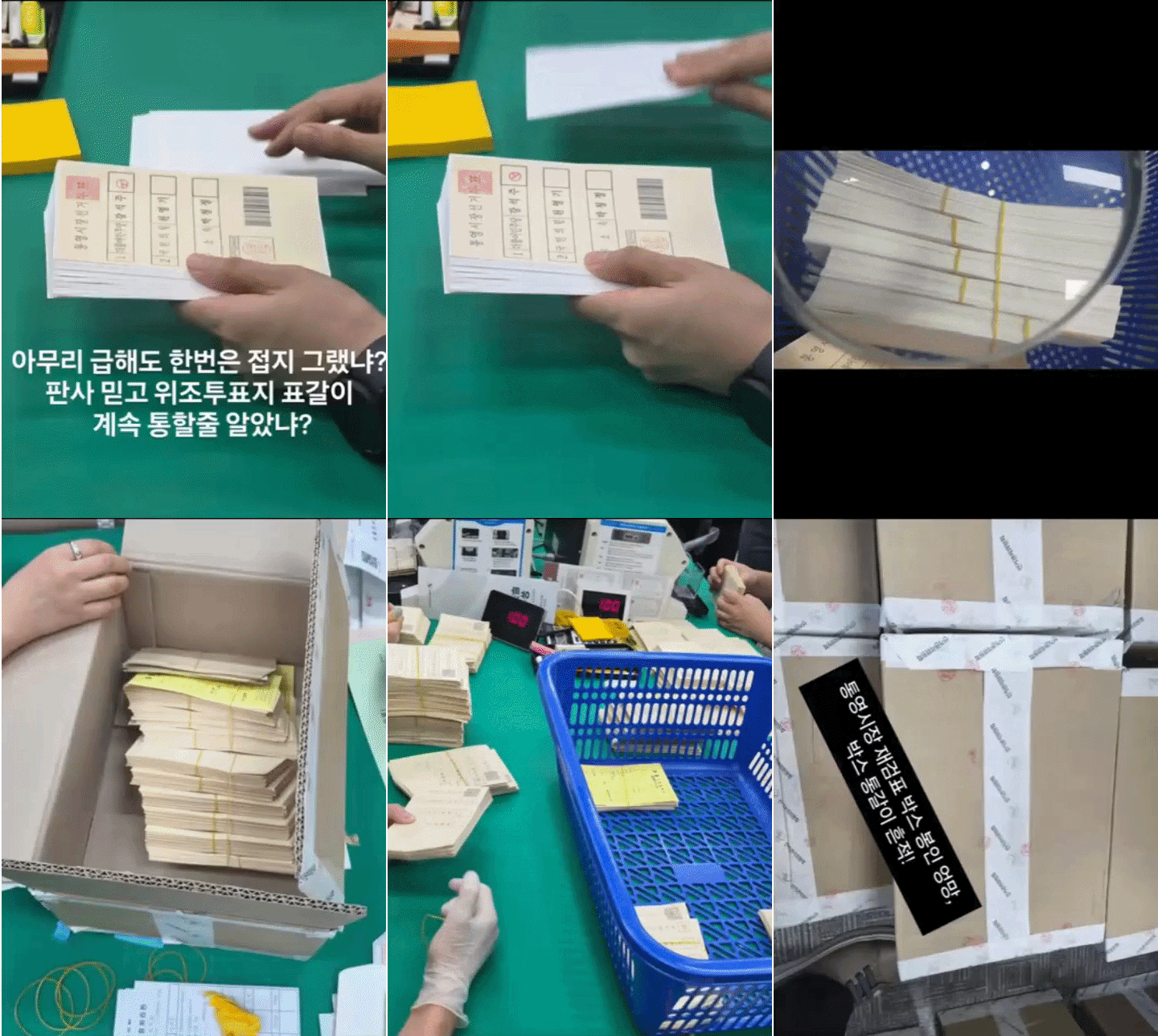 “Ignoring crisp ballots and damaged seals”… Tongyeong mayoral recount concludes with ‘no change in outcome,’ leaving suspicions and public outrage behind
Suspected counterfeit ballots discovered in Tongyeong [GIF from social media of Representative Hwang Kyo-ahn / Attorney Park Joo-hyun]During a recount of the Tongyeong mayoral election in South Gyeong
“Ignoring crisp ballots and damaged seals”… Tongyeong mayoral recount concludes with ‘no change in outcome,’ leaving suspicions and public outrage behind
Suspected counterfeit ballots discovered in Tongyeong [GIF from social media of Representative Hwang Kyo-ahn / Attorney Park Joo-hyun]During a recount of the Tongyeong mayoral election in South Gyeong
 President Yoon, regarding the first-instance ruling on the Public Official Election Act: “An excessive political verdict that distorts the facts… We will appeal immediately.”
The first-instance sentencing hearing for President Yoon Suk Yeol regarding violations of the Public Official Election Act is being broadcast live at Seoul Station on the 27th. [Photo=Yonhap News]Pres
President Yoon, regarding the first-instance ruling on the Public Official Election Act: “An excessive political verdict that distorts the facts… We will appeal immediately.”
The first-instance sentencing hearing for President Yoon Suk Yeol regarding violations of the Public Official Election Act is being broadcast live at Seoul Station on the 27th. [Photo=Yonhap News]Pres
 WSJ: "SK Hynix ADR Premium Is a Sign of AI Trading Overheat"
Advertisement for SK Hynix ADR listing in New York's Times Square [Reuters=Yonhap News file photo]The Wall Street Journal (WSJ) has pointed out that the price of SK Hynix’s American Depositary Recei
WSJ: "SK Hynix ADR Premium Is a Sign of AI Trading Overheat"
Advertisement for SK Hynix ADR listing in New York's Times Square [Reuters=Yonhap News file photo]The Wall Street Journal (WSJ) has pointed out that the price of SK Hynix’s American Depositary Recei
 'Godfather of Japanese Mystery Novels' Keigo Higashino Passes Away After Battle with Cancer at 68
Famous Japanese mystery novelist Keigo Higashino [AFP=Yonhap News]It has been belatedly reported that Keigo Higashino, the "godfather of Japanese mystery novels" and author of bestsellers such as "The
'Godfather of Japanese Mystery Novels' Keigo Higashino Passes Away After Battle with Cancer at 68
Famous Japanese mystery novelist Keigo Higashino [AFP=Yonhap News]It has been belatedly reported that Keigo Higashino, the "godfather of Japanese mystery novels" and author of bestsellers such as "The
 [Park Pil-kyu Security Column] To the Ignorant Trying to Clothe a Beast in Sheep's Clothing
Rep. Kim Byung-joo of the Democratic Party of Korea [Photo=Yonhap News]“The Air Force Academy doesn't teach you how to fly a plane!” “The Army, Navy, and Air Force academies are exactly the
[Park Pil-kyu Security Column] To the Ignorant Trying to Clothe a Beast in Sheep's Clothing
Rep. Kim Byung-joo of the Democratic Party of Korea [Photo=Yonhap News]“The Air Force Academy doesn't teach you how to fly a plane!” “The Army, Navy, and Air Force academies are exactly the
 [Issue Diagnosis] Two Effects of the Election Petition Review
 [Photo] Evidence of Election Fraud Flooding U.S. Media… Trump Had 2.7 Million Votes Stolen
 [Video] U.S. Semiquincentennial Air Show... 'Art in the Sky' streaks across New York
 [Editorial Cartoon] A Draconian Law That Undermines Freedom of Expression

 List
List