 The Strait of Hormuz as seen from a beach in Bandar Abbas, Iran. On the 21st (local time), a child swings on a swing with ships floating in the Strait of Hormuz in the background, on a beach in the southern Iranian port city of Bandar Abbas. [WANA·Yonhap News]
The United States and Iran are reportedly close to an agreement primarily aimed at opening the Strait of Hormuz and extending a ceasefire.
The plan is to first ease the blockage of the Strait of Hormuz, which is tightening the global economy, and then, during the extended ceasefire period, put the Iran nuclear issue on the agenda to formally commence peace negotiations.
According to a draft Memorandum of Understanding (MOU) reported by Axios, citing U.S. government officials, on the 23rd (local time), the U.S. and Iran are pursuing the conclusion of an MOU containing these provisions.
The U.S. and Iran are reportedly considering setting an initial validity period of 60 days for the MOU, with the possibility of extension upon mutual agreement.
During this period, a ceasefire will be maintained.
The draft includes provisions for Iran to open the Strait of Hormuz to all vessels without toll and to remove mines laid in the strait to ensure freedom of navigation for ships during this ceasefire period.
In return, the U.S. will lift the blockade on Iranian ports and implement measures to ease some sanctions, allowing Iran to freely sell its crude oil.
The U.S. reportedly expects these measures to bring significant stability not only to the Iranian economy but also to the global crude oil market.
A U.S. official indicated that the speed at which Iran removes mines and resumes ship operations will determine the speed of the blockade's de-escalation, suggesting that the opening of the Strait of Hormuz will be a phased process.
During the extended ceasefire, the U.S. and Iran will enter into peace negotiations with the issue of Iran's nuclear weapons development program as a key agenda item.
The draft reportedly includes Iran's commitment to never develop nuclear weapons and to negotiate the suspension of its uranium enrichment program and the disposal of its enriched uranium stockpiles.
Given that Iran has already publicly declared its policy of prohibiting nuclear weapons development to the international community, the commitment is expected to include similar declarative content.
However, the issues likely to cause difficulties in negotiations are the uranium enrichment moratorium period and the method of exporting weapons-grade highly enriched uranium, areas where the U.S. and Iran have shown sharp differences in views.
Sources indicate that Iran has verbally communicated its willingness to concede on issues such as suspending uranium enrichment and abandoning nuclear materials to the U.S. through intermediaries.
The U.S. will engage in negotiations for the release of frozen Iranian assets and permanent sanctions relief during the ceasefire period, but reportedly insists on the principle of "relief for performance" for any agreement.
This means that while Iran prefers a phased exchange of measures, the U.S. adopts a stance of granting concessions only after verifying substantial concessions from Iran in the nuclear negotiations.
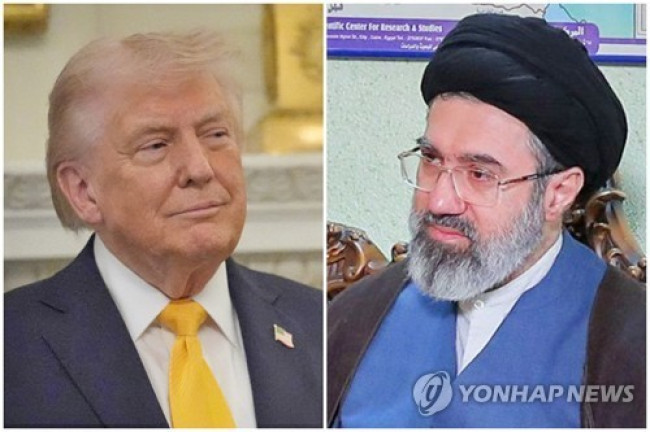 U.S. President Trump (left) and Iran's Supreme Leader Ayatollah Ali Khamenei [AP·AFP=Yonhap News file photo. HANDOUT / KHAMENEI.IR]
The withdrawal of U.S. troops is also reportedly mentioned in the draft.
The U.S. forces, which have been reinforced in the Middle East, will remain stationed there during the ceasefire period and will only withdraw if a final agreement is reached.
U.S. officials reportedly stated that the draft also specifies terms for ending the war between Israel and the Iran-backed armed group Hezbollah in Lebanon.
In relation to this, Axios reported that Israeli Prime Minister Benjamin Netanyahu expressed concerns about an agreement to end the war with Hezbollah during a phone call with U.S. President Donald Trump on the same day.
However, a U.S. official explained that Israel's military response would be permissible if Hezbollah re-arms or resumes attacks.
This is seen as an indication that the extended ceasefire could become precarious at any time, depending on Israel's stance.
While there are speculations that the agreement could be officially announced as early as the 24th, Axios assesses that there remains a possibility of the final deal falling through.
Axios reported that President Trump secured support by conducting a series of phone calls with leaders of Middle Eastern countries including Saudi Arabia, Qatar, the United Arab Emirates (UAE), Egypt, and Turkey during the process of preparing the agreement.
Axios reported that while President Trump has been deliberating between a large-scale military attack on Iran and a diplomatic resolution until recently, he is now leaning towards a diplomatic solution.
A U.S. official stated that if Iran is deemed not serious about nuclear negotiations, the agreement could collapse in less than 60 days, but also predicted that Iran's severe economic difficulties could lead to a final agreement for sanctions relief and the release of frozen funds.

 Iranian Foreign Ministry: "Continuing Message Exchanges with the U.S. and Activities of Mediating Countries"
Esmaeil Baghaei, Spokesperson for the Iranian Ministry of Foreign Affairs [Xinhua, Yonhap News file photo]Esmaeil Baghaei, spokesperson for the Iranian Ministry of Foreign Affairs, stated on the 26th
Iranian Foreign Ministry: "Continuing Message Exchanges with the U.S. and Activities of Mediating Countries"
Esmaeil Baghaei, Spokesperson for the Iranian Ministry of Foreign Affairs [Xinhua, Yonhap News file photo]Esmaeil Baghaei, spokesperson for the Iranian Ministry of Foreign Affairs, stated on the 26th
 President Yoon: "Do You Think You Are Safe from the Special Counsel?"... Final Statement Video Released
President Yoon Suk Yeol rebuking the special prosecutor on the 24th. [Court video / @birds_justice X account subtitle GIF] A video of President Yoon Suk Yeol's closing statement at his trial rega
President Yoon: "Do You Think You Are Safe from the Special Counsel?"... Final Statement Video Released
President Yoon Suk Yeol rebuking the special prosecutor on the 24th. [Court video / @birds_justice X account subtitle GIF] A video of President Yoon Suk Yeol's closing statement at his trial rega
 President Yoon, regarding the first-instance ruling on the Public Official Election Act: “An excessive political verdict that distorts the facts… We will appeal immediately.”
The first-instance sentencing hearing for President Yoon Suk Yeol regarding violations of the Public Official Election Act is being broadcast live at Seoul Station on the 27th. [Photo=Yonhap News]Pres
President Yoon, regarding the first-instance ruling on the Public Official Election Act: “An excessive political verdict that distorts the facts… We will appeal immediately.”
The first-instance sentencing hearing for President Yoon Suk Yeol regarding violations of the Public Official Election Act is being broadcast live at Seoul Station on the 27th. [Photo=Yonhap News]Pres
 WSJ: "SK Hynix ADR Premium Is a Sign of AI Trading Overheat"
Advertisement for SK Hynix ADR listing in New York's Times Square [Reuters=Yonhap News file photo]The Wall Street Journal (WSJ) has pointed out that the price of SK Hynix’s American Depositary Recei
WSJ: "SK Hynix ADR Premium Is a Sign of AI Trading Overheat"
Advertisement for SK Hynix ADR listing in New York's Times Square [Reuters=Yonhap News file photo]The Wall Street Journal (WSJ) has pointed out that the price of SK Hynix’s American Depositary Recei
 'Godfather of Japanese Mystery Novels' Keigo Higashino Passes Away After Battle with Cancer at 68
Famous Japanese mystery novelist Keigo Higashino [AFP=Yonhap News]It has been belatedly reported that Keigo Higashino, the "godfather of Japanese mystery novels" and author of bestsellers such as "The
'Godfather of Japanese Mystery Novels' Keigo Higashino Passes Away After Battle with Cancer at 68
Famous Japanese mystery novelist Keigo Higashino [AFP=Yonhap News]It has been belatedly reported that Keigo Higashino, the "godfather of Japanese mystery novels" and author of bestsellers such as "The
 [Park Pil-kyu Security Column] To the Ignorant Trying to Clothe a Beast in Sheep's Clothing
Rep. Kim Byung-joo of the Democratic Party of Korea [Photo=Yonhap News]“The Air Force Academy doesn't teach you how to fly a plane!” “The Army, Navy, and Air Force academies are exactly the
[Park Pil-kyu Security Column] To the Ignorant Trying to Clothe a Beast in Sheep's Clothing
Rep. Kim Byung-joo of the Democratic Party of Korea [Photo=Yonhap News]“The Air Force Academy doesn't teach you how to fly a plane!” “The Army, Navy, and Air Force academies are exactly the
 [Issue Diagnosis] Two Effects of the Election Petition Review
 [Photo] Evidence of Election Fraud Flooding U.S. Media… Trump Had 2.7 Million Votes Stolen
 [Video] U.S. Semiquincentennial Air Show... 'Art in the Sky' streaks across New York
 [Editorial Cartoon] A Draconian Law That Undermines Freedom of Expression

 List
List









