Lee Sang-ro, Columnist
Former MBC "Camera Out" Reporter
Donald Trump of the United States was elected president twice. The first time, he was elected the 45th President of the United States, defeating Hillary Clinton of the Democratic Party in the presidential election held on November 8, 2016. The second time, he successfully secured re-election against Kamala Harris, Vice President of the Biden administration, and was re-inaugurated as president on January 20, 2025.
The country with the deepest understanding of South Korea's nuclear armament is the United States. U.S. officials in Washington have thus far deterred nuclear proliferation. However, Trump holds a different view on this traditional non-proliferation stance. A prime example is his exchange with a reporter during his first presidential campaign. The reporter asked Trump, "If you are elected president, will you agree to nuclear armament for South Korea and Japan?" Trump responded without hesitation, "WHY NOT."
Upon Trump's inauguration as president for the first term, Secretary of State Rex Tillerson visited China, South Korea, and Japan by military aircraft. A defense correspondent was aboard. The reporter asked, "Will you tolerate nuclear armament for South Korea and Japan?" Secretary Tillerson replied, "We are positively considering it."
I believe that if Moon Jae-in had strongly requested nuclear armament for South Korea from the United States, tangible results could have been achieved during Trump's first term. However, Moon Jae-in did not make such a request to the U.S. Moon Jae-in sought to zero out all nuclear-related capabilities in South Korea, thus pursuing nuclear phase-out and attempting to decommission functioning nuclear power plants. Instead, Moon Jae-in focused on having Trump "meet the very nice Kim Jong Un."
Six months have passed since the launch of Trump's second administration. During this time, Trump has loudly pursued tariff negotiations and is boasting of having "successfully concluded" them. Recent reports indicate that the U.S. is again pursuing dialogue with North Korea. What is peculiar is that the U.S. expressed its willingness to engage in dialogue with North Korea immediately after receiving a message from North Korea stating, "If North Korea is recognized as a nuclear-armed state, we will respond to dialogue with the U.S."
There is a possibility that Trump will recognize North Korea as a nuclear-armed state and negotiate to reduce the number of nuclear warheads. This is the so-called "Small Deal." If this happens, we must take a clear stance. That is, we, the Republic of Korea, can gain the justification to pursue nuclear armament and should engage in high-level negotiations with the U.S. to achieve this.
Many people are expressing concern following the recent verbal tariff negotiations with the U.S. Soon, Lee Jae-myung will travel to Washington to sign the final agreement. While it is too early to judge, Lee Jae-myung will likely have to make significant concessions to the U.S. regarding his vulnerabilities, such as electoral integrity and remittances to North Korea. However, if Lee Jae-myung secures understanding from the U.S. regarding South Korea's nuclear armament, he can compensate for economic losses from tariff negotiations in political and defense sectors. Yet, it is highly probable he will not do so. This is because Kim Jong Un of North Korea does not want South Korea to be nuclear-armed.
Here, we can pose a larger question: Will China oppose South Korea's nuclear armament? Of course, on the surface, China will vehemently oppose South Korea's nuclear armament. However, inwardly, this may not be the case. This can be easily understood by examining China's traditional defense strategy. Specifically, China opposes North Korea unifying the Korean Peninsula because there is no guarantee that a unified Kim Jong Un would necessarily exist for China. China uses the term "lips and teeth" (脣亡齒寒) in its Korean Peninsula policy. What China wants least is to confront U.S. forces across the Yalu River. China fears North Korea unifying the peninsula as much as it fears South Korea unifying it. Just as unified Vietnam became an ally of the U.S., there is no guarantee that a unified North Korea would not side with the U.S.
China does not want the North and South to unify. Although a nuclear-armed North Korea is problematic, if South Korea maintains a balance with conventional weapons, China is satisfied with the current situation. However, it is unwelcome that Trump is getting closer to North Korea on the condition of partially recognizing its nuclear status.
There is another point of inconvenience for China. South Korea, unable to acquire nuclear weapons, is showing global prowess in the development of conventional weapons such as missiles. In reality, nuclear weapons are unusable. However, South Korea's missiles, comparable to nuclear weapons, are freely usable and easy to export. For China, it may be a better option for South Korea to be armed with nuclear weapons than for South Korea to export missiles to Taiwan. If China continues to block South Korea's nuclear armament, South Korea can disrupt the global defense system through the advancement and export of conventional weapons. South Korea's nuclear weapons are regional, but its missiles can become global.
Many people domestically express concern about our country's nuclear armament, specifically fearing retaliation from the IAEA and other countries. However, if Trump recognizes North Korea's nuclear capabilities, we can gain the justification for legal nuclear armament.
The issue here is whether Lee Jae-myung, who must make many concessions to the U.S. in trade negotiations, has the will and courage to secure our country's nuclear armament as a counter-concession. As repeatedly emphasized, China may outwardly oppose South Korea's nuclear armament but have different thoughts internally. Therefore, there is no need to link our nuclear armament to the reactions of China and North Korea. In conclusion, Lee Jae-myung's will is important.

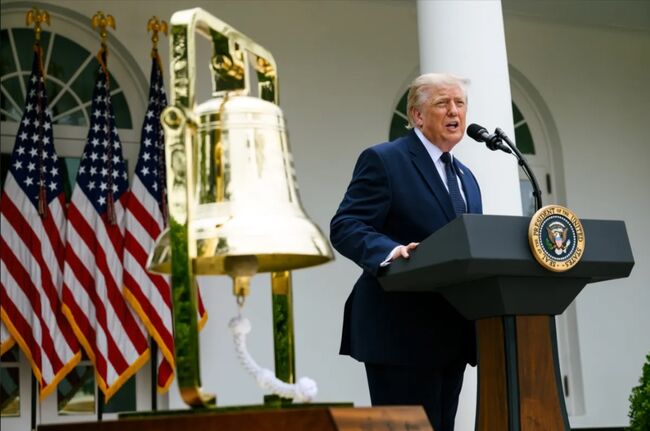 Trump pressures for rate cut again ahead of FOMC... "Should be the lowest in the world"
U.S. President Donald Trump. [Photo = The White House] U.S. President Donald Trump once again pressured the Federal Reserve, the U.S. central bank, to lower interest rates on the 27th (local time
Trump pressures for rate cut again ahead of FOMC... "Should be the lowest in the world"
U.S. President Donald Trump. [Photo = The White House] U.S. President Donald Trump once again pressured the Federal Reserve, the U.S. central bank, to lower interest rates on the 27th (local time
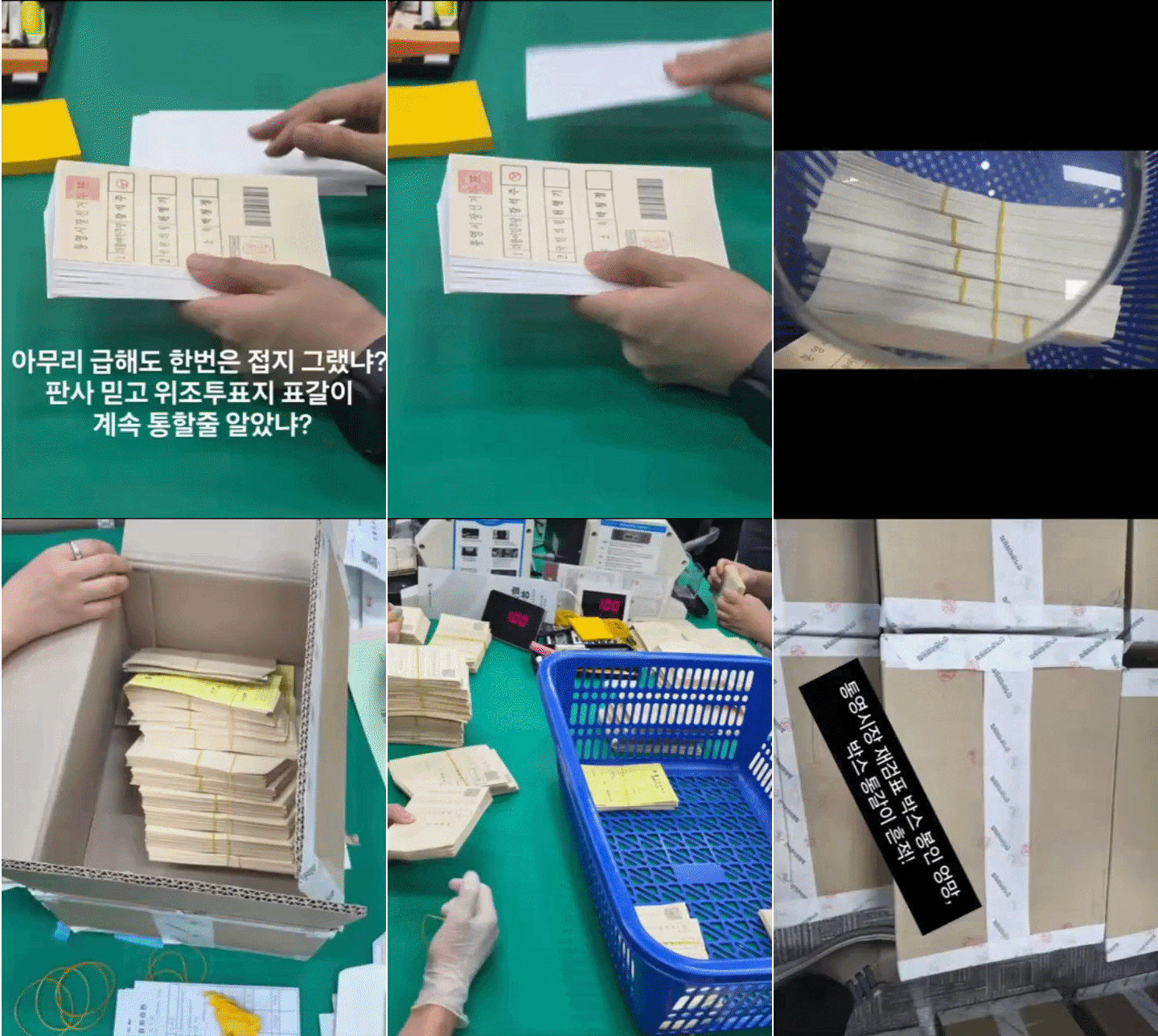 “Ignoring crisp ballots and damaged seals”… Tongyeong mayoral recount concludes with ‘no change in outcome,’ leaving suspicions and public outrage behind
Suspected counterfeit ballots discovered in Tongyeong [GIF from social media of Representative Hwang Kyo-ahn / Attorney Park Joo-hyun]During a recount of the Tongyeong mayoral election in South Gyeong
“Ignoring crisp ballots and damaged seals”… Tongyeong mayoral recount concludes with ‘no change in outcome,’ leaving suspicions and public outrage behind
Suspected counterfeit ballots discovered in Tongyeong [GIF from social media of Representative Hwang Kyo-ahn / Attorney Park Joo-hyun]During a recount of the Tongyeong mayoral election in South Gyeong
 President Yoon, regarding the first-instance ruling on the Public Official Election Act: “An excessive political verdict that distorts the facts… We will appeal immediately.”
The first-instance sentencing hearing for President Yoon Suk Yeol regarding violations of the Public Official Election Act is being broadcast live at Seoul Station on the 27th. [Photo=Yonhap News]Pres
President Yoon, regarding the first-instance ruling on the Public Official Election Act: “An excessive political verdict that distorts the facts… We will appeal immediately.”
The first-instance sentencing hearing for President Yoon Suk Yeol regarding violations of the Public Official Election Act is being broadcast live at Seoul Station on the 27th. [Photo=Yonhap News]Pres
 WSJ: "SK Hynix ADR Premium Is a Sign of AI Trading Overheat"
Advertisement for SK Hynix ADR listing in New York's Times Square [Reuters=Yonhap News file photo]The Wall Street Journal (WSJ) has pointed out that the price of SK Hynix’s American Depositary Recei
WSJ: "SK Hynix ADR Premium Is a Sign of AI Trading Overheat"
Advertisement for SK Hynix ADR listing in New York's Times Square [Reuters=Yonhap News file photo]The Wall Street Journal (WSJ) has pointed out that the price of SK Hynix’s American Depositary Recei
 'Godfather of Japanese Mystery Novels' Keigo Higashino Passes Away After Battle with Cancer at 68
Famous Japanese mystery novelist Keigo Higashino [AFP=Yonhap News]It has been belatedly reported that Keigo Higashino, the "godfather of Japanese mystery novels" and author of bestsellers such as "The
'Godfather of Japanese Mystery Novels' Keigo Higashino Passes Away After Battle with Cancer at 68
Famous Japanese mystery novelist Keigo Higashino [AFP=Yonhap News]It has been belatedly reported that Keigo Higashino, the "godfather of Japanese mystery novels" and author of bestsellers such as "The
 [Park Pil-kyu Security Column] To the Ignorant Trying to Clothe a Beast in Sheep's Clothing
Rep. Kim Byung-joo of the Democratic Party of Korea [Photo=Yonhap News]“The Air Force Academy doesn't teach you how to fly a plane!” “The Army, Navy, and Air Force academies are exactly the
[Park Pil-kyu Security Column] To the Ignorant Trying to Clothe a Beast in Sheep's Clothing
Rep. Kim Byung-joo of the Democratic Party of Korea [Photo=Yonhap News]“The Air Force Academy doesn't teach you how to fly a plane!” “The Army, Navy, and Air Force academies are exactly the
 [Issue Diagnosis] Two Effects of the Election Petition Review
 [Photo] Evidence of Election Fraud Flooding U.S. Media… Trump Had 2.7 Million Votes Stolen
 [Video] U.S. Semiquincentennial Air Show... 'Art in the Sky' streaks across New York
 [Editorial Cartoon] A Draconian Law That Undermines Freedom of Expression

 List
List