 First Vice Foreign Minister Park Yun-ju briefs the results of the investigation into the HMM Namuho attack. [Seoul=Yonhap News]The government has effectively designated Iran as the entity that attacked the Korean vessel HMM Namuho in the Strait of Hormuz.
The rationale behind this conclusion is that the aircraft that attacked the Namuho was highly likely to be an Iranian anti-ship missile, and there is no other entity in the Strait of Hormuz capable of such military action besides Iran.
At a press conference on the 27th, First Vice Foreign Minister Park Yun-ju announced the investigation results, stating, "Based on technical analysis, we have concluded that it is highly probable that the (object that struck the Namuho) was an anti-ship missile from the 'Nur' series developed in Iran."
Vice Minister Park explained that the conclusion was based on an analysis of the missile engine, warhead, explosives, and fuselage found on the Namuho.
According to the investigation, the Namuho was hit by two projectiles. The first warhead did not detonate, while the second warhead exploded. Explosive materials were also confirmed in the first projectile, believed to be a dud.
The shape of the projectile's warhead was similar to Iran's Nur anti-ship missile or its upgraded version, 'Qader'. Markings from an Iranian manufacturer were found on the parts.
The engine was similar to an Iranian turbojet engine. Analysis by the Agency for Defense Development confirmed characteristic features of Iran's 'Tulu 4' engine.
The fuselage debris was painted sky blue, the same color as the Iranian Nur series anti-ship missiles.
Regarding the circuit board debris, it is estimated to have been produced 20-30 years ago. Considering the production year, it was deemed more likely to be the older Nur missile rather than the newer Qader.
While Vice Minister Park did not explicitly name Iran as the attacker, he stated, "Various evidence points towards Iran." He added, "We will summon the Iranian Ambassador to Seoul, explain the investigation results, demand responsible measures including preventing recurrence, and request an apology."
At the time of the attack on the 4th, the Namuho was anchored in waters near the United Arab Emirates (UAE) within the Strait of Hormuz, with its stern facing Iran. The missile struck the stern of the ship, facing it from Iran.
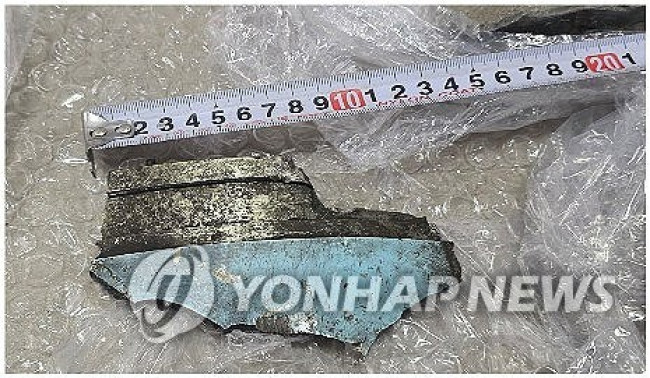 Government announces investigation results of the projectile that struck the HMM Namuho. [Yonhap News]
The launch origin could not be determined during the investigation. The Ministry of National Defense estimated that the missile traveled for approximately 6-7 minutes, considering that the Namuho was 90-100 km away from mainland Iran at the time of the attack.
Furthermore, the missile flew at its initially intended altitude in the terminal phase without any separate maneuvers, and the fact that two missiles were launched indicated a clear intent to inflict damage through an attack.
However, Vice Minister Park stated that it is "very difficult to confirm" Iran's intent and added, "We believe it is extremely difficult to ascertain the intent itself unless they admit it."
He also drew a line, saying, "It is difficult to judge whether Iran had a reason to intentionally target and attack a Korean vessel, and it is difficult to speak based on speculation."
He also noted that it is not easy to definitively identify the specific entity within Iran, such as the Revolutionary Guard, the regular army, or paramilitary forces.
In response, Deputy Director for International Affairs of the Ministry of National Defense, Ryu Woon-sang (Rear Admiral), who was present at the briefing, stated that while missiles from the Nur series have been exported to various military branches within Iran, pro-Iranian forces, and even countries like Syria, "we fundamentally believe that the Strait of Hormuz is controlled by Iran's Revolutionary Guard and Navy."

 Iranian Foreign Ministry: "Continuing Message Exchanges with the U.S. and Activities of Mediating Countries"
Esmaeil Baghaei, Spokesperson for the Iranian Ministry of Foreign Affairs [Xinhua, Yonhap News file photo]Esmaeil Baghaei, spokesperson for the Iranian Ministry of Foreign Affairs, stated on the 26th
Iranian Foreign Ministry: "Continuing Message Exchanges with the U.S. and Activities of Mediating Countries"
Esmaeil Baghaei, Spokesperson for the Iranian Ministry of Foreign Affairs [Xinhua, Yonhap News file photo]Esmaeil Baghaei, spokesperson for the Iranian Ministry of Foreign Affairs, stated on the 26th
 President Yoon: "Do You Think You Are Safe from the Special Counsel?"... Final Statement Video Released
President Yoon Suk Yeol rebuking the special prosecutor on the 24th. [Court video / @birds_justice X account subtitle GIF] A video of President Yoon Suk Yeol's closing statement at his trial rega
President Yoon: "Do You Think You Are Safe from the Special Counsel?"... Final Statement Video Released
President Yoon Suk Yeol rebuking the special prosecutor on the 24th. [Court video / @birds_justice X account subtitle GIF] A video of President Yoon Suk Yeol's closing statement at his trial rega
 President Yoon, regarding the first-instance ruling on the Public Official Election Act: “An excessive political verdict that distorts the facts… We will appeal immediately.”
The first-instance sentencing hearing for President Yoon Suk Yeol regarding violations of the Public Official Election Act is being broadcast live at Seoul Station on the 27th. [Photo=Yonhap News]Pres
President Yoon, regarding the first-instance ruling on the Public Official Election Act: “An excessive political verdict that distorts the facts… We will appeal immediately.”
The first-instance sentencing hearing for President Yoon Suk Yeol regarding violations of the Public Official Election Act is being broadcast live at Seoul Station on the 27th. [Photo=Yonhap News]Pres
 WSJ: "SK Hynix ADR Premium Is a Sign of AI Trading Overheat"
Advertisement for SK Hynix ADR listing in New York's Times Square [Reuters=Yonhap News file photo]The Wall Street Journal (WSJ) has pointed out that the price of SK Hynix’s American Depositary Recei
WSJ: "SK Hynix ADR Premium Is a Sign of AI Trading Overheat"
Advertisement for SK Hynix ADR listing in New York's Times Square [Reuters=Yonhap News file photo]The Wall Street Journal (WSJ) has pointed out that the price of SK Hynix’s American Depositary Recei
 'Godfather of Japanese Mystery Novels' Keigo Higashino Passes Away After Battle with Cancer at 68
Famous Japanese mystery novelist Keigo Higashino [AFP=Yonhap News]It has been belatedly reported that Keigo Higashino, the "godfather of Japanese mystery novels" and author of bestsellers such as "The
'Godfather of Japanese Mystery Novels' Keigo Higashino Passes Away After Battle with Cancer at 68
Famous Japanese mystery novelist Keigo Higashino [AFP=Yonhap News]It has been belatedly reported that Keigo Higashino, the "godfather of Japanese mystery novels" and author of bestsellers such as "The
 [Park Pil-kyu Security Column] To the Ignorant Trying to Clothe a Beast in Sheep's Clothing
Rep. Kim Byung-joo of the Democratic Party of Korea [Photo=Yonhap News]“The Air Force Academy doesn't teach you how to fly a plane!” “The Army, Navy, and Air Force academies are exactly the
[Park Pil-kyu Security Column] To the Ignorant Trying to Clothe a Beast in Sheep's Clothing
Rep. Kim Byung-joo of the Democratic Party of Korea [Photo=Yonhap News]“The Air Force Academy doesn't teach you how to fly a plane!” “The Army, Navy, and Air Force academies are exactly the
 [Issue Diagnosis] Two Effects of the Election Petition Review
 [Photo] Evidence of Election Fraud Flooding U.S. Media… Trump Had 2.7 Million Votes Stolen
 [Video] U.S. Semiquincentennial Air Show... 'Art in the Sky' streaks across New York
 [Editorial Cartoon] A Draconian Law That Undermines Freedom of Expression

 List
List









