 [AI-generated reference image]
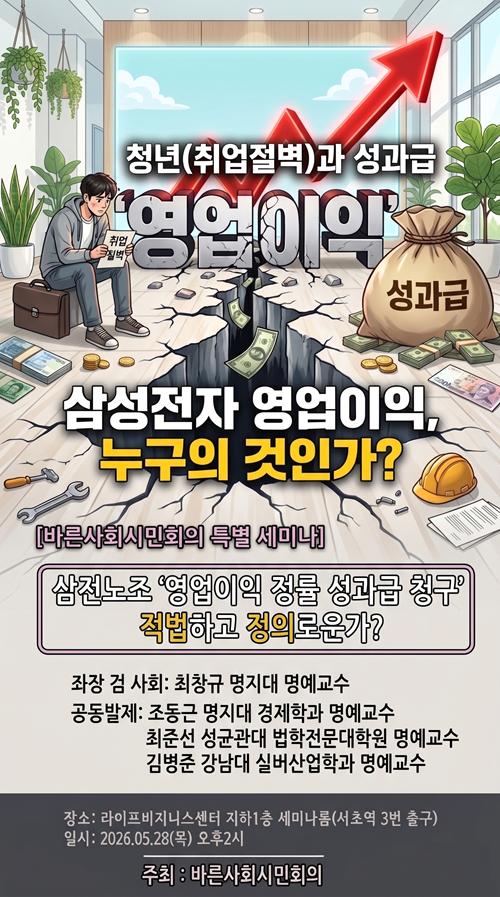
The Committee for a Sound Society held a special seminar on the afternoon of the 28th, near the Samsung Electronics Seocho Building, on the topic, "Is the Samsung Union's Demand for Proportional Performance Bonuses Based on Operating Profit Lawful and Just?"
This special seminar, moderated by Professor Emeritus Choi Chang-gyu of Economics at Myongji University, featured presentations by Professor Jo Dong-geun of Myongji University, Professor Kim Byung-joon of Kangnam University, and Professor Choi Jun-sun of Sungkyunkwan University. The seminar was designed to critically examine, point by point, the risks and the legal and economic contradictions inherent in the recent performance bonus agreement between Samsung Electronics management and the union.
Below is a summary of the presentations by the seminar participants.
Professor Jo Dong-geun, Myongji University: "Attributing the AI Boom to the Union's Efforts is the Height of Ignorance and Greed"
The Samsung Electronics union's demand for a proportional distribution of operating profit is an irresponsible act that squanders the present and exploits the future. The recent record-breaking operating profit is not a result of increased labor productivity, but rather a consequence of riding the wave of the external 'AI revolution' driven by increased investment in AI by global big tech companies.
Operating profit is a figure that does not reflect interest, taxes, or investment losses at all. Demanding performance bonuses based on this figure is a fatal error that views the company as an organization operating without capital input. If workers unilaterally claim a proportional share of the profits while shareholders bear all the risks, the market economy's principle of 'risk and reward' is destroyed.
In capital-intensive industries like semiconductors, failure to retain profits during boom times will eventually lead to weakened resilience during downturns and reduced investment, which will in turn destabilize employment. Performance bonuses should be a mechanism for distributing surplus value (EVA) after compensating for the opportunity cost of shareholders and creditors, not based on accounting profit.
The union's "threat of a general strike" is an attempt to paralyze industrial sites, no different from the slogans of the Cargo Transport Federation in the past. If the board of directors accepts such demands, harming shareholder interests, they will be unable to avoid charges of breach of trust under the revised Commercial Act.
Workers' contributions are already sufficiently compensated through wages and existing performance bonuses, and a claim of ownership over operating profit itself cannot be established. For the future of Samsung Electronics, investment for survival in the global supply chain should be prioritized over short-term distribution.
Professor Kim Byung-joon, Kangnam University: "Agreement Lacks Financial Soundness... Need for EVA-Based Compensation and Differentiated Shareholder Returns"
This agreement to fix the distribution of 12% of operating profit as performance bonuses is a decision that structurally infringes upon the compensation opportunities of shareholders, who are the ultimate risk-bearers. Since workers preemptively receive wages through prior contracts, they do not share market risks and therefore have no claim on residual profits.
However, choosing company stock (RSUs) instead of cash as a payment method is a positive, albeit difficult, measure in terms of fostering long-term employee loyalty and managing liquidity. The board of directors unilaterally distributing profits without shareholder approval constitutes a damage to shareholder value and will likely lead to strong lawsuits from minority shareholders in the future.
Reducing the current high shareholder return rate (50%) to around 30% to secure investment funds for foundry and next-generation chip development will be more beneficial for long-term shareholder value enhancement. The revised Commercial Act of 2026, which excessively emphasizes minority shareholder rights and weakens management control, should be abolished for the autonomy of corporate management.
Institutional improvements are urgently needed, such as granting multiple voting rights or differential dividends to long-term shareholders, as seen in France's Florange Law. The Yellow Envelope Act, which has led to subcontractors demanding profit sharing, is a bad law that directly undermines the principles of freedom of contract and risk sharing.
Samsung Electronics must establish a scientific compensation model that utilizes EVA or Free Cash Flow (FCF) instead of operating profit going forward. The government has the task of refining laws and regulations to ensure that private property is not unjustly expropriated by stipulating provisions for securing management rights.
Professor Choi Jun-sun, Sungkyunkwan University: "Ambiguity in Labor Union Act Threatens Management Rights... Need to Restore Board-Centric Management"
The core of the problem lies in Article 2, Clause 5 of the Labor Union Act, which has indiscriminately expanded the scope of labor disputes to include managerial decisions. According to the fundamental principles of the Commercial Act and Company Law, it is natural that residual profits remaining after all costs are paid primarily accrue to shareholders.
When management yields to union pressure and pays performance bonuses beyond a reasonable level, it can constitute a violation of the directors' duty of loyalty to shareholders (Article 382-3 of the Commercial Act). Such unreasonable distributions deplete the company's future investment capital, ultimately damaging corporate value and causing significant harm to shareholders.
The resolution of the Samsung Electronics dispute this time is merely an arbitrary individual agreement to avert a crisis, rather than institutional stabilization, and carries a high risk of generating greater side effects in the future. While there are discussions about socially sharing excess profits in the AI era, this must be done within the scope of respecting corporate autonomous management and private property rights.
To restore the essence of corporate governance, Articles 2 and 3 of the Labor Union Act (Yellow Envelope Act) must be revised to protect shareholders and management rights. In particular, national strategic industries such as semiconductors must maintain global supply chain stability through legislation that restricts the right to strike. Strong penalties without leniency must be imposed on illegal strikes to establish the rule of law across the industrial sector. "Board-centricity," which represents the interests of the entire company without succumbing to pressure from specific stakeholders, is the correct indicator for our companies to pursue.
Reporter Lim Yo-hee

 Iranian Foreign Ministry: "Continuing Message Exchanges with the U.S. and Activities of Mediating Countries"
Esmaeil Baghaei, Spokesperson for the Iranian Ministry of Foreign Affairs [Xinhua, Yonhap News file photo]Esmaeil Baghaei, spokesperson for the Iranian Ministry of Foreign Affairs, stated on the 26th
Iranian Foreign Ministry: "Continuing Message Exchanges with the U.S. and Activities of Mediating Countries"
Esmaeil Baghaei, Spokesperson for the Iranian Ministry of Foreign Affairs [Xinhua, Yonhap News file photo]Esmaeil Baghaei, spokesperson for the Iranian Ministry of Foreign Affairs, stated on the 26th
 President Yoon: "Do You Think You Are Safe from the Special Counsel?"... Final Statement Video Released
President Yoon Suk Yeol rebuking the special prosecutor on the 24th. [Court video / @birds_justice X account subtitle GIF] A video of President Yoon Suk Yeol's closing statement at his trial rega
President Yoon: "Do You Think You Are Safe from the Special Counsel?"... Final Statement Video Released
President Yoon Suk Yeol rebuking the special prosecutor on the 24th. [Court video / @birds_justice X account subtitle GIF] A video of President Yoon Suk Yeol's closing statement at his trial rega
 President Yoon, regarding the first-instance ruling on the Public Official Election Act: “An excessive political verdict that distorts the facts… We will appeal immediately.”
The first-instance sentencing hearing for President Yoon Suk Yeol regarding violations of the Public Official Election Act is being broadcast live at Seoul Station on the 27th. [Photo=Yonhap News]Pres
President Yoon, regarding the first-instance ruling on the Public Official Election Act: “An excessive political verdict that distorts the facts… We will appeal immediately.”
The first-instance sentencing hearing for President Yoon Suk Yeol regarding violations of the Public Official Election Act is being broadcast live at Seoul Station on the 27th. [Photo=Yonhap News]Pres
 WSJ: "SK Hynix ADR Premium Is a Sign of AI Trading Overheat"
Advertisement for SK Hynix ADR listing in New York's Times Square [Reuters=Yonhap News file photo]The Wall Street Journal (WSJ) has pointed out that the price of SK Hynix’s American Depositary Recei
WSJ: "SK Hynix ADR Premium Is a Sign of AI Trading Overheat"
Advertisement for SK Hynix ADR listing in New York's Times Square [Reuters=Yonhap News file photo]The Wall Street Journal (WSJ) has pointed out that the price of SK Hynix’s American Depositary Recei
 'Godfather of Japanese Mystery Novels' Keigo Higashino Passes Away After Battle with Cancer at 68
Famous Japanese mystery novelist Keigo Higashino [AFP=Yonhap News]It has been belatedly reported that Keigo Higashino, the "godfather of Japanese mystery novels" and author of bestsellers such as "The
'Godfather of Japanese Mystery Novels' Keigo Higashino Passes Away After Battle with Cancer at 68
Famous Japanese mystery novelist Keigo Higashino [AFP=Yonhap News]It has been belatedly reported that Keigo Higashino, the "godfather of Japanese mystery novels" and author of bestsellers such as "The
 [Park Pil-kyu Security Column] To the Ignorant Trying to Clothe a Beast in Sheep's Clothing
Rep. Kim Byung-joo of the Democratic Party of Korea [Photo=Yonhap News]“The Air Force Academy doesn't teach you how to fly a plane!” “The Army, Navy, and Air Force academies are exactly the
[Park Pil-kyu Security Column] To the Ignorant Trying to Clothe a Beast in Sheep's Clothing
Rep. Kim Byung-joo of the Democratic Party of Korea [Photo=Yonhap News]“The Air Force Academy doesn't teach you how to fly a plane!” “The Army, Navy, and Air Force academies are exactly the
 [Issue Diagnosis] Two Effects of the Election Petition Review
 [Photo] Evidence of Election Fraud Flooding U.S. Media… Trump Had 2.7 Million Votes Stolen
 [Video] U.S. Semiquincentennial Air Show... 'Art in the Sky' streaks across New York
 [Editorial Cartoon] A Draconian Law That Undermines Freedom of Expression

 List
List









