- Expanded budget scope for reductions below 28,500
- During the Iran War, Congress moved to check Trump's 'alliance shaking' which intensified.
- Future procedures, including coordination with the Senate, remain... Attention is focused on the final outcome of the wording.
 US Forces Korea [Yonhap News Photo]
A draft of the National Defense Authorization Act (NDAA) for Fiscal Year 2027 (October 2026-September 2027), prepared by the U.S. House of Representatives, has strengthened provisions related to maintaining the current troop levels of U.S. Forces Korea, it was learned on the 28th (local time).
The draft NDAA for the upcoming year (CHAIRMAN'S MARK), recently released by House Armed Services Committee Chairman Mike Rogers (R-Alabama), extends the prohibition on the use of funds related to "oversight of the posture of U.S. forces in Korea" from the current FY2026 NDAA through FY2027.
The FY2026 NDAA stipulates that amounts authorized under this act (NDAA) "may not be obligated or expended" for purposes such as reducing the number of U.S. Forces Korea below 28,500. The draft includes provisions to apply this prohibition to FY2027 as well.
Furthermore, the FY2027 NDAA draft goes a step further by expanding the scope of funds that cannot be spent on reducing U.S. Forces Korea below 28,500.
While the current NDAA only restricts the use of funds specifically authorized by the NDAA, the new NDAA draft stipulates that any amounts appropriated under other laws applicable to FY2026 and FY2027, not just the NDAA, "may not be obligated or expended."
This means that funds allocated not only by the NDAA but also by other laws cannot be used to reduce U.S. Forces Korea to fewer than 28,500.
The current U.S. House NDAA draft also includes provisions that strongly curb the President's arbitrary decisions regarding the reduction and redeployment of U.S. troops stationed in Europe.
However, it is highly likely that these restrictions on reducing U.S. Forces Korea will remain as recommendations, similar to the current NDAA, and may stay at the recommendation level next year as well.
The current NDAA includes a proviso that the prohibition can be lifted after 60 days if the Secretary of Defense submits to the relevant committee that such a reduction aligns with U.S. national security interests or has been consulted with South Korea, Japan, and member states of the UN Command. A similar proviso is expected to be included in the FY2027 NDAA.
Nevertheless, even as a recommendation, it can serve as a legal check if President Donald Trump attempts to arbitrarily reduce U.S. Forces Korea significantly, according to diplomatic circles.
The U.S. Congress's move to strengthen checks on President Trump's arbitrary reductions of U.S. Forces Korea appears to be related to President Trump's efforts to destabilize alliances.
Concerns about alliance management have grown inside and outside the United States since President Trump ordered a reduction of U.S. troops in Germany, viewing it as retaliation for Germany's discordant stance during the Iran conflict, including its refusal to meet demands for troop deployment.
However, as the NDAA must pass both the House and the Senate, the text may be amended during the coordination process with the Senate even after the House version is finalized.
The NDAA is an annual bill that authorizes the Department of Defense's budget and policies. It becomes effective after passing both the House and the Senate and being signed by the President.
What do you think of this article?

 Trump pressures for rate cut again ahead of FOMC... "Should be the lowest in the world"
U.S. President Donald Trump. [Photo = The White House] U.S. President Donald Trump once again pressured the Federal Reserve, the U.S. central bank, to lower interest rates on the 27th (local time
Trump pressures for rate cut again ahead of FOMC... "Should be the lowest in the world"
U.S. President Donald Trump. [Photo = The White House] U.S. President Donald Trump once again pressured the Federal Reserve, the U.S. central bank, to lower interest rates on the 27th (local time
 “Ignoring crisp ballots and damaged seals”… Tongyeong mayoral recount concludes with ‘no change in outcome,’ leaving suspicions and public outrage behind
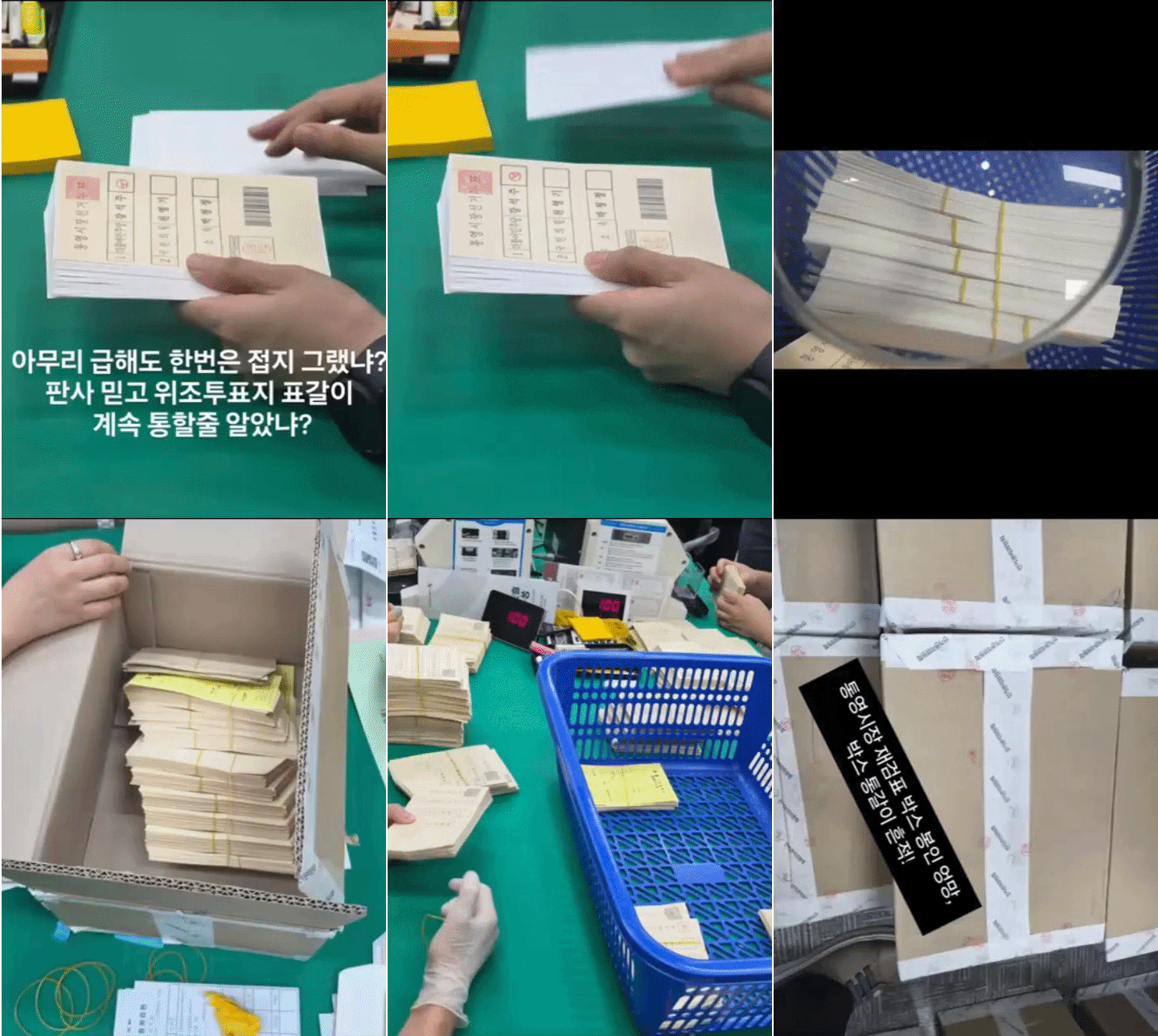
Suspected counterfeit ballots discovered in Tongyeong [GIF from social media of Representative Hwang Kyo-ahn / Attorney Park Joo-hyun]During a recount of the Tongyeong mayoral election in South Gyeong
“Ignoring crisp ballots and damaged seals”… Tongyeong mayoral recount concludes with ‘no change in outcome,’ leaving suspicions and public outrage behind
Suspected counterfeit ballots discovered in Tongyeong [GIF from social media of Representative Hwang Kyo-ahn / Attorney Park Joo-hyun]During a recount of the Tongyeong mayoral election in South Gyeong
 President Yoon, regarding the first-instance ruling on the Public Official Election Act: “An excessive political verdict that distorts the facts… We will appeal immediately.”
The first-instance sentencing hearing for President Yoon Suk Yeol regarding violations of the Public Official Election Act is being broadcast live at Seoul Station on the 27th. [Photo=Yonhap News]Pres
President Yoon, regarding the first-instance ruling on the Public Official Election Act: “An excessive political verdict that distorts the facts… We will appeal immediately.”
The first-instance sentencing hearing for President Yoon Suk Yeol regarding violations of the Public Official Election Act is being broadcast live at Seoul Station on the 27th. [Photo=Yonhap News]Pres
 WSJ: "SK Hynix ADR Premium Is a Sign of AI Trading Overheat"
Advertisement for SK Hynix ADR listing in New York's Times Square [Reuters=Yonhap News file photo]The Wall Street Journal (WSJ) has pointed out that the price of SK Hynix’s American Depositary Recei
WSJ: "SK Hynix ADR Premium Is a Sign of AI Trading Overheat"
Advertisement for SK Hynix ADR listing in New York's Times Square [Reuters=Yonhap News file photo]The Wall Street Journal (WSJ) has pointed out that the price of SK Hynix’s American Depositary Recei
 'Godfather of Japanese Mystery Novels' Keigo Higashino Passes Away After Battle with Cancer at 68
Famous Japanese mystery novelist Keigo Higashino [AFP=Yonhap News]It has been belatedly reported that Keigo Higashino, the "godfather of Japanese mystery novels" and author of bestsellers such as "The
'Godfather of Japanese Mystery Novels' Keigo Higashino Passes Away After Battle with Cancer at 68
Famous Japanese mystery novelist Keigo Higashino [AFP=Yonhap News]It has been belatedly reported that Keigo Higashino, the "godfather of Japanese mystery novels" and author of bestsellers such as "The
 [Park Pil-kyu Security Column] To the Ignorant Trying to Clothe a Beast in Sheep's Clothing
Rep. Kim Byung-joo of the Democratic Party of Korea [Photo=Yonhap News]“The Air Force Academy doesn't teach you how to fly a plane!” “The Army, Navy, and Air Force academies are exactly the
[Park Pil-kyu Security Column] To the Ignorant Trying to Clothe a Beast in Sheep's Clothing
Rep. Kim Byung-joo of the Democratic Party of Korea [Photo=Yonhap News]“The Air Force Academy doesn't teach you how to fly a plane!” “The Army, Navy, and Air Force academies are exactly the
 [Issue Diagnosis] Two Effects of the Election Petition Review
 [Photo] Evidence of Election Fraud Flooding U.S. Media… Trump Had 2.7 Million Votes Stolen
 [Video] U.S. Semiquincentennial Air Show... 'Art in the Sky' streaks across New York
 [Editorial Cartoon] A Draconian Law That Undermines Freedom of Expression

 List
List