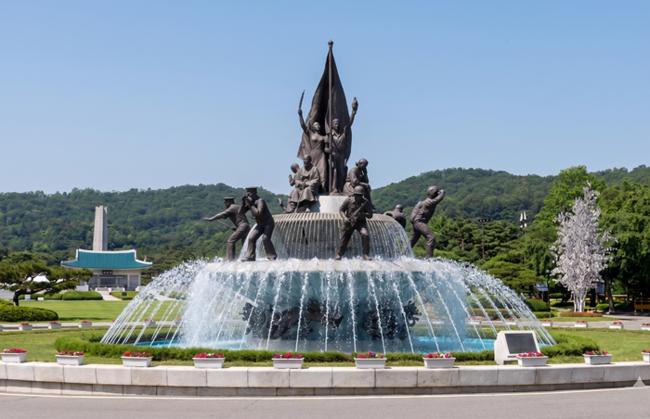
 In front of the "National Loyalty Fountain," which symbolizes six branches of the military – Army, Navy, Air Force, Marines, and Reserve Forces – stands 13 meters tall, located in the "Nation's Spirit Plaza" before reaching the Hyunchung Gate after passing through the main gate of Seoul National Cemetery. The fountain, spraying cool water, makes visitors forget the summer heat. ⒸHanmi Ilbo
In the heart of Paris, France, lie Montmartre Cemetery and Montparnasse Cemetery, beloved tourist attractions. Walking among the dense trees and sculpted tombstones, one feels as though they are strolling through a beautifully landscaped sculpture park rather than a cemetery.
While Seoul National Cemetery in Dongjak-dong, Seoul, may lack the artistic feel of Parisian cemeteries, its expansive grounds, meticulously manicured paths, lawns, and ponds serve as a vital resting place for citizens.
The First to be Buried Was an Unknown Soldier
Seoul National Cemetery was established in 1955 as a "National Military Cemetery" to bury fallen soldiers from the Korean War, with presidential approval in 1953. It began as a military cemetery and was initially managed by the Ministry of National Defense. Currently, it falls under the jurisdiction of the Ministry of Patriots and Veterans Affairs.
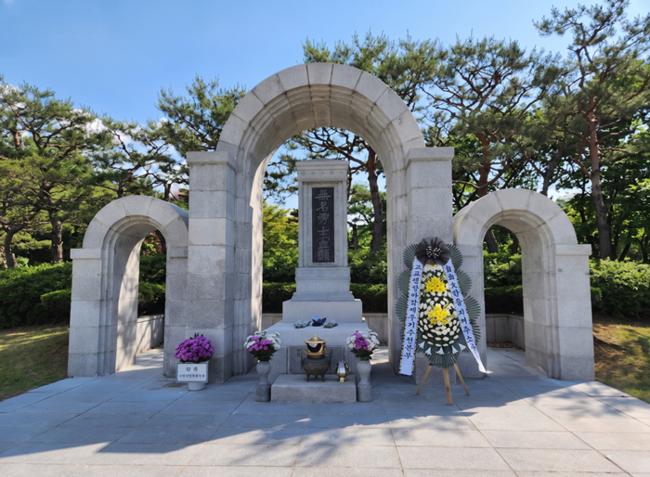 The Monument to the Unknown Student Soldier. ⒸHanmi Ilbo
The first person interred at Seoul National Cemetery was an unknown soldier. In January 1956, an unidentified soldier was the first to be buried at the Monument to the Unknown Soldiers. Unknown soldiers refer to fallen soldiers whose remains were difficult to recover or whose identities could not be ascertained due to severe damage.
In addition, Seoul National Cemetery has approximately 54,000 graves. Furthermore, the Hall of Tablets enshrines the memorial tablets of over 104,000 patriotic martyrs, and the ossuary holds the remains of approximately 7,000 unknown soldiers. A registry of fallen soldiers is displayed in front of the Hall of Tablets within the Hyunchung Tower.
In front of the "Nation's Spirit Plaza," located before the Hyunchung Gate after passing through the main entrance, stands the "National Loyalty Fountain," a 13-meter-high monument symbolizing six branches of the military: Army, Navy, Air Force, Marines, and Reserve Forces. The fountain, spraying cool water, offers respite from the summer heat.
The grave sections at Seoul National Cemetery are divided into categories such as Heads of State, Patriots, National Meritorious Persons, Military Personnel and Civilian Employees, Police Officers, General Public, and Foreigners. The Patriot section includes individuals who were involved in the independence movement during the Japanese colonial period, regardless of their social status. However, if cremation has already occurred, they are enshrined in the Hall of Loyalty.
The Altar for Ancestors Without Descendants (무후선열제단) enshrines the memorial tablets of individuals recognized as independence activists who received the Order of National Foundation but have no surviving family or descendants to care for them. Currently, the memorial tablets of 134 patriotic martyrs and independence activists, including Yu Gwan-sun, are enshrined here.
Only Four Presidents Are Enshrined at Seoul National Cemetery
In the central and prime locations of Seoul National Cemetery lie four presidents who led South Korea: Syngman Rhee, Park Chung-hee, Kim Young-sam, and Kim Dae-jung, resting alongside other national meritorious persons.
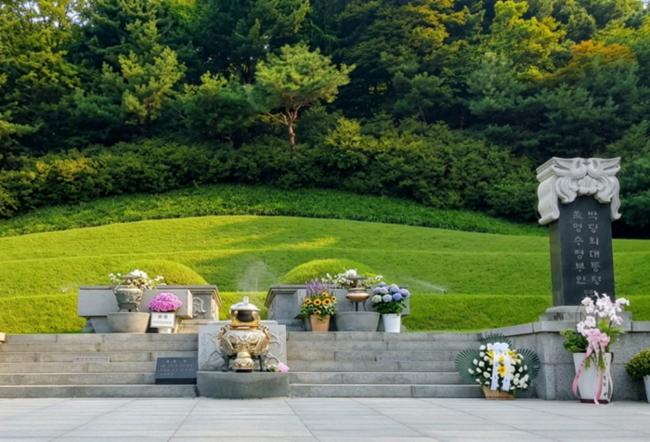 The gravesite of President Park Chung-hee and First Lady Yuk Young-soo boasts a panoramic view overlooking the entire cemetery and the Han River in the distance. ⒸHanmi Ilbo
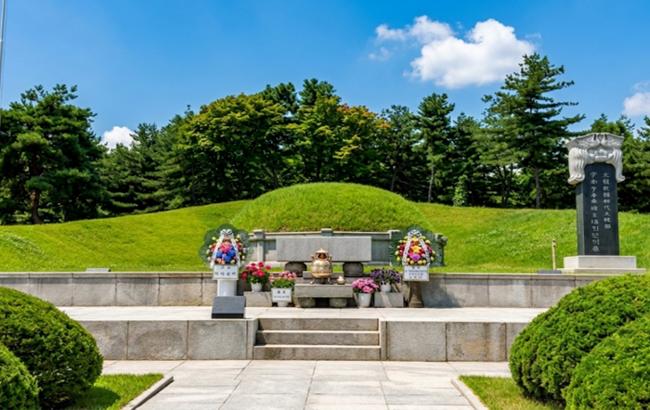 The joint grave of President Syngman Rhee and First Lady Francesca. ⒸHanmi Ilbo The grave of President Syngman Rhee, the founding president of South Korea, is situated in the central part of Seoul National Cemetery, while President Park Chung-hee's grave is located at the highest point. The gravesite of President Park Chung-hee offers a sweeping vista overlooking the entire cemetery and the Han River in the distance.
The gravesite of President Park Chung-hee was initially established following the state funeral of his wife, First Lady Yuk Young-soo, who passed away during the Liberation Day ceremony on August 15, 1974, at the age of 49.
At the time of First Lady Yuk's interment, some raised concerns about the "unlucky feng shui" of the cemetery's location. However, upon being informed, President Park dismissed the controversy by stating, "Even if this place is considered unlucky, we cannot leave it, as it is where the patriotic martyrs who sacrificed their lives for their country are laid to rest."
After President Park Chung-hee's passing on October 26, 1979, at the age of 62, he was interred next to his wife in a double grave, following a state funeral attended by the entire nation. Decades after his passing, as South Korea has emerged as one of the world's top ten economic powers, President Park Chung-hee's achievements are being re-evaluated.
Brigadier General Chae Myung-shin Rests Beside Privates
For a long time, national cemeteries have faced controversies regarding discrimination between "general's sections" and "private's sections" in terms of size and treatment. General's sections are allocated 26.4 square meters (8 pyeong) per person, allowing for burial and the construction of mounds. In contrast, private's sections are 3.3 square meters (1 pyeong) and only accommodate cremated remains without mounds. Furthermore, the two sections are physically distant from each other.
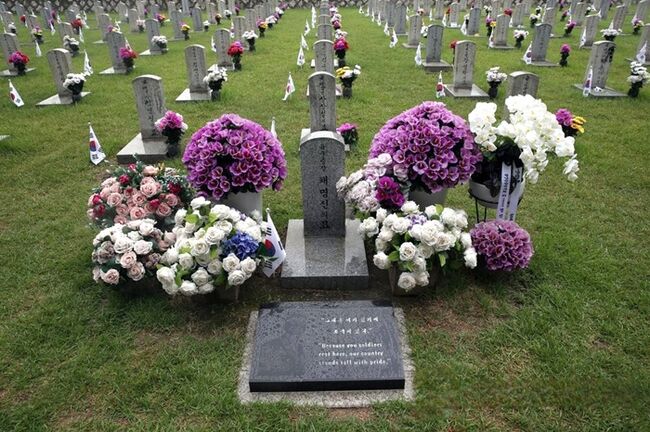 Brigadier General Chae Myung-shin's gravesite. He is buried beside privates. ⒸYonhap News
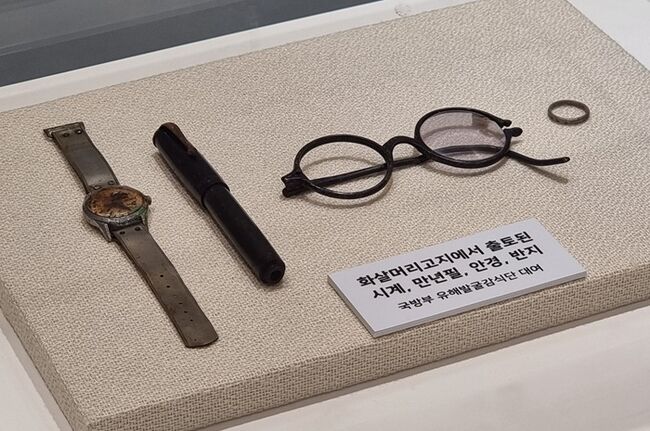 Artifacts unearthed from Arrowhead Hill in Cheorwon-gun, Gangwon-do. [Photo = Lim Yo-hee]
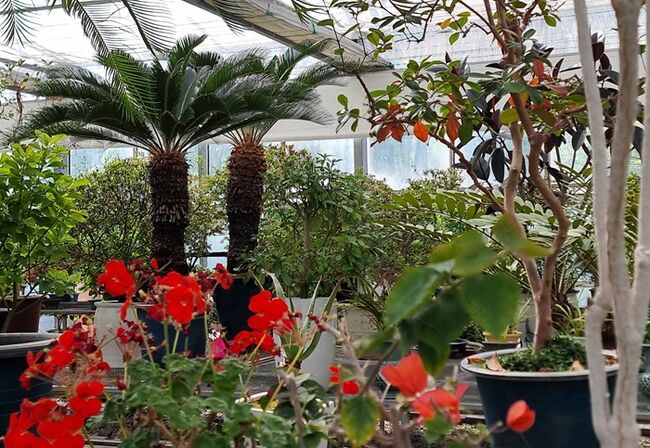 A greenhouse garden near the artifact exhibition hall. [Photo = Reporter Lim Yo-hee]
General Chae Myung-shin, a hero of the Vietnam War, opposed the discrimination between general and private sections, leaving a will requesting to be buried in the private's section alongside his fellow veterans of the Vietnam War. Accordingly, he was interred in the private's section.
Brigadier General Hwang Gyu-man, to honor a promise made 70 years ago to be buried next to Second Lieutenant Kim Soo-young, who died on the battlefield, declined a spot in the general's section. He was buried directly next to Second Lieutenant Kim's grave in the officer's section, demonstrating eternal camaraderie.
The Seoul National Cemetery Artifact Exhibition Hall is an indoor facility that offers a refuge from the hot summer sun. It displays personal belongings of patriotic martyrs and national heroes, as well as relics from the Korean War remains excavation. The exhibition is divided into two floors: the first floor (Independence Activists and National Meritorious Persons) and the second floor (Self-Reliant Defense and Remains Excavation).
Interactive programs for the whole family are available, including touch-screen memorial message writing, a photo zone, digital puzzles, and code-breaking activities. Nearby, a small greenhouse garden provides an opportunity to observe various plants.
Seoul National Cemetery is directly connected to Dongjak Station (Hyunchungwon Station) on Subway Lines 4 and 9. Admission is free, and the cemetery is open year-round.
By Reporter Lim Yo-hee

 Iranian Foreign Ministry: "Continuing Message Exchanges with the U.S. and Activities of Mediating Countries"
Esmaeil Baghaei, Spokesperson for the Iranian Ministry of Foreign Affairs [Xinhua, Yonhap News file photo]Esmaeil Baghaei, spokesperson for the Iranian Ministry of Foreign Affairs, stated on the 26th
Iranian Foreign Ministry: "Continuing Message Exchanges with the U.S. and Activities of Mediating Countries"
Esmaeil Baghaei, Spokesperson for the Iranian Ministry of Foreign Affairs [Xinhua, Yonhap News file photo]Esmaeil Baghaei, spokesperson for the Iranian Ministry of Foreign Affairs, stated on the 26th
 President Yoon: "Do You Think You Are Safe from the Special Counsel?"... Final Statement Video Released
President Yoon Suk Yeol rebuking the special prosecutor on the 24th. [Court video / @birds_justice X account subtitle GIF] A video of President Yoon Suk Yeol's closing statement at his trial rega
President Yoon: "Do You Think You Are Safe from the Special Counsel?"... Final Statement Video Released
President Yoon Suk Yeol rebuking the special prosecutor on the 24th. [Court video / @birds_justice X account subtitle GIF] A video of President Yoon Suk Yeol's closing statement at his trial rega
 President Yoon, regarding the first-instance ruling on the Public Official Election Act: “An excessive political verdict that distorts the facts… We will appeal immediately.”
The first-instance sentencing hearing for President Yoon Suk Yeol regarding violations of the Public Official Election Act is being broadcast live at Seoul Station on the 27th. [Photo=Yonhap News]Pres
President Yoon, regarding the first-instance ruling on the Public Official Election Act: “An excessive political verdict that distorts the facts… We will appeal immediately.”
The first-instance sentencing hearing for President Yoon Suk Yeol regarding violations of the Public Official Election Act is being broadcast live at Seoul Station on the 27th. [Photo=Yonhap News]Pres
 WSJ: "SK Hynix ADR Premium Is a Sign of AI Trading Overheat"
Advertisement for SK Hynix ADR listing in New York's Times Square [Reuters=Yonhap News file photo]The Wall Street Journal (WSJ) has pointed out that the price of SK Hynix’s American Depositary Recei
WSJ: "SK Hynix ADR Premium Is a Sign of AI Trading Overheat"
Advertisement for SK Hynix ADR listing in New York's Times Square [Reuters=Yonhap News file photo]The Wall Street Journal (WSJ) has pointed out that the price of SK Hynix’s American Depositary Recei
 'Godfather of Japanese Mystery Novels' Keigo Higashino Passes Away After Battle with Cancer at 68
Famous Japanese mystery novelist Keigo Higashino [AFP=Yonhap News]It has been belatedly reported that Keigo Higashino, the "godfather of Japanese mystery novels" and author of bestsellers such as "The
'Godfather of Japanese Mystery Novels' Keigo Higashino Passes Away After Battle with Cancer at 68
Famous Japanese mystery novelist Keigo Higashino [AFP=Yonhap News]It has been belatedly reported that Keigo Higashino, the "godfather of Japanese mystery novels" and author of bestsellers such as "The
 [Park Pil-kyu Security Column] To the Ignorant Trying to Clothe a Beast in Sheep's Clothing
Rep. Kim Byung-joo of the Democratic Party of Korea [Photo=Yonhap News]“The Air Force Academy doesn't teach you how to fly a plane!” “The Army, Navy, and Air Force academies are exactly the
[Park Pil-kyu Security Column] To the Ignorant Trying to Clothe a Beast in Sheep's Clothing
Rep. Kim Byung-joo of the Democratic Party of Korea [Photo=Yonhap News]“The Air Force Academy doesn't teach you how to fly a plane!” “The Army, Navy, and Air Force academies are exactly the
 [Issue Diagnosis] Two Effects of the Election Petition Review
 [Photo] Evidence of Election Fraud Flooding U.S. Media… Trump Had 2.7 Million Votes Stolen
 [Video] U.S. Semiquincentennial Air Show... 'Art in the Sky' streaks across New York
 [Editorial Cartoon] A Draconian Law That Undermines Freedom of Expression

 List
List










