 Current status board at Hana Bank's dealing room in Jung-gu, Seoul, on the 8th. On this day, the KOSPI closed down 676.18 points (8.29%) at 7,484.41, and the KOSDAQ closed down 91.05 points (9.08%) at 911.39. [Photo = Yonhap News]
The crash on the 8th is the starting condition for the market on the 9th
The writing reference point is after the market close on June 8, 2026. When previewing the Korean stock market on the 9th, the most important variable to check is not just the KOSPI futures or the bids for large-cap semiconductor stocks. It is the U.S. 10-year Treasury yield.
The core issue revealed in the crash market on the 8th was not just the selling pressure within the stock market, but the simultaneous instability of interest rates, exchange rates, foreign investor inflows/outflows, and individual buying capacity.
On the 8th, the KOSPI closed at 7,484.41. It plummeted by 8.3% from the previous trading day, and circuit breakers were activated during trading. Samsung Electronics and SK Hynix fell 10.2% and 7.7%, respectively.
Reuters analyzed that the increased possibility of interest rate hikes by the Federal Reserve following strong U.S. employment data led to selling of tech and semiconductor stocks.
Foreign investors continued their selling trend for the 21st consecutive trading day, net selling about 355 billion won on this day.
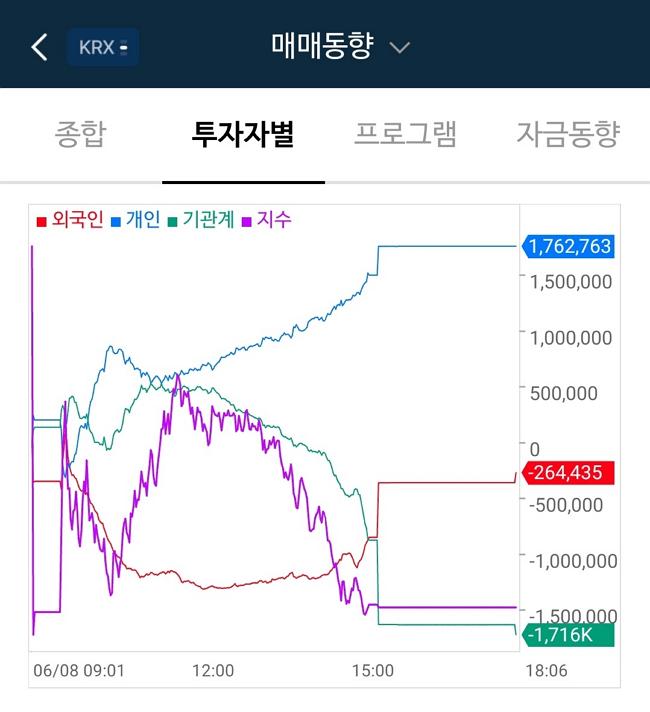 KOSPI intraday supply and demand screen on the 8th. Individual buying sentiment was maintained, but institutional investors abruptly turned to net selling from the mid-afternoon. Whether this pattern repeats in the market on the 9th is a key point to watch.1:30 PM on the 8th, the time when institutional demand shifted
However, the real question that will determine the market on the 9th is not "how much did it fall on the 8th?" but "is the intraday supply and demand reversal on the 8th repeated on the 9th?"
According to the intraday supply and demand screen checked by the editorial department, individual investors showed buying superiority throughout the day. In contrast, institutional investors seemed to support the market in the morning, but sharply turned to selling around 1:30 PM.
As of the closing, individual investors were net buyers of over 1.7 trillion won, and institutional investors turned to net sellers of around 1.7 trillion won. Individuals bought, and institutions reduced their defense from the mid-afternoon.
.
The U.S. 10-year yield is the first variable
There is one question for the stock market on the 9th.
Will the U.S. 10-year yield decline, or will it hold steady in the mid-to-high 4.5% range?
It was reported that the U.S. 10-year Treasury yield rose to 4.580% during trading in the Asian market on the 8th.
If U.S. interest rates remain at a high level, the Korean stock market will face pressure from three directions.
First, the discount burden for AI and semiconductor growth stocks increases. Second, selling by foreign investors and pressure for a weaker won continue. Third, the rise in domestic interest rates shakes the individual investors' capacity for credit and leverage buying.
The Korean bond market moved in the same direction.
On the morning of the 8th, yields on the 3-year Korean government bond rose to 3.960% and the 10-year yield to 4.328%, respectively, in the Seoul bond market. The 30-year yield also recorded 4.370%.
A market where stock prices plummet and bond yields rise simultaneously is not a normal risk-off environment.
Rather than funds moving from stocks to safe-haven assets, it is closer to a market where interest rate burdens, foreign investor outflows, and exchange rate instability are simultaneously reflected in prices.
Foreign selling and individual buying capacity clash
There are three structures to check in the market on the 9th.
First is the U.S. 10-year yield.
If the U.S. 10-year yield falls below 4.50% before the market opens on the 9th, it will create a rationale for a technical rebound.
However, if it holds above 4.55% or approaches 4.60% again, the rebound is likely to weaken. In this case, even if an initial rebound occurs, the selling pressure centered on large-cap semiconductor and growth stocks will not easily disappear.
Second is foreign selling.
While institutional selling amplified the closing shock of the 8th, the market's directional pressure came from foreign selling.
If foreign investors sell both spot and futures on the 9th, it will be difficult to defend the index's downside solely with individual buying.
Conversely, if the volume of foreign selling decreases and futures selling stabilizes, the institutional selling on the afternoon of the 8th could be interpreted as a one-off risk reduction.
Third is the individual buying capacity.
The fact that individual investors bought over 1.7 trillion won on the 8th is both a signal of market resilience and a warning sign.
If individual buying is for bargain hunting with cash, it can support the index's downside. However, if it includes elements of buying the dip with credit, margin, or leveraged ETFs, a lower opening on the 9th could quickly test individual investors' additional buying capacity.
A market where only individuals buy is not a strong market
This point is crucial. The fact that individuals are continuously buying does not necessarily mean the market is strong.
If the index fails to hold its ground despite individual buying, it means that individuals are absorbing foreign and institutional selling, rather than indicating strong buying sentiment.
Especially in an environment where both U.S. and Korean interest rates are rising simultaneously, the cost of individual credit buying and the risk of forced selling also increase.
The most dangerous trend for the market on the 9th is clear.
It is a market where only individuals buy after a decline at the opening, while foreign and institutional investors sell simultaneously.
If institutional selling expands again around 1:30 PM, the supply and demand reversal on the 8th could be interpreted as a pattern rather than a coincidence.
In this case, the market may price in the possibility of a secondary panic selling before a technical rebound.
The quality of the rebound on the 9th will be determined by supply and demand
Conversely, there is a less negative scenario.
This is when the U.S. 10-year yield declines, foreign selling slows down, and selling from financial investment and trust funds decreases.
If the National Pension Service provides support at a neutral or higher level in this scenario, the crash on the 8th could transition into a technical rebound after an overheating period is cleared.
However, even in this case, the quality of the rebound should be judged by supply and demand, not just the index. A rebound where only individuals are buying is weak. Only a rebound accompanied by slowing foreign selling and reduced institutional selling is meaningful.
The conclusion for the Korean stock market on the 9th is simple. Interest rates come before rebounds. If the U.S. 10-year yield does not decline, foreign selling pressure will not easily abate.
If foreign selling continues, institutions may again move to reduce risk. If institutions sell again in the afternoon, individual buying capacity will face a bigger test.
The Korean stock market on the 9th will be determined not by its opening price, but by U.S. interest rates, foreign investor flows, and institutional flows around 1:30 PM.
There are three points to watch for the market on the 9th.
Will the U.S. 10-year yield fall below 4.50%, will foreign selling continue for the 22nd consecutive trading day, and will institutional selling repeat around 1:30 PM?
If two or more of these three factors turn negative, the market on the 9th may not be a rebound but an extension of the crash on the 8th.
※ This article is for reference and analysis to help understand market trends, not investment advice. Actual market and stock prices may vary depending on U.S. Treasury yields, the KRW/USD exchange rate, foreign investor flows, the trend of large-cap semiconductor stocks, and individual credit buying capacity.

 Iranian Foreign Ministry: "Continuing Message Exchanges with the U.S. and Activities of Mediating Countries"
Esmaeil Baghaei, Spokesperson for the Iranian Ministry of Foreign Affairs [Xinhua, Yonhap News file photo]Esmaeil Baghaei, spokesperson for the Iranian Ministry of Foreign Affairs, stated on the 26th
Iranian Foreign Ministry: "Continuing Message Exchanges with the U.S. and Activities of Mediating Countries"
Esmaeil Baghaei, Spokesperson for the Iranian Ministry of Foreign Affairs [Xinhua, Yonhap News file photo]Esmaeil Baghaei, spokesperson for the Iranian Ministry of Foreign Affairs, stated on the 26th
 President Yoon: "Do You Think You Are Safe from the Special Counsel?"... Final Statement Video Released
President Yoon Suk Yeol rebuking the special prosecutor on the 24th. [Court video / @birds_justice X account subtitle GIF] A video of President Yoon Suk Yeol's closing statement at his trial rega
President Yoon: "Do You Think You Are Safe from the Special Counsel?"... Final Statement Video Released
President Yoon Suk Yeol rebuking the special prosecutor on the 24th. [Court video / @birds_justice X account subtitle GIF] A video of President Yoon Suk Yeol's closing statement at his trial rega
 President Yoon, regarding the first-instance ruling on the Public Official Election Act: “An excessive political verdict that distorts the facts… We will appeal immediately.”
The first-instance sentencing hearing for President Yoon Suk Yeol regarding violations of the Public Official Election Act is being broadcast live at Seoul Station on the 27th. [Photo=Yonhap News]Pres
President Yoon, regarding the first-instance ruling on the Public Official Election Act: “An excessive political verdict that distorts the facts… We will appeal immediately.”
The first-instance sentencing hearing for President Yoon Suk Yeol regarding violations of the Public Official Election Act is being broadcast live at Seoul Station on the 27th. [Photo=Yonhap News]Pres
 WSJ: "SK Hynix ADR Premium Is a Sign of AI Trading Overheat"
Advertisement for SK Hynix ADR listing in New York's Times Square [Reuters=Yonhap News file photo]The Wall Street Journal (WSJ) has pointed out that the price of SK Hynix’s American Depositary Recei
WSJ: "SK Hynix ADR Premium Is a Sign of AI Trading Overheat"
Advertisement for SK Hynix ADR listing in New York's Times Square [Reuters=Yonhap News file photo]The Wall Street Journal (WSJ) has pointed out that the price of SK Hynix’s American Depositary Recei
 'Godfather of Japanese Mystery Novels' Keigo Higashino Passes Away After Battle with Cancer at 68
Famous Japanese mystery novelist Keigo Higashino [AFP=Yonhap News]It has been belatedly reported that Keigo Higashino, the "godfather of Japanese mystery novels" and author of bestsellers such as "The
'Godfather of Japanese Mystery Novels' Keigo Higashino Passes Away After Battle with Cancer at 68
Famous Japanese mystery novelist Keigo Higashino [AFP=Yonhap News]It has been belatedly reported that Keigo Higashino, the "godfather of Japanese mystery novels" and author of bestsellers such as "The
 [Park Pil-kyu Security Column] To the Ignorant Trying to Clothe a Beast in Sheep's Clothing
Rep. Kim Byung-joo of the Democratic Party of Korea [Photo=Yonhap News]“The Air Force Academy doesn't teach you how to fly a plane!” “The Army, Navy, and Air Force academies are exactly the
[Park Pil-kyu Security Column] To the Ignorant Trying to Clothe a Beast in Sheep's Clothing
Rep. Kim Byung-joo of the Democratic Party of Korea [Photo=Yonhap News]“The Air Force Academy doesn't teach you how to fly a plane!” “The Army, Navy, and Air Force academies are exactly the
 [Issue Diagnosis] Two Effects of the Election Petition Review
 [Photo] Evidence of Election Fraud Flooding U.S. Media… Trump Had 2.7 Million Votes Stolen
 [Video] U.S. Semiquincentennial Air Show... 'Art in the Sky' streaks across New York
 [Editorial Cartoon] A Draconian Law That Undermines Freedom of Expression

 List
List









