 A soldier from the 6th Division of the Army moves along a patrol route on the central front in Cheorwon-gun, Gangwon-do. [Yonhap News]
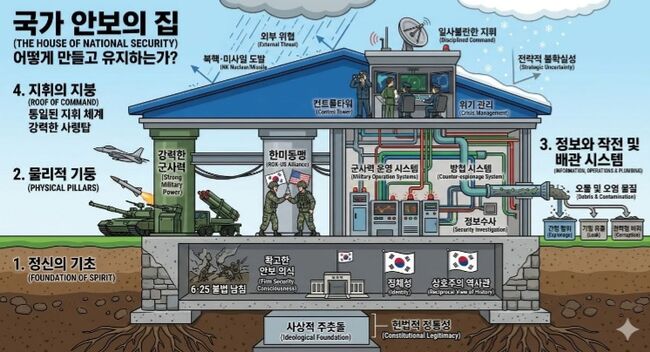
The edifice of national security requires a foundation of strong morale, followed by the erection of physical vertical pillars and beams, the installation of internal metabolic piping, and finally, the placement of a command and control roof. Upon the 'foundation of mental armament' of firm security awareness and identity, strong 'physical pillars' of military power and alliances are built, military operational systems corresponding to the building's electricity, communication, and disaster prevention must function smoothly, and a 'control tower roof' that directs command and control of major situations must be placed on the top floor.
Thus, security only becomes robust when intangible beliefs, tangible power, internal purification, and decisiveness are organically combined. The recent series of incidents within our military starkly illustrate how these four fundamental elements have been destroyed.
1. National security begins with the cornerstone of spirit and ideology.
The Korean War was a clear, illegal invasion war initiated by war criminal Kim Il-sung, instigated by China and the Soviet Union. The recent incident at the War Memorial of Korea, involving the 'Resist America, Aid Korea' perspective education on the Korean War, vividly demonstrates how severely the security foundation of our society has crumbled. The attempt to equate 'Resist America, Aid Korea,' a distortion of history and a term used for regime propaganda by the invading nation of China, with 'diverse perspectives and interpretations' is, in itself, an act of 'mental self-harm' that has demolished the security history and legitimacy of the Republic of Korea.
National security begins with a firm spirit, yet the current administration is engaging in self-harm by dismantling the military's ideological defense wall under the guise of peace and value neutrality. By excessively emphasizing the 'right to refuse unlawful orders' from superiors during ideological training, the military's chain of command and fundamental structure, which requires immediate order execution during wartime, has been shaken. Paradoxically, the 'integration of military academies' is an unlawful order that contravenes the Constitution, and thus the military must refuse it.
By labeling internal military books (like 'Grandfather's Stories of the Korean War') that exposed North Korea's Juche ideology and educated about the nation's founding and defense history as 'far-right,' and by forcibly collecting and abolishing them from military units, the soldiers' perception of the enemy has been blurred. Such actions are weakening military discipline and undermining the mental foundation.
2. Security is sustained by the strong pillars of military power and alliances.
The most certain physical and strategic framework to be built upon the ideological foundation of national security consists of two pillars: robust military power and the ROK-US alliance. However, the current administration is shaking the very roots of this security framework. In particular, the reckless pursuit of an early transfer of wartime operational control (OPCON) – the core link of the ROK-US alliance and the foundation of the combined defense system – is an act of self-harm that plunges the Republic of Korea into a severe security crisis. Weakening the combined forces structure, which is the core of military deterrence, is tantamount to disarming ourselves amidst North Korea's escalating nuclear and missile capabilities and the military expansion of China and Russia.
Furthermore, in the face of crises in the Strait of Hormuz, the lifeline of global energy supply, and a rapidly changing maritime security landscape, effective combined readiness and deterrence must be in place to strengthen alliance cohesion and protect national survival. If strategic misjudgments that weaken alliance cohesion and shake the foundations of military command continue, it will ultimately collapse under the slightest external pressure.
3. Security is maintained through the harmony of intelligence, operations, support systems, and counterintelligence functions.
Just as a building's electrical, communication, plumbing, fire fighting, and disaster prevention functions operate organically, complex military functions must also be interconnected vertically and horizontally. Just as a building has various corrosive elements and resistances that weaken its functions, the military also harbors contaminants that erode security, such as espionage, leakage of classified information, and corruption related to abuse of power.
Even with an ideological foundation and physical pillars in place, if the counterintelligence system, which acts as the plumbing to filter out internal contaminants, is weakened, the edifice of security will collapse from within due to vibrations and foul odors. Imagine weakening or removing the wastewater pipes in a high-rise building.
The Republic of Korea Armed Forces Counterintelligence Command is a precise system for accurately identifying internal threats. However, the recently announced plan for its dissolution and functional reorganization disperses and reorganizes counterintelligence information, security audits, and security investigations into the Defense Counterintelligence Headquarters, the Defense Security Support Command, and the Ministry of National Defense Investigation Agency. It was difficult to catch spies even when these three functions were integrated into one, but now they are moving in the opposite direction. While this may be intended to prevent past political interference, it is akin to breaking a pickle jar out of fear of maggots.
In a situation where the ROK-US alliance is already precarious due to the pursuit of OPCON transfer, if the fundamental mission of counterintelligence is disassembled and scattered, it will be difficult to prevent the activities of already infiltrated enemies, and China's 'super-war' will be in effect, jeopardizing the effectiveness of military security and military operations.
4. Unification of the command system that harmonizes and integrates military functions.
After the groundwork, erecting the pillars, and installing the internal piping to filter wastewater, the final step is to place the 'roof' that protects the house from heavy rain, snow, and external infiltration. In security, the roof represents the unified, disciplined command system and the leadership of a strong command center. If opinions within the government's unification and security lines differ, and if the philosophy of a strong military is eroded from above, causing lax discipline in the military, even a physically strong military cannot endure for long.
Currently, the security line is engaging in an 'unprecedented act of ideological self-harm,' undermining its own security foundation under the pretext of value neutrality and peace. National security transcends partisan divides and must never be a subject of compromise or experimentation.
To survive, we must strengthen our will to defend a robust free system and build the pillars of the ROK-US alliance even more firmly. Once the Republic of Korea is normalized, we must revive the counterintelligence functions and a unified command system free from political interference.

◆ Park Pil-gyu
Editorial Board Member, Hankook Military-Civilian News
Korea Military Academy, Class of '40

 Iranian Foreign Ministry: "Continuing Message Exchanges with the U.S. and Activities of Mediating Countries"
Esmaeil Baghaei, Spokesperson for the Iranian Ministry of Foreign Affairs [Xinhua, Yonhap News file photo]Esmaeil Baghaei, spokesperson for the Iranian Ministry of Foreign Affairs, stated on the 26th
Iranian Foreign Ministry: "Continuing Message Exchanges with the U.S. and Activities of Mediating Countries"
Esmaeil Baghaei, Spokesperson for the Iranian Ministry of Foreign Affairs [Xinhua, Yonhap News file photo]Esmaeil Baghaei, spokesperson for the Iranian Ministry of Foreign Affairs, stated on the 26th
 President Yoon: "Do You Think You Are Safe from the Special Counsel?"... Final Statement Video Released
President Yoon Suk Yeol rebuking the special prosecutor on the 24th. [Court video / @birds_justice X account subtitle GIF] A video of President Yoon Suk Yeol's closing statement at his trial rega
President Yoon: "Do You Think You Are Safe from the Special Counsel?"... Final Statement Video Released
President Yoon Suk Yeol rebuking the special prosecutor on the 24th. [Court video / @birds_justice X account subtitle GIF] A video of President Yoon Suk Yeol's closing statement at his trial rega
 President Yoon, regarding the first-instance ruling on the Public Official Election Act: “An excessive political verdict that distorts the facts… We will appeal immediately.”
The first-instance sentencing hearing for President Yoon Suk Yeol regarding violations of the Public Official Election Act is being broadcast live at Seoul Station on the 27th. [Photo=Yonhap News]Pres
President Yoon, regarding the first-instance ruling on the Public Official Election Act: “An excessive political verdict that distorts the facts… We will appeal immediately.”
The first-instance sentencing hearing for President Yoon Suk Yeol regarding violations of the Public Official Election Act is being broadcast live at Seoul Station on the 27th. [Photo=Yonhap News]Pres
 WSJ: "SK Hynix ADR Premium Is a Sign of AI Trading Overheat"
Advertisement for SK Hynix ADR listing in New York's Times Square [Reuters=Yonhap News file photo]The Wall Street Journal (WSJ) has pointed out that the price of SK Hynix’s American Depositary Recei
WSJ: "SK Hynix ADR Premium Is a Sign of AI Trading Overheat"
Advertisement for SK Hynix ADR listing in New York's Times Square [Reuters=Yonhap News file photo]The Wall Street Journal (WSJ) has pointed out that the price of SK Hynix’s American Depositary Recei
 'Godfather of Japanese Mystery Novels' Keigo Higashino Passes Away After Battle with Cancer at 68
Famous Japanese mystery novelist Keigo Higashino [AFP=Yonhap News]It has been belatedly reported that Keigo Higashino, the "godfather of Japanese mystery novels" and author of bestsellers such as "The
'Godfather of Japanese Mystery Novels' Keigo Higashino Passes Away After Battle with Cancer at 68
Famous Japanese mystery novelist Keigo Higashino [AFP=Yonhap News]It has been belatedly reported that Keigo Higashino, the "godfather of Japanese mystery novels" and author of bestsellers such as "The
 [Park Pil-kyu Security Column] To the Ignorant Trying to Clothe a Beast in Sheep's Clothing
Rep. Kim Byung-joo of the Democratic Party of Korea [Photo=Yonhap News]“The Air Force Academy doesn't teach you how to fly a plane!” “The Army, Navy, and Air Force academies are exactly the
[Park Pil-kyu Security Column] To the Ignorant Trying to Clothe a Beast in Sheep's Clothing
Rep. Kim Byung-joo of the Democratic Party of Korea [Photo=Yonhap News]“The Air Force Academy doesn't teach you how to fly a plane!” “The Army, Navy, and Air Force academies are exactly the
 [Issue Diagnosis] Two Effects of the Election Petition Review
 [Photo] Evidence of Election Fraud Flooding U.S. Media… Trump Had 2.7 Million Votes Stolen
 [Video] U.S. Semiquincentennial Air Show... 'Art in the Sky' streaks across New York
 [Editorial Cartoon] A Draconian Law That Undermines Freedom of Expression

 List
List










