 U.S. Capitol Building [Photo=Yonhap News]
Korean-American political columnist Jean Cummings has begun a clear fact-checking process regarding a bill passed by the U.S. Congress that could provide a legal basis for American intervention in South Korea's emergency situation of election fraud.
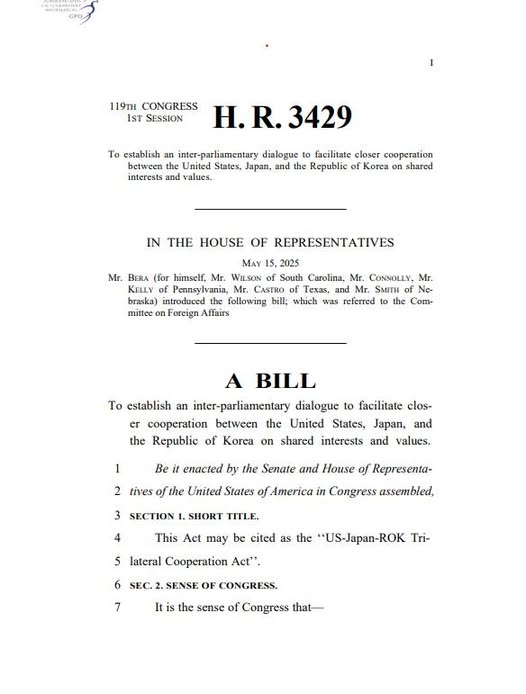
On November 11 (local time), Jean Cummings stated that the bill in question is "HR 3429 (a bill to establish regular dialogue channels between the U.S., Japan, and South Korea parliaments)," which passed the U.S. House of Representatives unanimously on June 8.
She pointed out, "To interpret this as simply a bill allowing immediate intervention by U.S. forces or the U.S. in South Korea's emergency situation of election fraud is an excessive claim based on facts," adding, "However, we must see the immense geopolitical destructive power hidden behind it."
The bipartisan bill, the U.S.-Japan-ROK Trilateral Cooperation Act (H.R. 3429), was introduced by Representative Ami Bera (Democrat, California) on May 15, 2025, and passed the U.S. House of Representatives unanimously on June 8, 2026. It has now moved to the Senate, and there is a high probability that it will pass the Senate and be signed by the President without significant issues in the near future.
Jean Cummings conveyed that the bill was created with the intention of continuously maintaining the cooperation structure at the congressional level following the meeting of the three leaders—Biden, Kishida, and Yoon Suk-yeol—in Camp David, Maryland, in 2023, to strengthen "trilateral cooperation." The aim is to create an institutional foundation so that U.S.-Japan-South Korea cooperation is not shaken, regardless of future changes in the administration.
She added, "This bill is by no means a trivial matter, even though it does not contain explicit clauses for domestic interference or direct intervention."
The true political significance of this bill is that the United States and Japan will no longer tolerate South Korea leaning towards China, and HR 3429 is an institutional mechanism created to monitor and pressure that trend.
Jean Cummings believes that since the bill implies measures to address China's interference in information manipulation within South Korea, it is not unreasonable to interpret it as the U.S. intending to address election fraud issues in South Korea, even though it was not created solely for that purpose.
Furthermore, he argued, "While the United States cannot legally intervene in South Korea's internal affairs based on this bill, the moment diplomatic meetings are regularized, a perfect structure is created where U.S. lawmakers can publicly point out and strongly pressure issues within South Korea if they are deemed detrimental to America's Indo-Pacific strategy."
Meanwhile, Jean Cummings also posted a message slightly earlier on the same day stating, "The reasons for former President Yoon Suk-yeol's declaration of emergency martial law have already been proven. Release him immediately!"
The following is the full text of Jean Cummings' Facebook post.
The Trump Administration's Strategy for Reorganizing South Korea Has Officially Begun
There are claims that a bill has been unanimously passed by the U.S. Congress providing a legal basis for U.S. intervention in South Korea's emergency election fraud situation. It is essential to fact-check this clearly and understand the immense geopolitical destructive power hidden behind it.
The official name of the bill unanimously passed by the U.S. House of Representatives on June 8 is HR 3429, which aims to establish regular dialogue channels between the U.S., Japan, and South Korea parliaments.
Therefore, interpreting this as simply a bill allowing immediate intervention by U.S. forces or the U.S. in South Korea's emergency situation of election fraud is an excessive claim based on facts.
The bipartisan bill, the U.S.-Japan-ROK Trilateral Cooperation Act (H.R. 3429), was introduced by Representative Ami Bera (Democrat, California) on May 15, 2025, and passed the U.S. House of Representatives unanimously on June 8, 2026. It has now moved to the Senate, and there is a high probability that it will pass the Senate and be signed by the President without significant issues in the near future.
The core of the bill, as written, is for the State Department to cooperate with the Japanese and South Korean governments to create regular congressional dialogue channels between the United States, Japan, and South Korea. The U.S. Congress will form a delegation of up to eight members to meet with their South Korean and Japanese counterparts at least once a year to discuss matters of common interest, such as security, economic security, advanced technology, and health.
This was created with the intention of continuously maintaining the cooperation structure at the congressional level following the meeting of the three leaders—Biden, Kishida, and Yoon Suk-yeol—in Camp David in 2023 to strengthen trilateral cooperation. The goal is to create an institutional foundation so that U.S.-Japan-South Korea cooperation is not shaken, regardless of future changes in the administration.
However, this bill is by no means a trivial matter, even though it does not contain explicit clauses for domestic interference or direct intervention.
The true political significance of this bill is that the United States and Japan will no longer tolerate South Korea leaning towards China, and HR 3429 is an institutional mechanism created to monitor and pressure that trend.
Therefore, the strong claims circulating on social media are not entirely incorrect because the bill's inherent purpose includes Indo-Pacific strategy, countering foreign information manipulation, protecting democratic institutions, and strengthening security cooperation.
The original text of the bill even includes a provision stating that the United States, Japan, and South Korea "should collaborate on countering foreign information manipulation and interference."
This implies that the three countries must recognize external interference affecting democratic institutions and electoral environments as a shared security issue, going beyond simple parliamentarian exchanges.
▲ Reference: Section 2, Sense of Congress, Paragraph (5) "the United States, Japan, and the ROK should collaborate on countering foreign information manipulation and interference to protect democratic institutions and promote accurate information sharing." |
In other words, because it includes the intent to prepare measures against China's interference in information manipulation within South Korea, it is not unreasonable to interpret it as the U.S. intending to address election fraud issues in South Korea, even though it was not created solely for election fraud.
Furthermore, this is not merely a social gathering for parliamentarians; it mandates that the State Department pursue negotiations, the U.S. congressional delegation engage in regular activities, and annual reports be submitted.
The bill specifies that within 180 days of its enactment, the U.S. Secretary of State must enter into negotiations with the South Korean and Japanese governments with the goal of a written agreement. Additionally, the U.S. delegation must submit an annual report to the House Committee on Foreign Affairs and the Senate Committee on Foreign Relations each fiscal year.
This signifies more than just parliamentarians from the three countries meeting for discussions. It means that the content and issues raised in this consultative body will be recorded and remain within the U.S. Congress's official records and reporting system.
Moreover, the original text of the bill stipulates that the three countries must strengthen "Trilateral Maritime Security Cooperation" for the stability of the Indo-Pacific and freedom of navigation.
This is not merely a phrase about maritime cooperation. In the context of increasing Chinese military pressure in the Taiwan Strait, the East China Sea, and the South China Sea, it signifies a deeper integration of South Korea into the U.S.-Japan-led maritime security strategy.
Once the regular meetings between the South Korean, U.S., and Japanese parliaments are formalized, the U.S. and Japan will possess a legitimate channel to exert incomparably stronger diplomatic and political pressure than before, even if lacking legal binding force, when the South Korean government pursues policies closely aligned with China.
This will inevitably place immense political pressure on the current Lee Jae-myung administration, making it virtually impossible for the government to unilaterally pursue pro-China policies.
While the U.S. cannot legally intervene in South Korea's internal affairs based on this bill, the moment diplomatic meetings are regularized, a perfect structure is created where U.S. lawmakers can publicly point out and strongly pressure issues within South Korea if they are deemed detrimental to America's Indo-Pacific strategy.
Specifically, issues such as North Korea, China, supply chains, and domestic political matters, including the highly controversial election issues currently plaguing South Korea, can be comprehensively discussed during these dialogues.
The very fact that the U.S. and Japan will be observing South Korea's situation with a microscope and exchanging opinions through regular official channels where parliamentarians from the three countries meet face-to-face is an immense pressure in itself.
Even if the bill was not created for direct U.S. intervention in election fraud disputes, the interpretation that an institutional snare has been completed to closely monitor and pressure South Korea is valid.
Conversely, while there are positive aspects, such as making it much easier for the U.S., South Korea, and Japan to jointly respond to North Korean threats or if a China-skeptic government comes to power and China pressures South Korea, this also means that a powerful mechanism for controlling and monitoring the South Korean government's independent decisions has been institutionalized.
This is because a structure has been established whereby the U.S. Congress can monitor the policy direction of the South Korean government in real-time and, if deemed problematic, corner the administration publicly.
If the Lee Jae-myung administration refuses U.S. demands and persists in policies leaning towards China, the concerns and information meticulously gathered at the congressional level will be immediately transmitted to the State Department and the White House, serving as a critical bridge to powerful sanctions and retaliatory measures at the executive level.
In the past, most U.S. lawmakers were preoccupied with domestic issues and did not pay much attention to the internal affairs of distant South Korea, and pressure was primarily exerted through indirect channels via the executive branch.
However, a permanent surveillance system has now been established where congressional bodies regularly summon and scrutinize the South Korean political establishment.
It will now be difficult to conceal or dismiss political corruption, bribery, recurring North Korean remittance issues, and clandestine dealings and security-compromising actions with China in South Korea as mere domestic political rhetoric or partisan debates.
When sensitive issues like "remittances to North Korea" arise, U.S. and Japanese lawmakers specializing in foreign affairs and security will demand specific data during regular meetings and pressure for explanations, leaving the South Korean political circles with no means to conceal or hide them.
Ultimately, the Trump administration views the policy deviations and security rifts occurring under the current Lee Jae-myung administration not as isolated incidents but as chronic structural ailments within the South Korean political landscape. They have taken bipartisan action to fundamentally reform the vicious cycle of attempts to impeach a pro-U.S. administration and the spread of anti-U.S. sentiment under a pro-China government.
The common conclusion within the U.S. political sphere is that merely addressing the Lee Jae-myung administration will not resolve the internal issues of South Korea. This is because both the ruling and opposition parties are believed to have serious concerns about the country leaning towards China.
This bill is a device to prevent alliance defection, holding South Korea on a leash to prevent it from drifting towards China's orbit, and it is equivalent to immense diplomatic pressure tightening the noose on all pro-China and pro-North Korean actions of the Lee Jae-myung administration.
The Trump administration will not view South Korea's issues as merely bringing down a single politician. There is a high possibility that they will pursue long-term structural reforms to reconfigure South Korea's political structure itself, preventing communist and pro-China forces from ever again dominating its political landscape.

 Iranian Foreign Ministry: "Continuing Message Exchanges with the U.S. and Activities of Mediating Countries"
Esmaeil Baghaei, Spokesperson for the Iranian Ministry of Foreign Affairs [Xinhua, Yonhap News file photo]Esmaeil Baghaei, spokesperson for the Iranian Ministry of Foreign Affairs, stated on the 26th
Iranian Foreign Ministry: "Continuing Message Exchanges with the U.S. and Activities of Mediating Countries"
Esmaeil Baghaei, Spokesperson for the Iranian Ministry of Foreign Affairs [Xinhua, Yonhap News file photo]Esmaeil Baghaei, spokesperson for the Iranian Ministry of Foreign Affairs, stated on the 26th
 President Yoon: "Do You Think You Are Safe from the Special Counsel?"... Final Statement Video Released
President Yoon Suk Yeol rebuking the special prosecutor on the 24th. [Court video / @birds_justice X account subtitle GIF] A video of President Yoon Suk Yeol's closing statement at his trial rega
President Yoon: "Do You Think You Are Safe from the Special Counsel?"... Final Statement Video Released
President Yoon Suk Yeol rebuking the special prosecutor on the 24th. [Court video / @birds_justice X account subtitle GIF] A video of President Yoon Suk Yeol's closing statement at his trial rega
 President Yoon, regarding the first-instance ruling on the Public Official Election Act: “An excessive political verdict that distorts the facts… We will appeal immediately.”
The first-instance sentencing hearing for President Yoon Suk Yeol regarding violations of the Public Official Election Act is being broadcast live at Seoul Station on the 27th. [Photo=Yonhap News]Pres
President Yoon, regarding the first-instance ruling on the Public Official Election Act: “An excessive political verdict that distorts the facts… We will appeal immediately.”
The first-instance sentencing hearing for President Yoon Suk Yeol regarding violations of the Public Official Election Act is being broadcast live at Seoul Station on the 27th. [Photo=Yonhap News]Pres
 WSJ: "SK Hynix ADR Premium Is a Sign of AI Trading Overheat"
Advertisement for SK Hynix ADR listing in New York's Times Square [Reuters=Yonhap News file photo]The Wall Street Journal (WSJ) has pointed out that the price of SK Hynix’s American Depositary Recei
WSJ: "SK Hynix ADR Premium Is a Sign of AI Trading Overheat"
Advertisement for SK Hynix ADR listing in New York's Times Square [Reuters=Yonhap News file photo]The Wall Street Journal (WSJ) has pointed out that the price of SK Hynix’s American Depositary Recei
 'Godfather of Japanese Mystery Novels' Keigo Higashino Passes Away After Battle with Cancer at 68
Famous Japanese mystery novelist Keigo Higashino [AFP=Yonhap News]It has been belatedly reported that Keigo Higashino, the "godfather of Japanese mystery novels" and author of bestsellers such as "The
'Godfather of Japanese Mystery Novels' Keigo Higashino Passes Away After Battle with Cancer at 68
Famous Japanese mystery novelist Keigo Higashino [AFP=Yonhap News]It has been belatedly reported that Keigo Higashino, the "godfather of Japanese mystery novels" and author of bestsellers such as "The
 [Park Pil-kyu Security Column] To the Ignorant Trying to Clothe a Beast in Sheep's Clothing
Rep. Kim Byung-joo of the Democratic Party of Korea [Photo=Yonhap News]“The Air Force Academy doesn't teach you how to fly a plane!” “The Army, Navy, and Air Force academies are exactly the
[Park Pil-kyu Security Column] To the Ignorant Trying to Clothe a Beast in Sheep's Clothing
Rep. Kim Byung-joo of the Democratic Party of Korea [Photo=Yonhap News]“The Air Force Academy doesn't teach you how to fly a plane!” “The Army, Navy, and Air Force academies are exactly the
 [Issue Diagnosis] Two Effects of the Election Petition Review
 [Photo] Evidence of Election Fraud Flooding U.S. Media… Trump Had 2.7 Million Votes Stolen
 [Video] U.S. Semiquincentennial Air Show... 'Art in the Sky' streaks across New York
 [Editorial Cartoon] A Draconian Law That Undermines Freedom of Expression

 List
List










