Daegu patriotic citizens march through the city on the evening of the 12th, chanting "Fraudulent Election, Re-election" and "In-person Voting, Manual Count." [Source: Screenshot from @hcuouvukkuvgufy X account]
The March 15th fraudulent election and the June 3rd local election disenfranchisement incident are not the same type of fraudulent election, based solely on the revealed facts.
The March 15th incident was a case where state power manipulated the vote count and election results. In contrast, the June 3rd local election, as confirmed so far, is a fraudulent election where the failure of the Central Election Management Committee to fulfill its duties led to the disenfranchisement of voters.
One was a fraudulent election that manipulated votes, and the other was a fraudulent election that prevented people from casting their votes.
The term "fraudulent" (不正) in "fraudulent election" means not right or not legitimate. Therefore, fraudulent elections cannot be limited solely to elections where a specific candidate's vote count is manipulated.
If the principles of freedom, fairness, equality, and secrecy in elections are undermined, and the people's substantive right to vote, which the state must guarantee, is infringed upon, hindering the free expression of will and its accurate reflection, then that election loses its legitimacy.
The planned intervention of state power is not a prerequisite for a fraudulent election. It is merely an aggravating factor that makes a fraudulent election a state-intervention type of fraudulent election.
The state can directly manipulate votes, or the election management body can fail to perform its essential duties, preventing citizens from voting. While the methods may differ, they all fall into the category of fraud because they undermine the legitimacy of the election.
March 15th Fraudulent Election: Manipulation for Vice President Lee Ki-poong's Election
The March 15th incident was a state-intervention type of vote-count manipulation in a fraudulent election.
The election on March 15, 1960, was held concurrently for the 4th Presidential Election and the 5th Vice Presidential Election. However, with the death of the Democratic Party's presidential candidate, Jo Byeong-ok, before the election, the presidential election effectively lost its competitive edge.
The Liberal Party's actual reason for resorting to manipulation was to ensure that Vice Presidential candidate Lee Ki-poong won against candidate Chang Myun. In other words, the core of the March 15th fraudulent election was a "state power intervention-type fraudulent election to ensure the election of Vice Presidential candidate Lee Ki-poong."
The "40% early voting" that was discussed at the time was not the legal early voting we have today. It was vote-count manipulation where a certain percentage of votes were pre-cast in favor of the Liberal Party candidate before voting began.
Open voting by groups of three or nine, manipulation of phantom voters, exclusion of observers, and manipulation of the vote counting process were also employed. The March 15th incident was not simply poor election management. It was an event where state power combined with the Liberal Party's organization to distort the people's actual voting will and the election results.
"Fraudulent Election" First Emerged on the Streets, Not in Court
However, just because the March 15th incident has been confirmed as a fraudulent election today does not mean that the citizens and students of that time waited for a verdict before taking to the streets.
The term "fraudulent election" first appeared on the streets, not in court. Citizens and students in Masan shouted on election day, "March 15th is a fraudulent election," and "Let's redo the rigged election." In today's terms, it was a demand for a "fraudulent election and re-election."
This point is important. The citizens did not cry out about a fraudulent election while waiting for a confirmed verdict. They immediately declared the abnormality of the election they witnessed on site as a fraudulent election and demanded a redo.
Subsequent investigations and trials confirmed that outcry. The process by which March 15th was confirmed as a state-intervention type of fraudulent election shows that citizens' slogans can be the starting point for uncovering the truth, not conspiracy theories.
The Political Responsibility Lesson from Syngman Rhee's Resignation
The political consequences of March 15th were also clear. While the direct focus of the manipulation was on ensuring Vice Presidential candidate Lee Ki-poong's election rather than President Syngman Rhee's, the responsibility did not remain with Lee Ki-poong alone.
The power structure of the Liberal Party regime enabled the fraudulent election, and Syngman Rhee was at its apex. The protests by Masan citizens and students, the death of martyr Kim Ju-yeol, and the national outrage that led to the April 19th Revolution ultimately culminated in Syngman Rhee's resignation.
This demonstrates that a fraudulent election is not a mere violation of election law but an event that undermines the legitimacy of a regime.
There are two lessons from March 15th. One is the fact that the direct target of the fraudulent election was the vice presidential race. The other is that the responsibility for undermining the election extends to the entire regime.
State power that manipulates the people's votes or prevents the exercise of their voting rights ultimately loses the trust of popular sovereignty. Syngman Rhee's resignation was the ultimate expression of that political responsibility.
State-Intervention Fraudulent Election Confirmed by Special Prosecutor and Special Court
After the April 19th Revolution, the investigation expanded to include Minister of Home Affairs Choi In-kyu, Director of the National Police Agency Lee Kang-hak, Vice Minister of Home Affairs Lee Seong-woo, Director of Local Administration at the Ministry of Home Affairs Choi Byeong-gyu, and Liberal Party Planning Chairman Han Hee-seok.
Through investigations and trials, the fraudulent election plan, specific execution guidelines, regional fraudulent election methods, mobilization of public officials, abuse of power, and falsification of official documents were revealed.
However, the truth-finding of March 15th did not end with ordinary investigations and trials. It was followed by the judgment that ordinary laws and judicial procedures had limitations in holding state power accountable for fraudulent elections.
Ultimately, a system of special laws was established after the April 19th Revolution to punish those involved in fraudulent elections, and a Special Prosecutor's Office and Special Court were established.
The criteria that the Special Court focused on were also clear. The March 15th incident involved fraudulent election management, campaigning, voting, and vote counting throughout the entire process. The authorities that should have prevented fraud instead mobilized state power to carry out a large-scale, planned, and organized fraudulent election.
The March 15th incident began with slogans on the streets, but through Syngman Rhee's resignation, the investigation by the Special Prosecutor's Office, and the judgment of the Special Court, it was recorded in history as a state-intervention type of vote-count manipulation in a fraudulent election.
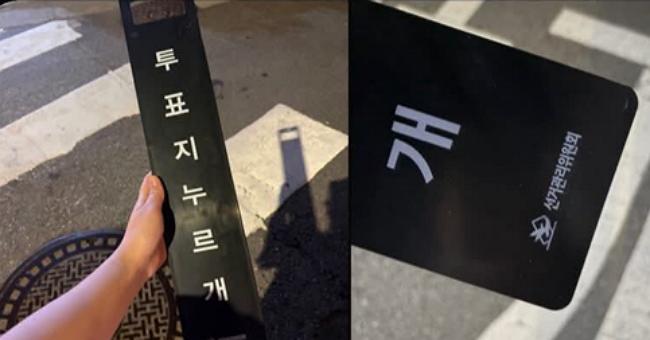 A black "ballot presser" with the name and logo of the Election Management Committee. The phrase "ballot presser" is written on the side. The ballot presser found on the street; its use during actual vote counting has not been confirmed. [Photo: Reader submission]June 3rd Disenfranchisement Confirmed Even by the Election Commission's Announcement
The June 3rd fraudulent election should be viewed from this perspective.
The June 3rd incident has not yet been confirmed as a vote-count manipulation-type fraudulent election like the March 15th incident. However, the fact that voters' normal exercise of their right to vote was obstructed has been confirmed by the Election Management Committee's own announcement.
According to the Election Management Committee's tally, additional ballot papers were urgently sent to 140 polling stations nationwide, and shortages were actually used in 91 locations. Voting was suspended in 26 locations, and the shortage of ballot papers in 91 polling stations amounted to 7,194 sheets.
This is not a simple administrative inconvenience. It is an incident where voters who arrived at the polling stations could not vote normally at the designated time and place due to the state's lack of preparation.
The right to vote is a fundamental right under the Constitution, and the Election Management Committee is a state agency responsible for guaranteeing the exercise of that fundamental right. Hankyoreh, Kyunghyang Shinmun, and JoongAng Ilbo define this situation, where voters' normal exercise of their right to vote was obstructed due to the state's management failure, as a constitutional disenfranchisement.
Under the Public Official Election Act, whether an election is invalid can be further assessed by whether such violations affected the election outcome or the success or failure of candidates. However, whether there has been an infringement of constitutional rights to participate in politics is a separate issue. If voters were unable to vote normally due to the state's lack of preparation, the infringement of their right to participate in politics has already occurred.
Failure to Perform Duties Led to Disenfranchisement
The description of "dereliction of duty-type disenfranchisement" in a fraudulent election is not an emotional statement.
The Election Management Committee has an affirmative duty to guarantee that voters can receive legal ballot papers at the designated time and place and vote without obstruction.
Calculating and printing ballot papers, sending, storing, and delivering them, and managing polling stations to prevent voting from being interrupted are the essential duties of the Election Management Committee.
These duties were undermined at the June 3rd polling stations. Additional ballot papers were urgently sent, actual shortages were used, and voting was suspended. The failure of the election management body to perform its duties led to the obstruction of voters' right to vote.
In addition to ballot paper shortages, issues have been raised regarding the transport of ballot boxes, observation procedures, the vote-counting process, and candidate qualification reviews. The facts of each case must be confirmed through evidence preservation and independent investigation.
"Dereliction of duty-type" here does not mean that a conviction for dereliction of duty under criminal law has already been established. It is a political and legal classification of the situation where the Election Management Committee failed to fulfill its constitutional and public law obligations to guarantee the voting rights of the people.
However, if the subsequent investigation confirms the disregard of prior warnings, the systemic neglect of forecasting voting demand, the failure to manage reserve supplies, the omission of reporting, and delays in on-site response, it could also expand to criminal dereliction of duty issues.
Therefore, the June 3rd fraudulent election can no longer be diluted by the term "controversy." Whether vote counts were manipulated must be determined separately through evidence preservation, investigation, a parliamentary inquiry, and judicial ruling. However, at the very least, classifying it as a "dereliction of duty-type disenfranchisement in a fraudulent election" is possible based on the facts confirmed so far.
The remaining issue is not whether the incident occurred. It is to determine whether its cause was simple negligence, neglect, criminal dereliction of duty, or, furthermore, organized fraud.
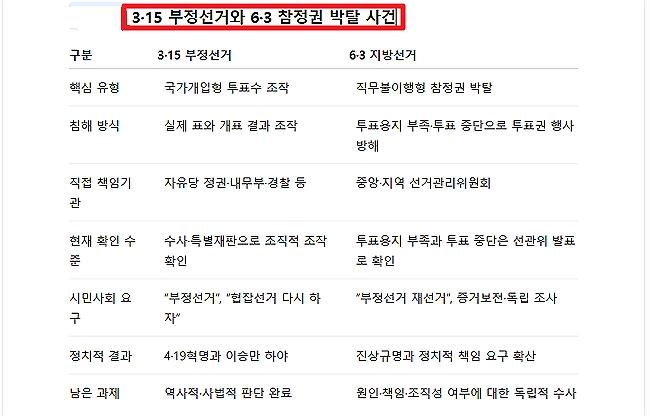 Image caption
The Election Management Committee is both responsible and under investigation
This historical experience applies to June 3rd as well.
The reason a Special Prosecutor's Office and Special Court were needed for the March 15th incident was that the party responsible for the fraudulent election was within the state power structure. In the case of June 3rd, the entity responsible for election management is also a state agency, the Election Management Committee.
The Election Management Committee is the manager of this situation and is also subject to investigation. The causes and responsibility for disenfranchisement cannot be determined solely based on the claims and internal investigations of the responsible party.
An independent external agency must investigate the entire process of ballot paper calculation and printing, reserve supply management and distribution decisions, on-site reporting, instructions for additional shipments, decisions to suspend voting, ballot box transport, and vote counting procedures.
Hankyoreh, Kyunghyang Shinmun, and JoongAng Ilbo believe that discussions on special legislation, including the introduction of a special prosecutor and the establishment of a special court, are necessary for the truth-finding of the June 3rd fraudulent election. This is not a matter of politically amplifying citizens' slogans. It is because, in a case where the election management body is the responsible party, the truth cannot be ascertained solely by the claims of the same body.
Just as the March 15th incident confirmed the structure of state-intervention fraudulent elections through a Special Prosecutor's Office and Special Court, the June 3rd incident must also reveal the causes and responsibilities of dereliction of duty-type disenfranchisement in a fraudulent election through independent investigation and judicial procedures.
The Warning of Public Sentiment Shown by Gallup and KSOI
Recent surveys by the Korea Gallup and Korea Society Opinion Institute (KSOI), whose neutrality has been questioned, also confirmed the warning from public sentiment.
In the Korea Gallup survey, the positive evaluation of President Lee Jae-myung's job performance fell by 7 percentage points compared to the previous survey, and "poor/fraudulent elections and issues with the Election Management Committee" were cited as the top reason for negative evaluations.
In the KSOI survey as well, positive evaluations plummeted by 9.4 percentage points, narrowing the gap between positive and negative evaluations to within the margin of error for the first time.
It is impossible to attribute all reasons for the decline in approval ratings solely to the June 3rd incident. However, it is clear that public sentiment has shifted rapidly since the local elections, and disenfranchisement and Election Management Committee issues have emerged as major headwinds in presidential approval ratings.
Despite this, old media and some political circles are attempting to dismiss the civic society's slogan of "fraudulent election, re-election" as conspiracy theories.
This is inconsistent with the history that led to March 15th and April 19th. On March 15th, citizens did not cry out about a fraudulent election after waiting for a verdict. They first called it a fraudulent election, denounced it as a rigged election, and demanded a redo. History and trials later confirmed the citizens' outcry.
The More the Citizens' Slogans Were Suppressed, the Greater the Anger Grew
A more serious aspect of the March 15th history is that the regime failed to read the citizens' demands in a timely manner.
Initially, the slogans on the streets were "Fraudulent election" and "Let's redo the rigged election." However, the regime treated them as mere disturbances or political opposition, and state violence further fueled the citizens' anger.
As a result, the denunciation of the fraudulent election spread into the April 19th Revolution and culminated in Syngman Rhee's resignation.
The current regime's perception of the situation is also not to be taken lightly. The shortage of ballot papers, suspension of voting, and obstruction of voters' right to vote have been confirmed by the Election Management Committee's own announcement.
However, if this is downplayed as a mere administrative error or a minor disturbance in some areas, and the civic society's slogan of "fraudulent election, re-election" is solely dismissed as a conspiracy theory, then the regime is misreading the lessons of March 15th.
There is no guarantee that the demand for a fraudulent election and re-election, which is now spreading nationwide, will not escalate into a massive citizen resistance like the April 19th Revolution.
History does not always repeat itself in the same way. However, the fact that citizens' anger exploded when power disregarded their votes and the media and political circles tried to cover up the disenfranchisement was already shown by March 15th and April 19th.
What is needed now is not to suppress or mock the citizens' slogans. It is to preserve evidence and discuss and accept an independent truth-finding process, including a special prosecutor and a special court.
"Fraudulent election, re-election" is not a final verdict. It is a political protest against disenfranchisement and a demand for truth-finding. The moment this is suppressed, the media and political circles will be suspected of being accomplices in the cover-up, not watchdogs.
What is needed now is not to veto the slogans. It is to preserve and investigate all records of ballot paper printing and distribution, reserve supply management, the circumstances of voting suspension, ballot box transport, observer participation, and the vote-counting process.
The March 15th incident was a fraudulent election that manipulated votes. The June 3rd incident was a fraudulent election that prevented people from casting their votes.
One was a state-intervention type of vote-count manipulation in a fraudulent election, and the other is at least a dereliction of duty-type disenfranchisement in a fraudulent election. While the methods differ, both undermined the legitimacy of the election by obstructing the free will of the people and its accurate reflection.
March 15th was the manipulation of votes. June 3rd is the deprivation of votes. While the methods differ, both are fraudulent elections that undermined popular sovereignty.
※ ※ The term "fraudulent election" in this article refers to an election that has fraudulently undermined the exercise of people's voting rights or the free and accurate reflection of public will. "Dereliction of duty-type" does not mean that a criminal conviction for dereliction of duty has been established, but rather describes the nature of the incident as a failure of the election management body to fulfill its constitutional and public law obligations.

 Iranian Foreign Ministry: "Continuing Message Exchanges with the U.S. and Activities of Mediating Countries"
Esmaeil Baghaei, Spokesperson for the Iranian Ministry of Foreign Affairs [Xinhua, Yonhap News file photo]Esmaeil Baghaei, spokesperson for the Iranian Ministry of Foreign Affairs, stated on the 26th
Iranian Foreign Ministry: "Continuing Message Exchanges with the U.S. and Activities of Mediating Countries"
Esmaeil Baghaei, Spokesperson for the Iranian Ministry of Foreign Affairs [Xinhua, Yonhap News file photo]Esmaeil Baghaei, spokesperson for the Iranian Ministry of Foreign Affairs, stated on the 26th
 President Yoon: "Do You Think You Are Safe from the Special Counsel?"... Final Statement Video Released
President Yoon Suk Yeol rebuking the special prosecutor on the 24th. [Court video / @birds_justice X account subtitle GIF] A video of President Yoon Suk Yeol's closing statement at his trial rega
President Yoon: "Do You Think You Are Safe from the Special Counsel?"... Final Statement Video Released
President Yoon Suk Yeol rebuking the special prosecutor on the 24th. [Court video / @birds_justice X account subtitle GIF] A video of President Yoon Suk Yeol's closing statement at his trial rega
 President Yoon, regarding the first-instance ruling on the Public Official Election Act: “An excessive political verdict that distorts the facts… We will appeal immediately.”
The first-instance sentencing hearing for President Yoon Suk Yeol regarding violations of the Public Official Election Act is being broadcast live at Seoul Station on the 27th. [Photo=Yonhap News]Pres
President Yoon, regarding the first-instance ruling on the Public Official Election Act: “An excessive political verdict that distorts the facts… We will appeal immediately.”
The first-instance sentencing hearing for President Yoon Suk Yeol regarding violations of the Public Official Election Act is being broadcast live at Seoul Station on the 27th. [Photo=Yonhap News]Pres
 WSJ: "SK Hynix ADR Premium Is a Sign of AI Trading Overheat"
Advertisement for SK Hynix ADR listing in New York's Times Square [Reuters=Yonhap News file photo]The Wall Street Journal (WSJ) has pointed out that the price of SK Hynix’s American Depositary Recei
WSJ: "SK Hynix ADR Premium Is a Sign of AI Trading Overheat"
Advertisement for SK Hynix ADR listing in New York's Times Square [Reuters=Yonhap News file photo]The Wall Street Journal (WSJ) has pointed out that the price of SK Hynix’s American Depositary Recei
 'Godfather of Japanese Mystery Novels' Keigo Higashino Passes Away After Battle with Cancer at 68
Famous Japanese mystery novelist Keigo Higashino [AFP=Yonhap News]It has been belatedly reported that Keigo Higashino, the "godfather of Japanese mystery novels" and author of bestsellers such as "The
'Godfather of Japanese Mystery Novels' Keigo Higashino Passes Away After Battle with Cancer at 68
Famous Japanese mystery novelist Keigo Higashino [AFP=Yonhap News]It has been belatedly reported that Keigo Higashino, the "godfather of Japanese mystery novels" and author of bestsellers such as "The
 [Park Pil-kyu Security Column] To the Ignorant Trying to Clothe a Beast in Sheep's Clothing
Rep. Kim Byung-joo of the Democratic Party of Korea [Photo=Yonhap News]“The Air Force Academy doesn't teach you how to fly a plane!” “The Army, Navy, and Air Force academies are exactly the
[Park Pil-kyu Security Column] To the Ignorant Trying to Clothe a Beast in Sheep's Clothing
Rep. Kim Byung-joo of the Democratic Party of Korea [Photo=Yonhap News]“The Air Force Academy doesn't teach you how to fly a plane!” “The Army, Navy, and Air Force academies are exactly the
 [Issue Diagnosis] Two Effects of the Election Petition Review
 [Photo] Evidence of Election Fraud Flooding U.S. Media… Trump Had 2.7 Million Votes Stolen
 [Video] U.S. Semiquincentennial Air Show... 'Art in the Sky' streaks across New York
 [Editorial Cartoon] A Draconian Law That Undermines Freedom of Expression

 List
List