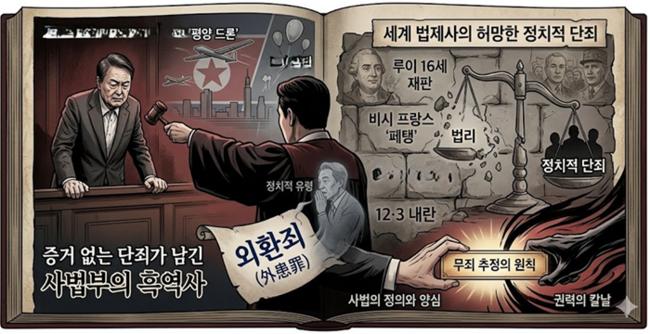
 President Yoon Suk-yeol attends a warrant review hearing at the Seoul Central District Court in Seocho-gu, Seoul, on July 9, 2025. [Photo=Yonhap News]On June 12, 2026, the Criminal Division 36 of the Seoul Central District Court (Presiding Judge Lee Jung-yeop) sentenced President Yoon Suk-yeol, who was indicted in relation to the 'Pyongyang drone infiltration (referred to as 'operation' by the defense)' allegations, to a heavy sentence of 30 years imprisonment, defining the case not as a simple military provocation but as an 'organized political conspiracy that shook the foundation of the nation,' and also found him guilty of foreign enemy treason (外患罪).
Throughout history, demonic powers have often burdened their perceived threats with the gravest charges.
The current 'Pyongyang drone operation' and its subsequent first-instance ruling are an extension of this 'burdening.' While the court imposed a heavy sentence on the former president for 'foreign enemy treason,' some within the legal community and those with a common-sense perspective are raising fundamental questions about the ruling's legal completeness.
1. The core of foreign enemy treason is 'conspiracy (通謀)'; did the court render its sentence after confirming North Korean leader Kim Jong-un's confession?
For foreign enemy treason to be established under criminal law, objective evidence of 'conspiracy (通謀)' is essential—meaning secret communication and collusion with an enemy nation that endangered the nation's existence. Conspiracy is a crime that requires mutual consent. In the case of the 'Pyongyang drone operation,' North Korea, as the perpetrator of the provocation, maintains only a hostile stance and remains thoroughly silent.
Can one party's unilateral act of provocation be legally considered to have formed a high-level accomplice relationship of 'conspiracy with an enemy nation'? This is the greatest legal contradiction of this trial.
While North Korea may have threatened 'disaster' in response to our operation, it has not provided any official statement or evidence of prior collusion with President Yoon's side. Logically, why would North Korea collude with the distribution of leaflets using drones that threaten the 'North Korean slave system'? Wouldn't it be possible to know the truth about North Korea's involvement in the 'Pyongyang drone operation' only after unification?
While foreign enemy treason under criminal law presupposes clear 'conspiracy' with an enemy nation, designating our military's drone operation in response to North Korea's 7,000 instances of balloon provocations as an act of foreign enemy treason is a legal leap. Conversely, ignoring substantial acts of treason, such as remitting funds to North Korea that threatened national security, and applying foreign enemy treason only to the former president who exercised the right of national defense, is an unavoidable criticism of political retaliation that lacks fairness and judicial murder through the use of judicial power.
2. The Futile Political Condemnation in World Legal History of 'Foreign Enemy Treason' Judgments
The court's logic was bold, but looking back at world legal history, it is extremely difficult to find cases where 'foreign enemy treason' was clearly established and punished. Judging conflicts between nations with domestic legal standards like foreign enemy treason has always remained in the realm of political interpretation.
Historically, attempts to condemn the actions of heads of state for foreign enemy treason have largely been used as a means of political purges during periods of regime change. Examples include the treason trial of Louis XVI during the French Revolution and the conviction of Marshal Pétain of the Vichy France government after World War II. However, these were more 'political condemnations' constructed by the victors to eliminate political rivals during upheavals like defeat in war or revolution, rather than based on legal rigor. In later times, they have been subjects of continuous re-evaluation and controversy from a rule of law perspective.
This is because the very charge of foreign enemy treason clashes between the geopolitical complexities of defining an external enemy and the objectivity that judicial judgment should possess. The reason numerous courts throughout world history have hesitated to establish foreign enemy treason is their caution against the 'danger of arbitrary interpretation' inherent in this charge.
3. Regimes are short-lived, but records remain forever; the blade of the rule of law must be precise.
Records of unjust trials become subject to retrial when the regime changes. Unscrupulous devils issue customized verdicts according to their orders. How much dead truth and legal principle lie within these verdicts? We must ask ourselves whether the court chose a legal leap to appease public anger or to strongly attribute political responsibility.
How long do you think the effectiveness of the 'december 3rd rebellion' narrative from the June 3rd election fraud period will last? The court must base its decisions on judicial justice and conscience, not on absurd verdicts that will be judged as products of politics.
The logic that North Korea's provocations were induced, therefore constituting foreign enemy treason, may be intuitively persuasive, but there are significant gaps in terms of the strict evidence and fulfillment of constituent elements required by criminal law. If verdicts can pass without strict evidence, how many innocent people will be harmed? Just as legal principles should not be tools of power, they should not be outlets for emotions.
Trials concerning national security history related to North Korea, where the truth is unknown, must also apply the principle of presumption of innocence. Just as the principle of presumption of innocence must be applied before a final judgment is rendered in court, numerous indictment cases related to national security history must also be subject to the principle of presumption of innocence until North Korea confesses the objective truth or clear documentary evidence emerges.
The demand for trials that are not shameful in the eyes of history is an order to uphold the principles of law and legal reasoning to the very end. We fear what kind of record this verdict, which did not prove the substantive truth of conspiracy while imposing the heavy charge of foreign enemy treason, will leave for our judiciary in the future. The courtroom is not a public square. Only evidence and legal reasoning should be the masters there.

◆ Park Pil-kyu
Editorial Committee Member, Korea-US-Japan Weekly
Korea Military Academy, Class of 40

 Iranian Foreign Ministry: "Continuing Message Exchanges with the U.S. and Activities of Mediating Countries"
Esmaeil Baghaei, Spokesperson for the Iranian Ministry of Foreign Affairs [Xinhua, Yonhap News file photo]Esmaeil Baghaei, spokesperson for the Iranian Ministry of Foreign Affairs, stated on the 26th
Iranian Foreign Ministry: "Continuing Message Exchanges with the U.S. and Activities of Mediating Countries"
Esmaeil Baghaei, Spokesperson for the Iranian Ministry of Foreign Affairs [Xinhua, Yonhap News file photo]Esmaeil Baghaei, spokesperson for the Iranian Ministry of Foreign Affairs, stated on the 26th
 President Yoon: "Do You Think You Are Safe from the Special Counsel?"... Final Statement Video Released
President Yoon Suk Yeol rebuking the special prosecutor on the 24th. [Court video / @birds_justice X account subtitle GIF] A video of President Yoon Suk Yeol's closing statement at his trial rega
President Yoon: "Do You Think You Are Safe from the Special Counsel?"... Final Statement Video Released
President Yoon Suk Yeol rebuking the special prosecutor on the 24th. [Court video / @birds_justice X account subtitle GIF] A video of President Yoon Suk Yeol's closing statement at his trial rega
 President Yoon, regarding the first-instance ruling on the Public Official Election Act: “An excessive political verdict that distorts the facts… We will appeal immediately.”
The first-instance sentencing hearing for President Yoon Suk Yeol regarding violations of the Public Official Election Act is being broadcast live at Seoul Station on the 27th. [Photo=Yonhap News]Pres
President Yoon, regarding the first-instance ruling on the Public Official Election Act: “An excessive political verdict that distorts the facts… We will appeal immediately.”
The first-instance sentencing hearing for President Yoon Suk Yeol regarding violations of the Public Official Election Act is being broadcast live at Seoul Station on the 27th. [Photo=Yonhap News]Pres
 WSJ: "SK Hynix ADR Premium Is a Sign of AI Trading Overheat"
Advertisement for SK Hynix ADR listing in New York's Times Square [Reuters=Yonhap News file photo]The Wall Street Journal (WSJ) has pointed out that the price of SK Hynix’s American Depositary Recei
WSJ: "SK Hynix ADR Premium Is a Sign of AI Trading Overheat"
Advertisement for SK Hynix ADR listing in New York's Times Square [Reuters=Yonhap News file photo]The Wall Street Journal (WSJ) has pointed out that the price of SK Hynix’s American Depositary Recei
 'Godfather of Japanese Mystery Novels' Keigo Higashino Passes Away After Battle with Cancer at 68
Famous Japanese mystery novelist Keigo Higashino [AFP=Yonhap News]It has been belatedly reported that Keigo Higashino, the "godfather of Japanese mystery novels" and author of bestsellers such as "The
'Godfather of Japanese Mystery Novels' Keigo Higashino Passes Away After Battle with Cancer at 68
Famous Japanese mystery novelist Keigo Higashino [AFP=Yonhap News]It has been belatedly reported that Keigo Higashino, the "godfather of Japanese mystery novels" and author of bestsellers such as "The
 [Park Pil-kyu Security Column] To the Ignorant Trying to Clothe a Beast in Sheep's Clothing
Rep. Kim Byung-joo of the Democratic Party of Korea [Photo=Yonhap News]“The Air Force Academy doesn't teach you how to fly a plane!” “The Army, Navy, and Air Force academies are exactly the
[Park Pil-kyu Security Column] To the Ignorant Trying to Clothe a Beast in Sheep's Clothing
Rep. Kim Byung-joo of the Democratic Party of Korea [Photo=Yonhap News]“The Air Force Academy doesn't teach you how to fly a plane!” “The Army, Navy, and Air Force academies are exactly the
 [Issue Diagnosis] Two Effects of the Election Petition Review
 [Photo] Evidence of Election Fraud Flooding U.S. Media… Trump Had 2.7 Million Votes Stolen
 [Video] U.S. Semiquincentennial Air Show... 'Art in the Sky' streaks across New York
 [Editorial Cartoon] A Draconian Law That Undermines Freedom of Expression

 List
List










