
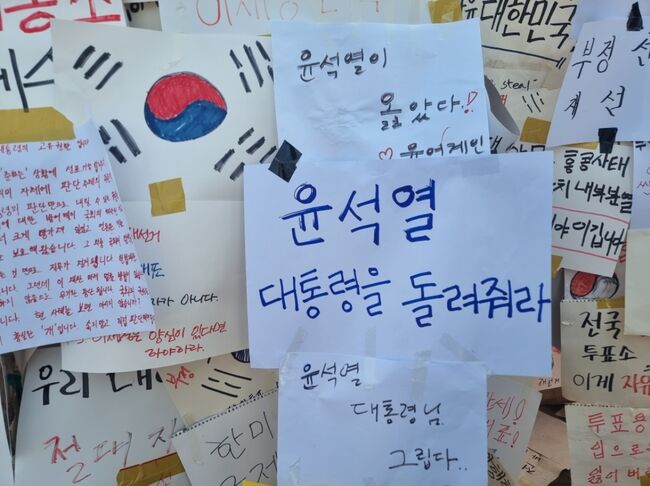
 “Yoon Suk-yeol was right” “Martial law is the president’s sole authority” “Give us back President Yoon Suk-yeol” “We miss Yoon Suk-yeol” posters are plastered all over Jamsil. ⒸHanmiilbo
At this point, I am no longer merely fighting, nor am I simply suffering. I am listening for the unheard answers to profound questions in a sacred atmosphere.
On this day, the judge named Lee Jeong-yeop convicted him of treason and sentenced him to another 30 years in prison. Those who spearheaded the charges, like Park Seon-won, and the judge were merely two sides of the same coin.
However, this article does not aim to criticize wicked judges or conspiratorial politicians, as one might find in newspaper articles or on YouTube.
Here, I borrow this valuable space to listen to his words, which illuminate the conflicts of this worldly politics as clearly as a bamboo stalk split with a swift blade, as a tangled thread cut by a sharp knife, or as clouds parting to reveal the sky through fog.
In his prison letter to the youth on June 12th, conveyed through his lawyer, he quoted two verses from the Bible: Habakkuk 2:14 and Isaiah 40:31 from the Old Testament.
Habakkuk, the author and prophet of the Book of Habakkuk, one of the twelve minor prophets in the Old Testament, pleads with Jehovah, asking why the wicked surround the righteous and why justice fails to prevail.
Jehovah declares that He will allow the Chaldeans (Babylonians), who worship their own strength as a god, to trample on Judah, much like parents withholding milk and food from a crying child. Habakkuk is beside himself with frustration.
“Why do you tolerate the deceitful and remain silent while the wicked swallow those more righteous than themselves?”
Jehovah speaks again, stating that His vision has an appointed time. The end of the wicked will come swiftly, and though it may tarry, it will surely come without fail or delay. The hearts of the wicked will be tormented by their own pride and dishonesty, while the righteous will endure and live by relying on their faith.
‘Vision’ refers to the world as seen from Jehovah’s perspective. He declares that the victory of the Chaldeans will not be eternal, the wicked will ultimately be judged, the righteous will live by faith, justice will eventually be realized, and the glory of truth will fill this unjust world.
While many are trapped in the present, rejoicing in their triumphs or drowning in despair, a perspective that penetrates the entire sweep of history allows one to see all of it anew.
Habakkuk then understands and rejoices, praising the truth of the boundless judgment. Mountains that seem eternal will crumble, and hills that appear unending will be brought low. Even in the midst of unimaginable suffering, one can endure, awaiting a glorious day.
Though I am a scholar of literature, I can only serve as an interpreter of the words of one imprisoned.
If Habakkuk was a prophet who questioned why the wicked prosper, Isaiah, they say, was a prophet who cried out that God’s salvation would eventually arrive, no matter how deep the darkness.
The imprisoned one, in his letter to the youth, referenced Isaiah 40:31: “But those who hope in the LORD will renew their strength. They will soar on wings like eagles; they will run and not grow weary, they will walk and not be faint.” What is the purpose of these words?
Isaiah Chapter 40 sings of comfort and salvation for those brought to Babylon and living as slaves. It speaks of a coming era of truth where valleys will be filled, mountains and hills leveled, rough places made smooth, and wildernesses turned into plains, marking the end of their enslaved wandering and labor.
Come to think of it, the German group Boney M’s ‘Rivers of Babylon’ was a song that captured the deep longing of the Jews exiled to Babylon. The song was based on Psalm 137 of the Bible. How could I have loved its opening lyrics, “By the rivers of Babylon, there we sat down, yea, we wept, when we remembered Zion,” without understanding their meaning?
As I open Isaiah Chapter 40 and read from the beginning, I am overcome with an involuntary shiver. I realize my heart is being wrung with deep emotion.
I instinctively understood that he was speaking of the imminent manifestation of truth before our eyes, a time when the wicked will cry out in fear, seek places to hide, and want to cover their faces in shame.
He saw through the deep fear, shame, and the sense of defeat in life of those who, with confident and triumphant expressions, imposed a 30-year sentence and cheered outwardly.
Without the language of biblical ‘parables’, there would have been no way to fully convey this astonishing victory, restoration, and liberation that has befallen him and ‘us’, and is now before my very eyes.
To the young people gathered at Olympic Park, to those who have endured the long struggle and grown “weary”: because we believed in justice, freedom, and democracy, and seized the opportunity on June 3rd when the wicked deeds of the unjust were exposed to the world, we have gained “new strength.” Like eagles soaring on wings, our aspirations will be fulfilled in this land. No matter how malicious the legal battles that trouble him, the day when the doors of unjust imprisonment will be shattered is not far off.
The day is not far off when the wicked will shamefully seek rat holes and be dumbfounded by the world turned upside down. The pathetic true nature of the unjust will finally be revealed clearly to the public.

◆ Professor Bang Min-ho
Doctor of Literature, Professor of Korean Language and Literature at Seoul National University. He is actively engaged as the editor-in-chief of the quarterly literary magazine ‘Maek’ (since 2022), as well as a poet, novelist, and literary critic. His published works include ‘Lover Simcheong’ (2015), ‘The Language of Pain’ (2019), ‘Revisiting Korean Criticism’ (2021), and ‘Seoul Literary Journeys’ (2024).

 Iranian Foreign Ministry: "Continuing Message Exchanges with the U.S. and Activities of Mediating Countries"
Esmaeil Baghaei, Spokesperson for the Iranian Ministry of Foreign Affairs [Xinhua, Yonhap News file photo]Esmaeil Baghaei, spokesperson for the Iranian Ministry of Foreign Affairs, stated on the 26th
Iranian Foreign Ministry: "Continuing Message Exchanges with the U.S. and Activities of Mediating Countries"
Esmaeil Baghaei, Spokesperson for the Iranian Ministry of Foreign Affairs [Xinhua, Yonhap News file photo]Esmaeil Baghaei, spokesperson for the Iranian Ministry of Foreign Affairs, stated on the 26th
 President Yoon: "Do You Think You Are Safe from the Special Counsel?"... Final Statement Video Released
President Yoon Suk Yeol rebuking the special prosecutor on the 24th. [Court video / @birds_justice X account subtitle GIF] A video of President Yoon Suk Yeol's closing statement at his trial rega
President Yoon: "Do You Think You Are Safe from the Special Counsel?"... Final Statement Video Released
President Yoon Suk Yeol rebuking the special prosecutor on the 24th. [Court video / @birds_justice X account subtitle GIF] A video of President Yoon Suk Yeol's closing statement at his trial rega
 President Yoon, regarding the first-instance ruling on the Public Official Election Act: “An excessive political verdict that distorts the facts… We will appeal immediately.”
The first-instance sentencing hearing for President Yoon Suk Yeol regarding violations of the Public Official Election Act is being broadcast live at Seoul Station on the 27th. [Photo=Yonhap News]Pres
President Yoon, regarding the first-instance ruling on the Public Official Election Act: “An excessive political verdict that distorts the facts… We will appeal immediately.”
The first-instance sentencing hearing for President Yoon Suk Yeol regarding violations of the Public Official Election Act is being broadcast live at Seoul Station on the 27th. [Photo=Yonhap News]Pres
 WSJ: "SK Hynix ADR Premium Is a Sign of AI Trading Overheat"
Advertisement for SK Hynix ADR listing in New York's Times Square [Reuters=Yonhap News file photo]The Wall Street Journal (WSJ) has pointed out that the price of SK Hynix’s American Depositary Recei
WSJ: "SK Hynix ADR Premium Is a Sign of AI Trading Overheat"
Advertisement for SK Hynix ADR listing in New York's Times Square [Reuters=Yonhap News file photo]The Wall Street Journal (WSJ) has pointed out that the price of SK Hynix’s American Depositary Recei
 'Godfather of Japanese Mystery Novels' Keigo Higashino Passes Away After Battle with Cancer at 68
Famous Japanese mystery novelist Keigo Higashino [AFP=Yonhap News]It has been belatedly reported that Keigo Higashino, the "godfather of Japanese mystery novels" and author of bestsellers such as "The
'Godfather of Japanese Mystery Novels' Keigo Higashino Passes Away After Battle with Cancer at 68
Famous Japanese mystery novelist Keigo Higashino [AFP=Yonhap News]It has been belatedly reported that Keigo Higashino, the "godfather of Japanese mystery novels" and author of bestsellers such as "The
 [Park Pil-kyu Security Column] To the Ignorant Trying to Clothe a Beast in Sheep's Clothing
Rep. Kim Byung-joo of the Democratic Party of Korea [Photo=Yonhap News]“The Air Force Academy doesn't teach you how to fly a plane!” “The Army, Navy, and Air Force academies are exactly the
[Park Pil-kyu Security Column] To the Ignorant Trying to Clothe a Beast in Sheep's Clothing
Rep. Kim Byung-joo of the Democratic Party of Korea [Photo=Yonhap News]“The Air Force Academy doesn't teach you how to fly a plane!” “The Army, Navy, and Air Force academies are exactly the
 [Issue Diagnosis] Two Effects of the Election Petition Review
 [Photo] Evidence of Election Fraud Flooding U.S. Media… Trump Had 2.7 Million Votes Stolen
 [Video] U.S. Semiquincentennial Air Show... 'Art in the Sky' streaks across New York
 [Editorial Cartoon] A Draconian Law That Undermines Freedom of Expression

 List
List










