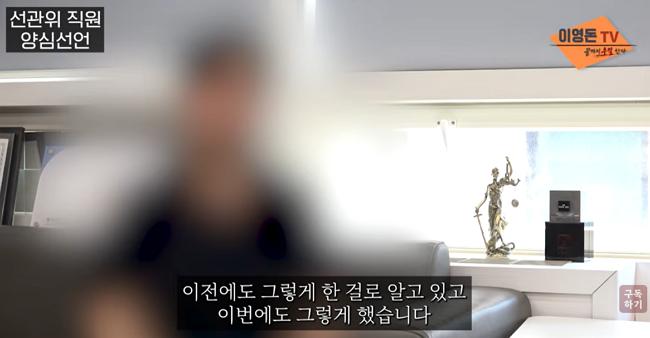
 In a broadcast on the 16th, Lee Young-don TV exposed the realities of the June 3 local elections as experienced firsthand by a serving official of the National Election Commission (NEC). [Photo = Screenshot from Lee Young-don TV]A growing number of questions are surrounding the actual structure of the early voting communication network after a serving National Election Commission (NEC) official testified that they had to connect to Wi-Fi to operate the integrated voter registry terminal during the June 3 local election early voting period because the wired communication equipment failed.
The official, who appeared on Lee Young-don TV, revealed that just minutes before the 6:00 a.m. start of early voting, the communication equipment failed, triggering an emergency, and that one polling station had to connect via Wi-Fi to conduct early voting for two days.
The official claimed that records of these events remain in the NEC’s internal group chat rooms.
Whether the whistleblower's account is accurate must be verified through equipment and communication logs. However, if the testimony is true, the NEC must answer at least three fundamental questions.
Why did the wired network, which had been tested three times, fail just before voting?
The first question is why the primary wired communication network, which had undergone three preliminary simulations and a final test on the eve of the election, failed just before voting began.
The NEC stated that it conducted three simulation drills ahead of this local election, focusing on equipment operation, usage of the integrated voter registry system, and procedures for responding to service disruptions. These drills included training for unexpected situations such as communication failures and power outages. [1]
The National Election Commission (NEC) also conducted a final simulation at all 3,571 early voting stations nationwide on May 28, the day before early voting, simulating the actual voting environment. The inspection covered not only the early voting equipment but also the status of the communication networks. [2]
Nevertheless, if the communication equipment failed just minutes before voting began at 6:00 a.m. the following day, the NEC must disclose what exactly was inspected and what criteria were used to deem the results "normal."
Whether a fault occurred in the wired line after the final test, whether there was a problem with the communication hardware, power supply, or LAN cables, or whether there was an error in central server authentication or IP address settings can be determined by checking communication equipment logs and central control records.
Simply claiming it was a "minor malfunction" is insufficient. The time of the failure, the cause, the point of initial detection, and the entire process from report to recovery must be recorded and made public.
If it was designed for automatic switching, why was there an emergency on-site?
The second question is why there was such confusion on the ground when the system was designed to automatically switch to a dedicated wireless backup network if the wired network fails.
The early voting communication network is bifurcated into a primary wired network and a secondary wireless network. The structure is designed to prevent communication outages by automatically and rapidly switching to the secondary wireless network in the event of a wired network failure. [3]
Indeed, even in early voting simulations, the automatic switching between wired and wireless networks and the procedures for switching to disaster recovery centers in the event of a central server failure have been tested.
Under a normal redundancy system, there would be no reason for on-site staff to search for alternative connection methods or raise an alarm saying, "We might not be able to start voting." This is because the communication equipment, having detected a wired network failure, should have automatically switched to the approved dedicated wireless network for elections.
If separate measures were still required on-site, it is possible that at least one of the following failed to function normally: wired network failure detection, automatic backup network switching, wireless communication equipment, or central server authentication.
Furthermore, the three simulation drills included training for communication failure responses. If the automatic switching that succeeded in the simulations failed on the actual day of voting, the testing methods or the inspection results themselves must be re-verified.
If it was "Wi-Fi" and not a wireless network, it conflicts with national standards
The third question is whether the connection method mentioned by the whistleblower was actually Wi-Fi, rather than the dedicated wireless network for elections.
These two are not the same. The dedicated wireless network for elections uses a closed LTE/5G network provided by mobile carriers as a backup communication path. In contrast, Wi-Fi is a short-range wireless communication method connecting laptops to routers or wireless access points.
The current national standard, KS X 3264, "Standard for Construction of Communication Systems for Early Voting Stations Using Integrated Registries," remains in "maintained" status and stipulates that wired/wireless communication equipment "must not support Wi-Fi." [4]
Therefore, if the Wi-Fi mentioned by the whistleblower was not simply a misnomer for the dedicated LTE/5G backup network but an actual Wi-Fi connection, both scenarios are problematic.
If official wired/wireless communication equipment for the election provided Wi-Fi, it directly conflicts with the language of the national standard. Conversely, if the official equipment was broken and the registry terminal was connected to a separate Wi-Fi source, such as a general router or a mobile hotspot, it bypassed the dedicated election communication path constructed in accordance with national standards.
If the integrated voter registry terminal connected directly to Wi-Fi, it also implies that the laptop in question was equipped with a functional internal or external wireless LAN device. If the system was designed to connect to the central server only via dedicated election communication equipment, the NEC must also clarify why the registry terminal itself retained external Wi-Fi access capabilities.
Original KakaoTalk logs and access records must be preserved
Currently, it cannot be concluded based solely on the whistleblower's testimony that actual hacking or manipulation of election data occurred. The possibility that the whistleblower used the term "Wi-Fi" to refer to the dedicated wireless backup network must also be verified.
However, this is not a matter that can be settled by the NEC simply explaining that "it was a dedicated wireless network." The whistleblower claimed that the details regarding the wired equipment failure and the use of Wi-Fi remain in internal group chat rooms.
The NEC must immediately preserve the originals of those chat records, communication failure reports, logs of automatic wired/wireless switching, models and serial numbers of the routers and access points used, the SSID/BSSID of the access devices, network access logs of the registry terminals, and authentication logs from the central server.
The core of this issue is not to jump to the conclusion of whether or not hacking occurred. Rather, it lies in determining why a wired network that passed three simulations and a final inspection failed right before voting, why the supposedly automatic wireless backup network failed to prevent confusion on the ground, and whether Wi-Fi, which is excluded by national standards, was actually used in early voting.
Elections do not earn trust solely through their results. If the NEC fails to disclose communication records and equipment data, their previous explanations—"closed network," "automatic switching," and "thorough pre-inspection"—will remain nothing more than claims rather than verified facts.
Basis of Report
[1] The Daejeon NEC explained that ahead of the 2026 local elections, they conducted three simulations including early voting equipment operation, integrated voter registry usage, and failure response procedures, and that these drills included scenarios for communication failures and power outages.
[2] The National Election Commission (NEC) conducted final simulations at 3,571 early voting stations nationwide on May 28, 2026, targeting the early voting communication network. The Ministry of the Interior and Safety also stated that this was an inspection of equipment operation simulating actual early voting environments.
[3] It is confirmed through related project materials and reports on simulations that the early voting communication network is bifurcated into a primary wired network and a secondary wireless network, and is built to automatically switch to the backup network in the event of a primary network failure.
[4] In the list of standards from the National Radio Research Agency, KS X 3264 is marked as "maintained" following its revision on November 2, 2021. The standard disclosed by the NEC excludes Wi-Fi support for wired/wireless communication equipment used for early voting.
|

 Trump pressures for rate cut again ahead of FOMC... "Should be the lowest in the world"
U.S. President Donald Trump. [Photo = The White House] U.S. President Donald Trump once again pressured the Federal Reserve, the U.S. central bank, to lower interest rates on the 27th (local time
Trump pressures for rate cut again ahead of FOMC... "Should be the lowest in the world"
U.S. President Donald Trump. [Photo = The White House] U.S. President Donald Trump once again pressured the Federal Reserve, the U.S. central bank, to lower interest rates on the 27th (local time
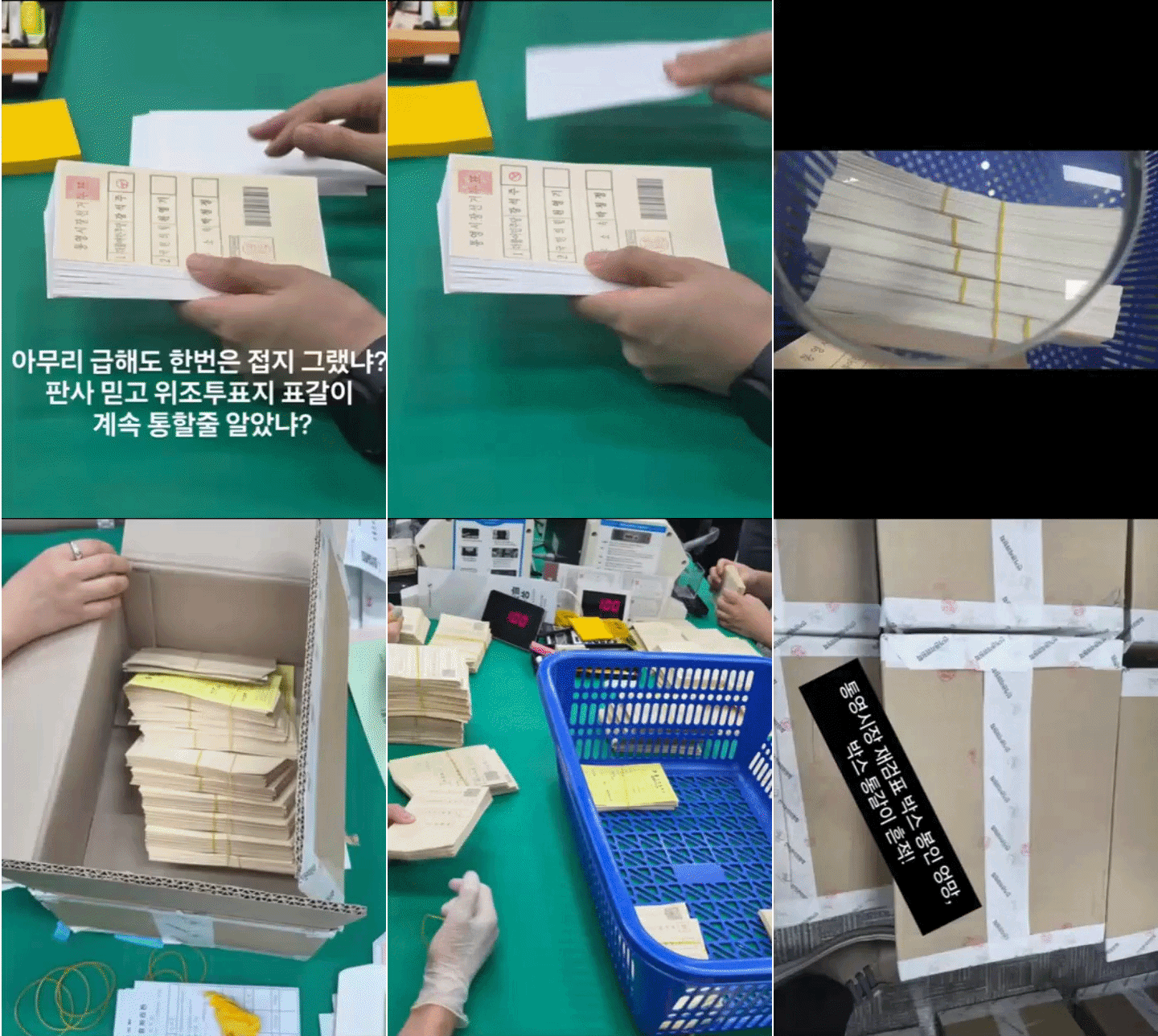 “Ignoring crisp ballots and damaged seals”… Tongyeong mayoral recount concludes with ‘no change in outcome,’ leaving suspicions and public outrage behind
Suspected counterfeit ballots discovered in Tongyeong [GIF from social media of Representative Hwang Kyo-ahn / Attorney Park Joo-hyun]During a recount of the Tongyeong mayoral election in South Gyeong
“Ignoring crisp ballots and damaged seals”… Tongyeong mayoral recount concludes with ‘no change in outcome,’ leaving suspicions and public outrage behind
Suspected counterfeit ballots discovered in Tongyeong [GIF from social media of Representative Hwang Kyo-ahn / Attorney Park Joo-hyun]During a recount of the Tongyeong mayoral election in South Gyeong
 President Yoon, regarding the first-instance ruling on the Public Official Election Act: “An excessive political verdict that distorts the facts… We will appeal immediately.”
The first-instance sentencing hearing for President Yoon Suk Yeol regarding violations of the Public Official Election Act is being broadcast live at Seoul Station on the 27th. [Photo=Yonhap News]Pres
President Yoon, regarding the first-instance ruling on the Public Official Election Act: “An excessive political verdict that distorts the facts… We will appeal immediately.”
The first-instance sentencing hearing for President Yoon Suk Yeol regarding violations of the Public Official Election Act is being broadcast live at Seoul Station on the 27th. [Photo=Yonhap News]Pres
 WSJ: "SK Hynix ADR Premium Is a Sign of AI Trading Overheat"
Advertisement for SK Hynix ADR listing in New York's Times Square [Reuters=Yonhap News file photo]The Wall Street Journal (WSJ) has pointed out that the price of SK Hynix’s American Depositary Recei
WSJ: "SK Hynix ADR Premium Is a Sign of AI Trading Overheat"
Advertisement for SK Hynix ADR listing in New York's Times Square [Reuters=Yonhap News file photo]The Wall Street Journal (WSJ) has pointed out that the price of SK Hynix’s American Depositary Recei
 'Godfather of Japanese Mystery Novels' Keigo Higashino Passes Away After Battle with Cancer at 68
Famous Japanese mystery novelist Keigo Higashino [AFP=Yonhap News]It has been belatedly reported that Keigo Higashino, the "godfather of Japanese mystery novels" and author of bestsellers such as "The
'Godfather of Japanese Mystery Novels' Keigo Higashino Passes Away After Battle with Cancer at 68
Famous Japanese mystery novelist Keigo Higashino [AFP=Yonhap News]It has been belatedly reported that Keigo Higashino, the "godfather of Japanese mystery novels" and author of bestsellers such as "The
 [Park Pil-kyu Security Column] To the Ignorant Trying to Clothe a Beast in Sheep's Clothing
Rep. Kim Byung-joo of the Democratic Party of Korea [Photo=Yonhap News]“The Air Force Academy doesn't teach you how to fly a plane!” “The Army, Navy, and Air Force academies are exactly the
[Park Pil-kyu Security Column] To the Ignorant Trying to Clothe a Beast in Sheep's Clothing
Rep. Kim Byung-joo of the Democratic Party of Korea [Photo=Yonhap News]“The Air Force Academy doesn't teach you how to fly a plane!” “The Army, Navy, and Air Force academies are exactly the
 [Issue Diagnosis] Two Effects of the Election Petition Review
 [Photo] Evidence of Election Fraud Flooding U.S. Media… Trump Had 2.7 Million Votes Stolen
 [Video] U.S. Semiquincentennial Air Show... 'Art in the Sky' streaks across New York
 [Editorial Cartoon] A Draconian Law That Undermines Freedom of Expression

 List
List