
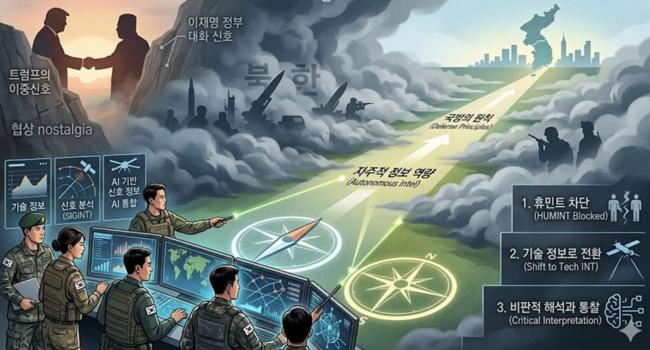
U.S. President Donald Trump has recently been sending mixed signals toward North Korea. On one hand, he stirs nostalgia for his role as a "successful negotiator" by sharing past photos with Chairman Kim Jong Un; on the other, he undermines existing denuclearization principles by labeling North Korea a "nuclear power." It is a classic case of someone being "startled by the lid of a pot, fearing it is a turtle," reacting with excessive caution to ghosts of the past.
President Trump's moves stand in stark contrast to the dialogue signals consistently sent by the Lee Jae-myung administration. The current government continues to knock on the door of dialogue with North Korea, upholding three principles: suspending loudspeaker broadcasts toward the North, prohibiting the distribution of leaflets by civic groups, and "excluding absorption unification."
In fact, while the joint ROK-EU statement included critical agenda items such as condemning North Korea-Russia military cooperation, refusing to recognize North Korea's status as a nuclear state, and urging improvements in North Korean human rights, the domestic press release appeared to omit these North Korea-related details to avoid provoking Pyongyang.
However, the reason for North Korea's persistent silence is clear: it is a "strategic detour." Pyongyang likely judges that leveraging the variable of Trump to gain recognition as a "nuclear state" is far more advantageous for regime survival and negotiating leverage than engaging in direct dialogue with our government. In short, the Lee Jae-myung administration's dialogue proposals have been relegated to a low priority in North Korea's calculations, overshadowed by the prospect of a "big deal" with Trump.
Amidst this imbalance between Trump's signals and our dialogue efforts, we must not lose our way at a time when information is being blocked. Security begins with the "eye that sees the unseen." The essence of intelligence lies in reading the adversary's intent and anticipating the direction of their hidden blade. Yet, today in 2026, the security environment on the Korean Peninsula we face is "a fog of intelligence" where we cannot see the uncertain battlefield ahead.
The closed system of North Korea has become an even tighter black box following the collapse of our human intelligence (HUMINT) networks. Even our ally, the United States, shares intelligence about North Korea only "selectively" based on its own political calculus, and at times, steers the situation in a direction independent of our will.
At this juncture, we must ask a painful question: "Are we truly advocating for peace and holding the steering wheel of our own security?"
1. The collapse of North Korean internal intelligence networks has exposed the most vulnerable link in our national defense.
HUMINT is the ultimate human intelligence asset for grasping the inner intentions of an enemy. However, even when HUMINT is cut off, we must not fall into the trap of "seeing only what we want to see." There was a time when we could know the breakfast menu of North Korea's top officials by lunchtime, but since those channels have been severed, we must turn our attention to technical intelligence—the realm of cold, hard data.
Modern intelligence warfare finds its answers in the flow of data rather than physical contact. Satellites, high-altitude unmanned aerial vehicles (UAVs), and AI-based signal intelligence are powerful tools capable of reading the minute noise emitted from within North Korea's massive system.
True intelligence capability comes from the insight into "how to interpret" that data. Only when experts' "North Korean intelligence analysis"—which penetrates the historical context of the Korean Peninsula and the psychological mechanisms of the enemy—is combined with the vast data analyzed by artificial intelligence, does intelligence become strategic wisdom rather than mere statistics.
2. The Trump administration's unconventional approach to North Korea is a massive test for us.
When the U.S. recognizes North Korea as a "nuclear state" and orchestrates a hasty peace event, will we remain mere bystanders to that scenario, or will we stand as remote monitors and adjusters?
In the past, we have often fallen into the trap of relying too heavily on U.S. intelligence assets, failing to speak up even when our core security interests were being compromised. This is why intelligence sharing must not end at mere "delivery of information." Intelligence autonomy requires high-level investment in securing one's own intelligence assets. In a country that prosecutes the deployment of drones to Pyongyang in response to 7,000 North Korean trash balloon provocations as high treason, such autonomy seems difficult to achieve.
This is exactly why our military must advance its independent reconnaissance assets and transition the ROK-U.S. intelligence sharing system from one-sided reception to an "equal analytical partnership."
3. The thicker the fog of intelligence, the clearer our defense principles must be.
We need constant readiness for the "worst-case scenario." We must face the reality of the advancement of nuclear capabilities hidden behind the flashy performances of Trump and Kim Jong Un. We need "field-centered integrated defense." Since HUMINT is blocked, we must complete a multi-layered surveillance network that integrates tactical information generated in real-time across all domains, from border areas to cyberspace, to immediately identify the enemy's intentions.
Finally, we must guard against "security fatigue" and "political apathy" within our society. Security is not the exclusive property of any single administration, nor should it ever be relegated to a tool for specific political forces. In an era of intelligence blockades, we need the strong foundation of national consensus to bolster our defense.
Walking through the fog is daunting. However, those who know their destination and take each step with purpose will not lose their way. Neither the closed nature of North Korea nor the uncertainty of the United States are uncontrollable variables if we possess the strength to analyze information and make judgments for ourselves.
What we need now is not more "secrets." We must clear the fog of intelligence through technology, humanistic insight, and bipartisan unity for security. We must ask ourselves again and provide the answer: Are we currently seeing the U.S.'s intentions regarding North Korea and the reality of the North? Or are we only seeing the illusions they want us to see?

◆ Commissioner Park Pil-gyu
Editorial Commissioner, Hanmi Ilbo
40th Class, Korea Military Academy

 Iranian Foreign Ministry: "Continuing Message Exchanges with the U.S. and Activities of Mediating Countries"
Esmaeil Baghaei, Spokesperson for the Iranian Ministry of Foreign Affairs [Xinhua, Yonhap News file photo]Esmaeil Baghaei, spokesperson for the Iranian Ministry of Foreign Affairs, stated on the 26th
Iranian Foreign Ministry: "Continuing Message Exchanges with the U.S. and Activities of Mediating Countries"
Esmaeil Baghaei, Spokesperson for the Iranian Ministry of Foreign Affairs [Xinhua, Yonhap News file photo]Esmaeil Baghaei, spokesperson for the Iranian Ministry of Foreign Affairs, stated on the 26th
 President Yoon: "Do You Think You Are Safe from the Special Counsel?"... Final Statement Video Released
President Yoon Suk Yeol rebuking the special prosecutor on the 24th. [Court video / @birds_justice X account subtitle GIF] A video of President Yoon Suk Yeol's closing statement at his trial rega
President Yoon: "Do You Think You Are Safe from the Special Counsel?"... Final Statement Video Released
President Yoon Suk Yeol rebuking the special prosecutor on the 24th. [Court video / @birds_justice X account subtitle GIF] A video of President Yoon Suk Yeol's closing statement at his trial rega
 President Yoon, regarding the first-instance ruling on the Public Official Election Act: “An excessive political verdict that distorts the facts… We will appeal immediately.”
The first-instance sentencing hearing for President Yoon Suk Yeol regarding violations of the Public Official Election Act is being broadcast live at Seoul Station on the 27th. [Photo=Yonhap News]Pres
President Yoon, regarding the first-instance ruling on the Public Official Election Act: “An excessive political verdict that distorts the facts… We will appeal immediately.”
The first-instance sentencing hearing for President Yoon Suk Yeol regarding violations of the Public Official Election Act is being broadcast live at Seoul Station on the 27th. [Photo=Yonhap News]Pres
 WSJ: "SK Hynix ADR Premium Is a Sign of AI Trading Overheat"
Advertisement for SK Hynix ADR listing in New York's Times Square [Reuters=Yonhap News file photo]The Wall Street Journal (WSJ) has pointed out that the price of SK Hynix’s American Depositary Recei
WSJ: "SK Hynix ADR Premium Is a Sign of AI Trading Overheat"
Advertisement for SK Hynix ADR listing in New York's Times Square [Reuters=Yonhap News file photo]The Wall Street Journal (WSJ) has pointed out that the price of SK Hynix’s American Depositary Recei
 'Godfather of Japanese Mystery Novels' Keigo Higashino Passes Away After Battle with Cancer at 68
Famous Japanese mystery novelist Keigo Higashino [AFP=Yonhap News]It has been belatedly reported that Keigo Higashino, the "godfather of Japanese mystery novels" and author of bestsellers such as "The
'Godfather of Japanese Mystery Novels' Keigo Higashino Passes Away After Battle with Cancer at 68
Famous Japanese mystery novelist Keigo Higashino [AFP=Yonhap News]It has been belatedly reported that Keigo Higashino, the "godfather of Japanese mystery novels" and author of bestsellers such as "The
 [Park Pil-kyu Security Column] To the Ignorant Trying to Clothe a Beast in Sheep's Clothing
Rep. Kim Byung-joo of the Democratic Party of Korea [Photo=Yonhap News]“The Air Force Academy doesn't teach you how to fly a plane!” “The Army, Navy, and Air Force academies are exactly the
[Park Pil-kyu Security Column] To the Ignorant Trying to Clothe a Beast in Sheep's Clothing
Rep. Kim Byung-joo of the Democratic Party of Korea [Photo=Yonhap News]“The Air Force Academy doesn't teach you how to fly a plane!” “The Army, Navy, and Air Force academies are exactly the
 [Issue Diagnosis] Two Effects of the Election Petition Review
 [Photo] Evidence of Election Fraud Flooding U.S. Media… Trump Had 2.7 Million Votes Stolen
 [Video] U.S. Semiquincentennial Air Show... 'Art in the Sky' streaks across New York
 [Editorial Cartoon] A Draconian Law That Undermines Freedom of Expression

 List
List









