 Court Logo [Yonhap News]
A court has decided to investigate whether the Constitutional Court of Korea has infringed upon a claimant's fundamental rights due to trial delays. This marks the first instance of a court publicly challenging the Constitutional Court over its slow processing of cases.
In an unusually stern tone, the court targeted the Constitutional Court, stating, "Just as all state powers are bound by the Constitution, the Constitutional Court must also be bound by it."
This move appears to be a counterattack against the Constitutional Court's assertion—made earlier this year upon introducing constitutional complaints regarding judicial trials—that "court rulings are also subject to constitutional control." A constitutional complaint regarding a trial allows a party to petition the Constitutional Court to overturn a final court judgment if it is believed to have infringed upon their fundamental rights.
On the 17th, the 50th Criminal Agreement Division of the Seoul Central District Court (Presiding Judge Jeon Bo-seong) issued an explanatory statement, declaring, "Based on Article 107, Paragraph 2 of the Constitution, we have initiated a review into whether the Constitutional Court's 'omission' (failure to perform a required duty) has infringed upon fundamental rights."
On the 12th, the tribunal sent an 'Inquiry on Reasons for Constitutional Trial Delay' to the Constitutional Court.
Article 107, Paragraph 2 of the Constitution stipulates that if the constitutionality or legality of an order, rule, or administrative action is a prerequisite for a trial, the Supreme Court has the final authority to review it.
The court has interpreted the Constitutional Court's trial delay as an "omission" subject to judicial review.
The case in question involves Jin Cheon-gyu, the CEO of Tongil TV, who is charged with violating the Inter-Korean Exchange and Cooperation Act.
In October 2020, Jin was indicted on charges of bringing North Korean books, video materials, and the Rodong Sinmun into the country via Incheon Airport in August 2018 without the approval of the Minister of Unification.
During the first trial, Jin requested a motion for a constitutional review of Article 13, Paragraph 1 of the Inter-Korean Exchange and Cooperation Act, which requires approval from the Minister of Unification for the import and export of goods. When the motion was rejected, he filed a constitutional complaint directly with the Constitutional Court in June 2022.
Following Jin's argument, the 50th Criminal Division of the Seoul Central District Court, which is handling the second trial, decided to suspend the proceedings until the results of the constitutional complaint were reached, determining that the outcome was a prerequisite for the trial’s conclusion.
However, the Constitutional Court has failed to reach a decision nearly four years after formally accepting the case in July of that year.
Noting the delay, the tribunal explained, "The defendant remains in a prolonged state of uncertainty, which is infringing upon his fundamental constitutional rights." Consequently, they requested the Constitutional Court's opinion on the status of the review and the reasons for the delay.
The tribunal pointed out, "Just as all state powers are bound by the Constitution, the Constitutional Court must also be bound by it," adding, "The Constitutional Court's delay has infringed upon the defendant's fundamental constitutional rights, including his right to a speedy trial."
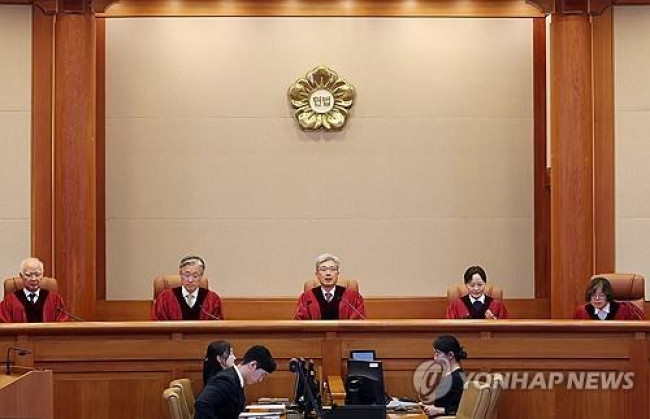 Constitutional Court [Yonhap News file photo]
The court argues that if the Constitutional Court has failed to reach a conclusion for an extended period without taking measures to guarantee the right of participation—such as reviewing legal or factual disputes or urging the parties to submit opinions when questions arise—it may constitute a violation of the Constitution.
The 50th Criminal Agreement Division of the Seoul Central District Court explained, "This measure is the first inquiry based on the premise that the court can question the Constitutional Court's trial practices and that its omissions can be subject to judicial review if they infringe upon the people's fundamental rights under the Constitution."
The inquiry sent to the Constitutional Court included questions regarding the current stage of the review, reasons for the delay, whether reports or opinion papers were exchanged between the judge in charge and the research officers, and whether opinions from related agencies were sought.
The tribunal requested that the Constitutional Court provide a written response within one month.
The Constitutional Court, however, maintains that the trial can proceed regardless of the outcome of the constitutional complaint, and thus it is difficult to accept the court's claim that the trial is stalled due to their delay. It also stated that it has no plans to respond to the inquiry.
A Constitutional Court official explained, "In cases of constitutional complaints (regarding the constitutionality of a law), there is no legal requirement to delay the trial; the court can simply proceed. Furthermore, this is a case where the court itself previously rejected a motion for a constitutional review, even if it was just in the first instance."
The official added, "It is questionable on what grounds the court requested this opinion, as it is not a party to the constitutional complaint. It is highly unlikely that an opinion will be submitted."
The two institutions have been at odds since the introduction of the system allowing constitutional complaints against judicial rulings earlier this year, and this case has reignited the conflict.
However, some predict that any conclusion the court reaches regarding the "infringement of fundamental rights" may have limited effect, as a court presiding over a criminal case cannot compel another institution to take corrective action beyond its own sentencing process.

 Iranian Foreign Ministry: "Continuing Message Exchanges with the U.S. and Activities of Mediating Countries"
Esmaeil Baghaei, Spokesperson for the Iranian Ministry of Foreign Affairs [Xinhua, Yonhap News file photo]Esmaeil Baghaei, spokesperson for the Iranian Ministry of Foreign Affairs, stated on the 26th
Iranian Foreign Ministry: "Continuing Message Exchanges with the U.S. and Activities of Mediating Countries"
Esmaeil Baghaei, Spokesperson for the Iranian Ministry of Foreign Affairs [Xinhua, Yonhap News file photo]Esmaeil Baghaei, spokesperson for the Iranian Ministry of Foreign Affairs, stated on the 26th
 President Yoon: "Do You Think You Are Safe from the Special Counsel?"... Final Statement Video Released
President Yoon Suk Yeol rebuking the special prosecutor on the 24th. [Court video / @birds_justice X account subtitle GIF] A video of President Yoon Suk Yeol's closing statement at his trial rega
President Yoon: "Do You Think You Are Safe from the Special Counsel?"... Final Statement Video Released
President Yoon Suk Yeol rebuking the special prosecutor on the 24th. [Court video / @birds_justice X account subtitle GIF] A video of President Yoon Suk Yeol's closing statement at his trial rega
 President Yoon, regarding the first-instance ruling on the Public Official Election Act: “An excessive political verdict that distorts the facts… We will appeal immediately.”
The first-instance sentencing hearing for President Yoon Suk Yeol regarding violations of the Public Official Election Act is being broadcast live at Seoul Station on the 27th. [Photo=Yonhap News]Pres
President Yoon, regarding the first-instance ruling on the Public Official Election Act: “An excessive political verdict that distorts the facts… We will appeal immediately.”
The first-instance sentencing hearing for President Yoon Suk Yeol regarding violations of the Public Official Election Act is being broadcast live at Seoul Station on the 27th. [Photo=Yonhap News]Pres
 WSJ: "SK Hynix ADR Premium Is a Sign of AI Trading Overheat"
Advertisement for SK Hynix ADR listing in New York's Times Square [Reuters=Yonhap News file photo]The Wall Street Journal (WSJ) has pointed out that the price of SK Hynix’s American Depositary Recei
WSJ: "SK Hynix ADR Premium Is a Sign of AI Trading Overheat"
Advertisement for SK Hynix ADR listing in New York's Times Square [Reuters=Yonhap News file photo]The Wall Street Journal (WSJ) has pointed out that the price of SK Hynix’s American Depositary Recei
 'Godfather of Japanese Mystery Novels' Keigo Higashino Passes Away After Battle with Cancer at 68
Famous Japanese mystery novelist Keigo Higashino [AFP=Yonhap News]It has been belatedly reported that Keigo Higashino, the "godfather of Japanese mystery novels" and author of bestsellers such as "The
'Godfather of Japanese Mystery Novels' Keigo Higashino Passes Away After Battle with Cancer at 68
Famous Japanese mystery novelist Keigo Higashino [AFP=Yonhap News]It has been belatedly reported that Keigo Higashino, the "godfather of Japanese mystery novels" and author of bestsellers such as "The
 [Park Pil-kyu Security Column] To the Ignorant Trying to Clothe a Beast in Sheep's Clothing
Rep. Kim Byung-joo of the Democratic Party of Korea [Photo=Yonhap News]“The Air Force Academy doesn't teach you how to fly a plane!” “The Army, Navy, and Air Force academies are exactly the
[Park Pil-kyu Security Column] To the Ignorant Trying to Clothe a Beast in Sheep's Clothing
Rep. Kim Byung-joo of the Democratic Party of Korea [Photo=Yonhap News]“The Air Force Academy doesn't teach you how to fly a plane!” “The Army, Navy, and Air Force academies are exactly the
 [Issue Diagnosis] Two Effects of the Election Petition Review
 [Photo] Evidence of Election Fraud Flooding U.S. Media… Trump Had 2.7 Million Votes Stolen
 [Video] U.S. Semiquincentennial Air Show... 'Art in the Sky' streaks across New York
 [Editorial Cartoon] A Draconian Law That Undermines Freedom of Expression

 List
List









