Smoke billows from southern Lebanon following an Israeli airstrike on the 19th. [Reuters=Yonhap News]
Peace talks are facing immediate setbacks as Israel continues its airstrikes on Lebanon, even after the United States and Iran signed a Memorandum of Understanding (MOU) for a ceasefire.
However, there is a possibility that working-level negotiations could begin soon, as Iran announced on the 19th (local time) that plans are being made to hold negotiations within the next few days.
Esmaeil Baghaei, spokesperson for the Iranian Foreign Ministry, stated on the same day, "The Swiss meeting scheduled for today (the 19th) has been postponed to another day. Plans to hold negotiations within the next few days are currently being formulated." The White House had previously announced that Vice President JD Vance's visit to Switzerland for follow-up nuclear negotiations with Iran had been postponed.
The Swiss canton of Nidwalden, which oversees Bürgenstock in Switzerland where the first working-level negotiations were scheduled to take place, announced that representatives from the United States and Iran were expected to negotiate the implementation of the MOU between the 19th and 21st over the weekend.
Nidwalden canton announced this via its homepage on the afternoon of the same day, extending the traffic restrictions in the surrounding areas, originally set to end on the 20th, until the morning of the 22nd.
Swiss media reported that despite the Swiss Foreign Ministry's announcement early in the day regarding the postponement of negotiations between the US and Iran, aircraft belonging to the mediating Qatari government and US military transport planes landed at Zurich Airport and a military base near Bürgenstock, respectively, on the morning of the same day.
However, it remains uncertain whether the chief negotiators from both sides, such as US Vice President Vance and Iranian Parliament Speaker Mohammad Bagher Ghalibaf, will directly attend the follow-up negotiations, even if they are held.
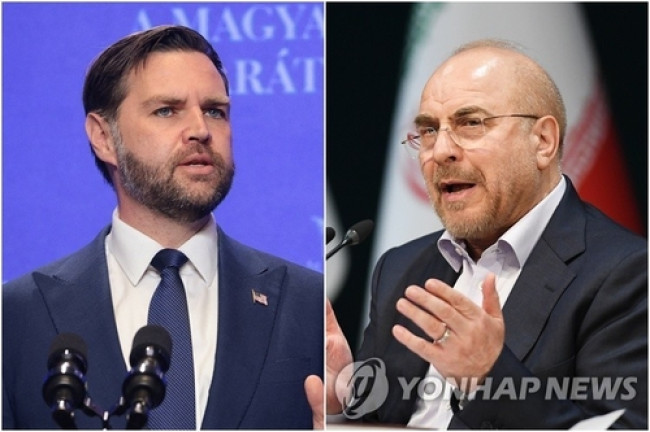 US Vice President JD Vance (left) and Iranian Parliament Speaker Mohammad Bagher Ghalibaf [Reuters · Xinhua=Yonhap News file photo]
There were also reports that Israel and the Iran-backed Hezbollah militant group in Lebanon agreed to a ceasefire on the afternoon of the same day, with mediation from the United States and Qatar.
A senior US official told the Israeli daily Times of Israel, "Israel and Hezbollah have agreed to a ceasefire in Lebanon. The ceasefire officially went into effect at 4 PM local time."
The official explained that this was the result of mediation efforts by the United States and Qatar, holding separate talks with Israel and Iran, respectively.
The background to the setbacks in the follow-up negotiations between the United States and Iran is the armed conflict between Israel and Hezbollah.
The Israeli military announced that it had conducted airstrikes on over 80 Hezbollah targets in Lebanon from the previous night to the morning of the same day.
Israel claims these airstrikes were in response to Hezbollah's 'ceasefire violations' that resulted in the deaths of four Israeli soldiers.
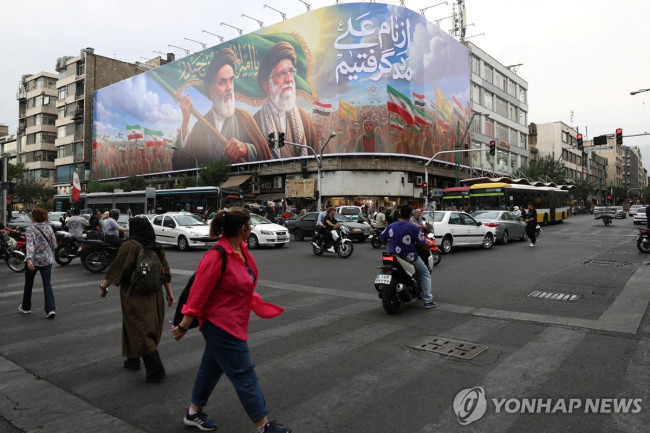 Portraits of past Iranian Supreme Leaders displayed in Tehran, Iran. [Reuters=Yonhap News file photo]
Article 1 of the ceasefire MOU signed by US President Donald Trump and Iranian President Masoud Pezeshkian stipulates, "The immediate and permanent cessation of all military operations on all fronts, including Lebanon."
For Iran, which had set a ceasefire in Lebanon as the top priority for peace talks, Israel's continued offensive could be considered a violation of the MOU.
There were also reports that the Iranian delegation postponed their visit to Switzerland, citing Israel's continued attacks on Lebanon as a problem, despite the ceasefire agreement between the two countries.
Spokesperson Baghaei also emphasized on the same day, "According to the MOU, the commencement of negotiations for a final agreement is contingent upon the initiation and continuation of the implementation of Articles 1 (ceasefire on all fronts, including Lebanon), 4 (lifting of the US maritime blockade), 5 (resumption of Iran's Strait of Hormuz passage), 10 (exemption from sanctions on Iranian crude oil, etc.), and 11 (release of Iran's frozen assets)." This means that Iran can only proceed with the main negotiations in Switzerland if Israel ceases its airstrikes on Hezbollah in Lebanon.

 Iranian Foreign Ministry: "Continuing Message Exchanges with the U.S. and Activities of Mediating Countries"
Esmaeil Baghaei, Spokesperson for the Iranian Ministry of Foreign Affairs [Xinhua, Yonhap News file photo]Esmaeil Baghaei, spokesperson for the Iranian Ministry of Foreign Affairs, stated on the 26th
Iranian Foreign Ministry: "Continuing Message Exchanges with the U.S. and Activities of Mediating Countries"
Esmaeil Baghaei, Spokesperson for the Iranian Ministry of Foreign Affairs [Xinhua, Yonhap News file photo]Esmaeil Baghaei, spokesperson for the Iranian Ministry of Foreign Affairs, stated on the 26th
 President Yoon: "Do You Think You Are Safe from the Special Counsel?"... Final Statement Video Released
President Yoon Suk Yeol rebuking the special prosecutor on the 24th. [Court video / @birds_justice X account subtitle GIF] A video of President Yoon Suk Yeol's closing statement at his trial rega
President Yoon: "Do You Think You Are Safe from the Special Counsel?"... Final Statement Video Released
President Yoon Suk Yeol rebuking the special prosecutor on the 24th. [Court video / @birds_justice X account subtitle GIF] A video of President Yoon Suk Yeol's closing statement at his trial rega
 President Yoon, regarding the first-instance ruling on the Public Official Election Act: “An excessive political verdict that distorts the facts… We will appeal immediately.”
The first-instance sentencing hearing for President Yoon Suk Yeol regarding violations of the Public Official Election Act is being broadcast live at Seoul Station on the 27th. [Photo=Yonhap News]Pres
President Yoon, regarding the first-instance ruling on the Public Official Election Act: “An excessive political verdict that distorts the facts… We will appeal immediately.”
The first-instance sentencing hearing for President Yoon Suk Yeol regarding violations of the Public Official Election Act is being broadcast live at Seoul Station on the 27th. [Photo=Yonhap News]Pres
 WSJ: "SK Hynix ADR Premium Is a Sign of AI Trading Overheat"
Advertisement for SK Hynix ADR listing in New York's Times Square [Reuters=Yonhap News file photo]The Wall Street Journal (WSJ) has pointed out that the price of SK Hynix’s American Depositary Recei
WSJ: "SK Hynix ADR Premium Is a Sign of AI Trading Overheat"
Advertisement for SK Hynix ADR listing in New York's Times Square [Reuters=Yonhap News file photo]The Wall Street Journal (WSJ) has pointed out that the price of SK Hynix’s American Depositary Recei
 'Godfather of Japanese Mystery Novels' Keigo Higashino Passes Away After Battle with Cancer at 68
Famous Japanese mystery novelist Keigo Higashino [AFP=Yonhap News]It has been belatedly reported that Keigo Higashino, the "godfather of Japanese mystery novels" and author of bestsellers such as "The
'Godfather of Japanese Mystery Novels' Keigo Higashino Passes Away After Battle with Cancer at 68
Famous Japanese mystery novelist Keigo Higashino [AFP=Yonhap News]It has been belatedly reported that Keigo Higashino, the "godfather of Japanese mystery novels" and author of bestsellers such as "The
 [Park Pil-kyu Security Column] To the Ignorant Trying to Clothe a Beast in Sheep's Clothing
Rep. Kim Byung-joo of the Democratic Party of Korea [Photo=Yonhap News]“The Air Force Academy doesn't teach you how to fly a plane!” “The Army, Navy, and Air Force academies are exactly the
[Park Pil-kyu Security Column] To the Ignorant Trying to Clothe a Beast in Sheep's Clothing
Rep. Kim Byung-joo of the Democratic Party of Korea [Photo=Yonhap News]“The Air Force Academy doesn't teach you how to fly a plane!” “The Army, Navy, and Air Force academies are exactly the
 [Issue Diagnosis] Two Effects of the Election Petition Review
 [Photo] Evidence of Election Fraud Flooding U.S. Media… Trump Had 2.7 Million Votes Stolen
 [Video] U.S. Semiquincentennial Air Show... 'Art in the Sky' streaks across New York
 [Editorial Cartoon] A Draconian Law That Undermines Freedom of Expression

 List
List