Semiconductor fabs and HBM chips, with intersecting graphs showing the dual nature of memory capacity expansion. Whether the memory shortage in 2026 provides sufficient justification for the additional construction of four new fabs in the 2030s requires separate verification. [Photo = Hanmi Ilbo Graphics]
Table of Contents
① Fact Check
② Is Additional Expansion Necessary?
③ Shadows Behind the Power Grid
“The First Industrial Question of Moving Semiconductors to the Honam Region… Is Additional Construction of 4 New Fabs Really Necessary?”
The first part addressed a question of fact: whether the "800 trillion won Honam semiconductor" plan announced by the Lee Jae-myung administration was a confirmed investment. Looking at the public disclosures from Samsung and SK Hynix, the conclusion was clear.
While the government presented it in definitive language, corporate disclosures included caveats such as future plans, guidelines, potential sites, variables depending on market conditions, and the requirement for board approval. Thus, the second question is more fundamental.
Even if the Honam semiconductor project could be pursued, is there truly a need for South Korea to construct four additional memory fabs at this time?
The debate over moving semiconductors to the Honam region shifted too quickly to "region." Should it be in Honam or the Capital region? Balanced development or industrial logic? The political debate immediately gravitated toward regional allocation.
However, the first question in evaluating national strategic industrial investments is not geography. It is demand. Is there really a need for four new memory fabs worth 800 trillion won in South Korea right now? Unless this question is answered, the debate over the Honam location is shaky from the starting line.
On June 29, the government announced at the "National Report on the 3 Major Mega-Projects for Korea's Great Leap" that it would build 4 semiconductor fabs and an ecosystem of partner companies and talent worth 800 trillion won in the Southwest region, and foster an HBM packaging hub in the Chungcheong region with an 81 trillion won investment.
The plan also included shortening the final completion dates for the Yongin National and General Industrial Complexes by 7 and 12 years, respectively, to double memory production capacity within five years.
According to the government’s explanation, the structure involves accelerating the existing production base in the Capital region and adding a second production base in the Southwest region.
This is exactly where the problem lies.
It is true that the memory market is currently facing a shortage. However, a shortage in 2026 does not automatically prove the necessity of four new fabs to be operational in the 2030s. A semiconductor fab is not a facility that, if it is short today, can be produced tomorrow. Supply effects appear years later after going through site selection, permitting, power and water procurement, equipment installation, cleanroom construction, yield stabilization, and client certification.
The question that needs to be asked now is not "Is there a memory shortage?" but "Can existing investments not handle the demand for AI memory in the 2030s?"
The signal that the current market is tight is clear.
Gartner forecasted that global semiconductor revenue will exceed $1.3 trillion in 2026, with memory revenue increasing threefold. It analyzed that annual DRAM prices would rise by 125% and NAND flash prices by 234%, and that significant price stabilization would be difficult before the end of 2027.
This shows that the memory shortage is not a temporary rumor, but a phenomenon reflected in actual price and revenue forecasts.
However, one must look at the nature of the shortage.
What is currently in short supply is not the entire range of general-purpose memory, but high-value memory used in AI servers, particularly HBM, server DRAM, and enterprise SSDs. TrendForce analyzed that memory investment in 2026 would be focused more on process upgrades and hybrid bonding rather than simple production capacity expansion, and that bit supply growth would be limited.
This implies that the solution may lie not in new fabs that simply print more wafers, but in HBM process transitions and resolving packaging bottlenecks.
4 Verification Points
Therefore, the first point of verification is the product mix.
It must first be made clear whether the four Honam fabs are intended to increase the volume of general-purpose DRAM and NAND, or for HBM4, HBM5, custom memory, and high-value server memory. What is in short supply now is not just the number of wafers, but the quality of AI memory, packaging, and client certification capabilities. If the HBM bottleneck lies in packaging and advanced processes, the solution may not be four new fabs, but the Chungcheong packaging hub, the Cheonan/Onyang back-end processes, or process transitions at existing Pyeongtaek and Yongin lines.
The second verification is redundancy with existing investments.
Reuters reported that Samsung Electronics plans to invest a total of 2,450 trillion won domestically from 2026 to 2040, with 2,100 trillion won allocated to semiconductor clusters in Pyeongtaek and Yongin. It was also reported that Samsung would invest 56 trillion won in the Cheonan/Onyang HBM fab, SK Hynix would complete its fourth fab in Yongin by 2033, and the investment in the new Southwest base would be executed in phases depending on market demand and board approval.
Astronomical investments are already underway in Pyeongtaek, Yongin, Icheon, Cheongju, Cheonan, and Onyang. The government intends to add the four Southwest fabs and the Chungcheong HBM packaging hub on top of this.
If so, what the government should first provide is not a political blueprint. It needs a supply and demand chart that reflects the expansion capacity, cleanroom area, equipment installation schedules, process transition possibilities, HBM packaging bottlenecks, and power/water constraints of Pyeongtaek, Yongin, Icheon, Cheongju, Cheonan, and Onyang.
If a 800 trillion won new fab plan is announced without such a chart, it can only be seen as a regional-distribution-style mega-investment rather than an expansion based on industrial demand.
Lee Jae-myung explained that the existing production bases centered on Yongin and Pyeongtaek have already reached their limits. However, for that argument to be convincing, the government and companies must prove it with figures.
They must disclose the remaining land in existing clusters, potential power input capacity, water procurement capacity, equipment installation schedules, lines available for HBM conversion, and long-term customer supply volumes. The mere statement that "it has reached its limit" cannot prove the necessity of an 800 trillion won new base.
The third verification is the risk of overinvestment.
The memory industry is traditionally cyclical. It is an industry where if you decide to invest when there is a shortage, you end up with an oversupply by the time the facilities are completed. In 2023 alone, Samsung Electronics and SK Hynix suffered a harsh downturn due to memory oversupply and price plunges. Samsung Electronics recorded an operating loss of 4.36 trillion won in its semiconductor division in the second quarter of 2023, and SK Hynix also recorded an operating loss of 2.9 trillion won in the same quarter.
While the AI boom has revived the market, the direction of the memory industry shifts quickly and violently. The current price spike may be a signal of investment necessity. However, it is not a sufficient condition for four new fabs in the 2030s.
Reuters reported that immediately after the announcement, Samsung Electronics and SK Hynix shares fell by 4.86% and 1.68%, respectively, and that some analysts warned of the possibility of oversupply due to the sharp increase in investment. The market did not perceive the "800 trillion won investment" purely as good news.
Expert concerns also point to the same issues. In the Reuters report, Professor Lee Jong-ho of Seoul National University’s Department of Electrical and Computer Engineering pointed out that a project of this scale requires very meticulous consideration and that, from an outside perspective, it seems to be moving too quickly. He also warned that no one can be certain that demand will remain strong for 20-30 years, and if demand drops, the consequences could be severe.
The fourth verification is the China variable.
China's CXMT is already increasing its presence in the global DRAM market. Reuters reported that CXMT signed a long-term supply contract for server DRAM with Tencent worth over 2 billion yuan, or approximately $2.94 billion. CXMT accounted for about 7.7% of the global DRAM market in 2025 and plans to double its monthly wafer production capacity from about 300,000 to 600,000 through facility expansion in Shanghai, Hefei, and Beijing.
These numbers have significant implications for the debate over the necessity of Honam fabs.
If Korea enters a volume competition for general-purpose DRAM and NAND again, it could collide head-on with China's low-price pursuit. On the other hand, for HBM, custom memory, and high-value server memory, client certification and technical barriers are what matter.
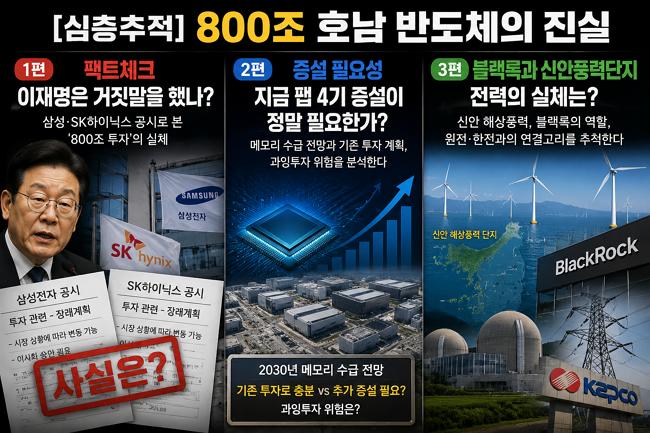
4 Necessary Conditions for Honam Fab Expansion
Therefore, the necessity of new fabs should be judged not by "how much we build," but by "what products we supply, to whom, and under what long-term contracts."
Ultimately, for the Honam fabs to be industrially justified, at least four conditions must be met.
First, long-term purchase contracts with AI Big Tech companies.
Second, a product mix centered on HBM4, HBM5, and custom memory, rather than general-purpose memory.
Third, a supply and demand chart showing that supply remains insufficient even after accounting for all existing investments in Pyeongtaek, Yongin, Icheon, Cheongju, Cheonan, and Onyang.
Fourth, a total cost verification including electricity rates, water, ultrapure water, wastewater treatment, personnel, and costs associated with relocating partner companies.
A Honam semiconductor project might be necessary. However, based on the currently released materials, it is difficult to see it as "absolutely necessary." Land, permits, and power grid preparation can be pursued as long-term options. But the commencement of four 800 trillion won fabs is a separate issue. It should be decided in phases after long-term demand contracts, product mixes, the limits of existing bases, and total costs for power and water are disclosed.
The first industrial question of moving semiconductors to the Honam region is not "Honam or the Capital region." It is "necessary investment or overinvestment."
The memory shortage in 2026 is a fact, but it is not sufficient grounds for four new fabs in the 2030s. What the government must prove is not regional 명분 (justification), but industrial demand.
What the government should present first is not the slogan "Semiconductors for Honam," but an industrial supply and demand chart comparing AI memory demand in the 2030s with the supply capacity of existing production bases.
Without that chart, the four Honam fabs will find it difficult to escape the criticism that they are a political industrial map rather than a future investment.
The next question is power. Even if four Honam fabs are necessary, what will power them? Sinan wind power may serve as a justification for RE100, but the 24-hour constant load of a fab ultimately returns to issues of nuclear power, KEPCO grids, backup power, and electricity rates. In part 3, Hanmi Ilbo will trace the power grid landscape where Sinan wind power, nuclear power, KEPCO, and BlackRock intersect.

 Trump pressures for rate cut again ahead of FOMC... "Should be the lowest in the world"
U.S. President Donald Trump. [Photo = The White House] U.S. President Donald Trump once again pressured the Federal Reserve, the U.S. central bank, to lower interest rates on the 27th (local time
Trump pressures for rate cut again ahead of FOMC... "Should be the lowest in the world"
U.S. President Donald Trump. [Photo = The White House] U.S. President Donald Trump once again pressured the Federal Reserve, the U.S. central bank, to lower interest rates on the 27th (local time
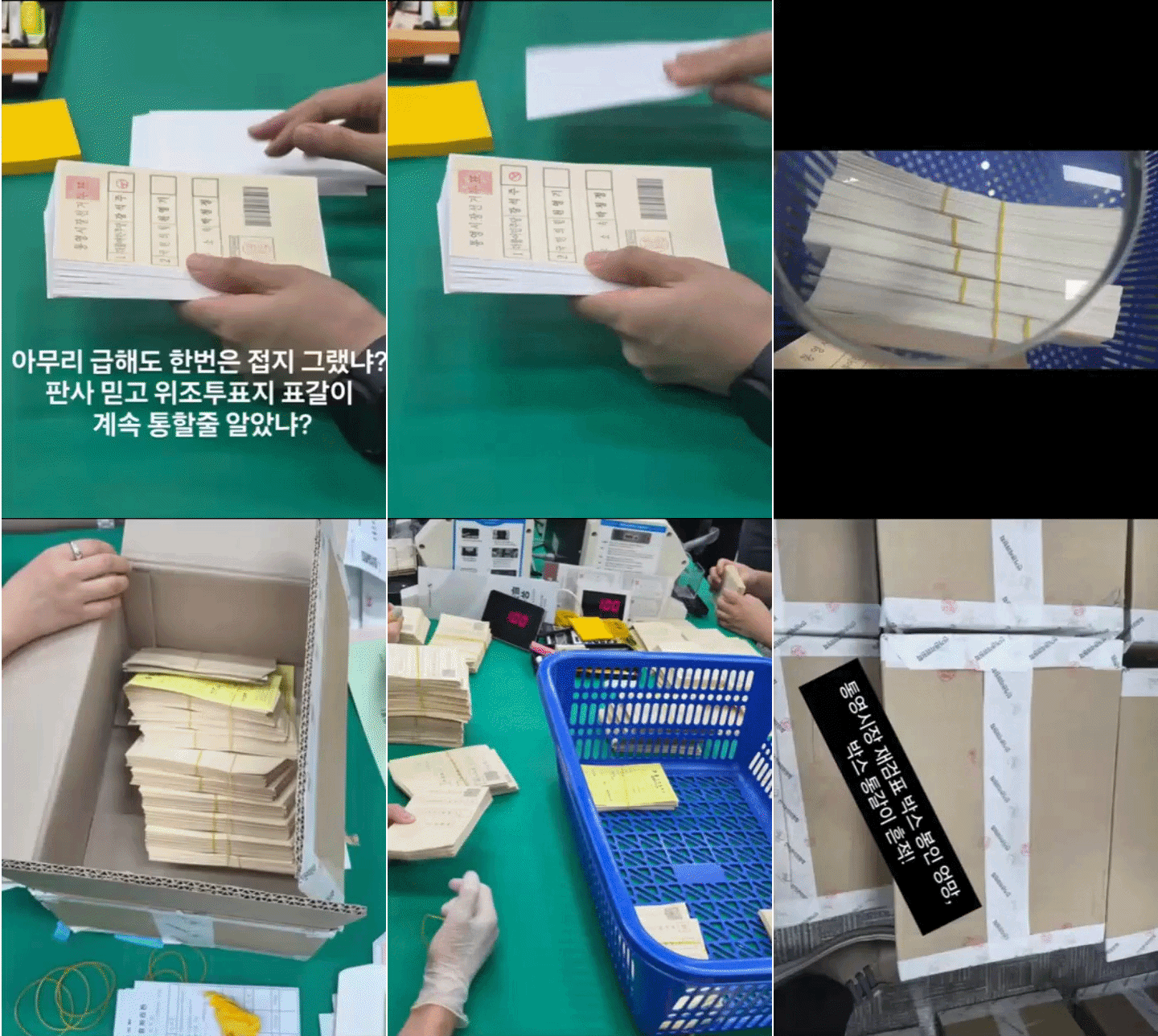 “Ignoring crisp ballots and damaged seals”… Tongyeong mayoral recount concludes with ‘no change in outcome,’ leaving suspicions and public outrage behind
Suspected counterfeit ballots discovered in Tongyeong [GIF from social media of Representative Hwang Kyo-ahn / Attorney Park Joo-hyun]During a recount of the Tongyeong mayoral election in South Gyeong
“Ignoring crisp ballots and damaged seals”… Tongyeong mayoral recount concludes with ‘no change in outcome,’ leaving suspicions and public outrage behind
Suspected counterfeit ballots discovered in Tongyeong [GIF from social media of Representative Hwang Kyo-ahn / Attorney Park Joo-hyun]During a recount of the Tongyeong mayoral election in South Gyeong
 President Yoon, regarding the first-instance ruling on the Public Official Election Act: “An excessive political verdict that distorts the facts… We will appeal immediately.”
The first-instance sentencing hearing for President Yoon Suk Yeol regarding violations of the Public Official Election Act is being broadcast live at Seoul Station on the 27th. [Photo=Yonhap News]Pres
President Yoon, regarding the first-instance ruling on the Public Official Election Act: “An excessive political verdict that distorts the facts… We will appeal immediately.”
The first-instance sentencing hearing for President Yoon Suk Yeol regarding violations of the Public Official Election Act is being broadcast live at Seoul Station on the 27th. [Photo=Yonhap News]Pres
 WSJ: "SK Hynix ADR Premium Is a Sign of AI Trading Overheat"
Advertisement for SK Hynix ADR listing in New York's Times Square [Reuters=Yonhap News file photo]The Wall Street Journal (WSJ) has pointed out that the price of SK Hynix’s American Depositary Recei
WSJ: "SK Hynix ADR Premium Is a Sign of AI Trading Overheat"
Advertisement for SK Hynix ADR listing in New York's Times Square [Reuters=Yonhap News file photo]The Wall Street Journal (WSJ) has pointed out that the price of SK Hynix’s American Depositary Recei
 'Godfather of Japanese Mystery Novels' Keigo Higashino Passes Away After Battle with Cancer at 68
Famous Japanese mystery novelist Keigo Higashino [AFP=Yonhap News]It has been belatedly reported that Keigo Higashino, the "godfather of Japanese mystery novels" and author of bestsellers such as "The
'Godfather of Japanese Mystery Novels' Keigo Higashino Passes Away After Battle with Cancer at 68
Famous Japanese mystery novelist Keigo Higashino [AFP=Yonhap News]It has been belatedly reported that Keigo Higashino, the "godfather of Japanese mystery novels" and author of bestsellers such as "The
 [Park Pil-kyu Security Column] To the Ignorant Trying to Clothe a Beast in Sheep's Clothing
Rep. Kim Byung-joo of the Democratic Party of Korea [Photo=Yonhap News]“The Air Force Academy doesn't teach you how to fly a plane!” “The Army, Navy, and Air Force academies are exactly the
[Park Pil-kyu Security Column] To the Ignorant Trying to Clothe a Beast in Sheep's Clothing
Rep. Kim Byung-joo of the Democratic Party of Korea [Photo=Yonhap News]“The Air Force Academy doesn't teach you how to fly a plane!” “The Army, Navy, and Air Force academies are exactly the
 [Issue Diagnosis] Two Effects of the Election Petition Review
 [Photo] Evidence of Election Fraud Flooding U.S. Media… Trump Had 2.7 Million Votes Stolen
 [Video] U.S. Semiquincentennial Air Show... 'Art in the Sky' streaks across New York
 [Editorial Cartoon] A Draconian Law That Undermines Freedom of Expression

 List
List