South Korea's national security is plunging into turbulent waters. [Photo=Republic of Korea Army]
South Korea's national security is plunging into turbulent waters. The international landscape surrounding the Korean Peninsula is changing rapidly, and North Korea's nuclear and missile threats have long since become a tangible terror. Yet, our security policy is creating an even greater crisis through internal administrative confusion than from external threats.
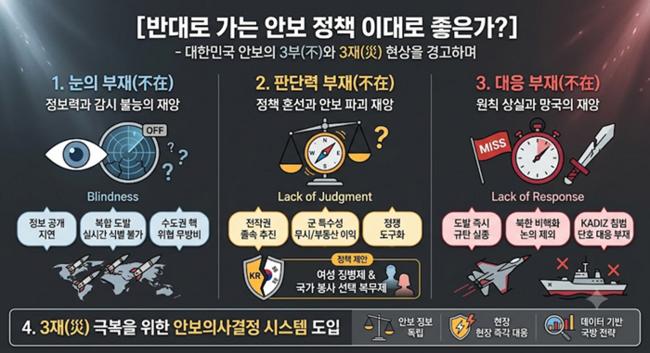
Current South Korean security is trapped in the "Three Absences" (3부): the absence of "eyes" (surveillance), the absence of "judgment," and the absence of "response"—meaning an inability to see first, judge first, and respond first. This has led to a "Three Disasters" (3재) phenomenon that amounts to a security catastrophe, displaying anti-military and treacherous tendencies that fail to protect even the present, let alone guarantee a free and prosperous future.
1. Absence of Eyes – A disaster of "inability to conduct intelligence and surveillance," the bedrock of security
The first step in security is to accurately see the enemy and grasp their intentions. However, looking at our military's recent responses to North Korean provocations, one must question whether our "eyes"—the systems intended to monitor enemy movements and intentions in real time—are functioning properly.
Despite North Korea firing ballistic missiles to coincide with the 76th anniversary of the outbreak of the Korean War, our military did not disclose it immediately.
The fact that we only admitted the truth after North Korea announced the provocation through its central broadcasting suggests either that our intelligence assets are failing or that, even when intelligence is gathered, we are unable to disclose it properly for fear of North Korea's reaction.
If North Korea conducts a tactical nuclear test in the near future, we will likely either fail to detect it or be unable to disclose it.
As North Korea employs complex provocation tactics combining ballistic missiles and multiple rocket launchers, it is expected that our current surveillance systems, including radar and satellite reconnaissance, will struggle to identify enemy provocations in real time. This represents a technical security gap and raises questions about the overall validity of our national defense system.
It highlights a critical strategic vulnerability: if the enemy were to launch a surprise landing on our western islands and threaten the capital region with nuclear weapons, real-time response might be impossible.
2. Absence of Judgment – A catastrophe of wasted budgets and destroyed security caused by misguided policies
The absence of judgment stems from a poverty of accumulated wisdom and insight, leading to ineffective responses. It is a state where one does not even know what constitutes national interest or what is detrimental to security. Even when the public recognizes the security breakdown and cries out, the authorities remain insensitive to these calls, operating like a closed-door cabal while stubbornly pushing unreasonable agendas for private gain.
The transfer of wartime operational control (OPCON) is a major issue that could lead to the dissolution of the ROK-U.S. Combined Forces Command, the unification of command solely under the Korean military, and the collapse of war deterrence. Yet, it is being pushed through in a hasty, unilateral manner without sufficient decision-making or deliberation.
One must wonder if they are truly concerned about South Korea's security. This lack of judgment, which treats national security as a tool for political strife and handles it like a lab rat, is a lethal poison destroying our military.
The recently resurfaced "selective volunteer military system" may have a justification in responding to the demographic cliff, but it ignores the concept of total war, fiscal support, and fairness. A structure where once a statement is made—like the relocation of a semiconductor complex—it creates undue pressure is truly perilous.
The alternatives needed now are to review the introduction of a "women's conscription system" and a "national service choice system" to enhance the fairness of military service and national defense capabilities. This is a security strategy that can solve both security and low-birth-rate issues by building social solidarity where men and women share the burden to replenish military forces, supported by unconventional incentives such as those for childbirth.
A representative policy showing this absence of judgment is the closure of the Korea Military Academy (KMA) under the guise of an integrated military academy. Modern warfare is the culmination of victory achieved through joint operations that combine the advanced expertise and tactical distinctiveness of each military branch. The world’s most powerful military, the U.S., and other Western powers maintain separate service academies for specific historical and tactical reasons.
The Ministry of National Defense's attempt at integration is packaged under the name of "efficiency," but behind it lies the rot of trying to convert the uniqueness and historical value of the military into real estate profits. It is also worth examining the profiles of those who attempted "land grabbing" in the Taereung area in anticipation of the KMA's relocation.
3. Absence of Response – A national disaster where political calculation takes precedence over field principles
Security responses must be based on principles and strategy. Regarding North Korea's provocations—which openly violate UN Security Council resolutions and flaunt their nuclear launch capabilities—the South Korean government's response has lost consistency. The principles of immediately condemning and warning against provocations have somehow been hidden behind political maneuvering and the rhetoric of "peace."
The joint statement from the G7 summit held in Evian, France, on June 17, 2026, expressed "serious concern" regarding North Korea's nuclear and ballistic missile programs and reaffirmed the commitment to realize complete denuclearization in accordance with UN Security Council resolutions. However, the fact that the issue of North Korean denuclearization was excluded from public disclosure for fear of upsetting North Korea is proof that we are missing the "golden time for response."
Repeating diplomatic rhetoric rather than taking firm military action while Chinese and Russian military aircraft invade our Air Defense Identification Zone as if it were their own backyard weakens our military's deterrence and serves as an act of subversion, sending the wrong signal to the enemy that "provocation is acceptable."
4. Policy Proposals for Overcoming the South Korean Security Catastrophe and the "Three Disasters"
What we need, placed in the most dangerous military standoff in the world, is not flashy policy slogans or political justification. We need "eyes" that peer accurately into the enemy, cold-blooded "judgment" for national survival, and "response" that stands firmly against provocation.
Vietnam and Hong Kong proved that once the dam of security collapses, it cannot be rebuilt. Even now, the government must stop the dissolution of military organizations contrary to military principles, cease "overcoming internal strife" rhetoric, and return to the basics and principles of security.
If the South Korean security trapped in these "Three Disasters" is not rectified now, there is no future. To achieve "security intelligence independence," we must ensure the political neutrality of military intelligence agencies and unify satellite and radar networks into a "real-time integrated control system" to restore the sanctity of surveillance. To ensure "immediate field response," we must establish an "automated response system" that allows for actions without top-level approval, effectively blocking the enemy's will to provoke at its source.
It is urgent to introduce a security decision-making system that establishes a permanent "National Defense Strategy Committee" to scrap unreasonable reforms like the integration of military academies and to formulate data-driven defense policies based on the deliberations of security experts.

◆ Commissioner Park Pil-gyu
Editorial Writer, Korea-U.S. Daily
40th Class, Korea Military Academy

 Trump pressures for rate cut again ahead of FOMC... "Should be the lowest in the world"
U.S. President Donald Trump. [Photo = The White House] U.S. President Donald Trump once again pressured the Federal Reserve, the U.S. central bank, to lower interest rates on the 27th (local time
Trump pressures for rate cut again ahead of FOMC... "Should be the lowest in the world"
U.S. President Donald Trump. [Photo = The White House] U.S. President Donald Trump once again pressured the Federal Reserve, the U.S. central bank, to lower interest rates on the 27th (local time
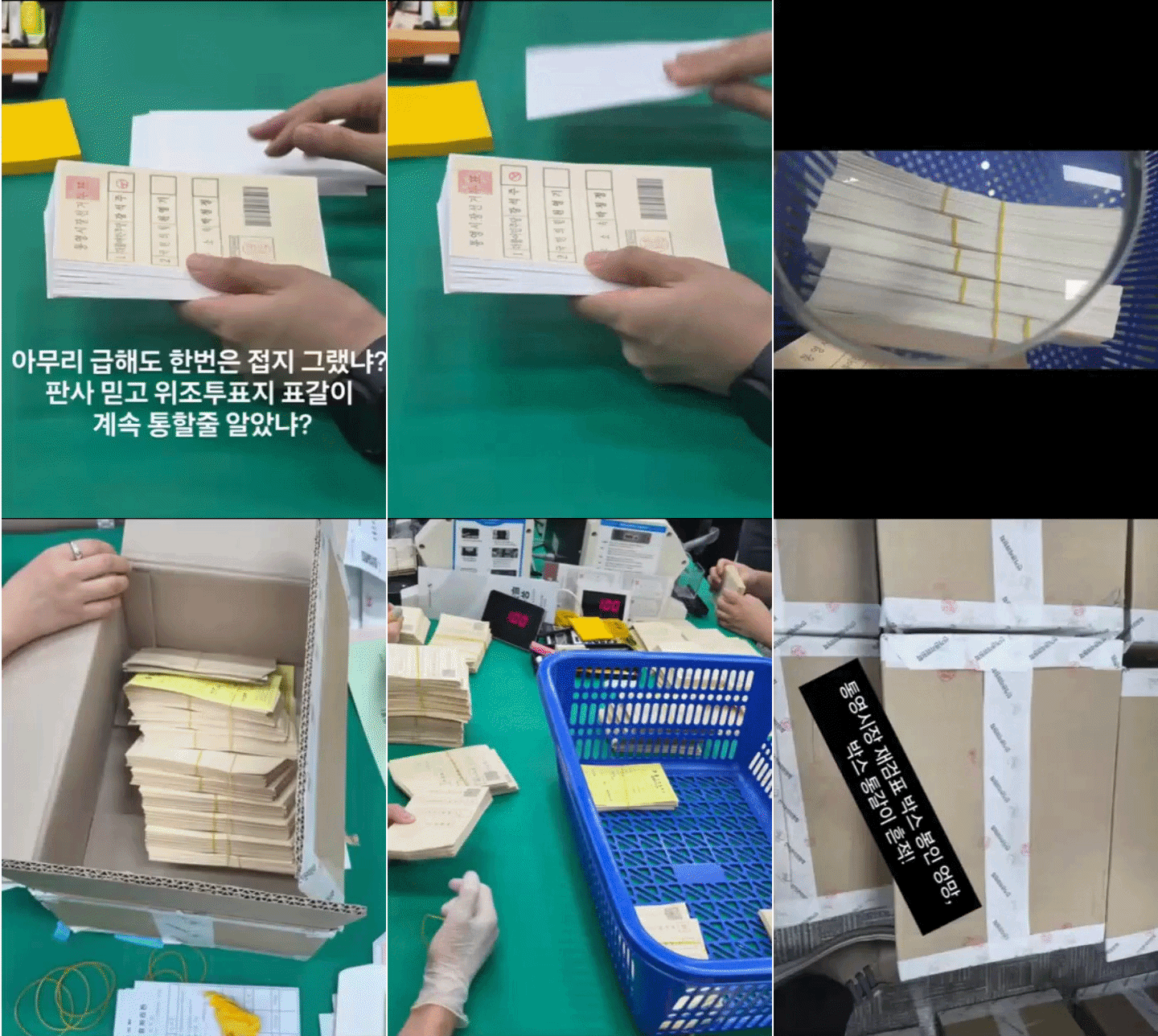 “Ignoring crisp ballots and damaged seals”… Tongyeong mayoral recount concludes with ‘no change in outcome,’ leaving suspicions and public outrage behind
Suspected counterfeit ballots discovered in Tongyeong [GIF from social media of Representative Hwang Kyo-ahn / Attorney Park Joo-hyun]During a recount of the Tongyeong mayoral election in South Gyeong
“Ignoring crisp ballots and damaged seals”… Tongyeong mayoral recount concludes with ‘no change in outcome,’ leaving suspicions and public outrage behind
Suspected counterfeit ballots discovered in Tongyeong [GIF from social media of Representative Hwang Kyo-ahn / Attorney Park Joo-hyun]During a recount of the Tongyeong mayoral election in South Gyeong
 President Yoon, regarding the first-instance ruling on the Public Official Election Act: “An excessive political verdict that distorts the facts… We will appeal immediately.”
The first-instance sentencing hearing for President Yoon Suk Yeol regarding violations of the Public Official Election Act is being broadcast live at Seoul Station on the 27th. [Photo=Yonhap News]Pres
President Yoon, regarding the first-instance ruling on the Public Official Election Act: “An excessive political verdict that distorts the facts… We will appeal immediately.”
The first-instance sentencing hearing for President Yoon Suk Yeol regarding violations of the Public Official Election Act is being broadcast live at Seoul Station on the 27th. [Photo=Yonhap News]Pres
 WSJ: "SK Hynix ADR Premium Is a Sign of AI Trading Overheat"
Advertisement for SK Hynix ADR listing in New York's Times Square [Reuters=Yonhap News file photo]The Wall Street Journal (WSJ) has pointed out that the price of SK Hynix’s American Depositary Recei
WSJ: "SK Hynix ADR Premium Is a Sign of AI Trading Overheat"
Advertisement for SK Hynix ADR listing in New York's Times Square [Reuters=Yonhap News file photo]The Wall Street Journal (WSJ) has pointed out that the price of SK Hynix’s American Depositary Recei
 'Godfather of Japanese Mystery Novels' Keigo Higashino Passes Away After Battle with Cancer at 68
Famous Japanese mystery novelist Keigo Higashino [AFP=Yonhap News]It has been belatedly reported that Keigo Higashino, the "godfather of Japanese mystery novels" and author of bestsellers such as "The
'Godfather of Japanese Mystery Novels' Keigo Higashino Passes Away After Battle with Cancer at 68
Famous Japanese mystery novelist Keigo Higashino [AFP=Yonhap News]It has been belatedly reported that Keigo Higashino, the "godfather of Japanese mystery novels" and author of bestsellers such as "The
 [Park Pil-kyu Security Column] To the Ignorant Trying to Clothe a Beast in Sheep's Clothing
Rep. Kim Byung-joo of the Democratic Party of Korea [Photo=Yonhap News]“The Air Force Academy doesn't teach you how to fly a plane!” “The Army, Navy, and Air Force academies are exactly the
[Park Pil-kyu Security Column] To the Ignorant Trying to Clothe a Beast in Sheep's Clothing
Rep. Kim Byung-joo of the Democratic Party of Korea [Photo=Yonhap News]“The Air Force Academy doesn't teach you how to fly a plane!” “The Army, Navy, and Air Force academies are exactly the
 [Issue Diagnosis] Two Effects of the Election Petition Review
 [Photo] Evidence of Election Fraud Flooding U.S. Media… Trump Had 2.7 Million Votes Stolen
 [Video] U.S. Semiquincentennial Air Show... 'Art in the Sky' streaks across New York
 [Editorial Cartoon] A Draconian Law That Undermines Freedom of Expression

 List
List