As the May 18th Democratization Movement is used as a political tool between factions, many are expressing concern that it is becoming a "forbidden zone" where even criticism is off-limits, or a solidified, establishment-entrenched narrative. [Photo = May 18th Cemetery Management Office Website]
Today, many people believe that restricting freedom of expression is necessary to create a more equal and tolerant society. The argument is that preventing hate speech and regulating uncomfortable remarks will reduce discrimination.
In fact, many countries are strengthening hate speech regulations, deleting online posts, and increasing instances of criminal punishment for certain remarks. However, there has long been a lack of empirical research on whether such policies have actually made society more tolerant.
Freedom of Expression and Tolerance Are Positively Correlated
In this context, a study published in the 2026 international journal Kyklos has yielded very interesting results. The research team analyzed data from the World Values Survey covering over 609,000 individuals across 115 countries between 1981 and 2022. This is among the largest studies to date analyzing the relationship between freedom of expression and tolerance at an individual level.
The results were contrary to many people's expectations. Individuals who chose freedom of expression as a top national priority were 2.3 percentage points more likely to demonstrate racially tolerant attitudes than those who did not.
The research team confirmed the same results even after controlling for various variables, including education level, income, religion, political orientation, age, gender, urban residence, social trust, and individualistic tendencies. The results remained largely unchanged even when changing the analytical model or removing differences between countries and years.
What is even more notable is the target of this tolerance. Those who value freedom of expression showed higher levels of acceptance not only toward other races but also toward various social minorities, including immigrants, people of other religions, Muslims, Jews, and homosexuals.
Contrary to the conventional wisdom that freedom of expression amplifies prejudice, the actual data shows that those who prioritize freedom of expression tend to be more accepting of diverse groups.
Why did such results emerge?
In a society where free discussion is possible, falsehoods are exposed, but the opportunity to refute them is also laid bare. Prejudice is scrutinized through debate, and misinformation is corrected by facts. As people with different experiences and ideas exchange opinions freely, the possibility of understanding others also grows.
Prejudice Dissipates Amid Free Discussion
Freedom of expression is not a mechanism for eliminating conflict, but a mechanism for resolving conflict through discussion rather than violence.
Conversely, censorship blocks discussion itself. When the state or a massive power begins to permit some opinions and ban others, citizens lose the opportunity to exercise their own judgment.
Counter-arguments disappear, criticism vanishes, and what remains is only the narrative permitted by those in power. Censorship does not just eliminate falsehoods; it also eliminates the opportunity for the truth to be revealed.
History has shown this repeatedly. Nazi Germany seized control of the media to spread anti-Semitic propaganda on a massive scale. During the Rwandan genocide, specific radio stations incited hatred and fueled the slaughter.
Neither of these cases was a tragedy caused by excessive freedom of expression. They were cases demonstrating what happens when power seizes control of information and the media. Limiting freedom of expression does not automatically create tolerance.
Freedom of expression is not just a right that upholds democratic procedure; it is a skill for people with different ideas to coexist. When I acknowledge the right to speak even to those with whom I disagree, I, too, can be protected when I eventually become a minority voice. This is why freedom of expression is not just the right of the majority, but also the right of the minority.
Of course, this study does not definitively conclude that freedom of expression "causally" creates tolerance. The research team also explains that they have confirmed a strong correlation, not necessarily a causal relationship. However, it clearly shows that the claim that freedom of expression breeds hate and discrimination lacks empirical evidence.
Today, liberal democratic nations are moving toward restricting freedom of expression little by little under the guise of safety, order, and preventing hate. However, good intentions do not always lead to good results. The belief that reducing freedom of expression will make society more tolerant must now be re-evaluated in the face of empirical evidence.
The message delivered to us by this study of over 600,000 people is that freedom of expression and tolerance are highly likely to be values that grow together, rather than values that conflict with each other.
The freer a society is to speak, the greater its capacity to coexist with different people can become. Protecting freedom of expression is not just about safeguarding one right. It is about protecting one of the most important foundations that upholds democracy, maintains a pluralistic society, and cultivates a culture of tolerance.

◆ Songsan Jeong Gwang-je
A poet and researcher of history and philosophy. Former director of the Rhee Syngman Academy. Currently serves as a research advisor for the Korea Modern History Research Association and representative of the philosophy forum Lyceum. He has published four volumes of poetry, co-translated "The Heroes of Hook Hill," and authored the humanities books "Joseon Become Myth," "Humanities on the Tatami," and "A Liberal's Reading of Gramsci." Songsan is his pen name.

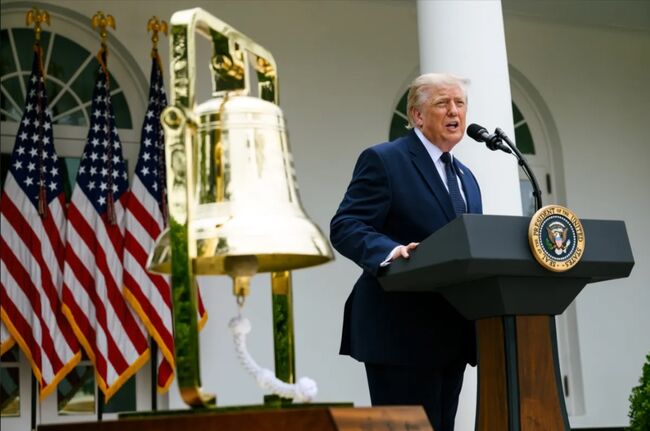 Trump pressures for rate cut again ahead of FOMC... "Should be the lowest in the world"
U.S. President Donald Trump. [Photo = The White House] U.S. President Donald Trump once again pressured the Federal Reserve, the U.S. central bank, to lower interest rates on the 27th (local time
Trump pressures for rate cut again ahead of FOMC... "Should be the lowest in the world"
U.S. President Donald Trump. [Photo = The White House] U.S. President Donald Trump once again pressured the Federal Reserve, the U.S. central bank, to lower interest rates on the 27th (local time
 “Ignoring crisp ballots and damaged seals”… Tongyeong mayoral recount concludes with ‘no change in outcome,’ leaving suspicions and public outrage behind
Suspected counterfeit ballots discovered in Tongyeong [GIF from social media of Representative Hwang Kyo-ahn / Attorney Park Joo-hyun]During a recount of the Tongyeong mayoral election in South Gyeong
“Ignoring crisp ballots and damaged seals”… Tongyeong mayoral recount concludes with ‘no change in outcome,’ leaving suspicions and public outrage behind
Suspected counterfeit ballots discovered in Tongyeong [GIF from social media of Representative Hwang Kyo-ahn / Attorney Park Joo-hyun]During a recount of the Tongyeong mayoral election in South Gyeong
 President Yoon, regarding the first-instance ruling on the Public Official Election Act: “An excessive political verdict that distorts the facts… We will appeal immediately.”
The first-instance sentencing hearing for President Yoon Suk Yeol regarding violations of the Public Official Election Act is being broadcast live at Seoul Station on the 27th. [Photo=Yonhap News]Pres
President Yoon, regarding the first-instance ruling on the Public Official Election Act: “An excessive political verdict that distorts the facts… We will appeal immediately.”
The first-instance sentencing hearing for President Yoon Suk Yeol regarding violations of the Public Official Election Act is being broadcast live at Seoul Station on the 27th. [Photo=Yonhap News]Pres
 WSJ: "SK Hynix ADR Premium Is a Sign of AI Trading Overheat"
Advertisement for SK Hynix ADR listing in New York's Times Square [Reuters=Yonhap News file photo]The Wall Street Journal (WSJ) has pointed out that the price of SK Hynix’s American Depositary Recei
WSJ: "SK Hynix ADR Premium Is a Sign of AI Trading Overheat"
Advertisement for SK Hynix ADR listing in New York's Times Square [Reuters=Yonhap News file photo]The Wall Street Journal (WSJ) has pointed out that the price of SK Hynix’s American Depositary Recei
 'Godfather of Japanese Mystery Novels' Keigo Higashino Passes Away After Battle with Cancer at 68
Famous Japanese mystery novelist Keigo Higashino [AFP=Yonhap News]It has been belatedly reported that Keigo Higashino, the "godfather of Japanese mystery novels" and author of bestsellers such as "The
'Godfather of Japanese Mystery Novels' Keigo Higashino Passes Away After Battle with Cancer at 68
Famous Japanese mystery novelist Keigo Higashino [AFP=Yonhap News]It has been belatedly reported that Keigo Higashino, the "godfather of Japanese mystery novels" and author of bestsellers such as "The
 [Park Pil-kyu Security Column] To the Ignorant Trying to Clothe a Beast in Sheep's Clothing
Rep. Kim Byung-joo of the Democratic Party of Korea [Photo=Yonhap News]“The Air Force Academy doesn't teach you how to fly a plane!” “The Army, Navy, and Air Force academies are exactly the
[Park Pil-kyu Security Column] To the Ignorant Trying to Clothe a Beast in Sheep's Clothing
Rep. Kim Byung-joo of the Democratic Party of Korea [Photo=Yonhap News]“The Air Force Academy doesn't teach you how to fly a plane!” “The Army, Navy, and Air Force academies are exactly the
 [Issue Diagnosis] Two Effects of the Election Petition Review
 [Photo] Evidence of Election Fraud Flooding U.S. Media… Trump Had 2.7 Million Votes Stolen
 [Video] U.S. Semiquincentennial Air Show... 'Art in the Sky' streaks across New York
 [Editorial Cartoon] A Draconian Law That Undermines Freedom of Expression

 List
List