A U.S. House of Representatives report released on Wednesday (1st) states that the South Korean government is weaponizing its organizational structure and laws to discriminately target U.S. companies.
The 35-page report, including the cover, points out that the South Korean government’s behavior has been ongoing since the early 2000s. It addresses the Coupang issue in great detail, noting that such discriminatory treatment is a violation of U.S.-Korea trade agreements.
The House Judiciary Committee released the report titled, "Blocking Competition: South Korea’s Discriminatory Attacks on American-Owned Businesses."
This report follows an investigation launched on February 5th by the Judiciary Committee, led by Chairman Jim Jordan, and the Subcommittee on the Administrative State, Regulatory Reform, and Antitrust into the South Korean government’s practice of targeting U.S.-owned companies.
Based on testimony and documents secured by the committee, the report alleges that "the Korea Fair Trade Commission (KFTC) has played a central role in this discrimination, using excessive mandates, aggressive enforcement practices, and even threats of criminal prosecution to punish U.S. companies and prevent them from succeeding against their Korean competitors."
Furthermore, it concludes that "South Korea has even weaponized digital laws and regulations to attack U.S. companies and restrict their business activities within the Korean market."
In a press release, the Judiciary Committee summarized that the report demonstrates the following facts:
---The Korea Fair Trade Commission (KFTC) has taken an especially aggressive stance toward U.S.-owned companies, regularly using coercive enforcement methods—including dawn raids, days-long interrogations, and even threats of criminal charges—to force compliance.
---South Korea has weaponized its laws to undermine the ability of innovative U.S. companies to compete effectively in its domestic market and has promoted anti-competitive legislation that prevents U.S. firms from competing successfully against Korean tech companies.
---Korean regulators have persistently targeted Coupang with hostile regulatory measures, unfair enforcement practices, and excessively high fines not imposed on Korean competitors.
---The South Korean government misled the public regarding this investigation, Coupang’s involvement in a data leak incident, and the government's role in the subsequent recovery operations.
---The South Korean government’s attacks on Coupang harm U.S. citizens and American businesses, which sell billions of dollars worth of products through Coupang’s online platform each year.
The report details the Coupang data leak incident, specifically drawing on testimony from Harold Rogers, interim representative of Coupang in Korea, during a hearing.
According to the report, Coupang was informed by the National Intelligence Service (NIS) that following their instructions was a legal mandate. Believing this to be true, Coupang faithfully complied with NIS directives to contact a former Chinese employee, execute an operation to recover relevant materials, statements, and even a laptop, and, as instructed, did not notify the police or the public of these actions.
The report also states that a high-ranking official in the South Korean Presidential Office instructed Coupang to work closely with the NIS to recover and hand over the hacking suspect’s electronic devices. When notified that the devices had been secured in Shanghai, China, the official stated, "I will report this to President Lee Jae-myung," and confirmed the following day, December 16, 2025, that the report had been made.
The report asserts, "The highest levels of the South Korean government, including President Lee Jae-myung, were aware that the NIS was closely directing Coupang's data recovery operation and that Coupang was acting in accordance with those instructions," adding, "The South Korean government knew that the scope of unauthorized access was much narrower than reported. Despite knowing these facts, the South Korean government continued to publicly attack Coupang and disseminate misleading information about the company."
Following the data leak incident, the South Korean government issued 4,229 requests for document submissions to Coupang and conducted 652 individual interviews with over 600 employees. According to Representative Rogers, this was "a response to the President’s instruction to agencies to directly attack Coupang," the report notes.
Rogers testified, "After the instruction was given by the President and Prime Minister to pressure Coupang using every possible means... officials suddenly appeared (at Coupang) offices and began seizing documents."
It was Coupang employees who contacted the former Chinese employee—the mastermind behind the incident—and obtained a signed statement from him, as well as evidence including four hard drives, one desktop computer, one graphics card, and a laptop he had thrown into a river immediately after the unauthorized access became public. The report specifies that this entire operation was conducted under the direction of the NIS.
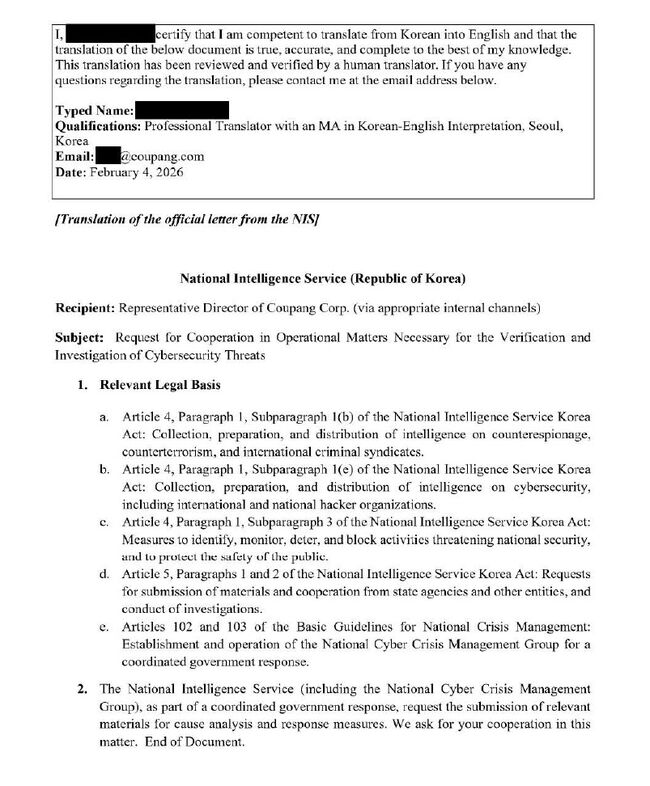 An English translation of an official letter confirming that Coupang had a legal obligation to comply with NIS instructions. Excerpt from the U.S. House Judiciary Committee report.
The report notes that the laptop recovery, in particular, involved the use of divers to search the river.
During this process, the former employee confirmed that he no longer possessed or controlled any data or information belonging to Coupang or its customers, and it was verified that the leaked data was only a partial amount, not the entirety.
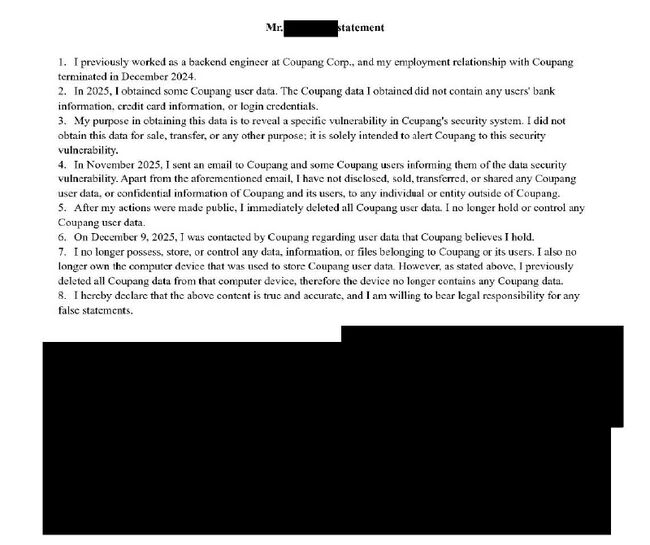 An English translation of the signed statement by the former Chinese employee, a suspect in the Coupang data leak incident. Excerpt from the U.S. House Judiciary Committee report.
However, the NIS issued an official statement claiming that Rogers' assertions are "entirely untrue, and the NIS has never issued any instructions, orders, or approvals to Coupang, nor does it have the authority to do so."
The report concludes that this NIS statement directly contradicts evidence collected by the House Judiciary Committee and its subcommittee. The report includes excerpts of the official letter sent by the NIS to Coupang and the statement from the former employee.
Nevertheless, the National Assembly of South Korea humiliated Coupang executives by forcing them to attend hearings and even threatened them with exit bans and criminal charges for perjury.
On June 10, the South Korean government imposed a $410 million fine on Coupang.
The report further notes that since being targeted in Korea, Coupang’s market capitalization has fallen by over 40%, negatively impacting U.S. investors and harming American companies and producers who sell $5 billion worth of goods through Coupang annually.
It also cites statistics indicating that South Korea’s discriminatory practices and hostile regulations could lead to a $525 billion loss for the U.S. and a $469 billion loss for Korea, potentially costing U.S. households an average of $3,800 over the next decade.
Previously, on April 20, 54 members of Congress sent a letter demanding that South Korea cease its practice of targeting U.S.-owned companies, noting that it "systematically targets American companies (such as Apple, Google, Meta, and Coupang)."
Additionally, Vice President JD Vance, in a letter to South Korean Prime Minister Kim Min-seok, stated that these practices likely violate the trade agreement recently concluded by the Trump administration with South Korea, which specifies that South Korea "must ensure that U.S. companies are not discriminated against... and do not face unnecessary barriers in terms of laws and policies related to digital services, including online platform regulations."
According to a column by Editor-in-Chief Jin Cummings in The Korea Signal, Coupang recently filed a Form 8-K with the U.S. Securities and Exchange Commission regarding the Korea Personal Information Protection Commission’s fine decision. Coupang disclosed that the fine was divided into portions related to the data leak and data collection/storage issues related to a third-party advertising program, and stated that it would actively contest the decision in the Seoul Administrative Court, as it is subject to judicial review.
It remains to be seen how much influence the data presented by this House Judiciary Committee report will have on the final penalty decided by the Korean courts.
U.S. NNP = Representative Reporter Hong Seong-gu / Special Correspondent for this publication NNP info@newsandpost.com

 Trump pressures for rate cut again ahead of FOMC... "Should be the lowest in the world"
U.S. President Donald Trump. [Photo = The White House] U.S. President Donald Trump once again pressured the Federal Reserve, the U.S. central bank, to lower interest rates on the 27th (local time
Trump pressures for rate cut again ahead of FOMC... "Should be the lowest in the world"
U.S. President Donald Trump. [Photo = The White House] U.S. President Donald Trump once again pressured the Federal Reserve, the U.S. central bank, to lower interest rates on the 27th (local time
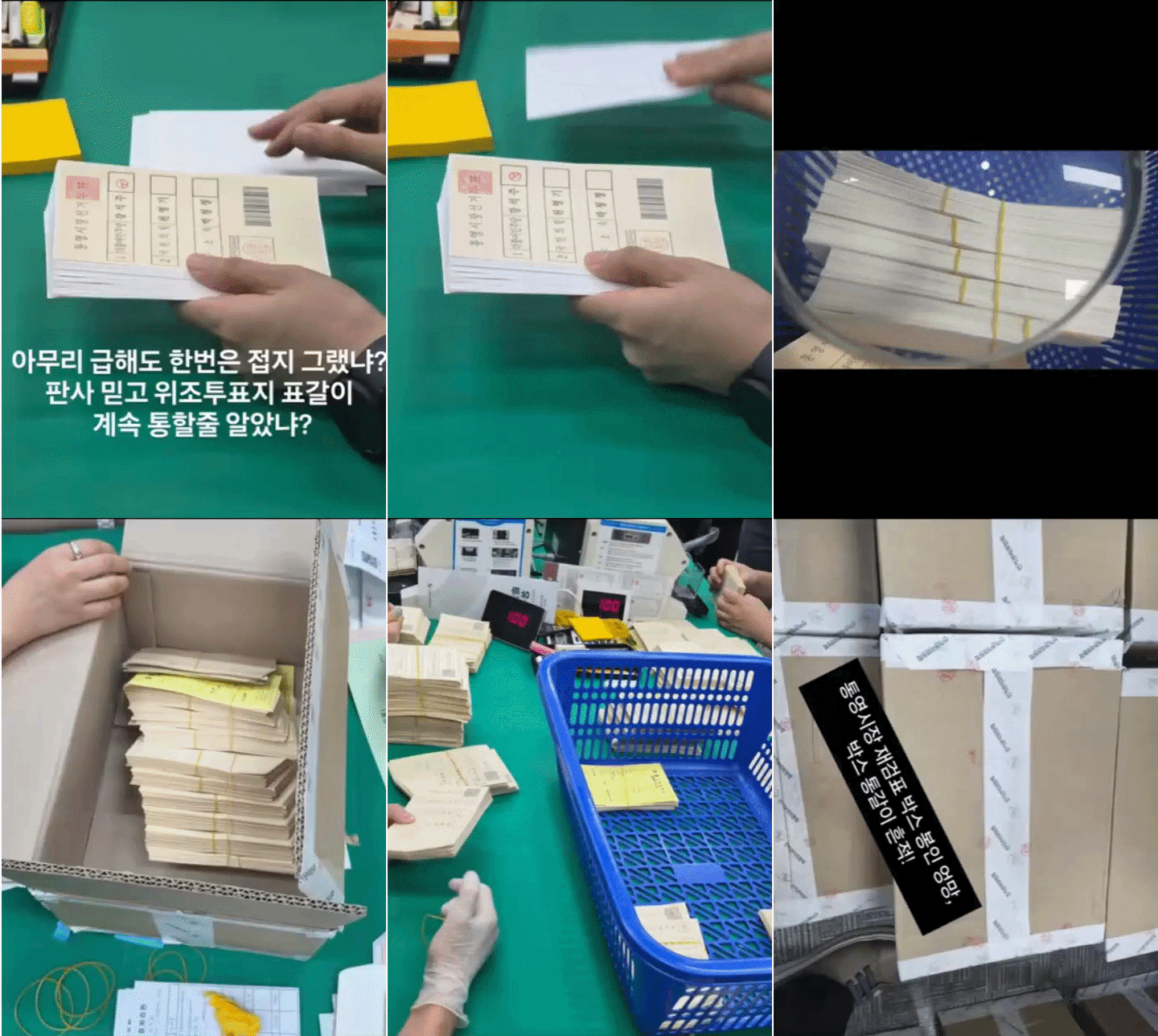 “Ignoring crisp ballots and damaged seals”… Tongyeong mayoral recount concludes with ‘no change in outcome,’ leaving suspicions and public outrage behind
Suspected counterfeit ballots discovered in Tongyeong [GIF from social media of Representative Hwang Kyo-ahn / Attorney Park Joo-hyun]During a recount of the Tongyeong mayoral election in South Gyeong
“Ignoring crisp ballots and damaged seals”… Tongyeong mayoral recount concludes with ‘no change in outcome,’ leaving suspicions and public outrage behind
Suspected counterfeit ballots discovered in Tongyeong [GIF from social media of Representative Hwang Kyo-ahn / Attorney Park Joo-hyun]During a recount of the Tongyeong mayoral election in South Gyeong
 President Yoon, regarding the first-instance ruling on the Public Official Election Act: “An excessive political verdict that distorts the facts… We will appeal immediately.”
The first-instance sentencing hearing for President Yoon Suk Yeol regarding violations of the Public Official Election Act is being broadcast live at Seoul Station on the 27th. [Photo=Yonhap News]Pres
President Yoon, regarding the first-instance ruling on the Public Official Election Act: “An excessive political verdict that distorts the facts… We will appeal immediately.”
The first-instance sentencing hearing for President Yoon Suk Yeol regarding violations of the Public Official Election Act is being broadcast live at Seoul Station on the 27th. [Photo=Yonhap News]Pres
 WSJ: "SK Hynix ADR Premium Is a Sign of AI Trading Overheat"
Advertisement for SK Hynix ADR listing in New York's Times Square [Reuters=Yonhap News file photo]The Wall Street Journal (WSJ) has pointed out that the price of SK Hynix’s American Depositary Recei
WSJ: "SK Hynix ADR Premium Is a Sign of AI Trading Overheat"
Advertisement for SK Hynix ADR listing in New York's Times Square [Reuters=Yonhap News file photo]The Wall Street Journal (WSJ) has pointed out that the price of SK Hynix’s American Depositary Recei
 'Godfather of Japanese Mystery Novels' Keigo Higashino Passes Away After Battle with Cancer at 68
Famous Japanese mystery novelist Keigo Higashino [AFP=Yonhap News]It has been belatedly reported that Keigo Higashino, the "godfather of Japanese mystery novels" and author of bestsellers such as "The
'Godfather of Japanese Mystery Novels' Keigo Higashino Passes Away After Battle with Cancer at 68
Famous Japanese mystery novelist Keigo Higashino [AFP=Yonhap News]It has been belatedly reported that Keigo Higashino, the "godfather of Japanese mystery novels" and author of bestsellers such as "The
 [Park Pil-kyu Security Column] To the Ignorant Trying to Clothe a Beast in Sheep's Clothing
Rep. Kim Byung-joo of the Democratic Party of Korea [Photo=Yonhap News]“The Air Force Academy doesn't teach you how to fly a plane!” “The Army, Navy, and Air Force academies are exactly the
[Park Pil-kyu Security Column] To the Ignorant Trying to Clothe a Beast in Sheep's Clothing
Rep. Kim Byung-joo of the Democratic Party of Korea [Photo=Yonhap News]“The Air Force Academy doesn't teach you how to fly a plane!” “The Army, Navy, and Air Force academies are exactly the
 [Issue Diagnosis] Two Effects of the Election Petition Review
 [Photo] Evidence of Election Fraud Flooding U.S. Media… Trump Had 2.7 Million Votes Stolen
 [Video] U.S. Semiquincentennial Air Show... 'Art in the Sky' streaks across New York
 [Editorial Cartoon] A Draconian Law That Undermines Freedom of Expression

 List
List