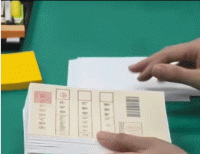
On the 2nd, members of the National Assembly's 'Special Committee on Fact-Finding for Violations of Constitutional Suffrage, such as the Ballot Shortage during the 9th Nationwide Simultaneous Local Elections, and Electoral Management Reform,' including Chairman Yoon Sang-hyun of the People Power Party, are visiting and inspecting the vote-counting station at the Handball Gymnasium in Olympic Park, Songpa-gu, Seoul. [Photo = Yonhap News]
Election integrity is not just a political slogan. If an election is the procedure through which state power derives its legitimacy, then that procedure requires standards as rigorous as the results themselves.
Whether voters cast their ballots without interference, whether one person's vote was treated with the same value as another's, whether the secrecy of the vote was guaranteed, whether ballot boxes and ballots were safely preserved, and whether vote counting and judicial remedies were conducted in a verifiable manner—all of these are components of election integrity.
The Constitution of the Republic of Korea also clearly defines these principles. Article 41 stipulates that the National Assembly shall be composed of members elected by universal, equal, direct, and secret ballot. Article 67 likewise mandates that the President be elected by universal, equal, direct, and secret ballot.
An election is not merely an administrative procedure. It is a constitutional process by which national sovereignty is transferred to state power.
The problem is whether South Korea's legal principles regarding election disputes have sufficiently reflected this constitutional significance.
Article 224 of the current Public Official Election Act stipulates that even if there is a violation of election regulations, a judgment for the nullification of an election or the invalidation of an election result should only be made if it is "recognized as having affected the outcome of the election."
Supreme Court precedents have interpreted this threshold as "a situation where it is acknowledged that the outcome could have been different from what actually occurred regarding the winning or losing of a candidate."
This legal doctrine is explainable in terms of the stability of election results. The logic is that one cannot upend results based on every procedural flaw after an election concludes.
However, from the perspective of election integrity, it has a fatal limitation. It prioritizes the final calculation of winners and losers over whether voters were actually unable to exercise their right to vote, whether election management procedures collapsed, or whether the chain of custody for ballot boxes and ballots can be verified.
International standards focus on the ‘effective opportunity to exercise voting rights’
International standards do not view elections merely as a final vote count.
Article 25 of the International Covenant on Civil and Political Rights (ICCPR) guarantees the right of citizens to participate in public affairs and to be elected through universal, equal, and secret ballots.
General Comment No. 25 of the UN Human Rights Committee explains that this clause lies at the core of a democratic government based on the consent of the people. It also views that states must take necessary legislative and other measures to ensure "effective opportunities" for citizens to enjoy their rights.
This point is crucial. International standards do not ask only, "Did the result change?" They also look at whether voters were guaranteed an actual opportunity to vote, whether the election process was free and fair, and whether the counting and verification were conducted in a trustworthy manner.
The Code of Good Practice in Electoral Matters by the Venice Commission also presents universal, equal, free, secret, and direct elections, along with periodic elections, as the basic principles of an election, explaining that these standards must be applied before, during, and immediately after the election.
The Inter-Parliamentary Union (IPU) standards for free and fair elections follow the same direction. The free formation of voters' will, fair competition among candidates and parties, and the possibility of remedies for infringements on voting rights are essential conditions for an election.
An election is not completed simply when the doors to the polling station close and the numbers are announced. Power gains legitimacy only when the people can trust the entire process that led to those numbers.
‘The theory of influence on election results’ has overwhelmed the principle of integrity
The South Korean judiciary is difficult to exempt from criticism on this point.
The Supreme Court and the Constitutional Court should have been the final defense line for election integrity. However, legal judgments and constitutional rulings have weighed outcome stability more heavily than procedural integrity.
Even when illegality in election management, obstacles to the exercise of voting rights, and lack of transparency in the management of ballot boxes and ballots are raised, the threshold for a final judgment has generally converged on "whether it influenced the outcome."
Of course, stability of election results is necessary for democracy. Overturning election results without any threshold could lead to further chaos.
However, stability must stand upon integrity. The logic that results must be stable even when procedures have collapsed is a self-negation of democracy. Election stability is created when the public trusts the election process, not when the judiciary retrospectively cuts away suspicions narrowly.
Therefore, the criticism that "the Supreme Court and the Constitutional Court are the ones who destroyed the principle of election integrity" is not a political exaggeration.
More precisely, these institutions may not be the primary actors who directly damaged integrity. The primary responsibility lies with the institutions that managed the election. However, the final responsibility to constitutionally control the failures of election management agencies, to judge the infringement of suffrage as an infringement of rights, and to restore procedural integrity lies with the judiciary and the Constitutional Court.
If that final defense line has retreated behind the logic of outcome influence and result stability, this is not merely a matter of legal precedent trends.
It is a reduction of the election from an issue of rights to an issue of arithmetic. It is treating the infringement of suffrage not as a constitutional issue, but merely as a variable in calculating winners and losers. In this process, election integrity retreats within the system.
The question posed by the June 3 suffrage deprivation incident
The June 3 suffrage deprivation incident is putting this outdated legal doctrine to a direct test.
The issue is not simply which candidate won or how narrow the vote margin was. The core is whether voters were unable to receive ballots, whether voting was interrupted, whether ballot boxes and ballots were preserved intact, and whether the records of early voting, election day voting, transport, and counting remain as verifiable data.
Article 198 of the Public Official Election Act also stipulates that a re-vote must be held when voting in a polling district could not be conducted due to natural disasters or other unavoidable circumstances, or when a ballot box is lost or destroyed. However, it allows for a winner to be declared without a re-vote if it is recognized that the re-vote would not affect the outcome of the election.
Although this clause also uses the threshold of outcome influence, its starting point is clear. When voting could not be conducted or the preservation of ballot boxes has failed, the election process itself is in question.
The question the judiciary must now answer is clear.
Even if there are voters who could not exercise their right to vote, is there no problem if the margin between candidates is large? If the chain of custody for ballot box and ballot management is shaken, is the election valid just because the final numbers match? If there is no responsible record from the election management agency or verification is impossible, can the judiciary only speak of result stability?
The answer from international standards is clear.
An election is not about numbers, but trust. The vote count is merely the conclusion of an election, not the entirety of it. When the voter's exercise of suffrage, the transparency of election management, the preservation of ballot boxes and ballots, the verification of the count, and judicial remedies are connected in a single chain, the election possesses integrity.
If that chain is broken, the judiciary should not just ask about the influence on the outcome. It must ask whether constitutional suffrage was infringed upon, whether the process of exercising national sovereignty was damaged, and whether public trust in the election results is recoverable. That is the reason for the existence of the Supreme Court and the Constitutional Court.
Election integrity is not a mechanism to prevent the loser from challenging the result. Rather, it is the minimum condition that enables the loser to accept the result. When there is a conviction that the procedure was transparent, management was fair, and verification was possible when suspicions were raised, the loser accepts the outcome. Demanding acceptance in an election where that conviction has collapsed is not democracy; it is the coercion of power.
The Supreme Court and the Constitutional Court must now choose. Will they continue to confine elections to the realm of winner-loser calculations, or will they re-establish election integrity as a constitutional standard?
The June 3 suffrage deprivation incident is not a simple election dispute. It is an event where the entire South Korean election jurisprudence is being judged again before international standards and constitutional principles.
■ Key International Standard Abbreviations ICCPR: International Covenant on Civil and Political Rights The international treaty on civil and political rights. In South Korea, it is commonly referred to as the 'Covenant on Civil and Political Rights'. UN Human Rights Committee: UN Human Rights Committee A UN body that monitors the implementation of the ICCPR and presents standards for treaty interpretation through general comments. General Comment No. 25: General Comment No. 25 An interpretive document that explains the standards for guaranteeing the right to political participation, suffrage, and the right to be elected under Article 25 of the ICCPR. Venice Commission: Venice Commission A constitutional advisory body under the Council of Europe that has presented international standards on electoral systems and constitutional order. IPU: Inter-Parliamentary Union The international organization of parliaments. Adopted the 'Declaration on Criteria for Free and Fair Elections' in 1994. |

 Trump pressures for rate cut again ahead of FOMC... "Should be the lowest in the world"
U.S. President Donald Trump. [Photo = The White House] U.S. President Donald Trump once again pressured the Federal Reserve, the U.S. central bank, to lower interest rates on the 27th (local time
Trump pressures for rate cut again ahead of FOMC... "Should be the lowest in the world"
U.S. President Donald Trump. [Photo = The White House] U.S. President Donald Trump once again pressured the Federal Reserve, the U.S. central bank, to lower interest rates on the 27th (local time
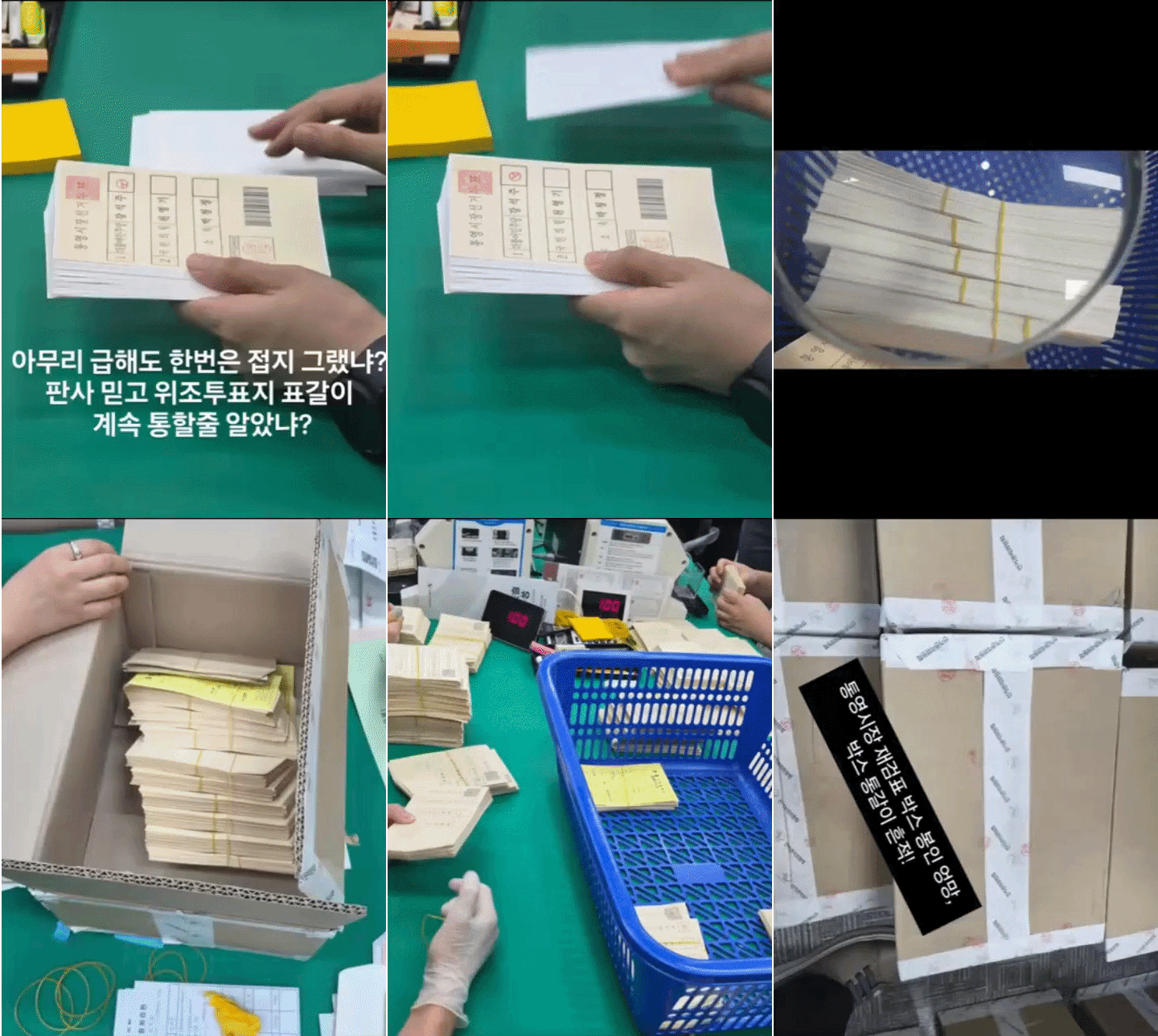 “Ignoring crisp ballots and damaged seals”… Tongyeong mayoral recount concludes with ‘no change in outcome,’ leaving suspicions and public outrage behind
Suspected counterfeit ballots discovered in Tongyeong [GIF from social media of Representative Hwang Kyo-ahn / Attorney Park Joo-hyun]During a recount of the Tongyeong mayoral election in South Gyeong
“Ignoring crisp ballots and damaged seals”… Tongyeong mayoral recount concludes with ‘no change in outcome,’ leaving suspicions and public outrage behind
Suspected counterfeit ballots discovered in Tongyeong [GIF from social media of Representative Hwang Kyo-ahn / Attorney Park Joo-hyun]During a recount of the Tongyeong mayoral election in South Gyeong
 President Yoon, regarding the first-instance ruling on the Public Official Election Act: “An excessive political verdict that distorts the facts… We will appeal immediately.”
The first-instance sentencing hearing for President Yoon Suk Yeol regarding violations of the Public Official Election Act is being broadcast live at Seoul Station on the 27th. [Photo=Yonhap News]Pres
President Yoon, regarding the first-instance ruling on the Public Official Election Act: “An excessive political verdict that distorts the facts… We will appeal immediately.”
The first-instance sentencing hearing for President Yoon Suk Yeol regarding violations of the Public Official Election Act is being broadcast live at Seoul Station on the 27th. [Photo=Yonhap News]Pres
 WSJ: "SK Hynix ADR Premium Is a Sign of AI Trading Overheat"
Advertisement for SK Hynix ADR listing in New York's Times Square [Reuters=Yonhap News file photo]The Wall Street Journal (WSJ) has pointed out that the price of SK Hynix’s American Depositary Recei
WSJ: "SK Hynix ADR Premium Is a Sign of AI Trading Overheat"
Advertisement for SK Hynix ADR listing in New York's Times Square [Reuters=Yonhap News file photo]The Wall Street Journal (WSJ) has pointed out that the price of SK Hynix’s American Depositary Recei
 'Godfather of Japanese Mystery Novels' Keigo Higashino Passes Away After Battle with Cancer at 68
Famous Japanese mystery novelist Keigo Higashino [AFP=Yonhap News]It has been belatedly reported that Keigo Higashino, the "godfather of Japanese mystery novels" and author of bestsellers such as "The
'Godfather of Japanese Mystery Novels' Keigo Higashino Passes Away After Battle with Cancer at 68
Famous Japanese mystery novelist Keigo Higashino [AFP=Yonhap News]It has been belatedly reported that Keigo Higashino, the "godfather of Japanese mystery novels" and author of bestsellers such as "The
 [Park Pil-kyu Security Column] To the Ignorant Trying to Clothe a Beast in Sheep's Clothing
Rep. Kim Byung-joo of the Democratic Party of Korea [Photo=Yonhap News]“The Air Force Academy doesn't teach you how to fly a plane!” “The Army, Navy, and Air Force academies are exactly the
[Park Pil-kyu Security Column] To the Ignorant Trying to Clothe a Beast in Sheep's Clothing
Rep. Kim Byung-joo of the Democratic Party of Korea [Photo=Yonhap News]“The Air Force Academy doesn't teach you how to fly a plane!” “The Army, Navy, and Air Force academies are exactly the
 [Issue Diagnosis] Two Effects of the Election Petition Review
 [Photo] Evidence of Election Fraud Flooding U.S. Media… Trump Had 2.7 Million Votes Stolen
 [Video] U.S. Semiquincentennial Air Show... 'Art in the Sky' streaks across New York
 [Editorial Cartoon] A Draconian Law That Undermines Freedom of Expression

 List
List