Citizens in traditional attire march through the city center to mark National Foundation Day. [Photo=Yonhap News]
July 4th marked the 250th anniversary of the United States declaring its independence from British rule in 1776.
The U.S. hosted a grand 250th-anniversary celebration titled "Tribute to America" at the National Mall between the Lincoln Memorial and the Washington Monument, attended by President Trump and tens of thousands of participants. The event concluded spectacularly with an Air Force air show, military band and honor guard performances, a speech by President Trump, and a 40-minute fireworks display.
August 15th is the 81st anniversary of Liberation Day. This day marks Korea's independence in 1945 from Japan's 36-year colonial rule, and three years later, the establishment of the Republic of Korea government. The Korean people, with a history spanning thousands of years, are celebrating their 78th year since foundation, while the relatively young United States is celebrating its 250th.
The Korean National Foundation Day should be Gaecheonjeol on October 3rd
However, can Liberation Day truly be considered the Korean nation's foundation anniversary? The true foundation anniversary of the Korean people should be Gaecheonjeol on October 3rd, not Liberation Day on August 15th, which signifies independence from Japan and the establishment of the Republic of Korea's government.
A major national event that requires the president's attendance, similar to U.S. Independence Day, should be Gaecheonjeol, not the March 1st Independence Movement Day or Liberation Day. Elevating Gaecheonjeol to the status of the national foundation anniversary and holding large-scale state commemorations is the correct way for the Korean people—who boast a history of thousands of years—to honor their history of foundation, unlike the 250-year-old United States.
The significance of March 1st and Liberation Day as national holidays has expired; they should remain as commemorative days. The repetitive anti-Japanese films, documentaries, and articles in various media on these days constitute anachronistic, brainwashing education that instills anti-Japanese sentiment—sentiments no longer valid in 21st-century Korea-Japan relations. This plays right into the hands of the North Korean communist regime's united front tactics of "anti-American, anti-imperialist, independent unification."
The Republic of Korea cannot turn its back on the U.S. and Japan to confront the expansionism of North Korea and Chinese communists. There are no eternal allies or eternal enemies. In the 20th-century global order where imperialism was rampant, Japan rapidly embraced Western civilization, achieved modernization and militarism, and annexed the Joseon Dynasty, which had failed to reform due to its isolationist policy. However, the current reality is that Japan, along with the U.S. and Korea, is working together to protect liberal democracy against North Korean and Chinese communists.
The U.S. suffered tremendous loss of life and property during the four years of the Pacific War against Japan following the Pearl Harbor attack in 1941, but after WWII, it formed an alliance with Japan to counter the threat of Soviet communists. The U.S.-Japan alliance, along with the U.S.-ROK alliance and NATO, is at the core of U.S. global strategy.
Germany, a key NATO member, was also an enemy of the U.S. during WWII. As the international situation changes, domestic policies regarding diplomacy and national defense must also shift. That is the fundamental principle of building a rich nation and a strong army. The Joseon Dynasty serves as a cautionary tale; it missed the currents of the era and failed to reform or open its doors due to outdated obsession with "Sadaejuui" (serving the great) toward China, eventually collapsing into a Japanese colony.
How long is the expiration date for March 1st and Liberation Day as national holidays? A hundred years? A thousand years? For those who lived through the 36 years of Japanese colonial rule, liberation holds great meaning. But how many South Korean citizens today have personally experienced the Japanese colonial era? Similarly, how many Japanese people hold memories of Japan's rule over Joseon?
Japan's rule over Joseon should only exist in history books
The Japanese rule over Joseon, known to both nations' citizens, exists only in history books. It should be remembered as history and cannot dictate the current relationship between the two countries. We must learn from the past, but we cannot be shackled by it; we must be faithful to the present to build a better future.
Following Japan's victory in the Sino-Japanese War in 1895, China's 500-year suzerainty over Joseon collapsed. Joseon declared independence from China and proclaimed the Korean Empire on October 12, 1897.
Thirteen years later, in 1910, Japan annexed Joseon and began 36 years of colonial rule. October 12th, which marks liberation from 500 years of being a vassal state to China, carries far greater significance than the August 15th Liberation Day from 36 years of Japanese colonial rule. Why is this day not designated as a national holiday?
Goryeo suffered immense loss of life and property during the 30-year Mongol invasion and was under Mongol rule for over 100 years after the land was devastated. Why is the day in 1356, when King Gongmin drove out the Mongol administration by force and achieved independence, not a national holiday? While we should learn lessons from history in the spirit of "On-go-i-ji-sin" (learning from the past to understand the future), history must not become an obstacle to real-life progress.
Those born in 1945, the year of liberation, are now 81 years old, and most South Koreans have no memory of the Japanese colonial era. It is the same for Japan. The young generation that will shoulder the future of the Republic of Korea needs a spirit of cooperation with Japan for the future, and the dark past of Japan's 36-year colonial rule should not be allowed to erode the present.
The current Republic of Korea is not the Joseon of the colonial era; it has already surpassed or approached Japan in many areas, including national competitiveness, economy, science, politics, diplomacy, society, and culture. The 36 years of Japanese rule occupy a small portion of the Korean people's thousands of years of history. A Republic of Korea that has successfully overcome Japan (Geuk-il) does not need to display a "petty" attitude obsessed with March 1st, Liberation Day, and anti-Japanese sentiment.
The founding philosophy of Hongik Ingan is the current educational ideology
Gaecheonjeol commemorates the founding of Dangun Joseon by Dangun Wanggeom on October 3rd, 2333 B.C., and has been celebrated as a national holiday since the establishment of the Provisional Government in Shanghai and the Republic of Korea government in 1948. The phrase "Dangi 4252" (the year 4252 of Dangun era) appeared in the 1919 March 1st Independence Declaration, and after liberation, the Dangun era became the government's official calendar before being replaced by the Gregorian calendar in 1962 amidst the waves of modernization.
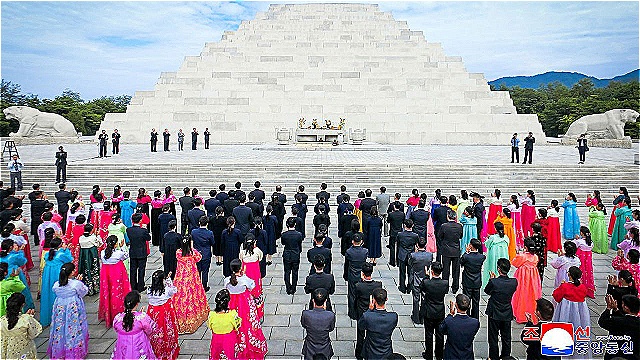 North Korean National Foundation Day event held in front of the Tomb of King Dangun in Pyongyang. [KCNA=Yonhap News]
The founding philosophy of Dangun Wanggeom, "Hongik Ingan" (to broadly benefit humanity), is codified in the Republic of Korea's Framework Act on Education as our educational ideology. While the Olympic flame is lit at the Hera Temple in Olympia, Greece, the flame for the National Sports Festival of Korea is lit at Chamseongdan Altar on Manisan Mountain on Ganghwa Island, where Dangun performed rites to heaven.
In 1993, North Korea announced the discovery of Dangun's remains at the Tomb of King Dangun in Pyongyang and carried out a massive construction project there. Even in Joseon, a Confucian state, shrines for Dangun were established and rites were held at the state level.
However, Gaecheonjeol is not just the commemoration of Dangun's founding of Gojoseon in 2333 B.C., but a day 1,565 years prior, commemorating Hwanung, the son of Hwanin (Heavenly God), descending to Taebaeksan Mountain and establishing the "Baedal" state through "Sinsi Gaecheon" (opening heaven at the city of God). The Baedal state, which began with the Sinsi Gaecheon of our founding father Hwanung, leads through Dangun’s Gojoseon, Buyeo, Goguryeo, Balhae, Silla, Goryeo, Joseon, and eventually to the Republic of Korea.
The reason the Korean people are called the "Baedal" people is that our history began with the Baedal state. The state name the Korean people reclaimed after Sinsi Gaecheon is the Republic of Korea. It is Korea. It is the Heavenly Kingdom. The Korean people, who began with the Sinsi Gaecheon of our founding father Hwanung who descended from heaven and the heavenly people, are the "descendants of heaven." Korea is a concept higher than the Republic of Korea or Dae-Han. Since nothing can be as vast as the sky, the character "Dae" (Great) is actually redundant.
The core of the teachings of "Sin-gyo" (Heavenly Religion) since Sinsi Gaecheon lies in the philosophy of the Three Gods, "Ilsin-gang-chung" (God’s spirit descending into our hearts), "Seong-tong-gong-wan" (perfecting our nature to be one with heaven), "Je-se-i-hwa" (governing the world according to divine reason), and "Hongik Ingan" (broadly benefiting humanity). In other words, God's will resides in our hearts (Ilsin-gang-chung), we achieve complete enlightenment by connecting our minds to divine will (Seong-tong-gong-wan), we realize the world according to heavenly principles (Je-se-i-hwa), and we live to benefit all of humanity (Hongik Ingan).
The Korean Peninsula, which has emerged as one of the world's few thriving Christian nations in just over a century, is a manifestation of the devotion that has been expressed in different forms for thousands of years in worshipping Hwanin, Hwanung, and Dangun. The first of the three holy figures, Hwanin, is a Chinese character representation of "Haneunim" (God). We have simply borrowed the Chinese characters for the sound of God. Then there is Hwanung, the son of God, and Dangun, the descendant of Hwanung. The nation of the three holy figures and the three gods is Baedal and Dangun Gojoseon.
In the "Sin-gyo" transmitted for thousands of years, the Three Gods also represent the trinity of "Seong" (Nature), "Myeong" (Breath/Life), and "Jeong" (Body). This was the practice followed by our ancestors, including the Seonbi and Hwarang. As explained in the Samil-Singo, the goal is to reach divine principles by well-regulating the body, mind, and the breath that connects and sustains them, making this the ultimate goal of life.
Buddhism emphasizes spiritual cultivation (Nature), Christianity focuses on prayer (Breath/Life), and Seon-do (Taoism) seeks to reach heaven through breath control (Dantian), while Confucianism leans toward the body (Essence). Choi Chi-won of the Silla period explained that the "Hyeon-myo-ji-do" (profound and subtle way), which integrates Confucianism, Buddhism, and Taoism, has always existed in our country. Practices like Dantian breathing and Guk-seon-do are all teachings of the Sin-gyo that have been passed down for thousands of years.
Dangun's philosophy of the Three Gods is the archetype of Buddhist theory
The philosophy of the Three Gods (Sam-sin) teaches that the trinity of nature, life, and essence resides in every individual, and anyone can reach divine principles through training. This is the archetype of the Buddhist theory that anyone can become a Buddha. The "Il-si-mu-si-il" (it began but didn't begin) and "Il-jong-mu-jong-il" (it ended but didn't end) of the Cheonbugyeong, suggesting there is no beginning and no end, is another expression of past lives and reincarnation.
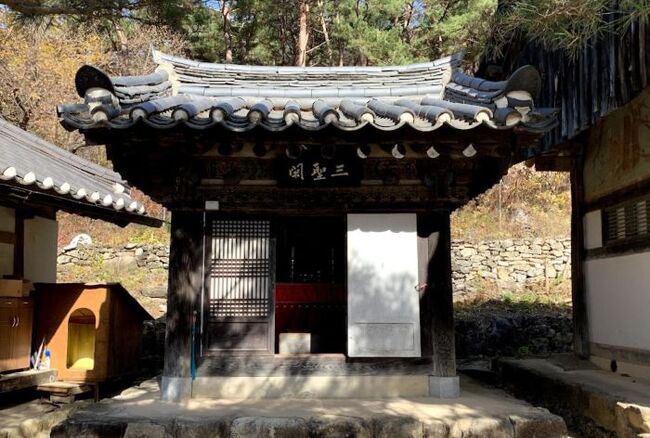 Samsingak (Hall of Three Gods) at Bongjeongsa Temple, Andong, North Gyeongsang Province ⒸHanmi Ilbo
The philosophy of the Three Gods, encompassing nature, life, essence, or heaven, earth, and man—the trinity—also appears in the Donghak concept of "In-nae-cheon" (Man is God). Heaven, earth, and man are the principles of the creation of Hangul; King Sejong and the scholars of Jiphyeonjeon combined heaven (•), earth (ㅡ), and man (ㅣ) to create the 28 letters of Hunminjeongeum.
The "Ja-bang-go-jeon" (letters imitate ancient seal script) in the preface to Hunminjeongeum means that Hangul was not a newly created script but a restoration of ancient characters that had disappeared. The Cheonbugyeong was written in an ancient language and translated into Chinese characters by Choi Chi-won. There is also a record that the Tang Dynasty poet Li Bai translated a state letter sent from Balhae, the successor to Goguryeo, into Chinese characters and wrote a reply.
Above the Daeungjeon hall of Korean temples, there is a symbol of three small dots in a large circle. It is a symbol representing the philosophy of the Three Gods. This philosophy, where heaven, earth, and man become one through nature, life, and essence, is expressed through the 81 characters of the Cheonbugyeong, based on multiples of 3 and 9. The Manchu etiquette of "Sam-yuk-gu-bae" (3, 6, and 9 bows) is also a traditional custom of the Korean people since Sinsi Gaecheon. The Cheonbugyeong is a numerical representation of the principles of the rotating universe, heaven, and truth.
Daeungjeon was originally Hwanungjeon, where Hwanung was enshrined, but the name was changed to Daeungjeon with the introduction of Buddhism. Both "Dae" and "Han" mean "Great." Hwanin, Hwanung, and Dangun, who were pushed out of the Daeungjeon, took their place in the Samsungak (Hall of Three Holy Figures) next to it. The Cheonbugyeong is a numerical representation of the principles of the rotating universe, heaven, and truth.
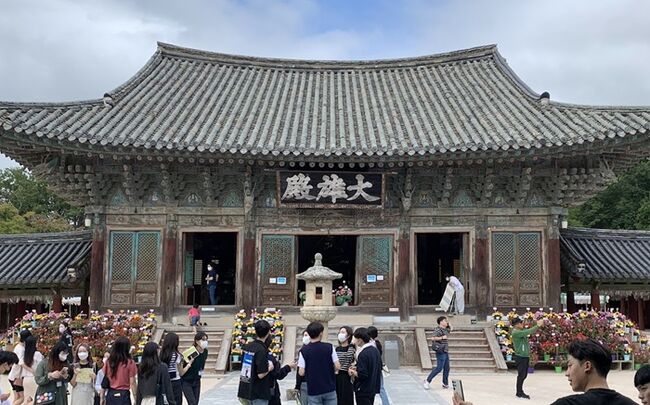 Daeungjeon Hall at Bulguksa Temple, Gyeongju, North Gyeongsang Province ⒸHanmi Ilbo
All things are one. Life and death are one. They start from one and return to one. Heaven and I were originally one, and since the will of heaven already resides in our bodies, the teachings of the Sin-gyo passed down since Hwanung and Dangun are to achieve enlightenment through study and discipline, live the life of Hongik Ingan by helping others realize enlightenment, evolve the soul, and finally return to the origin (Bok-bon).
The true foundation anniversary of the Korean people is Gaecheonjeol on October 3rd, not Liberation Day on August 15th, which signifies independence from Japan and the establishment of the Republic of Korea's government. The major national event attended by the president should be Gaecheonjeol, the anniversary of the Sinsi Gaecheon by Hwanung, the son of Hwanin—a date befitting the status of the Korean people who lead global culture and economy—rather than March 1st or Liberation Day, which are concepts tied to facing and being shackled by Japan.
Elevating Gaecheonjeol to our national foundation anniversary and holding grand state commemorations marks the beginning of the Korean people rising again, putting an end to the Joseon Dynasty and the Japanese colonial era, which were the nadirs of our thousands-year history. It is a start toward recreating the glory of Goguryeo, Balhae, Unified Silla, and Goryeo, and becoming a nation that leads not only in material civilization—through Hallyu (Korean Wave) and semiconductors—but also in spiritual civilization, including philosophy and religion, backed by a long history and tradition that surpasses even China and Japan.
◆ Hwang Doo-hyong
Former Washington Correspondent, Yonhap News
Former Deputy Managing Editor, Yonhap News

 Trump pressures for rate cut again ahead of FOMC... "Should be the lowest in the world"
U.S. President Donald Trump. [Photo = The White House] U.S. President Donald Trump once again pressured the Federal Reserve, the U.S. central bank, to lower interest rates on the 27th (local time
Trump pressures for rate cut again ahead of FOMC... "Should be the lowest in the world"
U.S. President Donald Trump. [Photo = The White House] U.S. President Donald Trump once again pressured the Federal Reserve, the U.S. central bank, to lower interest rates on the 27th (local time
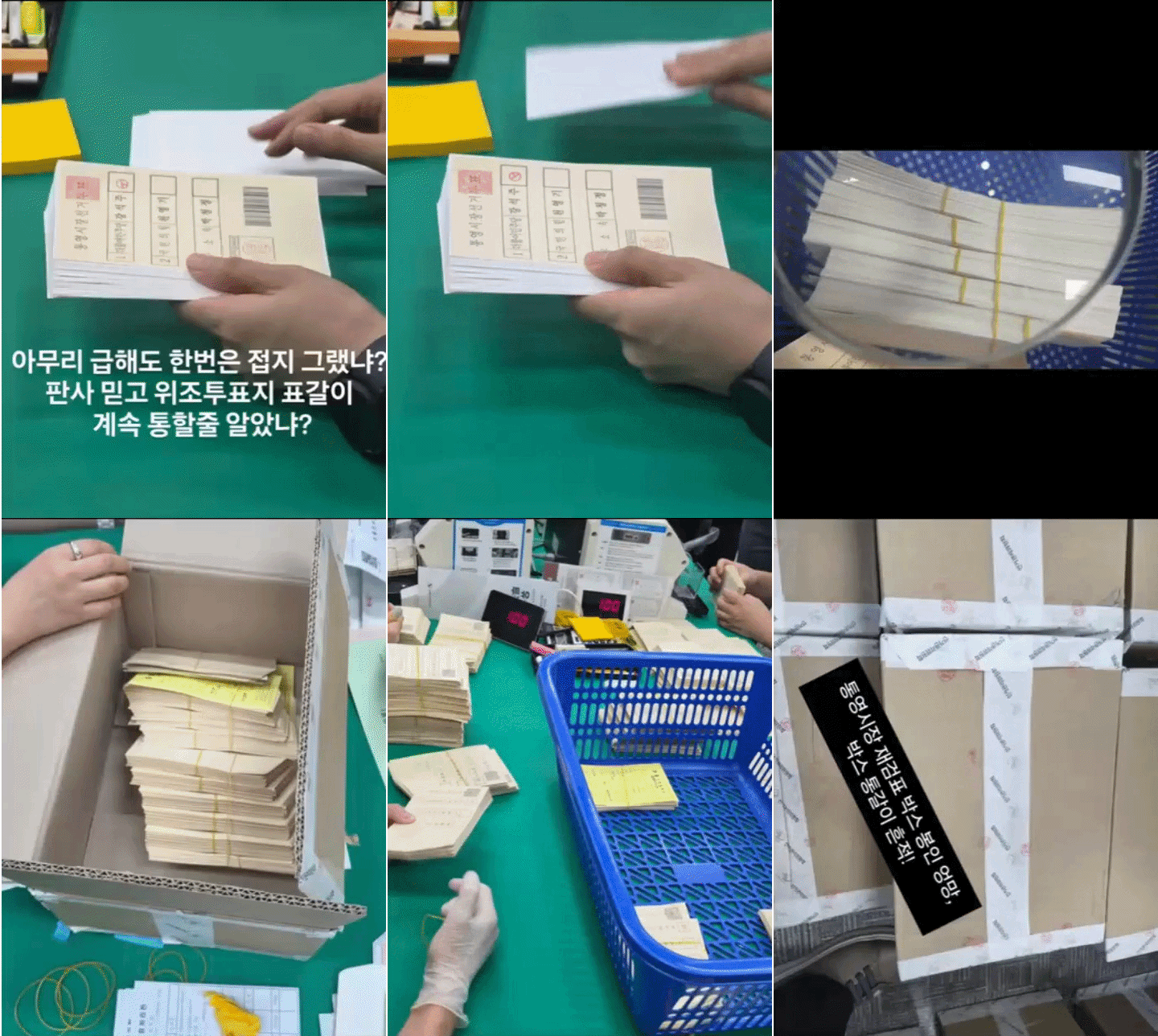 “Ignoring crisp ballots and damaged seals”… Tongyeong mayoral recount concludes with ‘no change in outcome,’ leaving suspicions and public outrage behind
Suspected counterfeit ballots discovered in Tongyeong [GIF from social media of Representative Hwang Kyo-ahn / Attorney Park Joo-hyun]During a recount of the Tongyeong mayoral election in South Gyeong
“Ignoring crisp ballots and damaged seals”… Tongyeong mayoral recount concludes with ‘no change in outcome,’ leaving suspicions and public outrage behind
Suspected counterfeit ballots discovered in Tongyeong [GIF from social media of Representative Hwang Kyo-ahn / Attorney Park Joo-hyun]During a recount of the Tongyeong mayoral election in South Gyeong
 President Yoon, regarding the first-instance ruling on the Public Official Election Act: “An excessive political verdict that distorts the facts… We will appeal immediately.”
The first-instance sentencing hearing for President Yoon Suk Yeol regarding violations of the Public Official Election Act is being broadcast live at Seoul Station on the 27th. [Photo=Yonhap News]Pres
President Yoon, regarding the first-instance ruling on the Public Official Election Act: “An excessive political verdict that distorts the facts… We will appeal immediately.”
The first-instance sentencing hearing for President Yoon Suk Yeol regarding violations of the Public Official Election Act is being broadcast live at Seoul Station on the 27th. [Photo=Yonhap News]Pres
 WSJ: "SK Hynix ADR Premium Is a Sign of AI Trading Overheat"
Advertisement for SK Hynix ADR listing in New York's Times Square [Reuters=Yonhap News file photo]The Wall Street Journal (WSJ) has pointed out that the price of SK Hynix’s American Depositary Recei
WSJ: "SK Hynix ADR Premium Is a Sign of AI Trading Overheat"
Advertisement for SK Hynix ADR listing in New York's Times Square [Reuters=Yonhap News file photo]The Wall Street Journal (WSJ) has pointed out that the price of SK Hynix’s American Depositary Recei
 'Godfather of Japanese Mystery Novels' Keigo Higashino Passes Away After Battle with Cancer at 68
Famous Japanese mystery novelist Keigo Higashino [AFP=Yonhap News]It has been belatedly reported that Keigo Higashino, the "godfather of Japanese mystery novels" and author of bestsellers such as "The
'Godfather of Japanese Mystery Novels' Keigo Higashino Passes Away After Battle with Cancer at 68
Famous Japanese mystery novelist Keigo Higashino [AFP=Yonhap News]It has been belatedly reported that Keigo Higashino, the "godfather of Japanese mystery novels" and author of bestsellers such as "The
 [Park Pil-kyu Security Column] To the Ignorant Trying to Clothe a Beast in Sheep's Clothing
Rep. Kim Byung-joo of the Democratic Party of Korea [Photo=Yonhap News]“The Air Force Academy doesn't teach you how to fly a plane!” “The Army, Navy, and Air Force academies are exactly the
[Park Pil-kyu Security Column] To the Ignorant Trying to Clothe a Beast in Sheep's Clothing
Rep. Kim Byung-joo of the Democratic Party of Korea [Photo=Yonhap News]“The Air Force Academy doesn't teach you how to fly a plane!” “The Army, Navy, and Air Force academies are exactly the
 [Issue Diagnosis] Two Effects of the Election Petition Review
 [Photo] Evidence of Election Fraud Flooding U.S. Media… Trump Had 2.7 Million Votes Stolen
 [Video] U.S. Semiquincentennial Air Show... 'Art in the Sky' streaks across New York
 [Editorial Cartoon] A Draconian Law That Undermines Freedom of Expression

 List
List