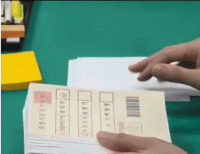
Students occupying the U.S. Cultural Center in Euljiro, Seoul, in May 1985 [Yonhap News File Photo]
1985 was a year when the nature of the South Korean student movement changed noticeably. Following the Gwangju Uprising in 1980, college campuses had been driven primarily by resistance against the military regime; however, from 1985 onward, certain activist groups began to promote anti-Americanism as an independent political agenda, going beyond simple anti-dictatorship sentiments.
The movement demanding democratization began to converge with the movement criticizing U.S. policy toward Korea into a single stream.
1. 1985: How Anti-Americanism Became the Core Agenda of the Student Movement
This change is also evident in government statistics. According to data released by the Ministry of Education, a total of 3,877 campus-based rallies, demonstrations, and various forms of unrest occurred at universities nationwide in 1985. The cumulative number of student participants in demonstrations was estimated at approximately 469,000.
The stage for these protests was not limited to Seoul National University, Korea University, Yonsei University, Sogang University, Sungkyunkwan University, and Ewha Womans University, but extended to universities across the country, including Pusan National University, Kyungpook National University, Chonnam National University, and Chungnam National University. Campuses were no longer just sites of individual school affairs; they were transforming into a nationwide political space.
The organizational structure of the student movement also reorganized rapidly. Moving away from the traditional student council-centered model, study groups and regional coalitions emerged, and organizations connecting labor sites with rural volunteer work expanded.
A representative organization that appeared around this time was the "Sammin-tu" (Struggle Committee for Three People/Min). The Sammin-tu advocated for "National Unification, People's Liberation, and Achievement of Democracy," proposing a more radical path than previous student movements. The government labeled it an enemy-sympathizing organization and initiated a massive investigation.
Ideological trends also began to diverge. Students who would later develop into the National Liberation (NL) faction identified the problems of Korean society in the division of the country and American influence.
In contrast, the People's Democracy (PD) faction interpreted society primarily through the lenses of capitalist structure and class issues. Although the two factions differed theoretically, they often acted together in anti-government rallies. For the remainder of the 1990s, most of the student movement unfolded around these two currents.
The decisive event that turned the 1985 student movement into a national political issue was the occupation of the U.S. Cultural Center. According to the memoirs of U.S. diplomats and American diplomatic documents, on May 25, 1985, 73 students entered the United States Information Service (USIS) library in Jeong-dong, Jung-gu, Seoul, and began a sit-in strike. Some domestic records summarize the event as taking place from May 23 to 26, including preparations for the occupation and the sit-in.
The students argued that the U.S. government had effectively condoned the Chun Doo-hwan regime during the 1980 Gwangju Uprising, demanding an official apology from then-U.S. Ambassador Richard L. Walker and a shift in U.S. policy toward Korea. Negotiations at the site of the sit-in were handled by Thomas P. Dunlop, the political counselor at the U.S. Embassy. In a later U.S. diplomatic oral history interview, he recalled that while the Korean government wanted an early suppression, the U.S. opted for negotiations rather than forced suppression. The students left peacefully after three days of the sit-in, and the participants were subsequently arrested and put on trial.
This incident received intense coverage from both domestic and international media. The Chosun Ilbo, Dong-A Ilbo, and Kyunghyang Shinmun reported daily on the students' demands and the government’s response, and international outlets such as The New York Times covered the occupation of the Seoul U.S. Cultural Center as major international news. The U.S. State Department also reviewed the safety of its mission in Seoul and reported the situation to Washington. This was the first instance in which the anti-American movement expanded beyond domestic student activism into an international diplomatic issue.
Within the student movement, the occupation of the U.S. Cultural Center also marked a major turning point. Until then, the U.S. had been one of many targets of criticism during the democratization process, but afterward, a growing tendency among some activists emerged to define the U.S. as the core cause of the contradictions in Korean society. Discourse attempting to explain the Gwangju issue, the ROK-U.S. alliance, U.S. forces in Korea, and unification issues within a single framework also began to form in earnest around this time.
However, not all student movement factions shared the same view. While some regarded direct actions like the U.S. Cultural Center occupation as legitimate political resistance, others worried that occupying diplomatic facilities could create international legal controversies and weaken the support for the democratization movement as a whole. This debate was not merely a difference in tactics but the starting point of a deeper ideological struggle over the future direction of the student movement.
1985 was not just a year of frequent demonstrations. It was the year when the organizational structure of the student movement changed, ideologies diverged, and anti-Americanism began to establish itself as an independent political agenda. These changes would go on to trigger much larger political upheavals, leading to the May 3 Incheon Incident the following year, the Konkuk University incident, and the June Democratic Struggle of 1987.
2. 1986–1987: Street Struggles and the Turning Point of Democratization
In 1986, the student movement began to build a larger-scale solidarity system based on the organizations and lines formed in 1985.
Protests, previously centered in Seoul, spread to major cities nationwide including Incheon, Busan, Gwangju, Daegu, and Daejeon. University student councils and regional student associations organized nationwide actions through joint rallies and statements. The government responded with a hardline stance, including increasing the number of riot police and expanding the use of tear gas, while the student movement strengthened its capacity for mass mobilization in response.
A representative event of this period was the May 3, 1986, Incheon Incident. At the Incheon Civic Hall, Juan Station, and Dong-Incheon Station area, students and civic groups held rallies demanding direct presidential elections and democratization, which led to large-scale clashes with the police. The government defined it as an illegal, violent protest, and many participants were taken into custody or arrested.
In contrast, the student movement criticized the excessive suppression and the use of tear gas. The Incheon Incident served as a catalyst for solidarity protests at universities across the country and is evaluated as a turning point where the student movement developed into a nationwide endeavor, transcending regional protests.
From October 28 to 31 of the same year, a nationwide student rally was held at Konkuk University in Seoul. When students from various universities across the country held a sit-in on campus to demand democratization and social reform, the police surrounded the school and carried out a suppression operation.
Helicopters were deployed to drop massive amounts of tear gas, and while figures vary, around 1,200 to 1,500 students were taken into custody or arrested. The Konkuk University incident is recorded as the largest arrest case among 1980s student movement events, remaining a symbol of the head-on collision between government hardline suppression and the organizational power of the student movement.
1987 was a year that changed the course not only for the student movement but for the entire direction of South Korean democracy. On January 14, Park Jong-cheol died while being tortured during police interrogation. Although the police initially explained in a press release that he died after "the desk was 'slapped' and he said 'ugh' and died," autopsy results and subsequent reporting revealed the truth of the torture. Following this, when the Catholic Priests’ Association for Justice disclosed further facts, the incident spread beyond the student movement into a nationwide demand for democratization.
Another turning point was the incident on June 9, 1987, when Yonsei University student Lee Han-yeol fell into critical condition after being hit by a tear gas canister fired by police during a protest. Lee Han-yeol passed away on July 5, and countless citizens participated in his funeral. His death became a symbol of the democratization movement and served as a catalyst for expanding civic participation.
The June Democratic Struggle, which lasted from June 10 to June 29, was not a protest by the student movement alone. Centered around the National Headquarters for the Struggle for a Democratic Constitution, religious figures, professors, lawyers, office workers, laborers, and the general public participated in large numbers.
Rallies were held in front of Seoul City Hall, Myeong-dong Cathedral, Jongno, and Sinchon, as well as in major cities across the country including Busan, Gwangju, Daejeon, Daegu, and Jeonju. The government eventually accepted the demands for direct presidential elections through a special declaration by Roh Tae-woo, the ruling party's presidential candidate, on June 29.
Even as democratization progressed, debates over protest methods and lines continued within the student movement. Some justified the use of firebombs and sit-ins as resistance against state power, while others believed these methods could weaken public support and burden the legitimacy of the democratization movement. The student movement was not a single organization but an aggregate where various lines and strategies coexisted; not all participants held the same position.
Immediately after democratization, the "Great Labor Struggle" followed from July to September 1987. Over 3,000 labor disputes occurred nationwide, and strikes demanding the formation of labor unions and wage increases spread to major workplaces such as Hyundai Heavy Industries, Daewoo Shipbuilding & Marine Engineering, and Kia Motors. As activists from the student movement actively entered industrial sites, the connection between the student movement and the labor movement was further strengthened.
The student movement from 1985 to 1987 was both a massive social movement toward democratization and a period of debate over the ideology and means of the movement. The expansion of anti-American discourse, the growth of national organizations, large-scale street protests, and the expansion into labor sites after democratization became important foundations that determined the direction of the student and civic movements in the 1990s.
◆ Songsan Jeong Kwang-je
A poet and researcher of history and philosophy. Former director of the Rhee Syngman Academy. Currently serving as a research advisor to the Society for the Study of Korean Modern and Contemporary History and representative of the philosophy forum "Lyceum." He has published four volumes of poetry, co-translated "Heroes of Heartbreak Ridge," and authored humanities books including "Joseon Turned into Myth," "Humanities on the Tatami," and "A Liberal’s Reading of Gramsci." "Songsan" is his pen name.

 Iranian Foreign Ministry: "Continuing Message Exchanges with the U.S. and Activities of Mediating Countries"
Esmaeil Baghaei, Spokesperson for the Iranian Ministry of Foreign Affairs [Xinhua, Yonhap News file photo]Esmaeil Baghaei, spokesperson for the Iranian Ministry of Foreign Affairs, stated on the 26th
Iranian Foreign Ministry: "Continuing Message Exchanges with the U.S. and Activities of Mediating Countries"
Esmaeil Baghaei, Spokesperson for the Iranian Ministry of Foreign Affairs [Xinhua, Yonhap News file photo]Esmaeil Baghaei, spokesperson for the Iranian Ministry of Foreign Affairs, stated on the 26th
 President Yoon: "Do You Think You Are Safe from the Special Counsel?"... Final Statement Video Released
President Yoon Suk Yeol rebuking the special prosecutor on the 24th. [Court video / @birds_justice X account subtitle GIF] A video of President Yoon Suk Yeol's closing statement at his trial rega
President Yoon: "Do You Think You Are Safe from the Special Counsel?"... Final Statement Video Released
President Yoon Suk Yeol rebuking the special prosecutor on the 24th. [Court video / @birds_justice X account subtitle GIF] A video of President Yoon Suk Yeol's closing statement at his trial rega
 President Yoon, regarding the first-instance ruling on the Public Official Election Act: “An excessive political verdict that distorts the facts… We will appeal immediately.”
The first-instance sentencing hearing for President Yoon Suk Yeol regarding violations of the Public Official Election Act is being broadcast live at Seoul Station on the 27th. [Photo=Yonhap News]Pres
President Yoon, regarding the first-instance ruling on the Public Official Election Act: “An excessive political verdict that distorts the facts… We will appeal immediately.”
The first-instance sentencing hearing for President Yoon Suk Yeol regarding violations of the Public Official Election Act is being broadcast live at Seoul Station on the 27th. [Photo=Yonhap News]Pres
 WSJ: "SK Hynix ADR Premium Is a Sign of AI Trading Overheat"
Advertisement for SK Hynix ADR listing in New York's Times Square [Reuters=Yonhap News file photo]The Wall Street Journal (WSJ) has pointed out that the price of SK Hynix’s American Depositary Recei
WSJ: "SK Hynix ADR Premium Is a Sign of AI Trading Overheat"
Advertisement for SK Hynix ADR listing in New York's Times Square [Reuters=Yonhap News file photo]The Wall Street Journal (WSJ) has pointed out that the price of SK Hynix’s American Depositary Recei
 'Godfather of Japanese Mystery Novels' Keigo Higashino Passes Away After Battle with Cancer at 68
Famous Japanese mystery novelist Keigo Higashino [AFP=Yonhap News]It has been belatedly reported that Keigo Higashino, the "godfather of Japanese mystery novels" and author of bestsellers such as "The
'Godfather of Japanese Mystery Novels' Keigo Higashino Passes Away After Battle with Cancer at 68
Famous Japanese mystery novelist Keigo Higashino [AFP=Yonhap News]It has been belatedly reported that Keigo Higashino, the "godfather of Japanese mystery novels" and author of bestsellers such as "The
 [Park Pil-kyu Security Column] To the Ignorant Trying to Clothe a Beast in Sheep's Clothing
Rep. Kim Byung-joo of the Democratic Party of Korea [Photo=Yonhap News]“The Air Force Academy doesn't teach you how to fly a plane!” “The Army, Navy, and Air Force academies are exactly the
[Park Pil-kyu Security Column] To the Ignorant Trying to Clothe a Beast in Sheep's Clothing
Rep. Kim Byung-joo of the Democratic Party of Korea [Photo=Yonhap News]“The Air Force Academy doesn't teach you how to fly a plane!” “The Army, Navy, and Air Force academies are exactly the
 [Issue Diagnosis] Two Effects of the Election Petition Review
 [Photo] Evidence of Election Fraud Flooding U.S. Media… Trump Had 2.7 Million Votes Stolen
 [Video] U.S. Semiquincentennial Air Show... 'Art in the Sky' streaks across New York
 [Editorial Cartoon] A Draconian Law That Undermines Freedom of Expression

 List
List