People Power Party Floor Leader Jeong Jeom-sik speaks at a floor policy meeting held on the 7th. On this day, Floor Leader Jeong defined the revised Information and Communications Network Act as the "Muzzle Law," and announced plans to file a constitutional complaint and propose a comprehensive amendment as the party's official policy. [Photo = Yonhap News]
Few people would oppose the eradication of false and manipulative information. Maliciously manipulated information, fraudulent misinformation, and false reports that destroy an individual's reputation and assets should naturally be regulated.
The issue lies not in the justification for regulation, but in the structure of the law. The revised Information and Communications Network Act, implemented on July 7, 2026—the so-called "July 7 Muzzle Law"—is criticized for having a structure that expands the scope of judgment, chills freedom of expression, and overlaps sanctions under the pretext of regulating false and manipulative information. The concern is that it may end up being a case of "burning down the house to get rid of the bedbugs."
If a law intended to prevent misinformation acts in a way that chills public interest suspicion, watchdog journalism, political criticism, and even citizen comments, the problem transcends a simple legal debate. This is because if the government abuses this law, it could threaten the very foundations of liberal democracy.
Hami Ilbo previously addressed the actual operation of this law in "[Analysis] 3 Key Issues Regarding the Operational Structure of the 7.7 'Muzzle Law'."
The core points were the pre-emptive platform measures, the support and independence of external fact-checking organizations, and the connection between the Information and Communications Service Transparency Center and media arbitration procedures. The issue was that even if the government does not press the delete button directly, the combination of reporting, fact-checking, platform actions, and administrative management structures could sufficiently narrow the channels for distributing expression.
Now, the remaining issue is the constitutional debate.
Since the People Power Party has announced its intention to file a constitutional complaint with the Constitutional Court, the debate moves beyond political slogans into the realm of legal judgment.
The core issues of the constitutional complaint are condensed into five points: the expansion of the scope of judgment, the chilling of freedom of expression, excessive and overlapping penalties and sanctions, the ambiguity of repetitive distribution criteria and punitive damages, and the possibility of voluntary over-regulation by platforms.
The first issue is the expansion of the scope of judgment. Existing defamation legal doctrine has primarily developed around individual social evaluation—that is, the infringement of reputation. The courts have weighed whether it was a statement of fact or an expression of opinion, whether it was false or true, whether there was public interest, and whether there were reasonable grounds to believe it was true. Media reports and political criticism were also judged within this framework.
However, false and manipulative information under the revised Information and Communications Network Act does not stop at reputation infringement. It encompasses infringements on personality rights, property rights, and public interest.
This expansion significantly widens the scope of legal risk. It can bring not only the assertion of false facts about a specific individual, but also corporate criticism, policy critiques, challenges to election management, and suspicions regarding public institutions into the boundary of legal application.
As the scope of judgment broadens, it becomes harder for citizens to predict which expressions are prohibited. This leads to the constitutional issue of the principle of clarity.
The second issue is the chilling effect on freedom of expression. Whether information is false must ultimately be determined by the court. However, judicial judgments usually come after the fact.
From the moment a poster uploads a post, and from the moment a platform receives a report, they calculate the legal risk. This gap is the problem. While the judgment occurs post-facto, the chilling effect occurs beforehand.
Media companies shorten headlines, YouTubers tone down their arguments, and citizens hesitate to comment. Even raising suspicions in the public interest can be filtered out amidst the anxiety of "could this be labeled as false and manipulative information?"
Freedom of expression is not a right protected only in court rulings. It must be protected in the real-world space where citizens criticize power, the media raises suspicions, and debates occur in the public sphere. If that space shrinks due to legal anxiety, freedom of expression has already been chilled.
The third issue is the excessive and overlapping nature of penalties and sanctions. A single act of expression can lead to multiple legal liabilities.
Defamation through the assertion of false facts can lead to criminal liability, and victims can claim civil damages. Creators who meet certain criteria face the risk of aggravated damages.
Added to this are the possibilities of platform deletion, access blocking, exposure restriction, account sanctions, and monetization restrictions. If information confirmed as illegal or false/manipulative by the court is repeatedly distributed, it can even lead to administrative fines.
Ultimately, a single piece of content is simultaneously exposed to four types of risks: criminal punishment, civil damages, platform sanctions, and administrative fines. Even if it cannot be legally classified as double jeopardy immediately, the question of whether it violates the constitutional principle of prohibition against excessive restriction is a significant issue.
Even if the purpose of protecting victims from misinformation is legitimate, if the means are excessive, it is difficult to avoid controversy over constitutionality. In a democratic society, the risk costs imposed on acts of expression should be minimized.
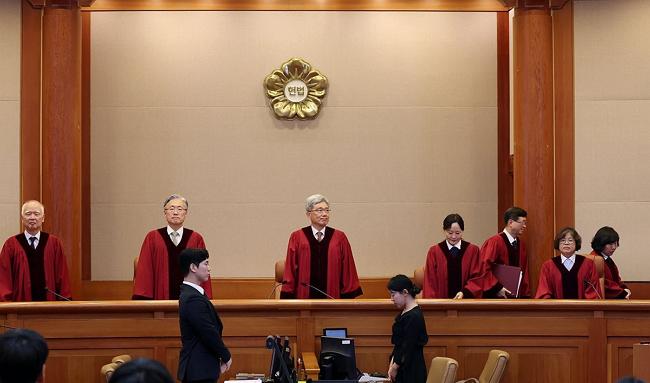 As the People Power Party announces its plan to file a constitutional complaint against the revised Information and Communications Network Act, the controversy over the 7.7 "Muzzle Law" is shifting into a constitutional battle over freedom of expression and the principle of prohibition against excessive restriction. [Photo = Yonhap News]
The fourth issue is the ambiguity of repetitive distribution criteria and punitive damages.
What is important in the administrative fine clause is whether information recognized by the court as illegal or false/manipulative was repeatedly distributed after a final judgment. The problem is that it is not easy to define what constitutes the "same information."
In a digital environment, a single piece of information remains in various formats. The original article, the version sent to portals, YouTube videos, Shorts, card news, newsletters, SNS summaries, and pinned comments exist separately. The scope of liability varies depending on whether the ruling concerned the entire article, a single headline, or a portion of a spoken remark in a video.
However, when the boundary for repetitive distribution in the law is unclear, media and users are more likely to choose the safest option: deletion and silence.
The same applies to punitive aggravated damages.
The intention to hold those distributing malicious misinformation strictly accountable is understandable. However, if the application criteria are broad and vague, it results in an inability to distinguish between public interest reporting and malicious manipulation.
Especially in the areas of media reporting or political criticism, the boundary between definitive falsehoods and reasonable suspicion is always a subject of debate. With this boundary blurred, the risk of damages up to five times the amount inevitably shakes legal stability.
The fifth issue is the voluntary over-regulation by platforms. This law is not a method where the state directly deletes all expressions. It is a structure that allows large-scale information and communication service providers to receive reports and take measures such as deletion, blocking, and exposure restrictions according to their own standards.
On the surface, it looks like self-regulation. However, when legal responsibility and administrative burdens are placed on platforms, they are highly likely to choose excessive blocking over under-blocking. From a corporate perspective, avoiding disputes is safer than broadly guaranteeing freedom of expression.
In this case, the state does not need to censor directly. The platforms do the filtering instead.
Users receive notices of deletion or restriction from the platform, not the state, but behind it lie legal obligations, the possibility of administrative investigations, transparency reporting, and the risk of fines. While not direct state censorship, it can function as an indirect restriction structure designed by the state.
The problem becomes even more complex when external fact-checking organizations and platform actions are combined.
Fact-checking is necessary. However, in areas where factual judgment and value judgment are intertwined—such as elections, history, security, diplomacy, ideology, gender, and regional issues—who determines what is "false" is not a simple question.
If government support or the selection structure of institutional platforms is involved, controversy over the independence of fact-checking organizations is inevitable.
If fact-checking becomes a tool that filters expression based on a specific perspective rather than a device to help verify the public sphere, it is not victim protection, but the control of the public sphere.
The essence of the constitutional complaint is therefore simple.
It is not about whether to stop false and manipulative information. It is about how far the state and platforms can restrict the distribution of expression under the pretext of stopping such information.
This is also the question the Constitutional Court will have to address.
Is the scope of prohibited expression clear? Is the means of restriction limited to what is strictly necessary? Are there sufficient safeguards to distinguish between public interest criticism and the malicious spread of falsehoods? Does indirect regulation through platforms excessively infringe upon freedom of expression?
The danger of the 7.7 Muzzle Law does not lie in a single provision of the law.
The object of judgment has expanded beyond defamation to include personality rights, property rights, and public interest. Freedom of expression can be chilled even before a ruling is made.
Sanctions are overlapped through criminal, civil, administrative, and platform measures. The criteria for repetitive distribution and punitive damages undermine legal stability.
When combined with the voluntary over-regulation of platforms, the structure allows expressions to be filtered out in advance without the state needing to delete them directly.
The law must stop falsehoods. But the law must not stop the mouths of citizens seeking the truth.
If, under the pretext of eradicating false and manipulative information, criticism of power, raising of public interest suspicions, media reporting, and political expression by citizens are all chilled, that law becomes not a shield for liberal democracy, but a risk factor.
One should not burn down the house to get rid of bedbugs. One must not shake the constitutional pillar of freedom of expression for the sake of stopping misinformation.

 Iranian Foreign Ministry: "Continuing Message Exchanges with the U.S. and Activities of Mediating Countries"
Esmaeil Baghaei, Spokesperson for the Iranian Ministry of Foreign Affairs [Xinhua, Yonhap News file photo]Esmaeil Baghaei, spokesperson for the Iranian Ministry of Foreign Affairs, stated on the 26th
Iranian Foreign Ministry: "Continuing Message Exchanges with the U.S. and Activities of Mediating Countries"
Esmaeil Baghaei, Spokesperson for the Iranian Ministry of Foreign Affairs [Xinhua, Yonhap News file photo]Esmaeil Baghaei, spokesperson for the Iranian Ministry of Foreign Affairs, stated on the 26th
 President Yoon: "Do You Think You Are Safe from the Special Counsel?"... Final Statement Video Released
President Yoon Suk Yeol rebuking the special prosecutor on the 24th. [Court video / @birds_justice X account subtitle GIF] A video of President Yoon Suk Yeol's closing statement at his trial rega
President Yoon: "Do You Think You Are Safe from the Special Counsel?"... Final Statement Video Released
President Yoon Suk Yeol rebuking the special prosecutor on the 24th. [Court video / @birds_justice X account subtitle GIF] A video of President Yoon Suk Yeol's closing statement at his trial rega
 President Yoon, regarding the first-instance ruling on the Public Official Election Act: “An excessive political verdict that distorts the facts… We will appeal immediately.”
The first-instance sentencing hearing for President Yoon Suk Yeol regarding violations of the Public Official Election Act is being broadcast live at Seoul Station on the 27th. [Photo=Yonhap News]Pres
President Yoon, regarding the first-instance ruling on the Public Official Election Act: “An excessive political verdict that distorts the facts… We will appeal immediately.”
The first-instance sentencing hearing for President Yoon Suk Yeol regarding violations of the Public Official Election Act is being broadcast live at Seoul Station on the 27th. [Photo=Yonhap News]Pres
 WSJ: "SK Hynix ADR Premium Is a Sign of AI Trading Overheat"
Advertisement for SK Hynix ADR listing in New York's Times Square [Reuters=Yonhap News file photo]The Wall Street Journal (WSJ) has pointed out that the price of SK Hynix’s American Depositary Recei
WSJ: "SK Hynix ADR Premium Is a Sign of AI Trading Overheat"
Advertisement for SK Hynix ADR listing in New York's Times Square [Reuters=Yonhap News file photo]The Wall Street Journal (WSJ) has pointed out that the price of SK Hynix’s American Depositary Recei
 'Godfather of Japanese Mystery Novels' Keigo Higashino Passes Away After Battle with Cancer at 68
Famous Japanese mystery novelist Keigo Higashino [AFP=Yonhap News]It has been belatedly reported that Keigo Higashino, the "godfather of Japanese mystery novels" and author of bestsellers such as "The
'Godfather of Japanese Mystery Novels' Keigo Higashino Passes Away After Battle with Cancer at 68
Famous Japanese mystery novelist Keigo Higashino [AFP=Yonhap News]It has been belatedly reported that Keigo Higashino, the "godfather of Japanese mystery novels" and author of bestsellers such as "The
 [Park Pil-kyu Security Column] To the Ignorant Trying to Clothe a Beast in Sheep's Clothing
Rep. Kim Byung-joo of the Democratic Party of Korea [Photo=Yonhap News]“The Air Force Academy doesn't teach you how to fly a plane!” “The Army, Navy, and Air Force academies are exactly the
[Park Pil-kyu Security Column] To the Ignorant Trying to Clothe a Beast in Sheep's Clothing
Rep. Kim Byung-joo of the Democratic Party of Korea [Photo=Yonhap News]“The Air Force Academy doesn't teach you how to fly a plane!” “The Army, Navy, and Air Force academies are exactly the
 [Issue Diagnosis] Two Effects of the Election Petition Review
 [Photo] Evidence of Election Fraud Flooding U.S. Media… Trump Had 2.7 Million Votes Stolen
 [Video] U.S. Semiquincentennial Air Show... 'Art in the Sky' streaks across New York
 [Editorial Cartoon] A Draconian Law That Undermines Freedom of Expression

 List
List